GCSE Biology 20 Minute Study Routine
GCSE Biology 20 minute study routine for busy students: use active recall, exam questions and spaced review without late-night cramming or burnout.
Revision often expands to fill the evening. You open a biology textbook after dinner, look up two hours later and realise you have highlighted several pages without testing whether you can remember any of them.
A GCSE Biology 20 minute study routine offers a calmer alternative. Spend a short period retrieving facts, answering one or two exam questions and correcting mistakes. Repeat that process across the week. It will not replace lessons or occasional longer past-paper sessions, but it can build knowledge steadily without turning the night before an exam into an all-nighter.
The routine is simple:
- First 222 minutes: choose one precise topic and remove distractions.
- Next 666 minutes: retrieve key knowledge without notes.
- Next 888 minutes: answer exam-style questions.
- Final 444 minutes: mark, correct and schedule a review.
That is the whole structure. The value comes not from making it longer, but from repeating it honestly.
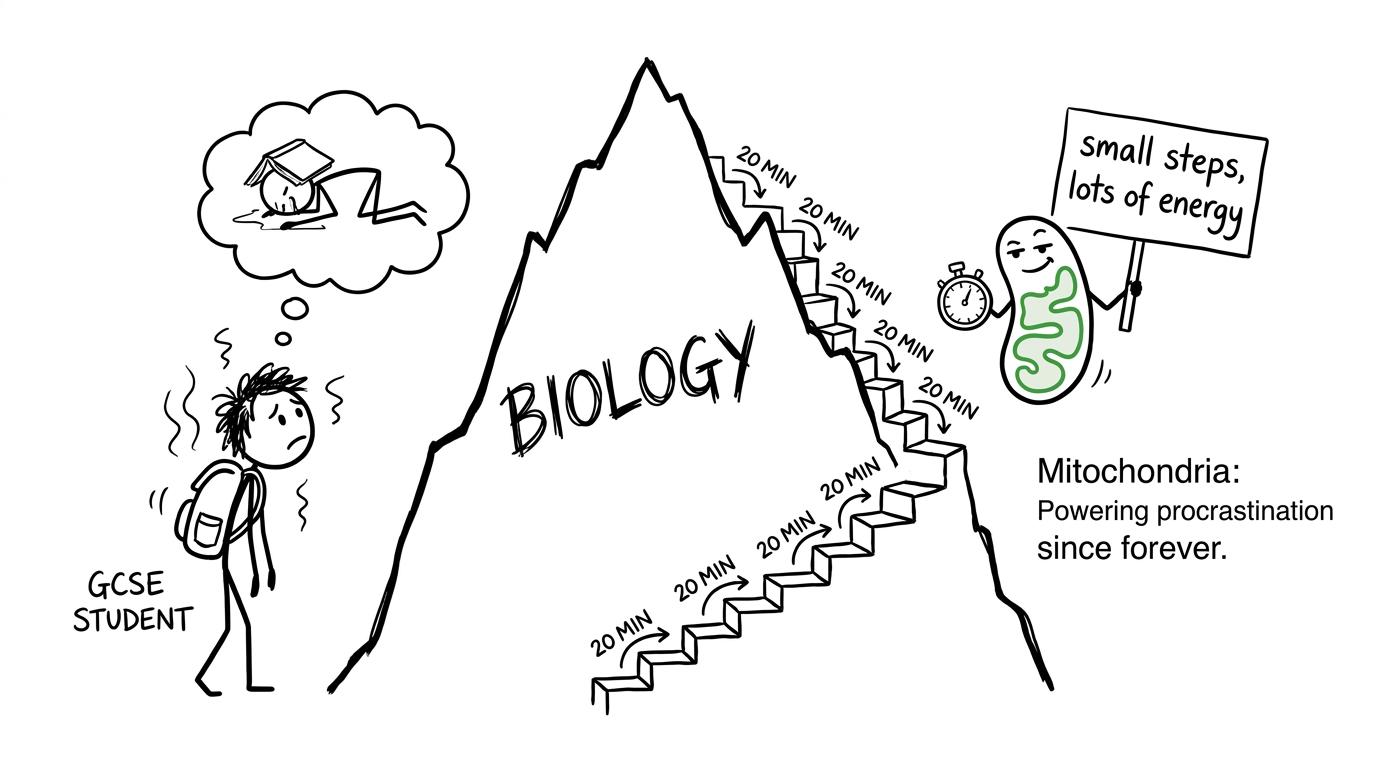 A student discovers that a biology mountain can be climbed using small daily steps
Why a short daily biology routine can work
Twenty minutes is not a magical number. It is useful because it is small enough to fit around homework, clubs, family commitments and maths revision, yet long enough to complete a meaningful cycle of recall, application and feedback.
Retrieval practice is the attempt to bring knowledge to mind before looking at an answer. Spaced practice means returning to that knowledge after a delay. Both are more active than repeatedly reading a page, and feedback matters because an uncorrected answer can reinforce a misconception.
GCSE Biology examinations do not only reward remembered definitions. Across specifications from exam boards such as AQA, Pearson Edexcel and OCR, students are expected to demonstrate knowledge, apply it in familiar and unfamiliar situations, and analyse or evaluate information. Practical understanding is also assessed through written questions. Your routine therefore needs more than flashcards.
It should alternate between three kinds of work:
- Recall: definitions, processes, structures and functions.
- Application: using familiar biology in a new context.
- Analysis: interpreting data, evaluating methods and drawing conclusions.
This is similar to effective maths revision. Reading a method can make it feel familiar, but only answering a question reveals whether you can use it. MathsGenie's guide to stopping GCSE content from being forgotten explains the same learn, retrieve, practise and revisit cycle for maths.
Set up the routine before the timer starts
A short session fails when the first half disappears into deciding what to revise. Make those decisions in advance.
Check whether you study separate Biology or Combined Science, then confirm your exam board and specification. AQA, Edexcel, OCR and Eduqas organise content and practical work differently. Use your school's topic list rather than assuming that an online checklist matches your course exactly.
Create a simple tracker with four columns:
| Topic | Last reviewed | Confidence | Next action |
|---|---|---|---|
| Cell biology | This week | Amber | Practise microscopy questions |
| Organisation | Last week | Red | Retrieve the digestive system |
| Ecology | Today | Green | Review again next week |
Confidence should be based on evidence, not mood. A topic is not green because the notes look familiar. It is green when you can recall the main ideas and answer an exam question accurately without support.
Keep the materials equally simple: your specification checklist, blank paper, a small set of questions, answers or a mark scheme, and an error log. Put your phone out of reach unless it is being used as the timer.
The four-part GCSE Biology 20 minute study routine
Use the first two minutes to choose one target
Write a target narrow enough to complete. “Revise biology” is too broad. “Recall the stages of mitosis and answer one application question” is useful. Other focused targets might include:
- compare diffusion, osmosis and active transport;
- identify variables in a required practical;
- interpret a graph of enzyme activity;
- explain how a leaf is adapted for photosynthesis;
- recall how the body controls blood glucose concentration.
Start with red and amber topics rather than comfortable ones. If you use the same principle for maths, the MathsGenie guide to finding weak GCSE topics provides a practical diagnostic approach.
Spend six minutes retrieving without notes
Close the textbook. On blank paper, write everything relevant that you can remember. Depending on the topic, you might draw and label a biological structure, list the stages of a process, define essential terms or explain a causal chain.
Do not check after every sentence. Retrieval needs a genuine attempt. When the six minutes end, compare your response with your notes or specification and add missing information in another colour.
Flashcards can work here, but only if you answer before turning the card over. Reading both sides is recognition, not retrieval. Keep prompts specific and include “why” and “how” questions alongside factual ones.
 One student highlights so much that the textbook glows while another quietly self-tests
Use eight minutes for exam-style application
Answer one longer question or a small group of short questions. Choose material that matches your exam board and qualification. The aim is not to complete an entire paper in eight minutes. It is to practise turning knowledge into marks.
Rotate the question type across the week:
- explanation questions using linked scientific reasoning;
- data and graph interpretation;
- practical-method questions;
- calculations involving percentage change, rates or magnification;
- extended responses requiring several connected ideas.
When a question uses an unfamiliar organism or experiment, pause before assuming it tests unfamiliar biology. The context may be new while the underlying idea remains diffusion, inheritance, homeostasis or natural selection.
Biology also contains mathematical skills. You may need to rearrange a magnification relationship, calculate a percentage change, interpret a line graph or compare rates. If these skills are costing marks, use the GCSE Maths revision hub to rebuild the underlying method. The writing and simplifying ratio guide is useful for proportional comparisons, while the probability revision guide can support your understanding of chance in genetics.
Finish with four minutes of feedback
Mark the work immediately. A score alone is not enough. For each lost mark, label the cause:
- missing knowledge;
- inaccurate scientific vocabulary;
- weak application;
- calculation or graph error;
- incomplete practical reasoning;
- misreading the command word.
Write one correction in your error log, then schedule the topic for another short review. If you could not explain osmosis accurately today, retrieve it again in a few days rather than waiting until the week before the examination.
Mark schemes are useful because they show the precision expected, but do not memorise isolated wording without understanding it. A differently phrased question may require the same idea to be applied in another way.
A weekly rotation that covers more than facts
A repeatable week prevents the routine from becoming seven days of flashcards. Adapt this outline to the order and wording of your own specification.
| Day | Main emphasis | Suggested task |
|---|---|---|
| Monday | Knowledge | Retrieve one core process and check missing details |
| Tuesday | Application | Answer questions set in an unfamiliar context |
| Wednesday | Practical skills | Review variables, controls, risks and method improvements |
| Thursday | Maths in biology | Practise a graph, rate, percentage or magnification task |
| Friday | Extended explanation | Build a logically connected response |
| Saturday | Mixed review | Revisit two older topics using short questions |
| Sunday | Plan or rest | Update the tracker and choose next week's priorities |
You do not have to revise biology every day. If maths is the approaching exam, keep biology ticking over on three or four days and give the remaining sessions to maths. A sustainable timetable responds to deadlines rather than pretending every subject has equal urgency every evening. The GCSE maths revision timetable guide can help you fit short topic sessions around longer paper practice.
How to build towards the exam
The daily routine develops knowledge and question technique, but it does not fully train concentration across an entire examination. As the exam approaches, add occasional longer sessions for mixed questions and complete papers.
Use the short routine on busy weekdays, then complete a longer timed section when your schedule allows. Afterwards, feed the errors back into the next week's twenty-minute targets. This creates a useful loop: the paper diagnoses the weakness, and the daily routine repairs it.
The same structure protects your maths revision. Use AQA GCSE Maths past papers or Edexcel GCSE Maths past papers under appropriate conditions, then return to focused revision lessons and practice questions. Predicted papers can provide additional unseen practice, but they cannot guarantee what will appear. The Edexcel GCSE Maths predicted papers are best treated as practice and diagnosis, not prophecy.
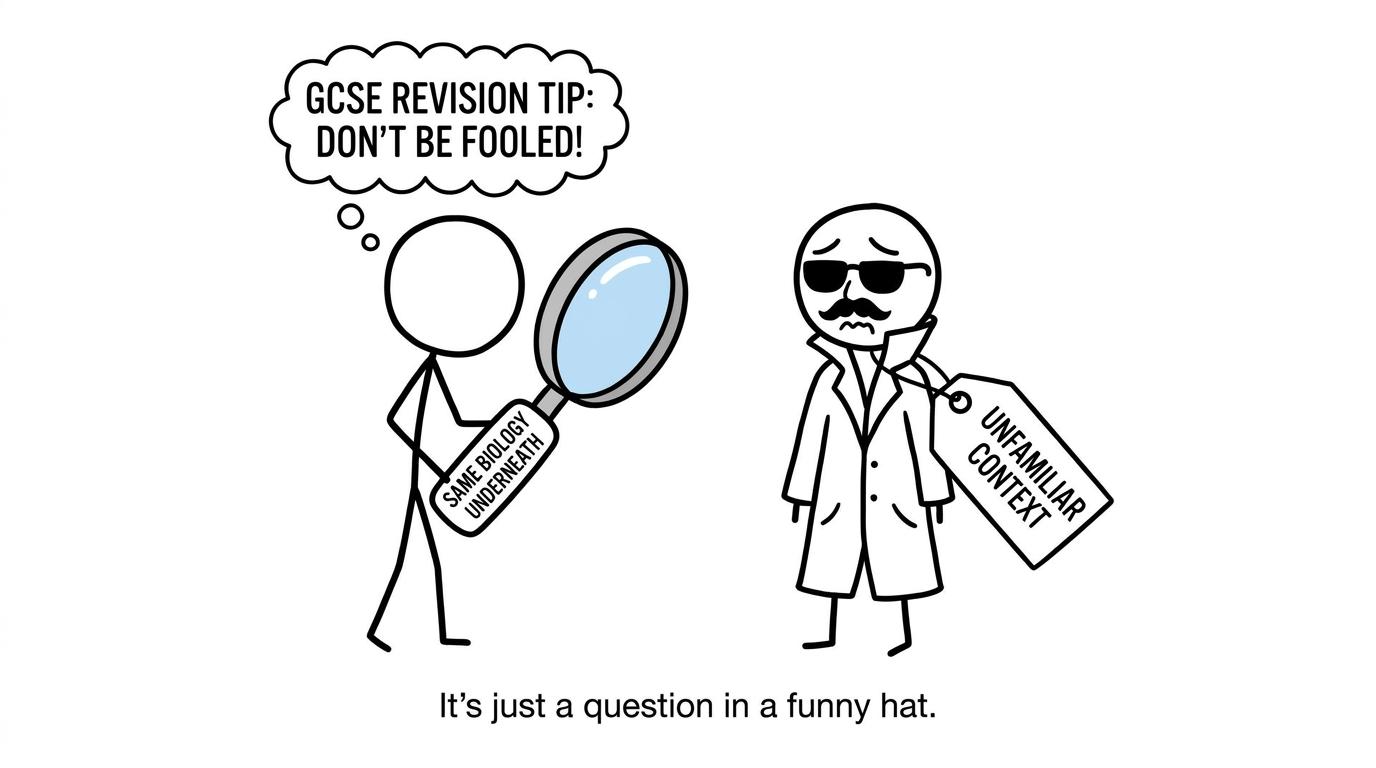 A disguised unfamiliar-context question is recognised as ordinary biology underneath
Common mistakes that weaken a short routine
Turning retrieval into rereading
If the book stays open, the task can feel easy because the answer is visible. Close it first. Attempting to remember is the important part, even when the first attempt is incomplete.
Choosing targets that are too large
“Genetics” cannot be repaired in one short session. Choose inheritance terminology, genetic crosses, variation or natural selection. Smaller targets produce clearer feedback.
Revising facts but ignoring practical questions
Practical work is assessed through written examinations. Know why controls are used, how variables are identified, how accuracy can be improved and whether evidence supports a conclusion. Do not merely memorise an equipment list.
Avoiding biology calculations
A student may understand the science but lose marks through percentages, ratios, units or graph scales. Record these as mathematical weaknesses and practise the underlying skill separately. MathsGenie's overview of GCSE topics by exam board and tier can help you locate the relevant maths area.
Marking without correcting
Looking at a mark scheme and thinking “I nearly wrote that” changes little. Write the improved answer, identify what was missing and revisit the idea later.
Extending every session into an hour
A daily minimum works because it remains manageable. Stop after twenty focused minutes when your schedule is crowded. Longer sessions can be planned separately for papers; they should not make the everyday routine feel impossible.
Small sessions, accumulated calmly
Cramming is often an attempt to solve in one night what consistency could have made ordinary. A twenty-minute biology routine lowers the barrier to starting. More importantly, it combines remembering, applying and correcting: the activities that reveal whether knowledge is usable.
Choose one topic tonight. Retrieve it without notes, answer a genuine exam question, mark it and record the next action. Then stop.
For the maths side of your GCSE preparation, make MathsGenie your free revision base. Use revision lessons and practice questions to repair individual skills, mini tests to check progress, and past papers or predicted papers to build exam readiness. Mark schemes and video solutions then turn every dropped mark into a clear next step, without requiring an all-nighter.