GCSE Biblical Hebrew Topics Breakdown & Revision
GCSE Biblical Hebrew topics breakdown: see Edexcel paper weightings, key language and literature skills, and a practical plan for smarter revision.

Revision becomes difficult when every page feels equally important. Vocabulary lists grow, verb forms blur together, and two set texts can seem far larger than the hours left before the exam.
The useful answer is simpler. This GCSE Biblical Hebrew topics breakdown follows the Pearson Edexcel GCSE structure: Language carries 50%50\%50% of the qualification and Literature carries 50%50\%50%. A sensible starting plan therefore divides revision time equally between them, before shifting extra time towards the areas where your marked work shows the greatest losses.
This guide is about priorities rather than predictions. It shows where the marks sit, what each section demands and how to turn the specification into a practical revision timetable.
The GCSE Biblical Hebrew revision checklist
Before making a detailed plan, confirm the following with your teacher or examination centre:
- your examination board and specification code
- the current prescribed texts for your examination series
- whether you will answer the grammar questions or translate into Biblical Hebrew
- which vocabulary, morphology and syntax appear in your specification
- the dates and arrangements for both written papers
For Pearson Edexcel GCSE Biblical Hebrew, specification code 1BH01\text{BH}01BH0, the qualification is assessed through two externally examined papers. Each paper lasts 222 hours and is worth 100100100 marks.
The broad structure is:
| Area | Qualification weighting | Raw marks |
|---|---|---|
| Language | 50%50\%50% | 100100100 |
| Literature | 50%50\%50% | 100100100 |
| Total | 100%100\%100% | 200200200 |
At assessment-objective level, AO1 language is worth 50%50\%50%, AO2 knowledge and understanding of literature is worth 25%25\%25%, and AO3 analysis, evaluation and response is worth 25%25\%25%.
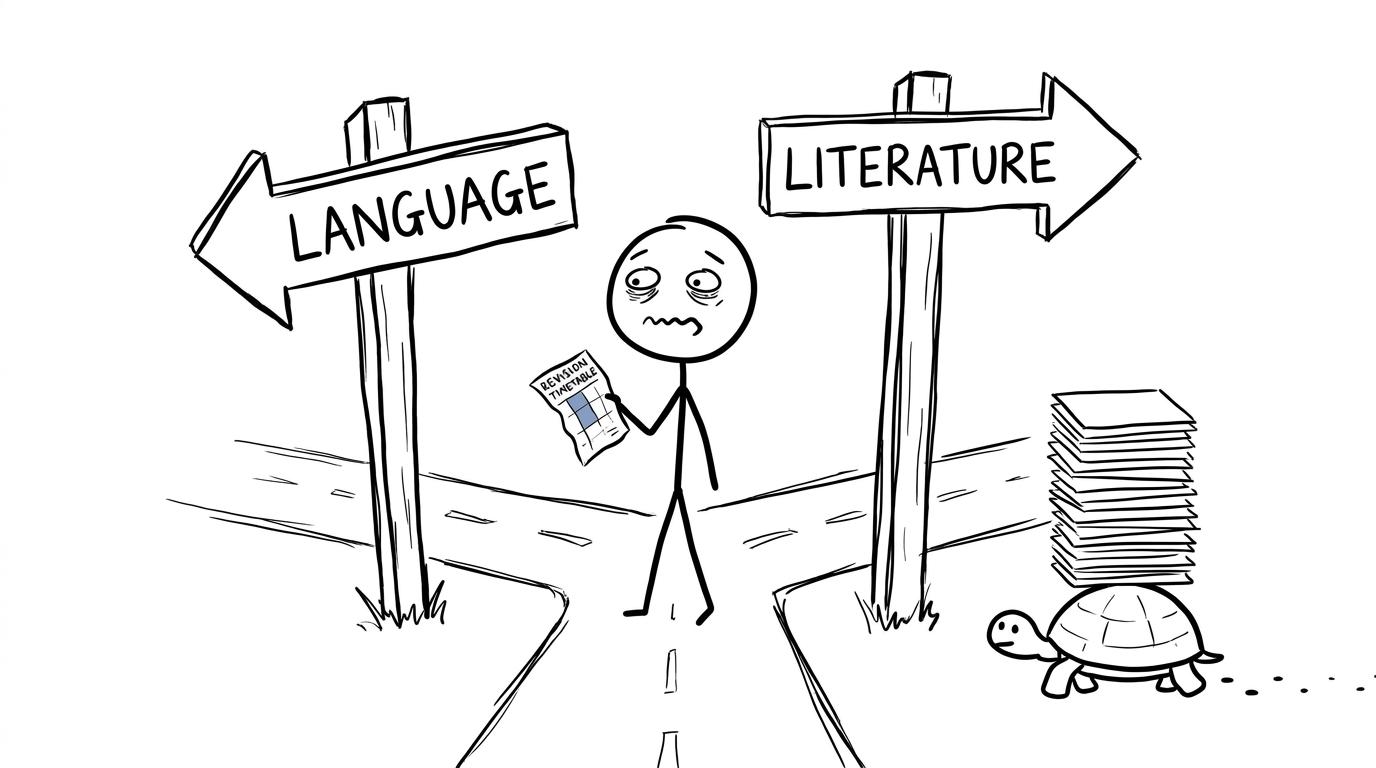 A student choosing between language and literature revision
Language topics and where the marks are
Paper 111, Language, tests your ability to understand unseen Biblical Hebrew. It is not a test of isolated vocabulary alone. Vocabulary, morphology and syntax must work together while you read unfamiliar passages.
Comprehension and your optional route
Section A is worth 505050 marks. It contains two unseen passages and includes:
- compulsory comprehension questions worth 303030 marks in total
- optional language questions worth 202020 marks in total
For the optional element, students follow the route permitted by the paper: explaining grammatical structures in context or translating short English sentences into pointed Biblical Hebrew.
This makes comprehension a major priority. You need to locate information accurately, recognise who is performing an action, follow references across a passage and express answers clearly in English. Small grammatical details can change the entire meaning of a sentence.
Your chosen optional route also deserves regular practice. If you are taking the grammar route, concentrate on identifying forms precisely and explaining their function in context. If you are taking the composition route, accurate pointing, agreement and verb formation matter. Confirm your intended route with your teacher rather than switching casually during revision.
Translation into English
Section B is also worth 505050 marks. It assesses translation from unseen Biblical Hebrew through:
- words or short phrases worth 151515 marks
- a short unseen passage worth 151515 marks
- a longer unseen passage worth 202020 marks
The longer translation has the largest individual allocation, but neglecting shorter items would be costly. Short phrases can expose uncertain vocabulary or morphology quickly, while the longer passage tests whether you can preserve meaning across several connected sentences.
Accurate translation is more than replacing one word with another. You must establish the grammatical relationships first, then produce natural English without adding information that the Hebrew does not support.
Vocabulary, morphology and syntax
Vocabulary does not have its own separate box of marks, yet it affects almost every mark on the language paper. The same is true of morphology and syntax. They are foundation skills rather than isolated exam sections.
Prioritise:
- high-frequency vocabulary and principal meanings
- noun, adjective and pronoun forms
- person, number and gender
- verb stems, aspects, voices and moods required by the specification
- prefixed elements and suffixed pronouns
- agreement and common sentence structures
- recognition of forms inside complete passages
Flashcards help with retrieval, but passage work reveals whether that knowledge is usable. A word recognised on a card may still be missed when it carries a prefix, suffix or unfamiliar form.
Literature topics and where the marks are
Paper 222, Literature, is also worth 100100100 marks. Students study two prescribed texts and answer questions on both. Because prescribed material can change, use the current Pearson notice and your teacher's text list rather than relying on an old revision guide.
Set text one and set text two
Each set text section is worth 444444 marks, making the two texts together worth 888888 marks. Each section includes:
- short-response questions worth 303030 marks
- a translation passage worth 555 marks
- an extended response worth 999 marks
The two texts deserve equal attention unless your marked work gives you a clear reason to favour one. Knowing the narrative outline is not enough. You should be able to explain content, language, literary effects, values, social practices and the relevant cultural, historical and literary context found within the books being studied.
The official subject content places an important boundary around context: for Biblical Hebrew, specifications must not require material beyond the books from which the set texts are taken. Revision should therefore deepen your understanding of the prescribed material rather than expand into unrelated historical reading.
For each passage, prepare concise notes on:
- what happens and why it matters
- significant words or phrases
- characterisation and viewpoint
- repetition, contrast, imagery and other literary effects
- ideas, values and social practices shown in the text
- evidence that could support an extended response
The synoptic comparison
Section C is worth 121212 marks. It requires an extended response comparing and contrasting ideas, values or social practices across both prescribed texts.
Its weighting is smaller than either set-text section, but it should not be left until the final evening. Comparison is a distinct skill. Knowing both texts separately does not automatically mean you can connect them under time pressure.
Build comparison notes around themes rather than chapters. For each theme, identify evidence from both texts, a meaningful similarity or difference, and what that comparison reveals. The goal is a reasoned response supported by the material, not two disconnected summaries.
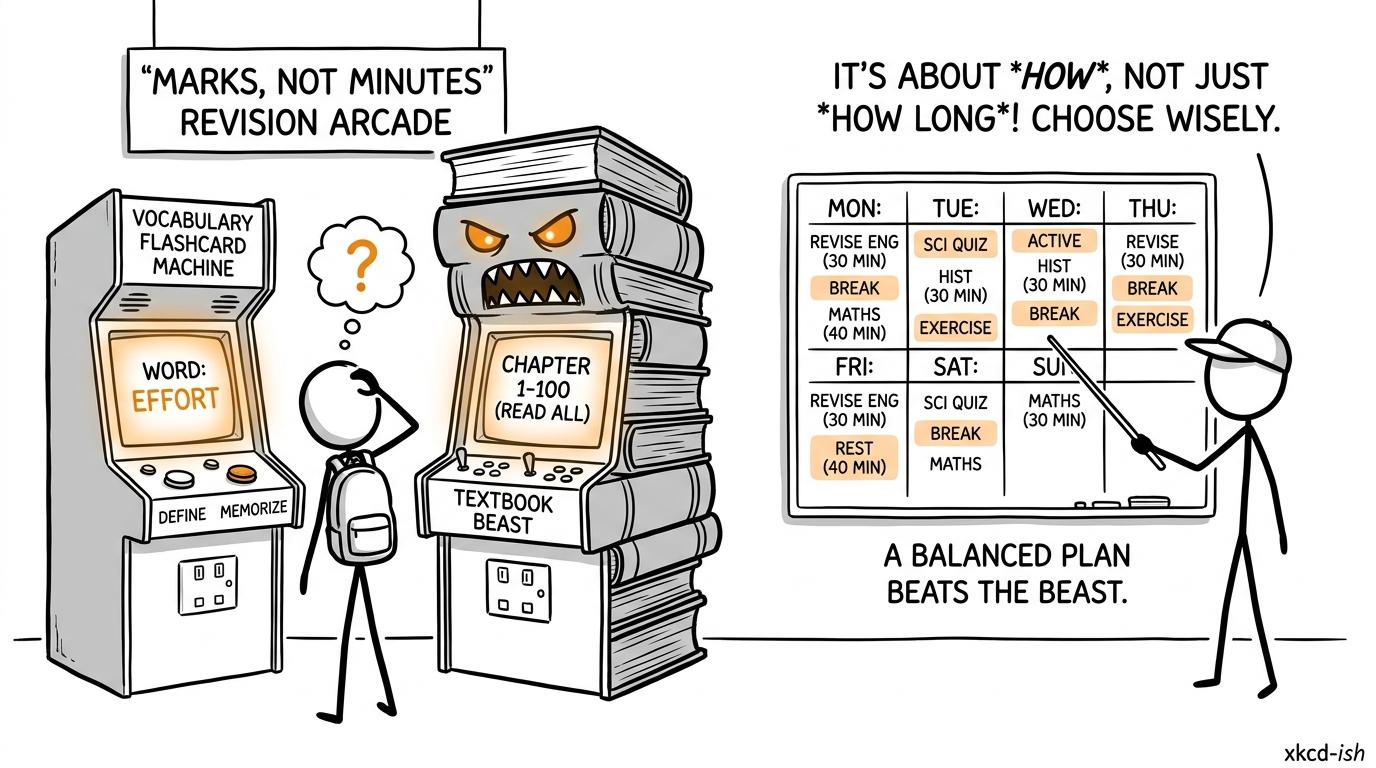 A revision game balancing flashcards, books and a weekly plan
How much revision time should each topic receive?
If you have 101010 hours available and no diagnostic evidence yet, divide them according to the raw marks:
| Revision area | Baseline time from each 101010 hours |
|---|---|
| Comprehension and optional language route | 2.52.52.5 hours |
| Unseen translation | 2.52.52.5 hours |
| Set text one | 2.22.22.2 hours |
| Set text two | 2.22.22.2 hours |
| Synoptic comparison | 0.60.60.6 hours |
This is a baseline, not a rigid law. Vocabulary, morphology and syntax should be woven through both language blocks. Literature translation and language analysis should also appear inside each set-text block.
The better method is to let evidence change the allocation. Complete a timed section, mark it carefully and record marks lost by category. MathsGenie's guide to finding your weakest GCSE topics explains this diagnostic principle clearly: revise the gaps revealed by performance, not simply the material that feels familiar.
A student losing marks repeatedly on verb recognition may temporarily give language 60%60\%60% of their time and literature 40%40\%40%. Another who translates confidently but writes vague literary responses may reverse that balance. Return towards an even split once the weakness improves.
A revision cycle that produces evidence
Passive rereading creates familiarity, which can feel like progress without proving recall. Use a short cycle instead:
- retrieve vocabulary or textual evidence without notes
- complete one focused passage or question set
- mark it immediately using the available mark scheme or teacher guidance
- classify each lost mark
- correct the underlying gap
- retest it later with different material
If you also take GCSE maths, the same approach works across both subjects. The MathsGenie GCSE maths revision hub combines topic resources, papers, solutions, flashcards and short tests. Its GCSE one-month revision plan can also help you organise several subjects without allowing one to consume the entire week.
A realistic timetable protects consistency. The GCSE revision timetable guide shows how focused topic sessions and timed practice can coexist. Apply the same structure here: brief vocabulary retrieval, concentrated language or literature work, then marking and correction.
When to move from topics to papers
Topic revision builds individual skills. Full papers test whether you can select and sustain those skills for 222 hours.
Begin with short sections when knowledge is still developing. Move towards complete papers once you have covered most of the course, but continue to use the results diagnostically. MathsGenie's advice on when to start GCSE past papers explains why papers should become more frequent as the examination approaches.
Use official Biblical Hebrew papers that match your specification, prescribed texts and optional route. Old papers may still offer useful language practice, but check that their format and content remain relevant.
Predictions should never replace specification coverage. This principle also sits behind MathsGenie's guide to GCSE predicted topics: recurring patterns can guide practice, but they cannot guarantee the next paper. For maths preparation, GCSE predicted papers are most useful after topic work and alongside official past papers.
 A tiny checklist overtaking a mountain of revision notes
Common GCSE Biblical Hebrew revision mistakes
Giving vocabulary all the attention
Vocabulary is essential, but memorising meanings without reading passages leaves syntax and morphology underdeveloped. Combine retrieval with unseen comprehension and translation.
Revising both set texts only as stories
Plot knowledge may support basic answers, but higher-quality responses require precise textual evidence, literary analysis and relevant context from the prescribed books.
Ignoring the smaller sections
A 555-mark set-text translation or 121212-mark synoptic response may look less important than a 303030-mark group of questions. Together, smaller sections can still shape the final grade.
Practising without marking
An unmarked answer provides activity but little diagnosis. Mark schemes, examiner materials and teacher feedback show whether you have supplied the detail, evidence and analysis the question requires.
Treating all revision time equally
An hour spent repeating secure vocabulary is not as valuable as an hour correcting a recurring verb-form error. Allocate time by marks and weakness, then review the balance each week.
Using an outdated text list
Prescribed literature must match your examination series. Confirm the current texts before investing time in detailed quotation and commentary notes.
Turn the breakdown into your next action
The examination is balanced: 50%50\%50% Language and 50%50\%50% Literature. Start there. Within Language, divide attention evenly between comprehension and translation. Within Literature, give almost all your time to detailed knowledge and analysis of both set texts while reserving regular practice for the synoptic comparison.
Then let your own marked answers refine the plan. The specification tells you where marks are available; your errors tell you where your next hour belongs.
For your maths exams, make MathsGenie the other half of that organised revision system. Use free revision lessons and practice questions to repair individual topics, mini tests to check recall, and past papers, predicted papers, mark schemes and video solutions to build exam confidence. Good revision is rarely about doing everything at once. It is about knowing what matters next, and doing that carefully.