

GCSE Biblical Hebrew With No Background Knowledge
GCSE Biblical Hebrew no background knowledge? See if starting from scratch is realistic, what the exams test and how to catch up without neglecting maths.
A new subject can look inviting from a distance and impossible close up. Biblical Hebrew may feel especially daunting: a different writing system, unfamiliar grammar and ancient texts, all while GCSE maths is already demanding your attention. If you searched for gcse biblical hebrew no background knowledge, the practical answer is yes: the qualification itself does not require prior learning. But starting from scratch is only realistic if your school permits it, suitable teaching is available and you have enough time to build the language systematically.
The distinction matters. Being allowed to enter a qualification is not the same as being ready for its examinations. Before committing, speak to the teacher or examinations officer who would oversee your course and ask exactly how the missing foundations will be taught.
The quick decision checklist
Starting GCSE Biblical Hebrew without the usual background may be sensible if you can answer yes to most of these questions:
- Does your school or examination centre allow a beginner to join?
- Is there a teacher with appropriate Biblical Hebrew expertise?
- Do you know which specification and examination series you would follow?
- Is there enough teaching time to cover reading, vocabulary, morphology, syntax and set texts?
- Can you practise briefly on most days rather than relying on occasional long sessions?
- Can you add the subject without weakening your preparation for compulsory GCSEs, especially maths and English?
- Are you interested in analysing an ancient language, rather than expecting a conversational Modern Hebrew course?
If several answers are uncertain, pause before enrolling. The subject may still be possible, but you need a clearer plan rather than more determination.
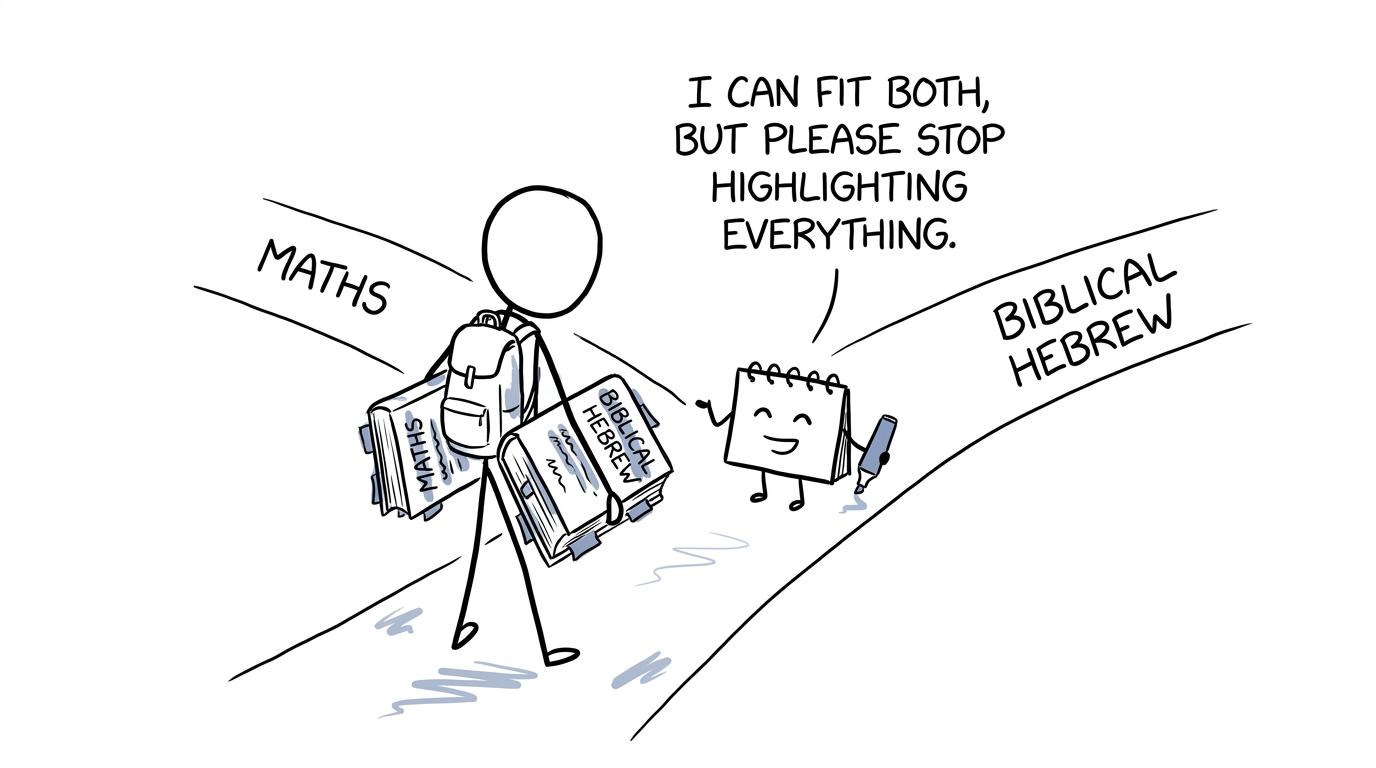 A student choosing between maths and Biblical Hebrew while a calendar asks for a realistic plan
What GCSE Biblical Hebrew actually involves
The current Pearson Edexcel GCSE Biblical Hebrew qualification has code 1BH0 and is graded from 999 to 111. It is an approved, untiered qualification, so there is no foundation or higher tier decision as there is in GCSE maths.
The specification states that there are no prior learning or other entry requirements. Assessment is linear, with both externally examined components taken in the same May/June examination series:
- Component 111: Language: a 222-hour written examination worth 100100100 marks and 50%50\%50% of the qualification.
- Component 222: Literature: a 222-hour written examination worth 100100100 marks and 50%50\%50% of the qualification.
The language component assesses comprehension and translation of unseen Biblical Hebrew. Students also meet grammatical structures through morphology and syntax. The literature component examines prescribed texts, including translation, content, context, literary features and evidence-based analysis.
Ofqual's assessment objectives divide the qualification between language knowledge at 50%50\%50%, knowledge and understanding of literature at 25%25\%25%, and analysis, evaluation and response at 25%25\%25%. This means success is not simply a matter of memorising translations. You must understand how the language works and explain how textual evidence supports an interpretation.
Specifications, prescribed texts and administrative arrangements can change. Your teacher should therefore confirm the current Pearson documents for your intended examination year before you begin.
What “no background knowledge” really means
There are several different starting points hiding inside that phrase.
A complete beginner may not yet recognise the script or understand that Biblical Hebrew is read from right to left. Another student may read Hebrew script from a religious setting but have little understanding of grammar. Someone who knows Modern Hebrew may recognise vocabulary and structures, yet still need to learn the conventions and texts required by the Biblical Hebrew specification.
These students are not starting from the same place. A fair initial assessment should check:
- recognition and accurate reading of letters and vowel signs;
- confidence reading from right to left;
- basic vocabulary recall;
- understanding of nouns, number, gender and state;
- recognition of common verb forms;
- ability to translate a short passage carefully;
- English-language confidence when explaining a text.
This is diagnostic information, not a verdict. In maths, a student who struggles with quadratics may really have a factorising gap. Biblical Hebrew works similarly: identify the earliest insecure skill and begin there.
Is catching up fast realistic?
It depends on what “fast” means. Catching up over a properly supported course can be realistic. Attempting to compress the whole qualification into a few unsupervised weeks is a much weaker proposition.
Your prospects are better when you have regular specialist teaching, a clear vocabulary sequence, frequent feedback and protected time for the prescribed literature. They are worse when you are joining late, learning entirely alone or assuming that familiarity with translations of biblical passages replaces knowledge of the Hebrew.
Ask your school four direct questions:
- How many supervised teaching hours remain?
- Which foundations has the existing class already covered?
- Who will mark translations and grammatical explanations?
- What evidence will be used to decide whether continuing is sensible?
A short baseline assessment followed by a review date is more useful than an immediate promise. Agree what progress should be visible after several weeks and reconsider the decision using actual work.
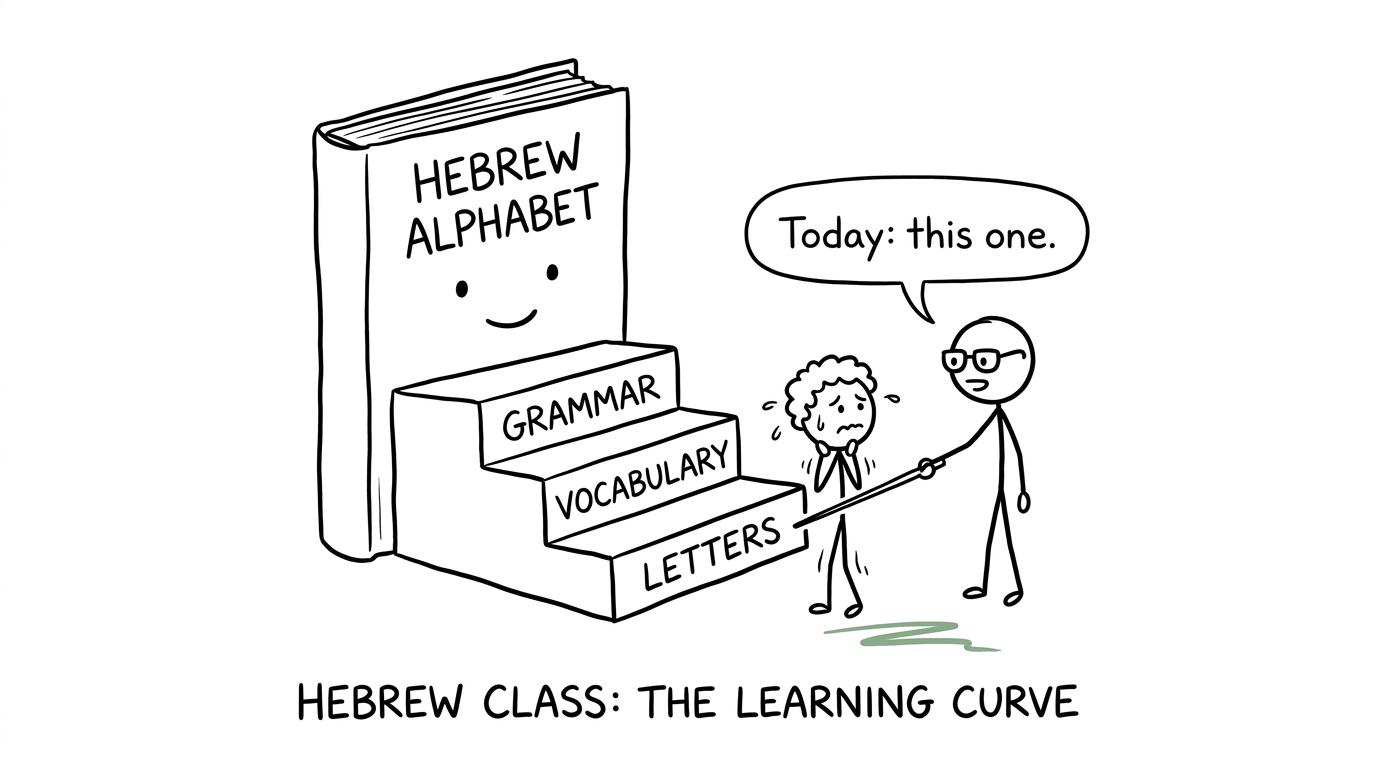 A student taking the first step on a friendly staircase of letters, vocabulary and grammar
How to catch up without wasting time
Build the reading foundation first
Speed cannot compensate for insecure decoding. Learn the script, direction of reading and vowel system accurately enough that every later task is not slowed by uncertainty. Short daily reading practice is usually easier to sustain than a large weekend session.
Do not rush past this stage because it feels elementary. Foundations are quiet: nobody applauds them, but everything rests on them.
Learn vocabulary through retrieval
Looking repeatedly at a word list creates familiarity, which can be mistaken for recall. Close the list, retrieve the meaning, check it and return to missed words later. The same principle is explained in MathsGenie's guide to turning GCSE notes into active recall.
Keep vocabulary connected to passages and grammatical forms where possible. Your teacher should decide which vocabulary and forms deserve priority under the current specification.
Treat grammar as a recognition system
Do not collect isolated grammar rules without using them. For each feature, aim to recognise it in context, state what information it provides and explain how it affects translation. That movement from recognition to application is central to unseen language work.
Create a small error log. Record the form you misidentified, why you misread it and the clue you should notice next time. Review patterns, not just individual errors.
Begin set-text work early
The literature paper accounts for half the qualification. Leaving prescribed texts until language study feels “finished” is therefore risky. Work through the current set texts with your teacher, building accurate translation alongside knowledge of content, context and literary features.
Learn to support analytical comments with precise textual evidence. A remembered opinion without evidence is fragile; an observation tied to the text can earn credit.
Use assessment material deliberately
Official sample materials, past papers and mark schemes reveal the wording, timing and depth expected. Start with short sections before attempting full papers. Complete a section, mark it carefully, identify the cause of each lost mark and retest the skill.
That is also the method behind using GCSE maths past papers properly. Past papers are not just score generators. They are diagnostic tools.
How to balance Biblical Hebrew with GCSE maths
An optional subject should not quietly consume the time needed for a compulsory one. Begin with a weekly timetable that protects existing commitments. The MathsGenie GCSE maths revision timetable offers a practical structure for combining focused topic sessions, retrieval and timed work.
On busy school days, use short blocks. A possible routine is:
- 202020 minutes of Biblical Hebrew reading or vocabulary;
- 252525 to 353535 minutes of focused GCSE maths revision;
- immediate marking and one written correction for each subject.
MathsGenie's 20-minute GCSE maths routine can help when homework and another GCSE leave little room. The point is not to divide every evening equally. It is to stop the new subject expanding until everything feels urgent.
Use evidence to adjust the balance. If maths practice reveals repeated gaps, return to revision lessons and practice questions. Short Edexcel GCSE maths mini tests can check a specific skill without taking over the evening. If you study another board, select the appropriate AQA, OCR or Eduqas pathway from the main revision hub.
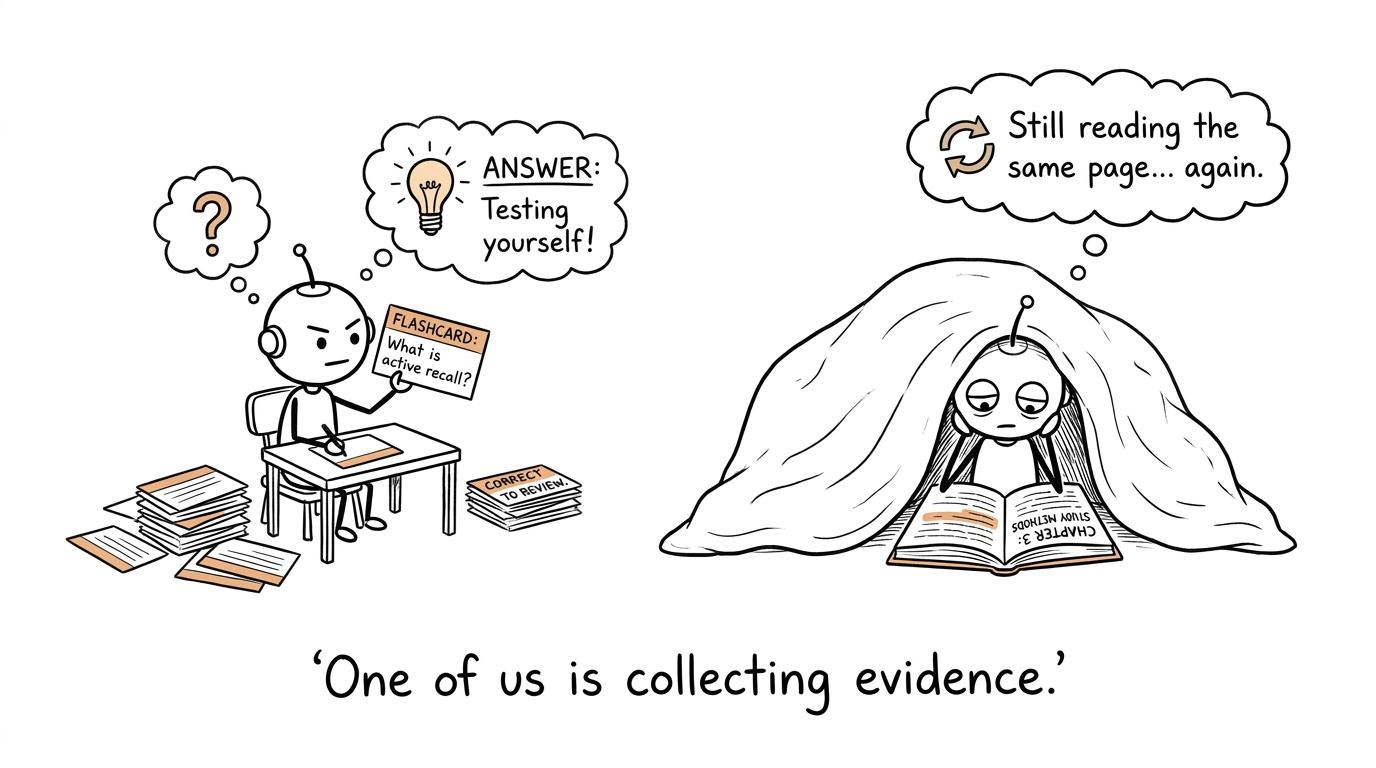 Two revision robots compare active retrieval with endless rereading
Common mistakes when starting from scratch
Confusing Biblical Hebrew with Modern Hebrew
They are related, but the GCSE course is built around an ancient language and prescribed biblical literature. It is not primarily a speaking and listening qualification. Confirm the exact subject before choosing resources or tuition.
Assuming no formal prerequisite means no foundation is needed
The qualification may not require previous certification, but its examinations still require substantial knowledge and skill. Entry rules remove a formal barrier; they do not remove the learning.
Joining before checking whether the school can support you
A school or centre may set its own practical conditions based on staffing, timetabling and whether it can deliver and administer the course. Get written clarity about teaching, entry and assessment arrangements.
Memorising translations without understanding the language
Known passages may feel reassuring, but the language paper includes unseen material. Build vocabulary, morphology and syntax rather than relying on a remembered English version.
Letting catch-up replace all other revision
Novel subjects attract attention because progress feels visible. Protect maths with a fixed weekly minimum, then use past-paper practice to check whether that minimum is enough. Nearer the maths examinations, predicted papers can provide fresh exam-style practice, but they should supplement official past papers rather than replace them.
A realistic next step
Ask for the current specification, prescribed texts, course timetable and a short diagnostic task. Then build a trial plan covering reading, vocabulary, grammar and literature while keeping your maths revision protected. Review the evidence with your teacher before committing fully.
Starting without the usual background is possible. The decisive factor is not whether you begin behind; it is whether your route forward is taught, measurable and sustainable.
For maths, keep that route simple with MathsGenie. Use free revision lessons to repair weak methods, practice questions and mini tests to build accuracy, then move into past papers and predicted papers with mark schemes and video solutions. The efficient GCSE maths revision guide gives you a repeatable learn, practise, mark, fix and retest cycle, leaving enough structure to explore a demanding new subject without losing sight of the exams already in front of you.










