GCSE Biblical Hebrew Homework Grade Impact
GCSE Biblical Hebrew homework grade impact explained: see what counts towards your final grade, which tasks help, and how to balance GCSE maths revision.

A homework mark can feel strangely permanent. You see a percentage in red ink, compare it with the result you hoped for, and begin wondering whether your final GCSE grade has already started slipping away.
The short answer to the GCSE Biblical Hebrew homework grade impact question is reassuring: ordinary homework marks do not directly contribute to your final Pearson Edexcel GCSE grade. The qualification is assessed through external examinations. Homework matters indirectly because effective tasks strengthen the language, translation and literature skills those examinations reward.
That distinction matters. Completing more homework is not automatically better. Completing focused work, checking it carefully and acting on feedback is what can move your grade. If you are also preparing for GCSE maths, the aim is not to neglect either subject. It is to spend limited revision time where it produces the most learning.
The quick answer and revision checklist
Use this checklist when deciding how seriously to treat a Biblical Hebrew task:
- Homework is not a separate component of the final GCSE grade. Your external examination performance determines the qualification result.
- Homework can still influence that performance. It provides practice in vocabulary, grammar, unseen translation, set texts and literary analysis.
- Quality matters more than sheer quantity. A short task with retrieval, correction and feedback is usually more useful than lengthy copying.
- Feedback is part of the task. Correcting errors is often where the most valuable learning happens.
- Your revision time has an opportunity cost. Over-polishing one low-value task may take time away from a serious weakness in Biblical Hebrew or maths.
- School requirements still matter. If workload is becoming unmanageable, speak to your teacher rather than silently abandoning assignments.
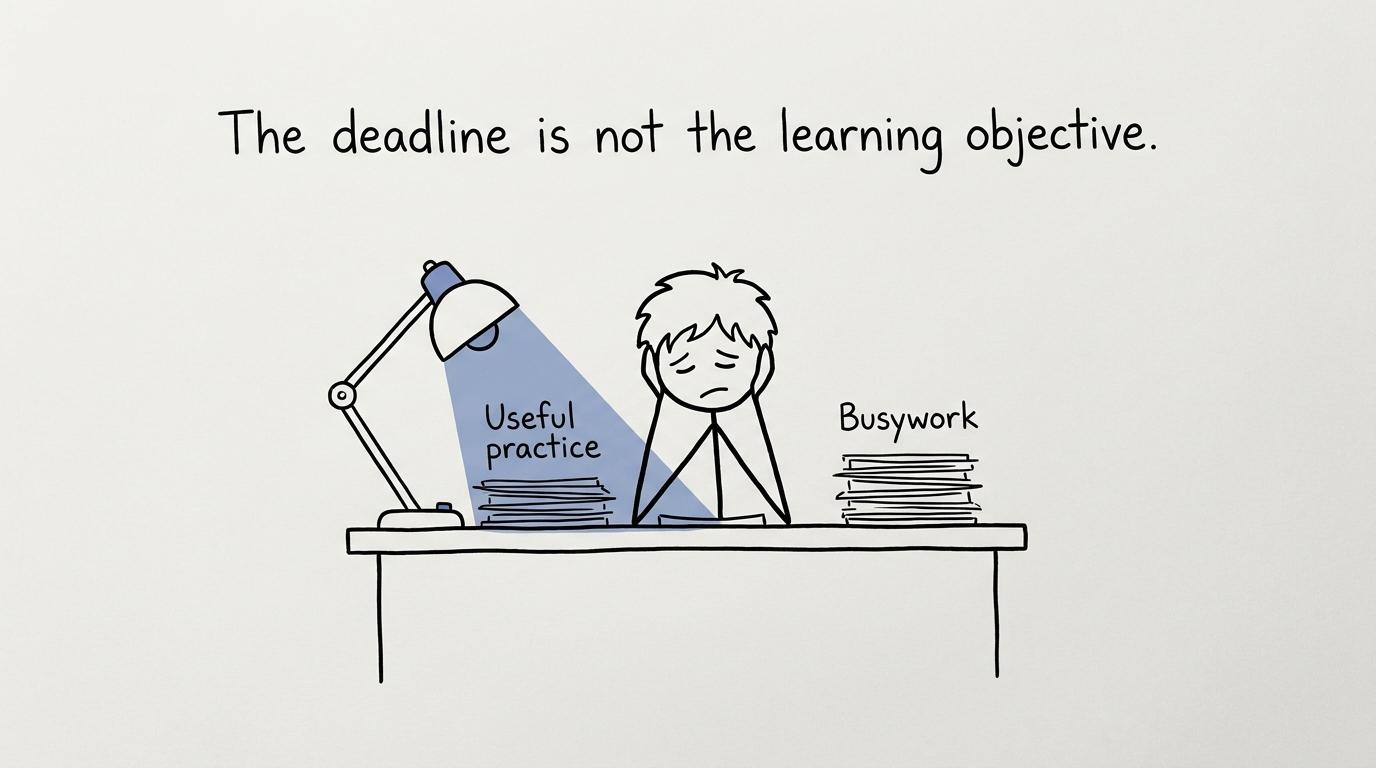 A student discovers that the deadline is not the learning objective
What actually determines your GCSE Biblical Hebrew grade?
Pearson Edexcel GCSE Biblical Hebrew, specification code 1BH0, consists of two externally examined components: Language and Literature. Each contributes 50%50\%50% of the qualification.
Across the qualification, the regulated assessment objectives are weighted as follows:
- AO1, knowledge and understanding of the language: 50%50\%50%
- AO2, knowledge and understanding of literature or ancient sources: 25%25\%25%
- AO3, analysis, evaluation and response to literature or ancient sources: 25%25\%25%
Your teacher may record homework marks for reports, progress tracking, predicted grades or decisions about support. Those records can be important within school, but they are not an additional assessed component added to the marks from the final papers.
This is also why one disappointing homework result does not fix your eventual grade. It is evidence about your current understanding, not a verdict. A low mark can even become useful if it identifies a recurring problem early enough to correct it.
Biblical Hebrew should not be confused with Modern Hebrew. The qualifications have different specifications and assessment structures. Biblical Hebrew focuses on ancient-language knowledge, translation, prescribed literature and analytical response. Always revise from the specification and set texts for your own examination series.
How homework can affect your grade indirectly
Homework works through practice rather than accounting. It does not supply examination marks in advance; it changes what you may be able to do when those marks become available.
The Education Endowment Foundation reports a positive average effect for homework at secondary level, but it also rates the security of that evidence as low and highlights substantial variation between tasks. Its evidence is not specific to GCSE Biblical Hebrew, so it cannot tell an individual student that completing a certain number of worksheets will produce a particular grade.
The more useful findings concern design. Homework tends to be more effective when it is connected to classroom learning, has a clear purpose and receives feedback. There is also evidence that impact can diminish as the amount of time spent increases. More time is not a guarantee of more progress.
For Biblical Hebrew, homework is likely to have high value when it asks you to:
- retrieve vocabulary without immediately consulting notes;
- recognise morphology, syntax and grammatical forms;
- translate an unseen passage accurately;
- recall and understand prescribed set-text material;
- explain how language creates a literary effect;
- produce an evidence-based analytical response;
- correct previous errors and attempt a similar task again.
By contrast, copying a translation you do not understand or repeatedly reading notes without testing recall may create the appearance of work without building reliable examination performance.
The homework tasks with the greatest grade impact
Retrieval before recognition
Recognition feels fluent because the answer is visible. Retrieval is harder because you must produce the knowledge yourself. The examination requires retrieval, so effective homework should sometimes begin with books and notes closed.
This applies to vocabulary, verb forms, grammatical terminology and set-text knowledge. Check afterwards, record what was missing and revisit it later. The initial struggle is not proof that revision failed; it is the information that makes the next session more precise.
Translation followed by diagnosis
A translation mark alone is less valuable than knowing why marks were lost. Separate mistakes into useful categories: vocabulary, morphology, syntax, omission, English expression or misreading of the passage.
Patterns matter more than isolated slips. If several errors come from the same grammatical weakness, another full translation may be less efficient than a short targeted task on that weakness.
Literature practice tied to assessment objectives
Knowing the narrative is necessary, but not sufficient. Literature questions may require knowledge, explanation, analysis and evaluation. Useful homework therefore moves beyond retelling events. It asks you to select relevant evidence, explain language and connect each observation to the precise question.
For examinations from 2026 to 2028, students should use the prescribed texts stated in the current Pearson specification rather than relying on an older revision list. Set texts change between examination cycles, so check with your teacher if a resource is undated.
Correction and re-testing
Feedback only changes performance when you use it. After homework is marked, write a brief correction for each significant error and reattempt the skill after a gap. The second attempt tests whether the correction has become usable knowledge.
The same principle supports effective maths revision. A completed worksheet is not the finish line. On MathsGenie, you can use GCSE mini tests to expose gaps, then return to the relevant revision lesson and practice questions.
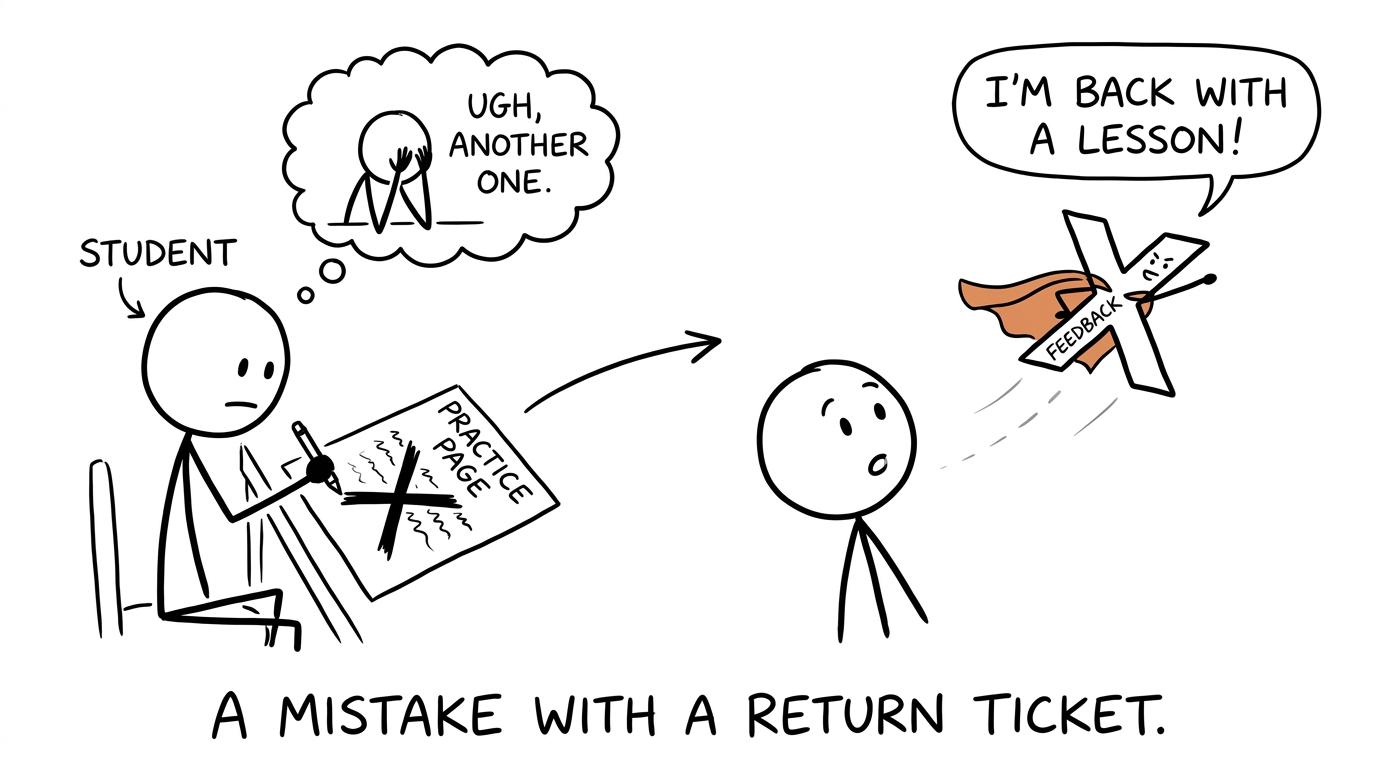 A corrected mistake returns wearing a feedback cape
Should Biblical Hebrew homework take priority over maths?
Not automatically. Nor should maths automatically win every evening. The right decision depends on deadlines, current weaknesses and the likely value of the next task.
Consider four questions:
- Is the homework compulsory and due soon?
- Does it address a skill assessed heavily in Biblical Hebrew?
- Will your teacher provide feedback you can use?
- Is there a more urgent weakness in another subject?
Suppose your Biblical Hebrew task is an important unseen translation that your teacher will mark closely. That is likely to deserve focused attention. If the task is largely repetitive and you have an imminent maths mock with major algebra gaps, completing the Hebrew requirement accurately without unnecessary decoration may be the wiser choice.
This is not permission to skip work whenever another subject feels harder. It is a case for proportion. Your final timetable should reflect the marks you are losing, not the subject that happens to feel most comfortable.
For maths, start with the GCSE maths revision hub and choose the correct exam board and tier. Edexcel, AQA, OCR and Eduqas organise their papers differently, while foundation and higher tier target different grade ranges. Biblical Hebrew itself does not use the same foundation and higher tier structure.
If you are unsure where maths time should go, the guide to finding your weakest GCSE topics provides a practical diagnostic process. You can then build those findings into a realistic GCSE maths revision timetable.
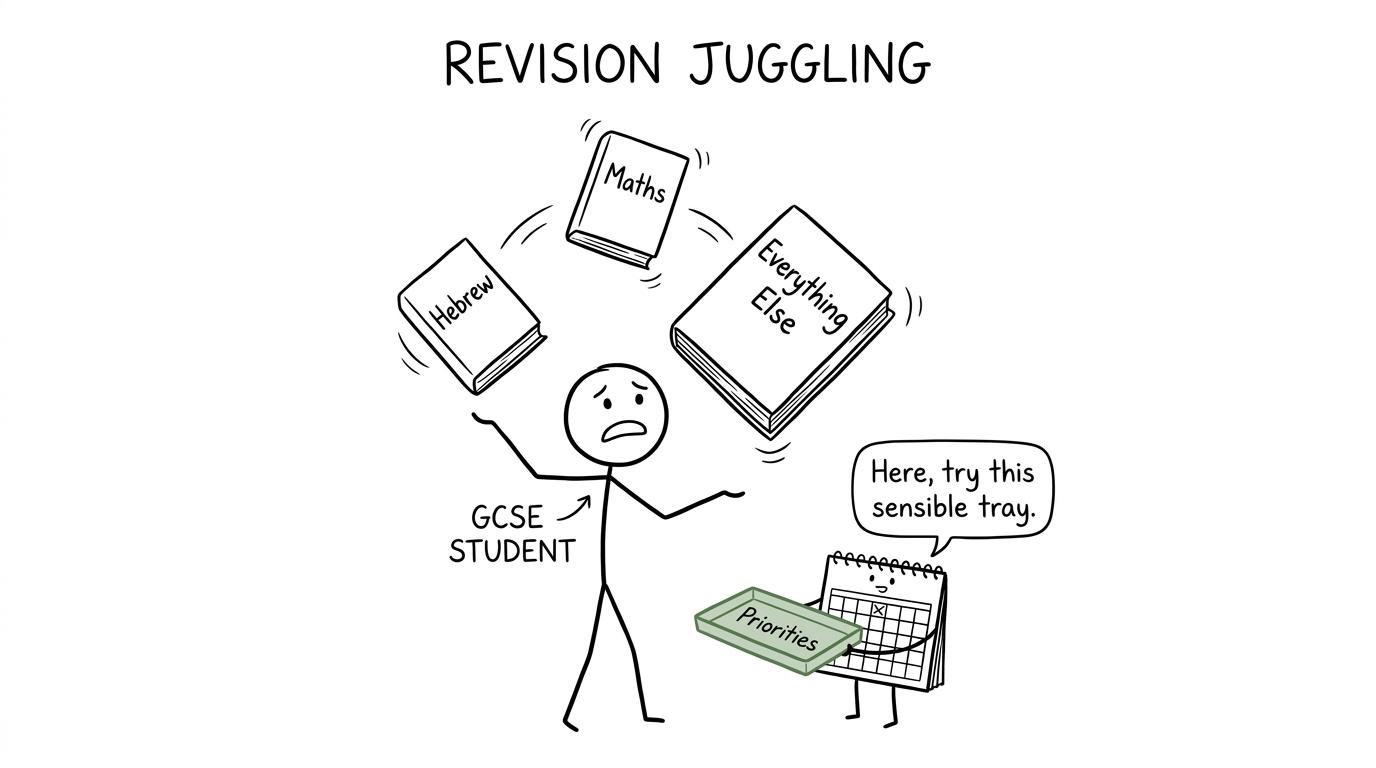 A student juggles Hebrew, maths and everything else
A balanced weekly approach
A useful revision week contains three kinds of activity:
- Required work: homework that must be submitted.
- Repair work: targeted practice on weaknesses revealed by marking.
- Exam work: timed questions that test whether knowledge survives pressure.
Begin by placing firm deadlines into your week. Next, reserve short sessions for your most important weaknesses. Finally, include mixed or timed practice so that revision does not remain permanently comfortable.
On crowded school days, a repeatable short session is better than waiting for an ideal evening. MathsGenie’s 20-minute GCSE maths revision routine shows how retrieval, questions and marking can fit into a small block. If examinations are closer, use the one-month GCSE maths revision plan to move from diagnosis towards timed papers.
A Level students can use the same planning principle, although they must follow their own specifications: identify what is assessed, practise the required skill, obtain feedback and retest it.
Common mistakes when judging homework value
Treating every homework mark as a predicted final grade
One task samples a narrow part of the course and may have been completed under very different conditions from an examination. Look for trends across several tasks rather than turning one result into a forecast.
Spending too long making work look perfect
Presentation should be clear enough for your teacher to follow, but decorative effort rarely strengthens translation or analysis. Stop when the learning purpose and submission requirements have been met.
Checking notes too early
Immediate checking removes the retrieval demand. Attempt what you can first, then use notes to diagnose gaps.
Ignoring marked work
Reading a correction and putting the page away does little. Rewrite the faulty part, state the reason for the error and test the same skill later.
Sacrificing all past-paper practice for homework
Homework may cover individual skills, while examinations also demand timing, selection and stamina. In maths, use the guidance on when to start GCSE past papers, then add fresh Edexcel predicted papers nearer the examination if that is your board.
Make homework serve the examination
Biblical Hebrew homework matters, but not because every exercise contributes a hidden percentage to your certificate. It matters when it helps you retrieve language, translate accurately, understand prescribed texts, analyse evidence and correct recurring errors.
The sensible goal is not maximum homework time. It is maximum useful learning from the time available. Complete required tasks, seek feedback, repair weaknesses and protect enough space for your other GCSE subjects.
For maths, make MathsGenie your free revision base. Use revision lessons and practice questions to rebuild individual skills, mini tests to check progress, and past papers, predicted papers, mark schemes and video solutions to prepare for the real examination. Start with one weakness today, mark the work honestly, and let the next task be chosen by evidence rather than panic.