GCSE Biblical Hebrew Cram Guide: 1-Week Plan
GCSE Biblical Hebrew cram guide 1 week: a focused plan for vocabulary, grammar, unseen translation, set texts, timing and calm exam prep.
Starting late creates a particular kind of panic. You open the vocabulary list, remember that there are two set texts, and briefly consider revising everything at once. That instinct is understandable. It is also inefficient.
This GCSE Biblical Hebrew cram guide 1 week plan gives you a more useful answer: spend seven focused days retrieving vocabulary, repairing essential grammar, translating unseen passages and preparing evidence from the correct set texts. You cannot rebuild an entire course in a week, but you can become faster, more accurate and much clearer about where marks are available.
The plan is based on the current Pearson Edexcel GCSE Biblical Hebrew qualification. It is untiered, so there is no foundation or higher paper. There are two externally examined components, each lasting 222 hours, worth 100100100 marks and contributing 50%50\%50% of the qualification. Confirm your examination year, specification and set texts with your teacher before beginning.
Your one-week revision checklist
Keep the plan deliberately small:
- Check that you have the correct specification and set texts.
- Gather the official vocabulary list, class notes, past papers and mark schemes.
- Complete active vocabulary recall every day.
- Practise both unseen comprehension and translation.
- Review morphology and syntax through passages, not isolated rereading.
- Prepare concise notes on content, context and literary features.
- Complete timed sections before attempting a full paper.
- Keep one error log and revisit it daily.
- Stop heavy revision early enough to sleep properly before the exam.
You will normally need around 222 to 333 focused hours each day. Divide longer sessions into blocks of roughly 252525 to 404040 minutes, with short breaks between them. If you also have maths exams approaching, the MathsGenie GCSE revision hub can keep that part of your timetable organised without adding another pile of decisions.
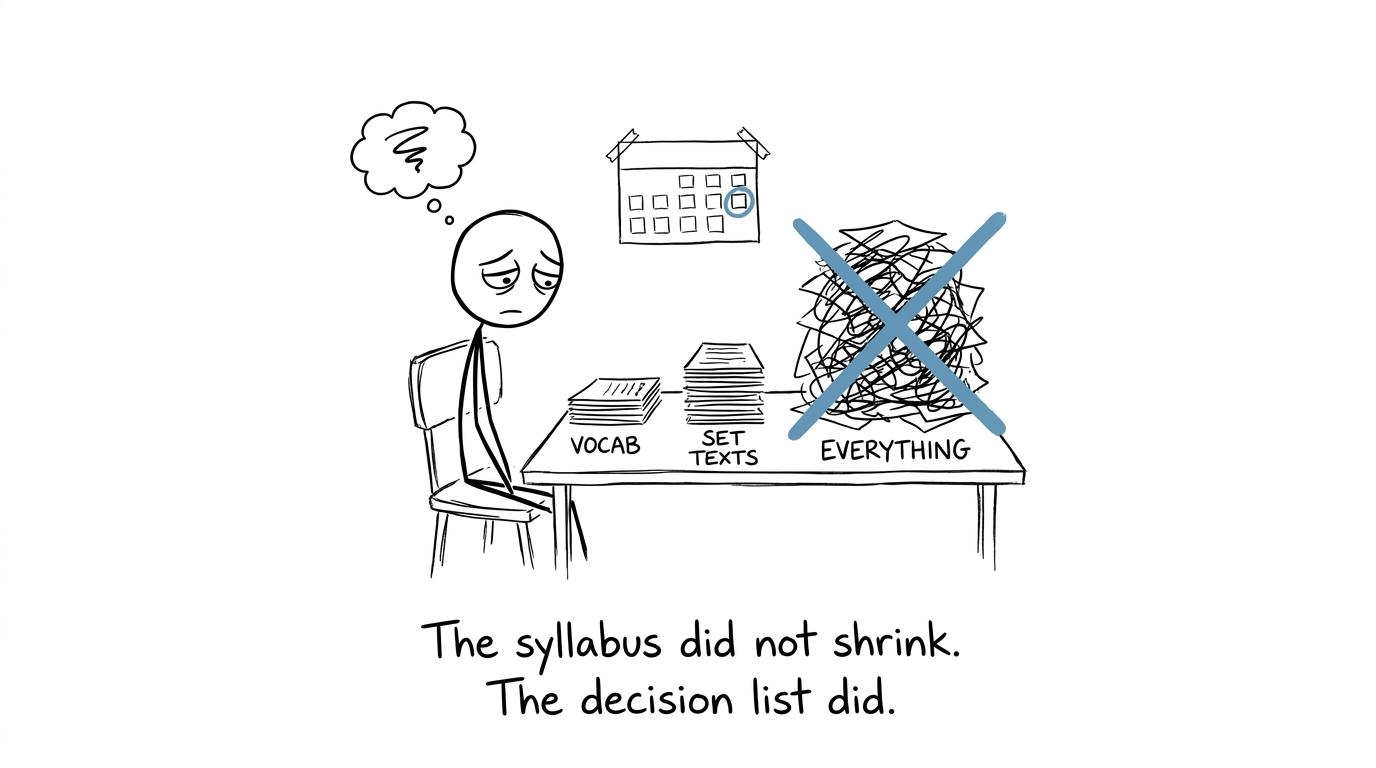 A student replaces an impossible pile of revision with two manageable priorities
Know what the examination actually tests
Pearson Edexcel GCSE Biblical Hebrew, specification 1BH01\mathrm{BH}01BH0, has two equally weighted papers.
Component 1: Language tests comprehension and translation using unseen passages. You also answer optional questions involving either grammatical structures or translation from English into pointed Biblical Hebrew. The specification states that unfamiliar vocabulary is generally supplied, except where a word has an obvious cognate relationship with listed vocabulary. That makes secure recognition of roots and forms especially valuable.
Component 2: Literature tests knowledge, understanding, analysis and evaluation of two prescribed texts. It includes short responses, translation, extended responses and a synoptic question. For examinations from 202620262026 to 202820282028, the prescribed selections are Genesis chapters 414141 to 434343, covering Joseph's rise to power, and 222 Kings chapters 444 to 777, covering the miracles of Elisha. Check this against your own examination year rather than assuming an older class resource is still current.
The assessment objectives divide the qualification clearly: language contributes 50%50\%50%, knowledge and understanding of literature contributes 25%25\%25%, and analysis, evaluation and response to literature contributes 25%25\%25%. Your week should reflect that balance. Memorising set-text translations while avoiding unseen language would leave half the qualification underprepared.
Day one: diagnose and reduce the problem
Do not begin by copying vocabulary. Begin with evidence.
Attempt one timed section from an official or teacher-provided paper without notes. Mark it strictly, then classify every lost mark under one of these headings:
- vocabulary recognition;
- morphology or syntax;
- inaccurate English;
- misunderstood question;
- set-text knowledge;
- literary analysis;
- timing.
Choose the three categories causing the greatest damage. These become your priorities for the week. A precise weakness such as “I miss pronominal suffixes” is actionable; “Hebrew is bad” is not.
This diagnostic approach works in every subject. MathsGenie's guide to finding your weakest GCSE topics explains the same principle: use mistakes as data, then repair the smallest identifiable gap.
Finish the day by testing the official vocabulary list in both directions. Create three piles: secure, hesitant and unknown. Spend most of the week on the last two.
Day two: rebuild high-value grammar
Grammar revision should improve what you can do with a passage. Concentrate on features that help you identify who is acting, when the action occurs and how words relate to one another.
Prioritise:
- recognition of verbal roots and derived forms;
- person, gender and number;
- perfect, imperfect, imperative, infinitive and participle forms;
- prefixed and suffixed conjunctions, prepositions and pronouns;
- construct chains;
- agreement between nouns and adjectives;
- common changes caused by weak roots;
- the role of word order and context.
Use your class grammar summary, but keep testing yourself against unseen sentences. Cover the notes, identify each form, explain its function, then check. Recognition under pressure matters more than producing a beautiful page of copied paradigms.
End with a short timed comprehension section and add recurring errors to your log. For managing several GCSE subjects in short blocks, the MathsGenie twenty-minute revision routine offers a useful structure for active recall, practice and immediate marking.
Day three: train unseen comprehension
Comprehension rewards disciplined reading. Before trying to translate everything, identify proper nouns, repeated roots, connectives, changes of speaker and the main sequence of events. Read each question carefully and answer what it asks rather than unloading everything you know about the passage.
Use this routine:
- Read the title and any vocabulary assistance.
- Scan the whole passage for people, places and repeated words.
- Mark finite verbs and likely subjects.
- Answer direct retrieval questions first.
- Return to grammatical or inferential questions with the wider context in mind.
- Check that each answer is supported by the specified line or lines.
Complete two shorter unseen passages rather than one very long, untimed session. Mark immediately. If the mark scheme accepts an idea you expressed too vaguely, rewrite your answer with the required precision.
Day four: improve translation accuracy
A translation must communicate the meaning of the Hebrew in natural, accurate English. It should not become so literal that it is unclear, but it must not add details that are absent from the source.
Work through a timed unseen passage in small sense units. For each unit, identify the main verb, subject, object and attached particles before polishing the English. When a word has several possible meanings, let grammar and context decide.
After marking, label each error as vocabulary, form, relationship or English expression. Then redo only the affected phrase without looking at the mark scheme. This final step matters: seeing a correction is not the same as being able to produce it.
Past papers are most useful when they create a feedback loop. MathsGenie's explanation of when to begin GCSE past papers shows why marking and targeted repair matter more than merely accumulating completed papers.
Day five: secure the two set texts
Divide the day between both prescribed texts. For each chapter or episode, prepare a compact sheet containing:
- the sequence of events;
- key characters and motives;
- cultural and historical context taught in your course;
- significant vocabulary and phrases;
- examples of literary techniques;
- why those techniques affect meaning or emphasis;
- short references that can support an analytical response.
Do not try to memorise an English translation without understanding the Hebrew. Literature questions can require translation, contextual knowledge and analysis. Your notes therefore need to connect language, content and effect.
Practise planning extended responses rather than writing several full essays. Build a clear argument, select relevant evidence and explain how it supports the conclusion. A list of features is not analysis. The important step is explaining what a feature contributes to the passage.
Day six: complete timed examination practice
Choose the paper you currently find weaker and complete it under realistic conditions: 222 hours, no interruptions and only the materials permitted in the examination. If a full paper is not possible, complete two substantial timed sections and preserve the correct pace.
Mark the work carefully. Record:
- marks lost through missing knowledge;
- marks lost through inaccurate reading;
- questions that consumed too much time;
- answers that needed clearer evidence;
- corrections that must be retested tomorrow.
Do not spend the evening completing another full paper. Repair the three largest leaks instead. The same learn, practise, mark and fix cycle is explained in MathsGenie's guide to efficient GCSE revision.
Day seven: consolidate without panic
The final day is for retrieval, not expansion. Test hesitant vocabulary, review core forms, retell the sequence of both set texts and complete one short unseen task. Revisit yesterday's three biggest errors using fresh questions or passages.
Then prepare for the examination. Check the time and location, pack permitted equipment and stop demanding new content from a tired brain. Calm preparation cannot guarantee a particular grade, but exhaustion predictably makes careful reading harder.
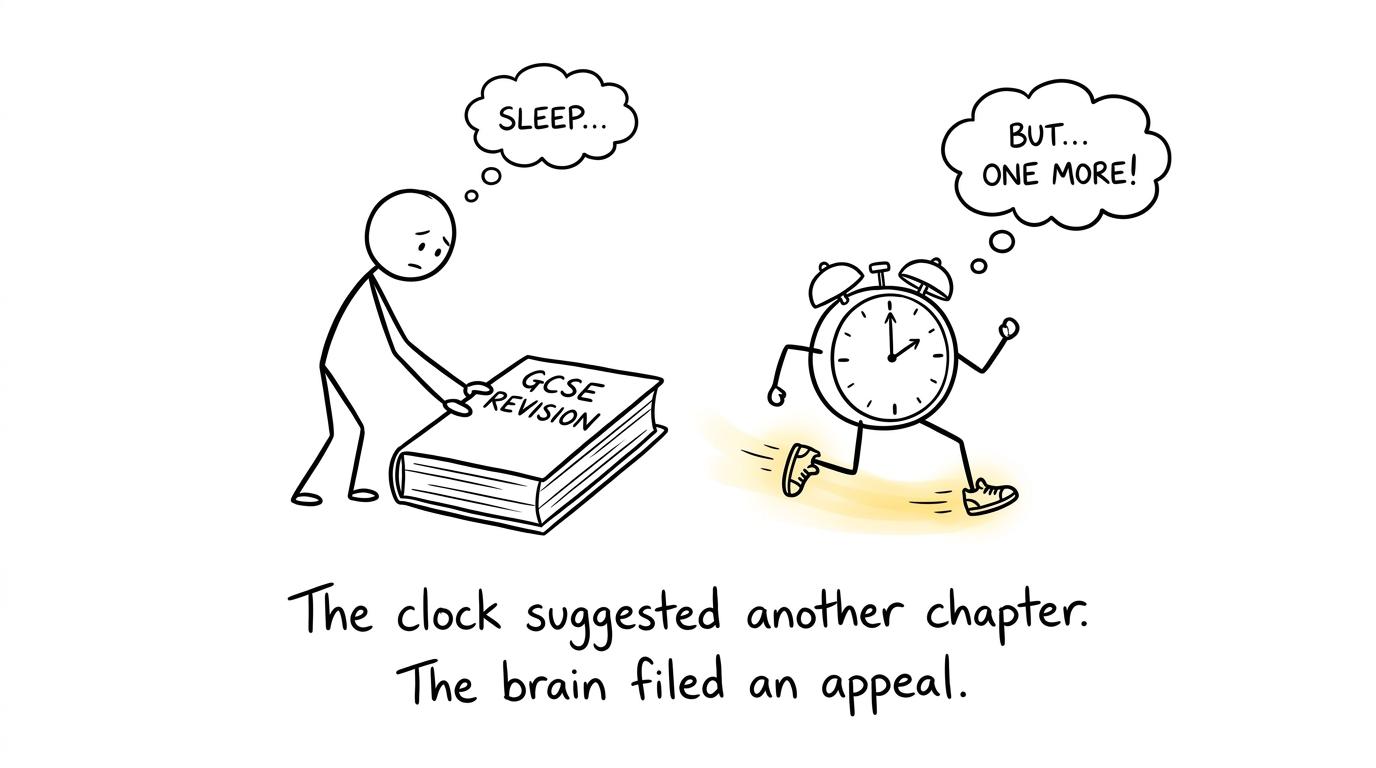 A tired student's brain appeals against one more chapter before bed
Common mistakes in a GCSE Biblical Hebrew cram week
Spending the week rereading
Familiarity can feel like knowledge. Close the book and retrieve vocabulary, forms, events and evidence from memory. Testing exposes gaps that rereading hides.
Revising only the set texts
Prepared passages feel safer, but Language contributes 50%50\%50% of the qualification. Include unseen comprehension or translation every day.
Using the wrong prescribed texts
Set texts change between examination cycles. Verify your year with your teacher and current specification before investing hours in old material.
Treating every vocabulary item equally
Start with unknown and hesitant words, especially common words and roots that affect passage comprehension. Secure words need brief maintenance, not most of your time.
Ignoring the mark scheme
A mark scheme reveals the precision and evidence a response requires. Mark on the same day, rewrite weak answers and retest the error.
Letting one subject consume the whole week
Biblical Hebrew may be urgent, but your other GCSEs still need maintenance. A short daily maths block using Edexcel GCSE Maths past papers, where appropriate, or resources for your own board can prevent avoidable forgetting. The MathsGenie one-week maths plan can help you divide that time sensibly.
Make the next seven days count
A late start changes the strategy, not the value of the remaining time. Diagnose first. Retrieve vocabulary daily. Practise unseen language. Connect each set-text detail to an argument. Mark everything that can be marked, and let each error decide the next task.
For Biblical Hebrew, use the current Pearson specification, your teacher's resources and official assessment materials. For the maths exams running alongside it, make MathsGenie your free revision base: use revision lessons and practice questions to repair topics, then test them through mini tests, past papers, predicted papers, mark schemes and video solutions.
Open the MathsGenie GCSE Maths revision page, choose your exam board, and give both subjects a clear place in the week. Seven days is short. It is still long enough to make better decisions.