

GCSE Biblical Hebrew 20 Minute Study Routine
GCSE Biblical Hebrew 20 minute study routine: build vocabulary, grammar, translation and set-text recall while protecting your maths revision time too.
Revision becomes difficult when every subject seems to deserve an entire evening. Biblical Hebrew needs vocabulary, grammar, translation and literature. Maths needs regular question practice. Other GCSEs are waiting too. The predictable result is postponement, followed by an exhausting attempt to recover everything at once.
A GCSE Biblical Hebrew 20 minute study routine offers a calmer answer: spend a short, protected period retrieving knowledge, complete one focused task, check it and stop. You are not trying to cover the whole specification each night. You are keeping important knowledge available while gradually strengthening your weakest area.
This routine is designed for students taking Pearson Edexcel GCSE Biblical Hebrew alongside GCSE maths. MathsGenie does not teach Biblical Hebrew, but its free GCSE Maths Revision hub can organise the maths side of your timetable, leaving this routine to handle Hebrew without creating an all-nighter.
Your Twenty-Minute Routine at a Glance
Keep the structure identical each day so that your limited time goes into revision rather than deciding how to revise:
- First 222 minutes: choose one precise target and remove distractions.
- Next 555 minutes: retrieve vocabulary or forms without notes.
- Next 101010 minutes: complete the day's main grammar, translation or literature task.
- Final 333 minutes: check, record one error and choose tomorrow's target.
The timer matters. When it ends, stop. A routine only remains sustainable if it has a reliable boundary.
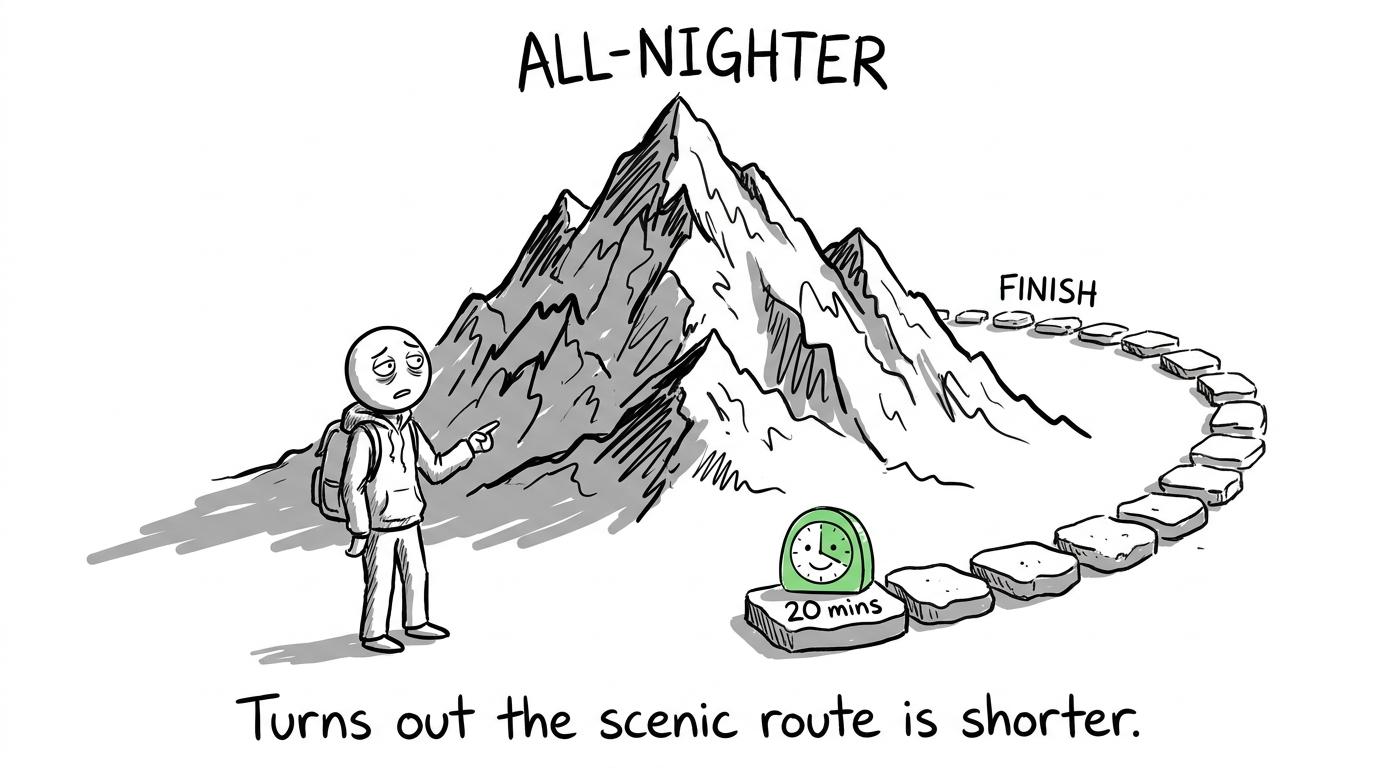 A student chooses the twenty-minute path around the all-nighter mountain
Why Short Daily Biblical Hebrew Revision Works
GCSE Biblical Hebrew contains several connected demands. Official GCSE subject content requires students to develop vocabulary, morphology and syntax so that they can understand an ancient language. It also requires engagement with literature, including its language, context and effects.
The Pearson Edexcel qualification has two externally examined components. Component 111, Language, and Component 222, Literature, each contribute 50%50\%50% of the qualification. Language includes unseen comprehension and translation into English, followed by a choice involving grammar questions or translation into pointed Biblical Hebrew. Literature assesses knowledge, translation and analysis of the prescribed texts.
That breadth makes occasional rereading unreliable. You can recognise a word on a page without being able to recall it in an unseen passage. You can follow a grammatical explanation without identifying the form independently. Short retrieval followed by immediate checking exposes that difference.
There is another advantage for a busy maths student: 202020 minutes is small enough to schedule honestly. MathsGenie's twenty-minute maths revision routine uses a similar principle: one target, active practice and quick feedback. Keep the subjects in separate blocks, but use the same dependable rhythm.
How to Use Each Part of the Routine
Set one target in the first two minutes
Do not begin with a target such as “revise Hebrew”. It is too large to guide a short session. Choose one outcome you can test:
- recall a small group of vocabulary;
- identify selected verb forms;
- translate a short passage accurately;
- review one section of a prescribed chapter;
- plan evidence for one literature theme;
- correct yesterday's translation errors.
Put your phone out of reach, open only the material you need and start the timer. If choosing tasks repeatedly wastes time, write the week's targets in advance. Maths students can use the same idea when following a realistic GCSE maths revision timetable.
Retrieve vocabulary for five minutes
The official ancient-languages subject content requires a defined vocabulary list containing at least 400400400 words, alongside regular compounds. This is not a list to “finish” once. Vocabulary has to become quickly available while you are reading under exam conditions.
Use a small set of words and test in both directions where appropriate. Cover the answers. Say or write the meaning before checking. Include troublesome forms, prefixed elements and words that look similar. Separate the words you recalled immediately from those you hesitated over.
End by placing uncertain words on tomorrow's list. Five honest minutes of recall are more informative than fifteen minutes spent looking at familiar entries.
Spend ten minutes on the day's main task
This is the active part of the session. Rotate its focus across the week rather than trying to squeeze every skill into every evening.
For grammar, identify forms in context and state the relevant person, gender, number, stem or aspect required by your course. For unseen language, translate a manageable section and resist checking each word immediately. For literature, retrieve the sequence, important language and evidence for a theme before consulting your notes.
If you choose the English-to-Biblical-Hebrew option in Component 111, include regular practice with the restricted vocabulary and the precise forms required by the specification. If you intend to choose the grammar alternative, give grammar the greater share of these blocks. Follow your teacher's guidance rather than dividing your effort equally between two options you will not both answer in the examination.
For examinations in 202620262026 to 202820282028, Pearson's published specification identifies Genesis Chapters 414141 to 434343, concerning Joseph's rise to power, and Kings Chapters 444 to 777, concerning the miracles of Elisha, as the set texts. Confirm the correct examination series and prescribed texts with your teacher before building your rotation, especially if you are preparing beyond those years.
Check and log for three minutes
The final minutes turn activity into useful evidence. Compare your answer with an authorised translation, class material or mark scheme supplied for your course. Do not merely count errors. Classify the cause:
- unknown vocabulary;
- misidentified form;
- missed prefix or suffix;
- inaccurate English expression;
- misunderstanding of context;
- unsupported literature point.
Write one correction and one next action. This resembles the diagnostic approach in MathsGenie's guide to finding your weakest GCSE topics: the purpose of checking is to decide what should happen next.
A Weekly Rotation That Fits Around Maths
A useful school-week pattern is:
- Monday: vocabulary retrieval followed by grammar recognition;
- Tuesday: vocabulary followed by unseen comprehension or translation;
- Wednesday: vocabulary followed by close review of a set-text passage;
- Thursday: vocabulary followed by your chosen grammar or composition option;
- Friday: a short mixed test, then repair the week's most frequent error;
- Weekend: one optional catch-up block or a longer task set by your teacher.
Do not turn missed sessions into debt. If Wednesday disappears because of homework or an after-school commitment, continue with Thursday's plan. Stacking several missed blocks together destroys the feature that makes the routine workable.
Your maths revision needs its own protected time. Use MathsGenie's free lessons, practice questions and mini tests for targeted work, then introduce papers gradually. The guide to when GCSE students should start past papers explains how topic practice can develop into timed exam practice rather than becoming a last-minute jump.
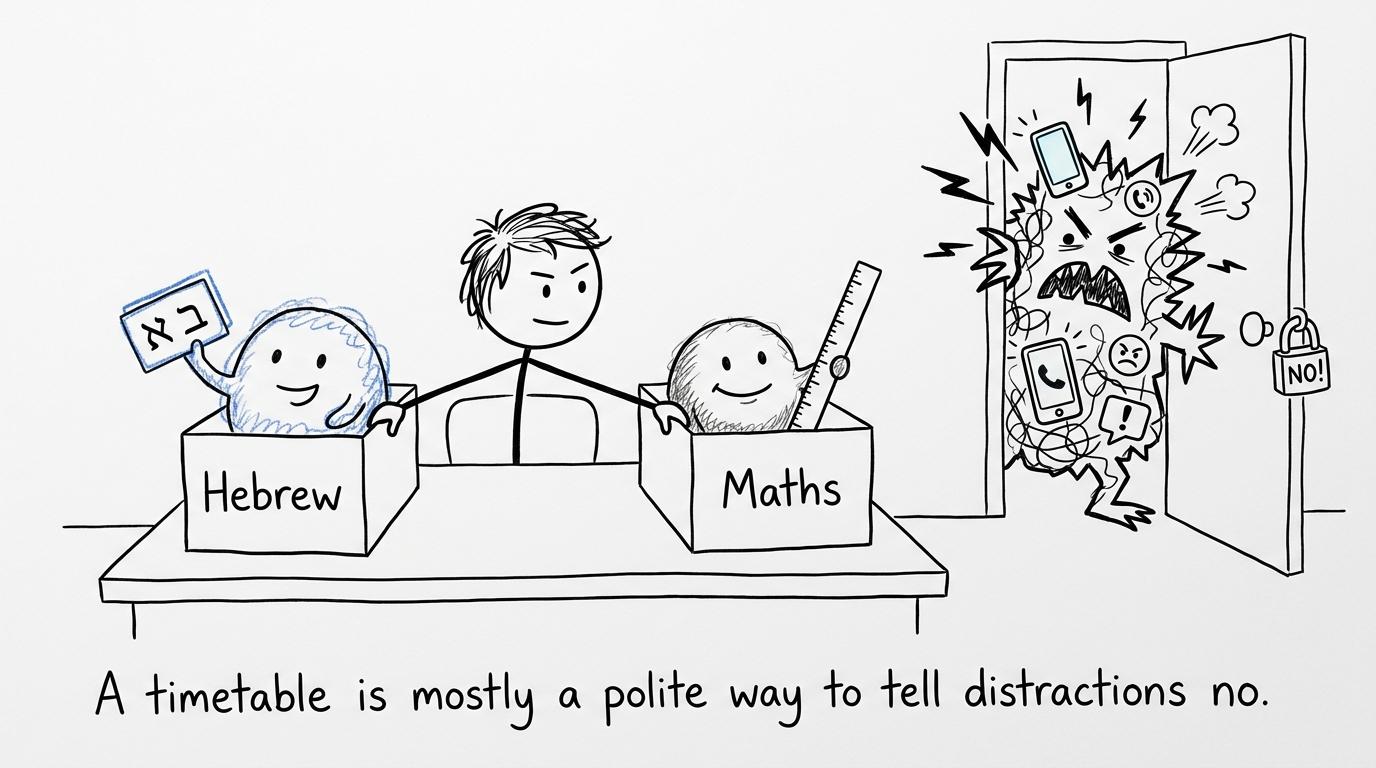 A timetable keeps Hebrew, maths and phone distractions in their proper places
Adjusting the Routine as the Exam Approaches
Early in the course, vocabulary and core grammar may occupy most sessions. As your knowledge develops, give more ten-minute blocks to unseen passages and prescribed literature. Closer to the examination, replace occasional short blocks with timed sections or full papers when your schedule allows.
A full paper cannot be compressed meaningfully into 202020 minutes. Use the daily routine to maintain knowledge and repair specific weaknesses; use separate, planned sessions for realistic paper practice. Afterwards, bring one error from the paper back into the next daily block.
Apply the same distinction to maths. A short topic session builds a method, whereas a full paper tests selection, accuracy and stamina. If you take Edexcel GCSE Maths, the Edexcel past papers and mark schemes provide structured paper practice. Students using AQA, OCR or Eduqas can select their board from the wider GCSE hub.
Common Mistakes to Avoid
Rereading instead of retrieving
A highlighted vocabulary list can feel reassuring because every word is visible. Hide the meanings and produce an answer first. Difficulty during recall is useful information, not evidence that the session has failed.
Trying to cover language and literature every day
Twenty minutes divided among too many tasks creates shallow contact with all of them. Keep the short vocabulary warm-up, then give the main block to one skill.
Confusing Biblical Hebrew with Modern Hebrew
They are different GCSE qualifications with different content and assessment. Check that every vocabulary list, paper and grammar resource is specifically for Pearson Edexcel GCSE Biblical Hebrew, qualification code 1BH01\mathrm{BH}01BH0, unless your teacher directs you otherwise.
Recording scores but not causes
A low score says that something went wrong. An error label tells you what to practise. “Missed suffixed pronoun” is actionable; “bad translation” is not.
Letting short revision become an all-nighter
The final five minutes often become another twenty, especially when an exam feels close. Set a stopping time. MathsGenie's GCSE night-before plan applies particularly to maths, but its wider lesson is valuable: focused review and sensible rest are better than an uncontrolled final-night workload.
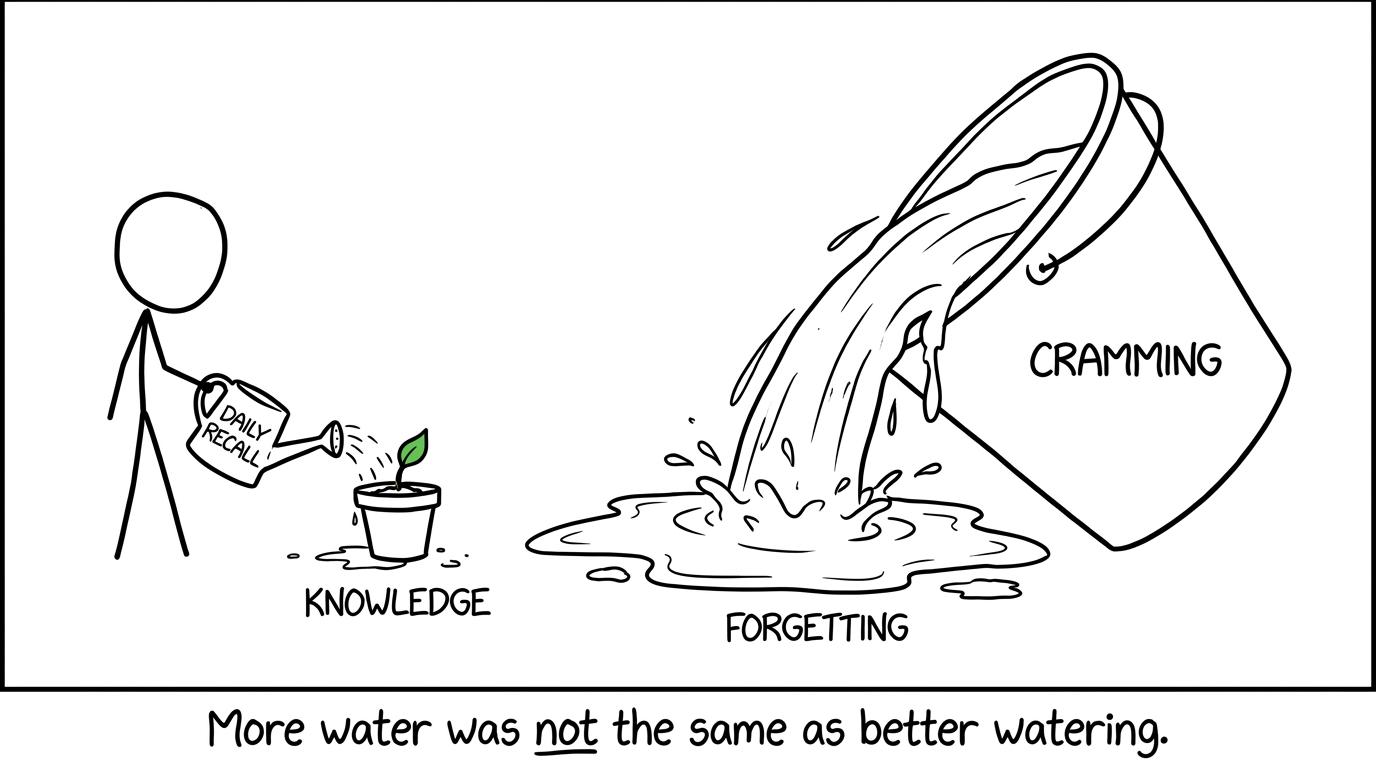 Daily recall waters the plant while cramming floods the floor
Make the Routine Easy to Repeat
Lay out tomorrow's material before ending today's session. Keep one small error log. Use the same location when possible, and decide whether Hebrew comes before or after maths according to your energy and timetable.
Most importantly, judge the routine by what you can produce without support. Can you recall the word? Can you identify the form? Can you translate accurately? Can you support a literature point from the text? Revision becomes more effective when those questions replace the vague feeling of having spent a long time at a desk.
Twenty minutes will not replace teaching, homework or timed papers. It does something quieter and often more valuable: it prevents knowledge from being repeatedly abandoned and rebuilt.
Start one Biblical Hebrew block today, then organise your maths revision through MathsGenie's free GCSE resources. Use revision lessons and practice questions to strengthen individual maths topics, mini tests to check recall, and past papers, predicted papers, mark schemes and video solutions to prepare for the examination. Two subjects can share a busy week without either one taking over the night.










