GCSE Bengali Weak Topic: How to Fix It
GCSE Bengali weak topic holding you back? Use this practical diagnose, practise, mark and retest plan to turn repeated errors into reliable exam skills.
A difficult topic can acquire a reputation. You see it in your revision notes and postpone it. It appears in a test and your confidence disappears. Soon, you are no longer dealing with a few uncertain words or one awkward task. You are dealing with a story: I always get this wrong.
The way to fix a GCSE Bengali weak topic is to make it smaller, identify the exact cause of each lost mark, practise one skill at a time and retest it without notes. Avoiding the topic protects your confidence today, but focused practice builds confidence you can use in the exam.
This guide gives you a practical repair process. Although MathsGenie specialises in free GCSE and A Level maths revision, the underlying loop is remarkably transferable: diagnose, learn, practise, mark, correct and retest.
Your weak-topic checklist
Use this process rather than simply rereading your notes:
- Confirm your qualification, specification and tier where applicable.
- Name the precise weakness, not an entire theme.
- Collect evidence from marked work or an exam-style task.
- Separate vocabulary, grammar, comprehension and exam-technique errors.
- Relearn only the missing knowledge.
- Practise using active recall rather than copying.
- Check your response against reliable marking guidance.
- Retest the skill on a different day and under time pressure.
- Keep the topic in weekly revision until it becomes dependable.
The key word is precise. “Travel is difficult” is too broad to guide a session. “I miss negative details in travel listening questions” tells you what to train.
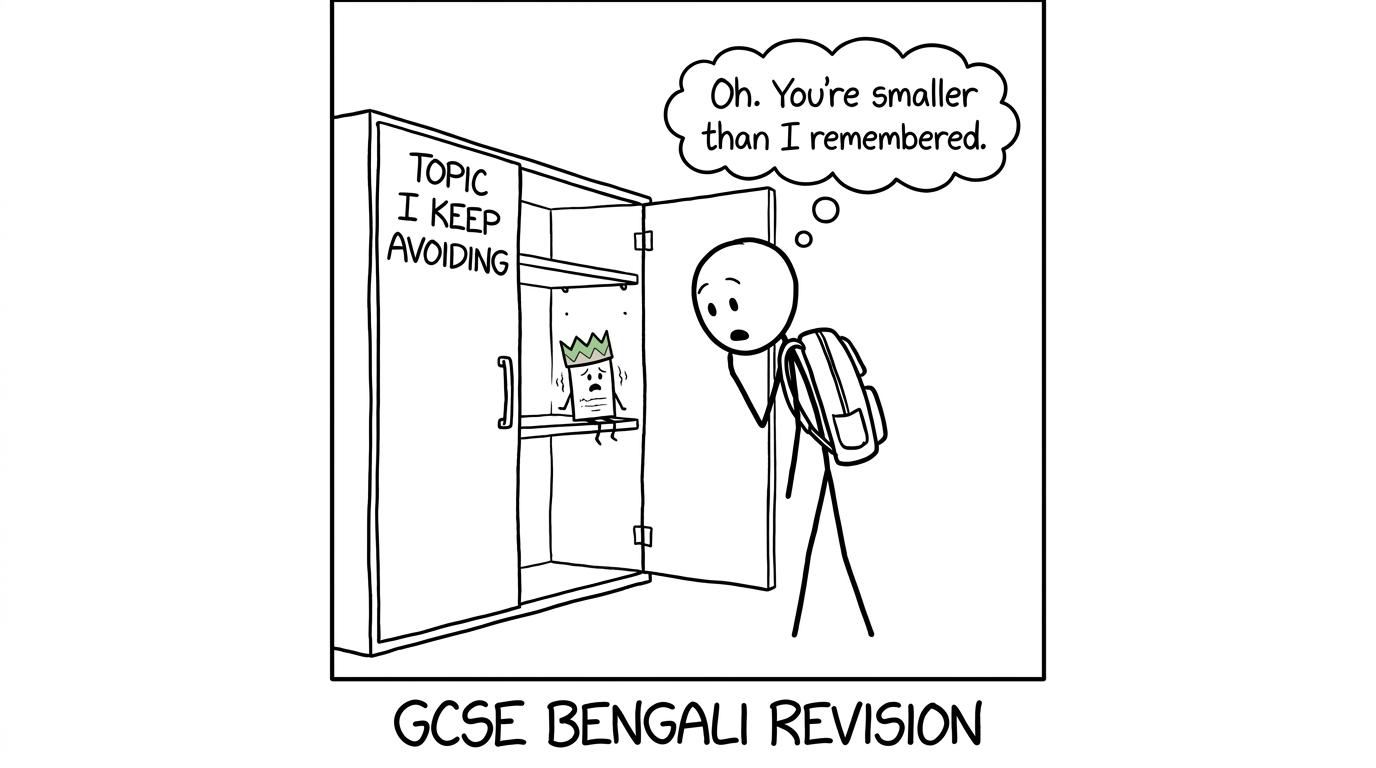 A student discovers that an avoided revision topic is smaller than expected
First, check what your GCSE Bengali course assesses
Do not assume that every Bengali qualification has the same structure. Check the specification named by your school and use materials for that qualification.
For example, the current AQA GCSE Bengali specification assesses four skills: listening, speaking, reading and writing. Each contributes approximately 25%25\%25% of the qualification. It is tiered, with Foundation targeting grades 111 to 555 and Higher targeting grades 444 to 999, and candidates take all four papers at the same tier.
Pearson Edexcel International GCSE Bangla is a different qualification with a different assessment structure. This matters because practice is only useful when it matches the task you will actually face. Your teacher, examination entry information and official specification should settle any uncertainty.
Once you know the qualification, locate the weakness in two ways:
Is it a content topic?
A content weakness concerns what you can understand or communicate. Under AQA, broad themes include identity and culture; local, national, international and global areas of interest; and current and future study and employment.
Within one theme, your gap might involve vocabulary, opinions, reasons, time frames or understanding unfamiliar language in context.
Is it an assessed skill?
Sometimes the theme is not the real problem. You may know the vocabulary for school but struggle to understand it at natural listening speed. You may speak confidently at home yet lose accuracy when writing. You may understand a passage but answer a question without enough detail.
That distinction changes your revision. More vocabulary will not automatically fix rushed reading, weak pronunciation or a failure to address every bullet point.
Replace the label with a diagnosis
“I am bad at Bengali listening” feels permanent because it contains no next action. A useful diagnosis describes something observable:
- I recognise a word on paper but not when I hear it.
- I confuse past, present and future references.
- I understand the passage but misread the question.
- I rely on familiar vocabulary and cannot infer meaning.
- I give opinions without developing them.
- I omit part of the task.
- I know an answer but cannot produce it quickly enough.
Use your latest marked task, mock or teacher feedback. For every lost mark, record the question type, what happened and what you will do differently. The same evidence-led principle sits behind MathsGenie’s guide to finding your weakest GCSE topics: weakness becomes manageable when it is measured through actual attempts rather than guessed from feelings.
If several errors share one cause, you have found your first target. Work on that before opening another full paper.
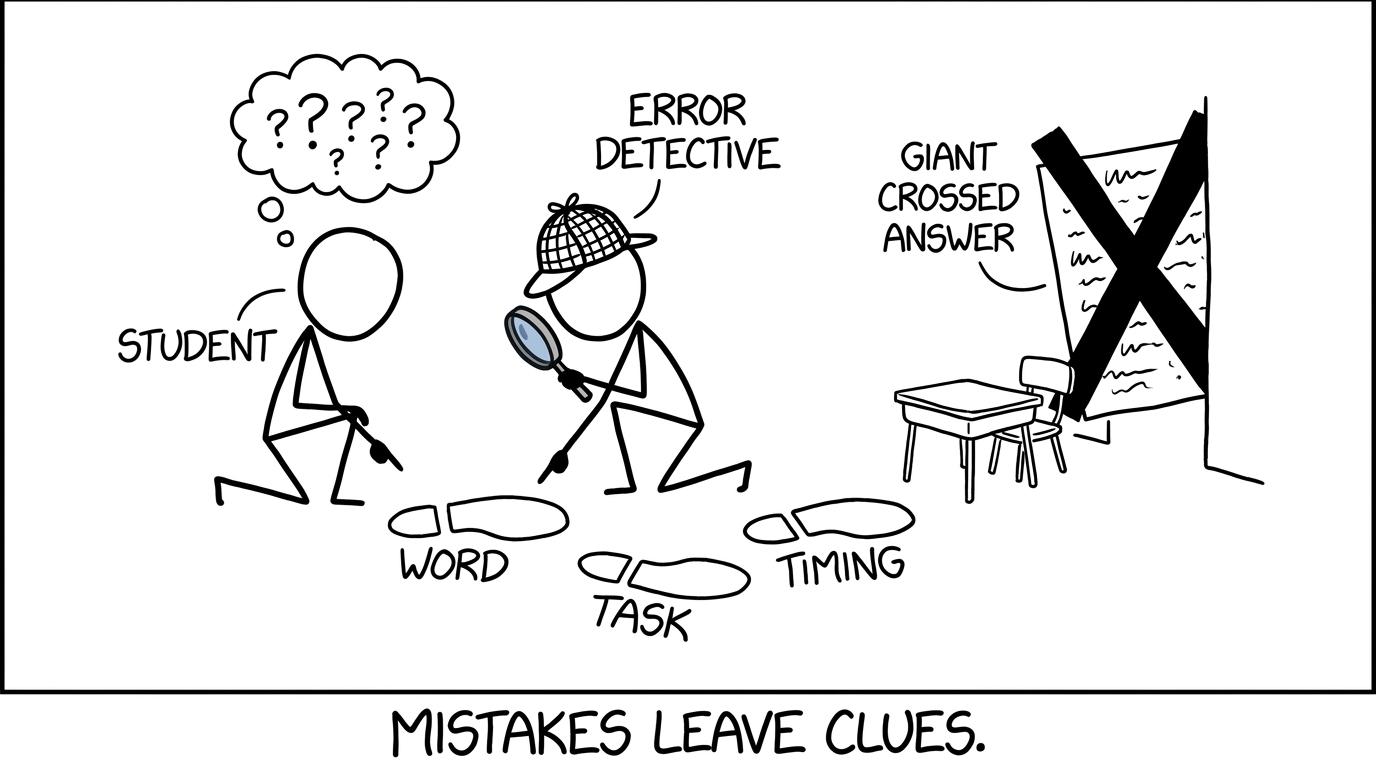 A revision detective follows the clues left by mistakes
Use a short repair cycle for your GCSE Bengali weak topic
A good repair session is narrow enough to finish. It should produce evidence that something changed.
Retrieve before reviewing
Begin with your notes closed. Try to recall the vocabulary, grammatical pattern, response structure or listening strategy that the task requires. This reveals what you can produce independently.
Only then check your class materials. Add what was missing, but avoid copying an entire page. Your correction should be short enough to recall later.
This principle also drives effective maths revision. The MathsGenie GCSE revision hub moves students from focused lessons into practice questions, because recognising an explanation is not the same as producing an answer alone.
Practise one component at a time
Break the weak area into its smallest trainable parts. A writing problem might involve understanding the prompt, selecting vocabulary, controlling time frames, connecting ideas or checking accuracy. A speaking problem might involve pronunciation, fluency, extending answers or responding spontaneously.
Train the weakest component first. Then place it back inside a complete exam-style task. This prevents you from repeating the entire task while preserving the same hidden error.
Mark immediately and specifically
Do not write only “wrong”. Classify the error:
- Knowledge: the word, structure or convention was unknown.
- Recognition: you had learnt it but did not notice it in context.
- Retrieval: you recognised it afterwards but could not produce it.
- Task: you misunderstood or incompletely answered the instruction.
- Accuracy: you knew the method but made an avoidable slip.
- Timing: pressure changed the quality of your response.
Use your teacher’s marking, the task guidance and available mark schemes. Maths students can see the same feedback habit in how to use GCSE mark schemes effectively: the useful question is not merely whether an answer was wrong, but why it failed to earn the mark.
Correct from memory
After checking, close the answer or feedback and produce the correction again. Looking at a polished response can create familiarity without retrieval. Rebuilding it yourself is the test.
Keep a one-line rule beside each repeated error. It might remind you to check every bullet point, listen for a change of opinion or leave time to review written accuracy. The rule should tell your future self what to do.
Retest until the skill survives a gap
A correct answer immediately after seeing the solution is encouraging, but it does not prove the weakness is fixed. Retest the skill later with a fresh question and no notes.
A practical pattern is:
- First attempt: diagnose the weakness.
- Short-gap retest: retrieve and practise it again after a day or two.
- Longer-gap retest: use a fresh task approximately one week later.
- Pressure test: attempt it as part of mixed, timed practice.
The dates are less important than the separation between attempts. Schedule them in your planner rather than trusting yourself to remember. MathsGenie’s guide to a GCSE revision timetable that works shows how weak topics can be revisited without allowing one subject to consume the week.
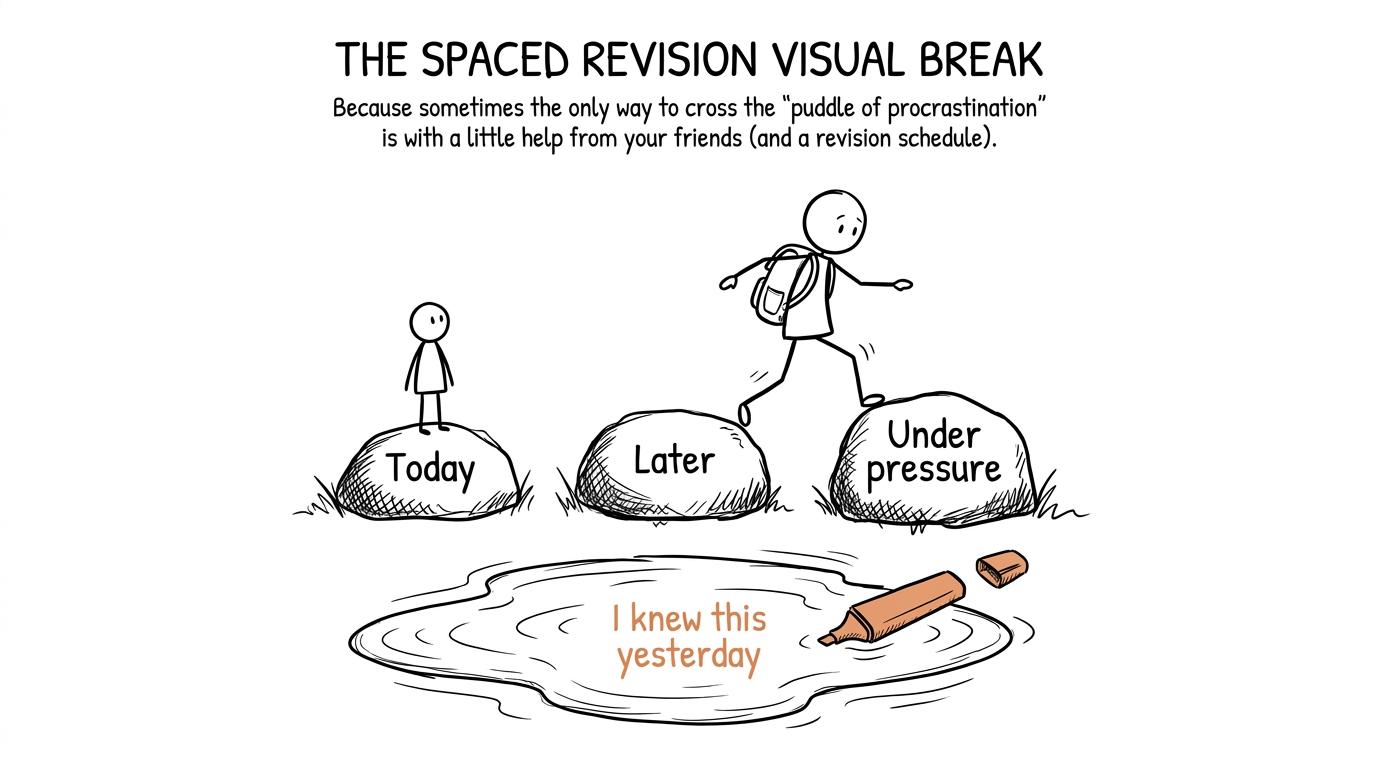 A student crosses three revision stepping stones while an abandoned highlighter floats away
Match the practice to the Bengali skill
Different assessed skills require different forms of practice.
Listening
Listen for meaning before trying to capture every word. After an attempt, identify whether the problem was unfamiliar vocabulary, sound recognition, speed, a distractor or a missed detail. Replay only after committing to an answer, then record the clue that changed your interpretation.
Speaking
Practise aloud. Silent preparation cannot test pronunciation, pace or spontaneous response. Record a short answer, listen once and choose one improvement. Avoid scripting every possible response so rigidly that an unexpected question causes you to stop.
Reading
Read the question carefully before hunting for evidence. Distinguish what the text states from what you assume. When an unknown word appears, use surrounding details, word families and the overall context before reaching for a dictionary during untimed revision.
Writing
Plan around the task requirements. Make sure every compulsory point is addressed, then check communication, range and accuracy in the way your specification rewards them. Do not use a complicated structure unless you can control it reliably.
Move from isolated practice to exam conditions
A repaired skill must eventually work inside a complete paper or assessment. First use short topic practice. Next mix the topic with stronger areas. Finally, introduce the correct timing and conditions for your qualification.
Past papers are most useful after they are marked and analysed. The MathsGenie guide on using GCSE past papers properly describes the transferable cycle: complete, mark, diagnose, relearn and retest.
Do not judge progress only by your total mark. Ask whether the particular weakness improved. If your handling of one question type becomes more accurate but another section remains difficult, the repair cycle is working. You have simply found the next target.
For students balancing Bengali with maths, a compact routine can help. The twenty-minute GCSE maths revision routine offers a useful model: choose a small goal, practise actively, mark immediately and schedule the next action.
Common mistakes when fixing a weak topic
Revising the whole theme at once
Large labels create vague sessions. Reduce the theme to one vocabulary set, response feature or question type.
Copying notes instead of retrieving
Neat notes may feel productive, but the exam requires independent recall and application. Attempt first and consult notes second.
Repeating the same material
You can memorise the order of familiar answers without becoming more flexible. Use fresh prompts when you retest.
Ignoring the reason for an error
Two incorrect answers may require different solutions. Missing knowledge needs teaching; a task-reading mistake needs a checking routine.
Using materials for the wrong qualification
GCSE Bengali and International GCSE Bangla are not interchangeable. Match resources to your awarding body, specification and tier where relevant.
Waiting until the topic feels comfortable
Confidence often arrives after several honest attempts, not before them. Begin with a small task you can finish and measure.
Turn avoidance into evidence
A topic you always get wrong is rarely one enormous weakness. More often, it is a collection of smaller gaps that have been allowed to travel together. Separate them and the story changes. One missed detail becomes a listening target. One incomplete response becomes a task checklist. One forgotten structure becomes a retrieval prompt.
Start today with one marked GCSE Bengali task. Name the exact error, practise the smallest missing skill and book a retest. Then apply the same disciplined loop across your other subjects.
For maths, make MathsGenie’s free GCSE revision resources your starting point. Use revision lessons to rebuild understanding, practice questions and video solutions to correct methods, mini tests to check recall, and past papers, predicted papers and mark schemes to prove that the improvement survives exam conditions. Weak topics stop feeling permanent when every session produces a clear next step.