

GCSE Bengali Translation Questions: What Earns Marks
GCSE Bengali translation questions reward complete meaning, accurate grammar and natural phrasing. Learn how to check and protect every available mark.
A translation can contain the right dictionary words and still lose marks. That is the uncomfortable lesson behind many GCSE Bengali translation questions. Examiners are not simply counting vocabulary matches. They are judging whether you have carried the complete message into Bengali, used grammar accurately and produced language that makes sense naturally.
For the current AQA GCSE Bengali specification, translation is assessed through two broad ideas: conveying key messages and applying grammatical knowledge of language and structures. That distinction matters. A sentence can be understandable but inaccurate, or grammatically polished while quietly omitting an important detail. Strong answers do both jobs.
The encouraging part is that translation is a process you can practise. You do not need a mysterious talent for languages. You need a reliable method for reading, transferring meaning and checking what you have written.
The short checklist examiners reward
Before exploring the detail, keep this practical checklist beside your translation practice:
- Convey every key message, not merely the general topic.
- Preserve who did what, when it happened and why.
- Choose vocabulary that fits the context.
- Keep tense and time sequence consistent.
- Use natural Bengali syntax rather than copying English word order.
- Translate idiomatic meaning rather than individual words.
- Check negatives, quantities, opinions and connecting words.
- Use accurate spelling wherever possible.
- Make the response clear enough to understand on the first reading.
These priorities apply most directly to AQA GCSE Bengali. Pearson Edexcel also offers International GCSE Bangla qualifications, but their assessment structure and mark grids are different. Always check the specification named on your entry or ask your teacher before using a particular paper.
What GCSE Bengali translation questions actually assess
In AQA GCSE Bengali, students translate from English into Bengali in the writing assessment. The task requires at least 505050 words and is used at both Foundation and Higher tier. The response is considered across the five sentences as a whole.
There are 555 marks for conveying key messages and 555 marks for applying knowledge of vocabulary and grammatical structures. At the top of the communication grid, all key messages are conveyed. At the top of the language grid, vocabulary and structures are handled very well and with high accuracy.
This means an examiner is effectively asking two separate questions:
- Has the student transferred the required information?
- How successfully has the student used Bengali to do it?
A mark of zero for conveying key messages also produces zero for the application of grammatical knowledge. Otherwise, the two judgements are not automatically tied together. You therefore need to protect both meaning and language.
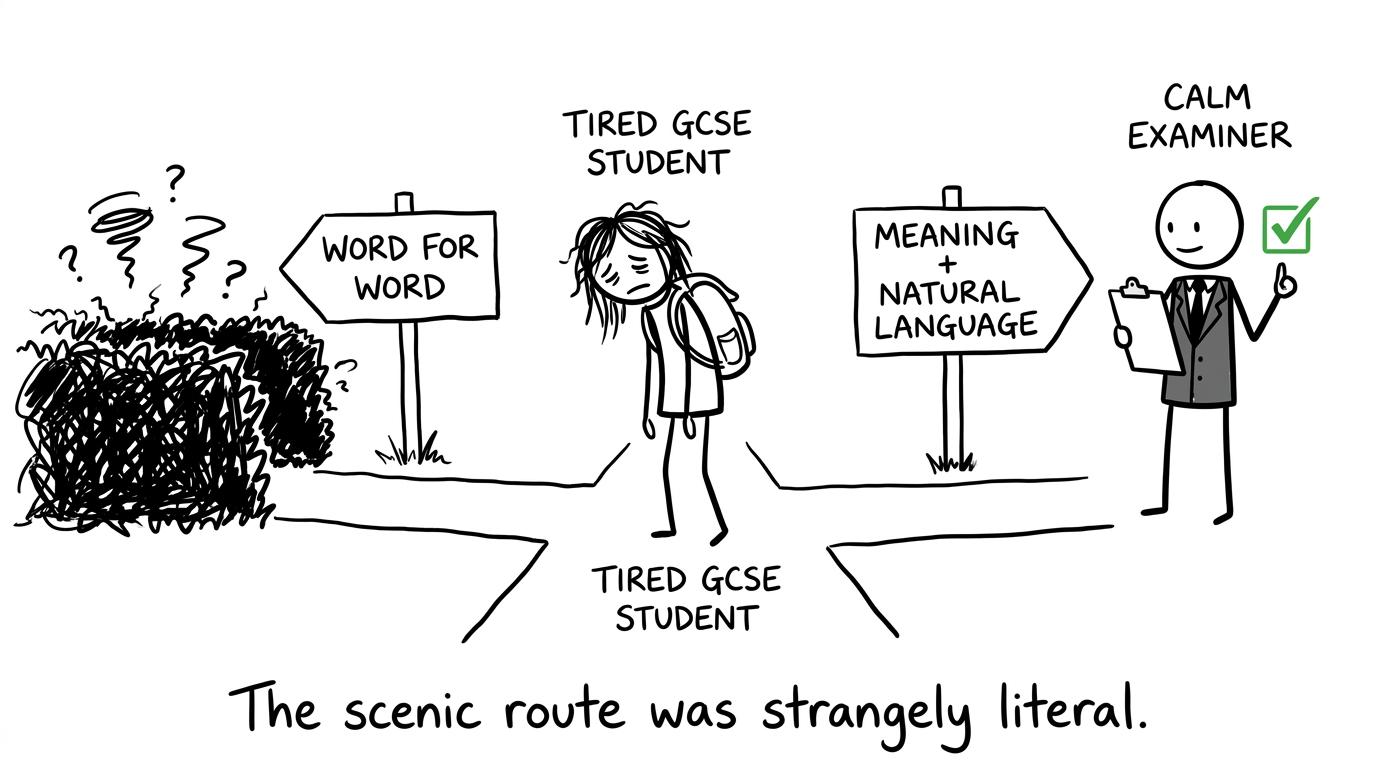 A student chooses between literal translation and meaningful natural language
Complete meaning matters more than matching every word
Word-for-word translation feels safe because it gives you something mechanical to do. Yet languages do not arrange ideas in identical ways. Literal translation can create awkward phrasing, the wrong emphasis or even a different meaning.
A strong answer first identifies the message unit. That unit might include:
- a person or group;
- an action or state;
- a time reference;
- a negative or qualifying word;
- an opinion, reason or contrast;
- an important object, place or quantity.
Leaving out one small component can alter the whole statement. Words such as “not”, “although”, “usually”, “before” and “because” carry more assessment value than their size suggests. Examiners reward what reaches the target language, not what you understood silently but failed to write.
Before translating, read the complete set of sentences. Context may reveal whether a word is being used literally, whether the register should be formal and how pronouns relate to earlier information.
Natural Bengali separates strong answers from literal ones
Accuracy does not mean preserving English word order. It means preserving meaning through appropriate Bengali.
A stronger translation sounds as though the idea belongs in Bengali. This involves selecting a suitable register, arranging words naturally and choosing expressions that fit the situation. If an English phrase has no sensible direct equivalent, communicate its intended meaning with an appropriate Bengali expression instead.
This is especially important with idiom, nuance and tone. The reader should receive the same impression as the reader of the original sentence. A formal request should not become casual. A firm negative should not become uncertainty. An opinion should not be rewritten as a fact.
There is no reward for making the sentence artificially complicated. Ambitious vocabulary only helps when it is accurate and contextually appropriate. A clear, controlled sentence is usually stronger than an elaborate one containing uncertain structures.
Grammar carries hidden parts of the message
Grammar is not decoration added after meaning. It often carries the meaning itself.
Tense and time sequence
Look for every time marker before writing. A sentence may refer to a completed past action, a present habit or a future intention. If the time reference changes during translation, the key message may change with it.
Read the finished response as a sequence. If several sentences form a short narrative, their tenses should relate logically to one another.
Subject, pronoun and verb relationships
The examiner must be able to tell who performs each action. Check that pronouns remain clear and that verb forms match the intended subject and level of formality.
This becomes particularly important where English repeatedly uses the same pronoun but Bengali requires choices shaped by respect, familiarity or context. Consistency helps the passage feel coherent.
Negatives and qualifying language
A missing negative reverses meaning. A missing qualifier can turn “sometimes” into “always” or a possibility into a certainty. Circle or underline these high-risk words while reading the question, if your exam conditions permit annotations on the paper.
Sentence connections
Conjunctions explain the relationship between ideas. Contrast, cause, sequence and condition should survive the translation. Without them, individual clauses may be accurate while the overall message becomes misleading.
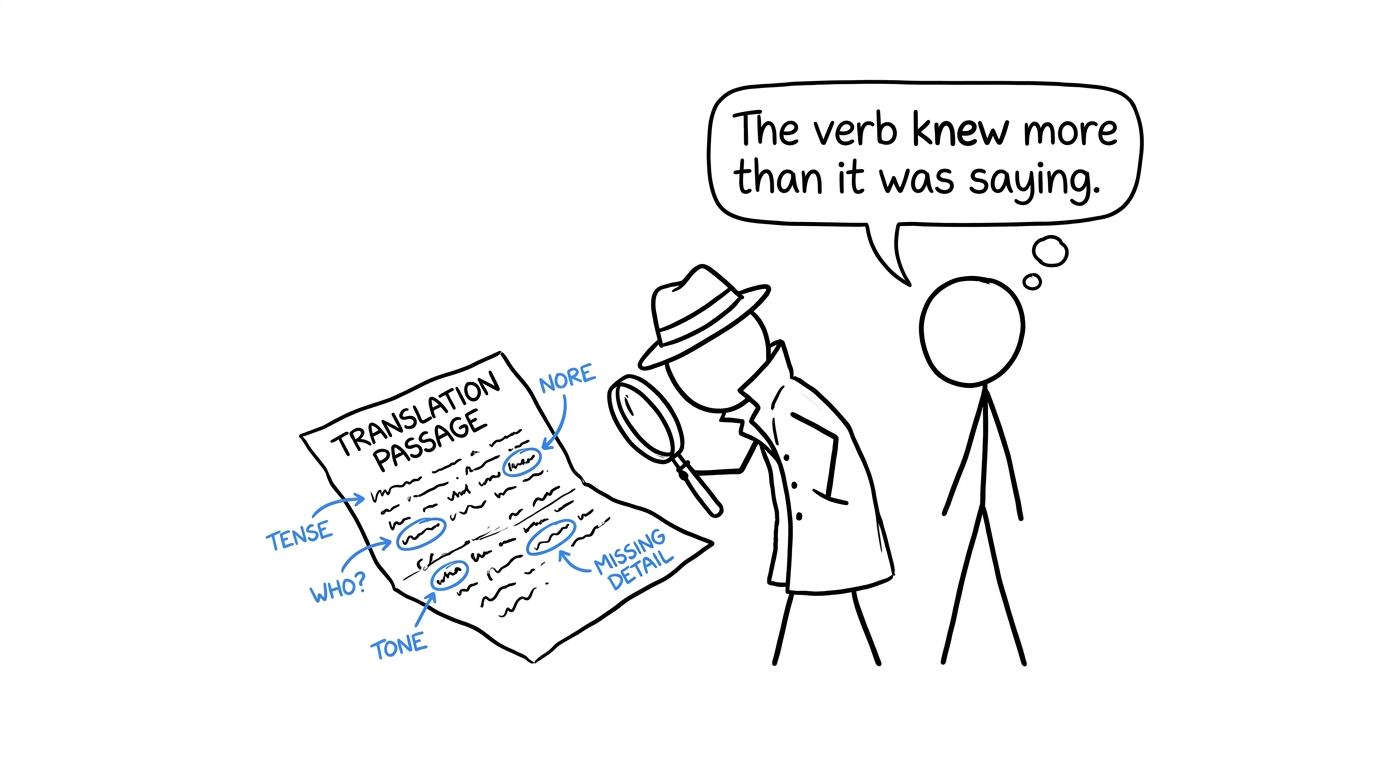 A student detective searches a passage for tense, tone and missing details
Spelling matters most when it changes meaning
Correct spelling supports accuracy and makes a response easier to read. However, not every slip has the same consequence. A minor error that leaves the intended word unmistakable is less damaging than a spelling choice that creates another word or forces the reader to guess.
This suggests a sensible checking order. Correct errors that threaten communication first:
- words whose spelling could produce a different meaning;
- verbs carrying tense or subject information;
- negatives;
- key topic vocabulary;
- repeated misspellings that make the passage difficult to follow.
Then use any remaining time to polish smaller details. Examiners award marks positively, but they cannot credit a message they cannot identify with confidence.
A reliable three-pass translation method
Good exam technique reduces the number of decisions you must make under pressure.
Pass one: map the message
Read all five sentences before translating. Mark the subject, main verb, tense, negative, time phrase and any logical connector. Identify words whose meaning depends on context.
Do not begin with the first familiar noun and improvise from there. Understand the whole sentence first.
Pass two: translate in meaningful chunks
Build each sentence around its message rather than replacing one English word at a time. If you cannot recall a perfect equivalent, use accurate Bengali you control to express the idea. Sensible rephrasing is safer than an invented word or an English expression forced into Bengali syntax.
Keep moving. A blank conveys nothing, while a clear paraphrase may preserve the key message.
Pass three: compare source and response
Read the English sentence and then your Bengali response. Ask:
- Is every person, action and object present?
- Is the time reference unchanged?
- Have I preserved negatives and quantities?
- Is the tone appropriate?
- Does the Bengali read naturally?
- Could a spelling error change the meaning?
This source-to-response comparison is more useful than proofreading only the Bengali, because it exposes omissions.
How to practise translation efficiently
Translation improves fastest when practice produces specific feedback. Use official past questions and mark schemes supplied by your school or exam board, then classify each lost mark. Was the problem missing meaning, vocabulary, grammar, spelling or unnatural phrasing?
Keep a short error log. Record the phrase or structure you mishandled, the reason and the correction. Reattempt the same material later without looking at your first answer. Recognition feels comfortable; retrieval builds exam performance.
The same feedback loop is central to effective maths revision. MathsGenie’s guide to using GCSE past papers at the right stage explains why a paper becomes useful only when its mistakes shape your next practice. Its advice on using Edexcel GCSE Maths past papers properly shows the same mark, diagnose, repair and retest cycle.
A balanced weekly routine might include short vocabulary retrieval, one untimed translation for accuracy and one timed task for independence. Do not judge progress from a single attempt. Look for repeated errors becoming less frequent.
Common mistakes that weaken translation answers
Translating before reading the whole sentence
This often produces the wrong meaning for an ambiguous word. Read for context first, then commit to vocabulary.
Following English word order too closely
The individual words may be recognisable while the sentence remains awkward or unclear. Rebuild the idea using natural Bengali structure.
Omitting small but important words
Negatives, time phrases, quantities and connectors are easy to overlook. Mark them during the planning pass and verify them afterwards.
Guessing impressive vocabulary
An uncertain sophisticated word can damage meaning. Prefer accurate vocabulary and structures that you can control.
Changing the level of formality
Pronouns, verb forms and phrasing should suit the relationship and situation suggested by the source.
Checking only spelling
A beautifully spelled response can still miss a key message or use the wrong tense. Check meaning first, grammar second and surface details third.
Treating the mark scheme as a score only
A mark tells you where you finished. The descriptors tell you what to improve. Compare your response with the language of the assessment grid and identify one precise next action.
Build an exam routine that transfers across subjects
Although MathsGenie specialises in free GCSE and A Level maths revision, its most useful habits travel well: retrieve knowledge, answer under exam conditions, mark honestly and repair weaknesses.
Start with the GCSE Maths revision hub for board-specific lessons, practice questions, past papers and solutions. The GCSE topics by exam board and tier guide can help you organise Edexcel, AQA, OCR or Eduqas maths revision without confusing specifications.
When examinations approach, use predicted topics and papers carefully: as fresh assessment, not as a substitute for learning. If time is short, the GCSE night-before revision plan offers a calmer model than trying to relearn an entire course at once.
Meaning first, then control
The strongest GCSE Bengali translation answers are not mechanical copies. They transmit every important idea, preserve tense and tone, use contextually suitable vocabulary and read naturally in Bengali. Accuracy remains essential, but accuracy belongs to the complete message rather than to isolated words.
Use three passes: map the meaning, translate in chunks and compare both versions. Then learn from every omission or language error you find.
For your maths preparation, make MathsGenie your free revision base. Use its revision lessons and practice questions to strengthen individual topics, mini tests to check recall, and past papers, predicted papers, mark schemes and video solutions to turn weaknesses into a clear next step. Good revision in any subject has the same quiet rhythm: attempt, inspect, correct and return.










