

Is GCSE Bengali Similar to GCSE Panjabi?
GCSE Bengali similar to GCSE Panjabi? Compare the languages, scripts, AQA assessments and revision demands before deciding whether to take both.
A subject can feel familiar without being easy. That distinction matters when you are choosing another GCSE alongside maths, English and everything else competing for revision time.
So, is GCSE Bengali similar to GCSE Panjabi? The short answer is: the qualifications are highly similar in structure, themes and exam technique, but the languages themselves are substantially different. Experience of GCSE Bengali may give you confidence with language learning and the AQA assessment format. It does not automatically give you the Panjabi vocabulary, grammar, pronunciation or script needed for the exam.
Trying GCSE Panjabi can make sense if you already speak, hear, read or write some Panjabi and have access to suitable teaching. It is much less sensible to choose it simply because you enjoyed Bengali.
The decision checklist
Before committing, ask yourself:
- Can I already understand everyday spoken Panjabi?
- Can I read and write Gurmukhi, or am I prepared to learn it securely?
- Does my school or an approved centre offer the AQA qualification?
- Is a teacher able to assess and develop my speaking?
- Can I fit another subject around GCSE maths revision and my other commitments?
- Have I looked at an actual Panjabi paper rather than judging from the subject name?
The strongest reason to take Panjabi is genuine ability or sustained interest in Panjabi. Familiarity with Bengali is useful background, but it should be treated as a supporting advantage rather than a shortcut.
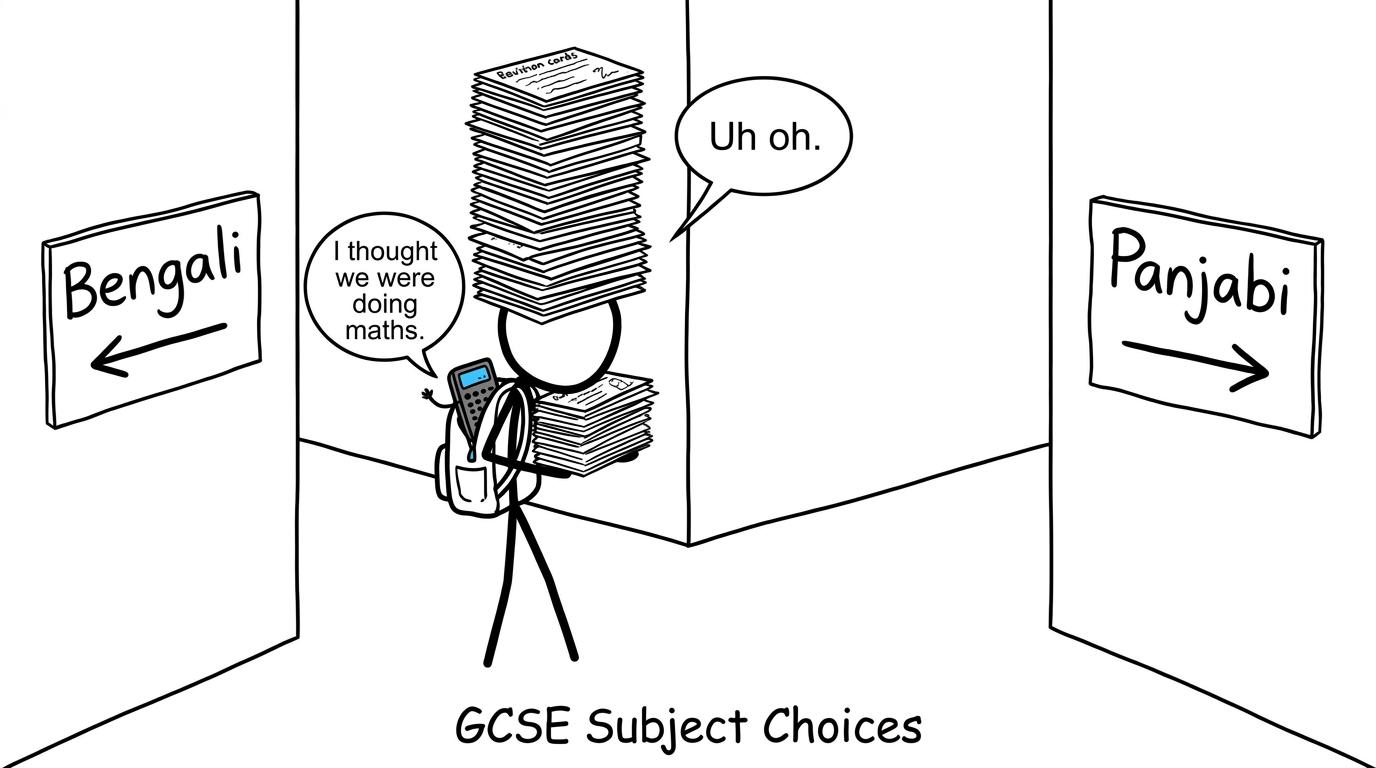 A student choosing between Bengali and Panjabi while a calculator wonders what happened to maths revision
How much genuine overlap is there?
There are two different kinds of overlap to consider: linguistic overlap and qualification overlap. Students often combine them, which can make the decision look simpler than it really is.
The languages share a broad family, not an exam-ready toolkit
Bengali and Panjabi are both Indo-Aryan languages. That means there are distant historical relationships and some broad grammatical or vocabulary connections. Students familiar with South Asian languages may occasionally notice recognisable patterns or words.
But broad linguistic ancestry does not make the languages interchangeable. Modern Bengali and Panjabi have distinct sound systems, everyday vocabulary, grammatical conventions and literary traditions. Knowing how to express an opinion in Bengali does not mean you can produce the equivalent Panjabi sentence accurately.
They also use different writing systems in these GCSEs. Bengali uses the Bengali script, while AQA GCSE Panjabi expects students to work with Gurmukhi. Reading fluency in one therefore does not provide reading fluency in the other.
A useful comparison is learning two different mathematical topics. Being organised and confident when revising algebra helps when you approach geometry, but it does not supply the missing angle facts. The transferable habits matter. The subject knowledge still has to be learnt.
The qualifications have very close structures
The current AQA GCSE Bengali and AQA GCSE Panjabi specifications follow the same broad modern foreign language model. Both are linear qualifications with four assessed skills:
| Assessment area | Weighting |
|---|---|
| Listening | 25%25\%25% |
| Speaking | 25%25\%25% |
| Reading | 25%25\%25% |
| Writing | 25%25\%25% |
Both offer foundation tier, covering grades 1-5, and higher tier, covering grades 4-9. In each subject, students take all four assessments at the same tier and in the same exam series.
That creates meaningful overlap in exam technique. A Bengali student may already understand how to prepare for role-play, respond to a photo card, sustain a general conversation, extract details from a listening passage and approach translation tasks. Those routines can reduce the unfamiliarity of Panjabi assessment.
However, exam familiarity only helps if the underlying Panjabi is strong enough. Knowing what a translation question wants is different from knowing the words and structures needed to answer it.
The topics will feel familiar
Both AQA specifications organise content around the same three broad themes:
- identity and culture;
- local, national, international and global areas of interest;
- current and future study and employment.
Within them, students encounter familiar GCSE language topics such as family, friendships, technology, free time, customs, home, travel, social issues, education and careers.
This is genuine overlap. If you have revised how to develop opinions about school life in Bengali, you already understand the intellectual task involved. You know that a strong answer usually moves beyond naming a preference and gives reasons, details and different time frames where appropriate.
What does not transfer automatically is the language used to do it. Your Panjabi vocabulary must be accurate, your spoken responses must be intelligible, and your writing must satisfy the demands of the Panjabi paper.
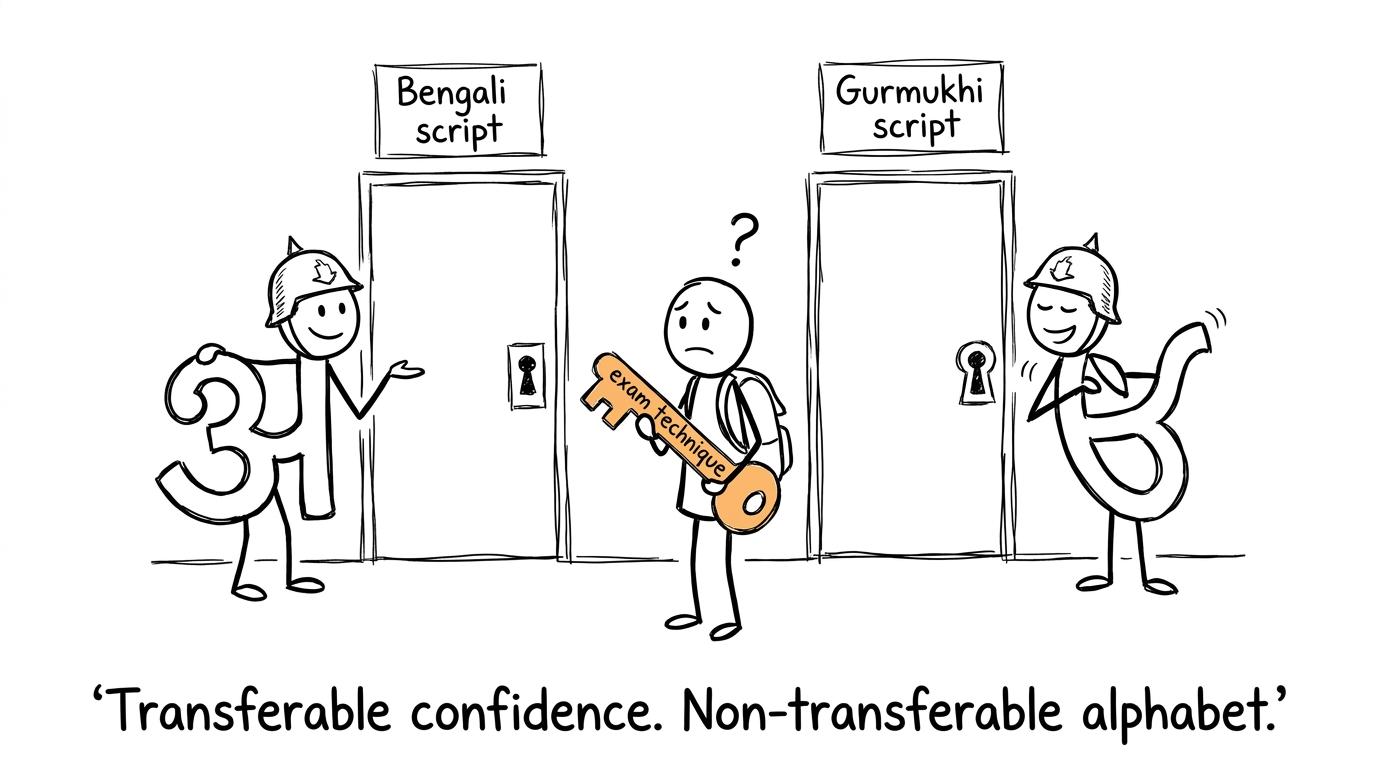 Two different script doors demonstrate that confidence transfers more readily than an alphabet
What Bengali experience can transfer
Enjoying Bengali can still be valuable evidence. It may show that you like communicating, exploring culture and building accuracy over time. Several practical skills can carry across.
You understand language revision
You may already know how to use vocabulary retrieval, listening practice and repeated speaking. You have probably discovered that recognising a word in a list is not the same as retrieving it under exam pressure.
That lesson applies equally to Panjabi and maths: familiarity can feel like mastery until a blank page asks you to produce an answer unaided.
You recognise the assessment rhythm
The progression from short responses to extended communication will not be entirely new. You may also be more comfortable with translation, timed listening and responding spontaneously during a speaking assessment.
You may have relevant cultural awareness
Experience of discussing family, community, celebrations, food and education through one language can help you approach similar themes thoughtfully in another. But avoid assuming that Bengali-speaking and Panjabi-speaking communities are culturally identical. Each specification expects engagement with the communities associated with its own language.
You have evidence about your motivation
Perhaps the most important transfer is self-knowledge. If you enjoyed the repeated practice required for Bengali, another language GCSE may suit you. If you enjoyed only the parts you already knew from home, beginning a less familiar language could feel very different.
When taking GCSE Panjabi is a sensible choice
Panjabi is worth serious consideration if you can already hold everyday conversations, understand speech from more than one familiar speaker and read Gurmukhi with reasonable fluency. Existing home or community exposure can provide a useful foundation, although informal fluency still needs to be adapted to formal assessment.
You also need practical confirmation from your school or exam centre. AQA is the accredited board offering these GCSE specifications, but a qualification appearing on an exam board website does not mean every school teaches it or accepts private entries. Check teaching, speaking-assessment arrangements, entry deadlines and tier decisions directly with your centre.
Ask to see current specification materials and sample or past assessment resources before deciding. Your teacher can help judge whether your reading, writing, listening and speaking are balanced enough for foundation or higher tier.
When it may add too much pressure
A second language GCSE becomes risky when enthusiasm is doing the work that prior knowledge needs to do. Starting a new script, building a large vocabulary and preparing four assessed skills require sustained time.
That time has an opportunity cost. If maths is already one of your weaker subjects, adding Panjabi should not leave you repeatedly postponing core practice. Use the MathsGenie guide to finding your weakest GCSE topics to assess the situation honestly.
A balanced week might contain separate blocks for Panjabi vocabulary, speaking and writing alongside protected maths sessions. For maths, Edexcel GCSE mini tests are useful because they provide focused practice without consuming an entire evening.
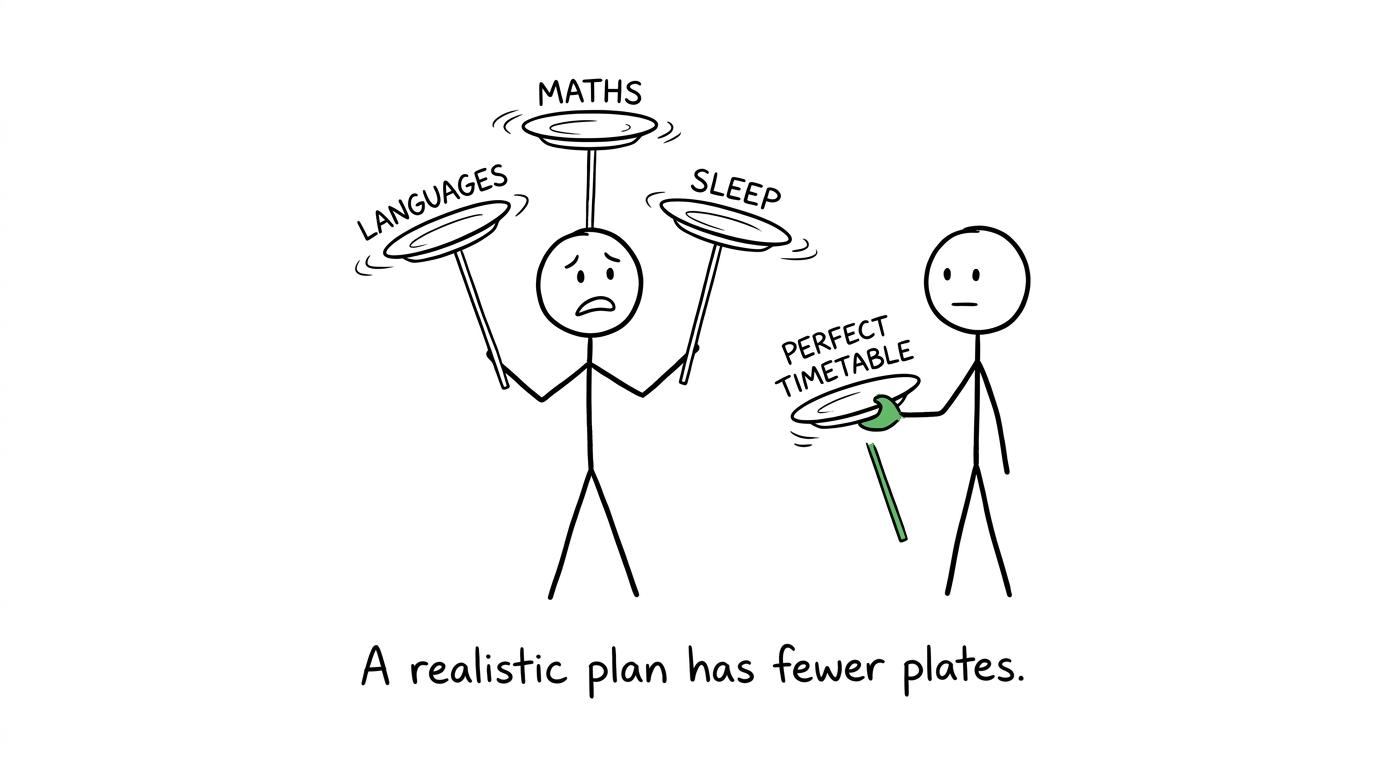 A student balances Languages, Maths and Sleep while abandoning the idea of a perfect timetable
Test the decision before committing
Run a short, realistic trial rather than relying on enthusiasm alone.
First, inspect the Panjabi specification and assessment materials with a teacher. Try representative listening, reading and writing tasks at the appropriate tier. Arrange an informal speaking assessment if possible. The purpose is diagnosis, not proving that you are already exam-ready.
Then record what requires improvement under four headings: vocabulary, grammar, script and exam technique. If most difficulties concern exam technique, your Bengali experience may provide a strong platform. If every task is blocked by basic Panjabi comprehension or Gurmukhi reading, the learning commitment will be much larger.
Apply the same evidence-based approach to maths. The GCSE one-month maths revision plan can help you judge whether another subject fits your timetable. You can also use GCSE predicted papers to check whether your current maths preparation remains on track.
Common mistakes when comparing Bengali and Panjabi
Assuming similar exam papers mean similar languages
The assessment structure is closely aligned, but the language knowledge is not. Treat the shared format as an exam-technique advantage, not evidence of mutual fluency.
Underestimating the script difference
Reading Bengali script does not mean you can read Gurmukhi. Script fluency affects reading speed, writing accuracy and your ability to revise independently.
Focusing only on speaking
A student may communicate comfortably at home yet struggle with formal reading or extended writing. All four skills contribute equally to the final qualification, so spoken confidence alone is not enough.
Choosing a tier without evidence
Foundation and higher tier differ in demand, timing and available grades. Discuss the decision with your teacher after completing suitable assessment tasks rather than choosing higher automatically.
Letting another GCSE crowd out maths
Ambition needs structure. If adding Panjabi causes your maths practice to disappear, reconsider the timetable. The best order for learning GCSE maths topics provides a clear route through number, algebra, geometry, statistics and exam technique.
The honest conclusion
GCSE Bengali and GCSE Panjabi are similar as qualifications but not close substitutes as languages. The four skills, topic themes, tier system and many assessment habits overlap strongly. The scripts, vocabulary, pronunciation and detailed grammar require separate learning.
Try Panjabi if you have real language exposure, access to appropriate teaching and enough time to prepare every assessed skill. Do not take it solely because Bengali went well. A good GCSE choice rests on evidence: what you can do now, what you need to learn and what your timetable can carry.
Keep maths protected while you decide. Start with MathsGenie's free GCSE and A Level maths revision resources, diagnose gaps through GCSE mini tests, and build exam confidence with revision lessons, practice questions, mark schemes, video solutions, past papers and predicted papers. The aim is not to collect the most subjects. It is to prepare properly for the subjects you choose.










