GCSE Bengali Revision Timetable: Is It Worth It?
GCSE Bengali revision timetable worth it? Learn when a written plan helps, when flexible revision works better and how to balance Bengali with maths.

There is a particular kind of revision that feels productive without requiring much revision at all: drawing boxes, choosing colours and planning every evening until the exams. The page looks organised. The difficult work remains untouched.
So, is a GCSE Bengali revision timetable worth it? Usually, yes, but only if it is short, flexible and built around specific tasks. A timetable cannot improve your grade by itself. Its value is that it reduces daily decisions, spreads practice across the weeks and protects time for Bengali alongside demanding subjects such as GCSE maths.
If a detailed schedule makes you anxious or collapses whenever life changes, flexible revision can work just as well. You still need a plan, but it can be a weekly priority list rather than a rigid hour-by-hour calendar.
The quick answer: which approach should you choose?
Use a written timetable if you:
- keep postponing Bengali because other subjects feel more urgent;
- forget to practise listening or speaking;
- revise only the topics you already enjoy;
- have several GCSE subjects competing for the same evenings;
- work better when the next task has already been chosen.
Choose a flexible weekly plan if you:
- have changing family, school or work commitments;
- become discouraged after missing one scheduled session;
- can reliably choose and complete your most useful task;
- prefer working from priorities rather than fixed times.
In either case, the essential cycle is the same: plan, practise, check, adjust. Educational evidence on metacognition and self-regulated learning supports helping pupils plan, monitor and evaluate their learning. It does not show that an attractive calendar alone produces better results.
Maths students can apply the same principle through the GCSE maths revision timetable guide, which turns broad intentions into lessons, questions and marked practice.
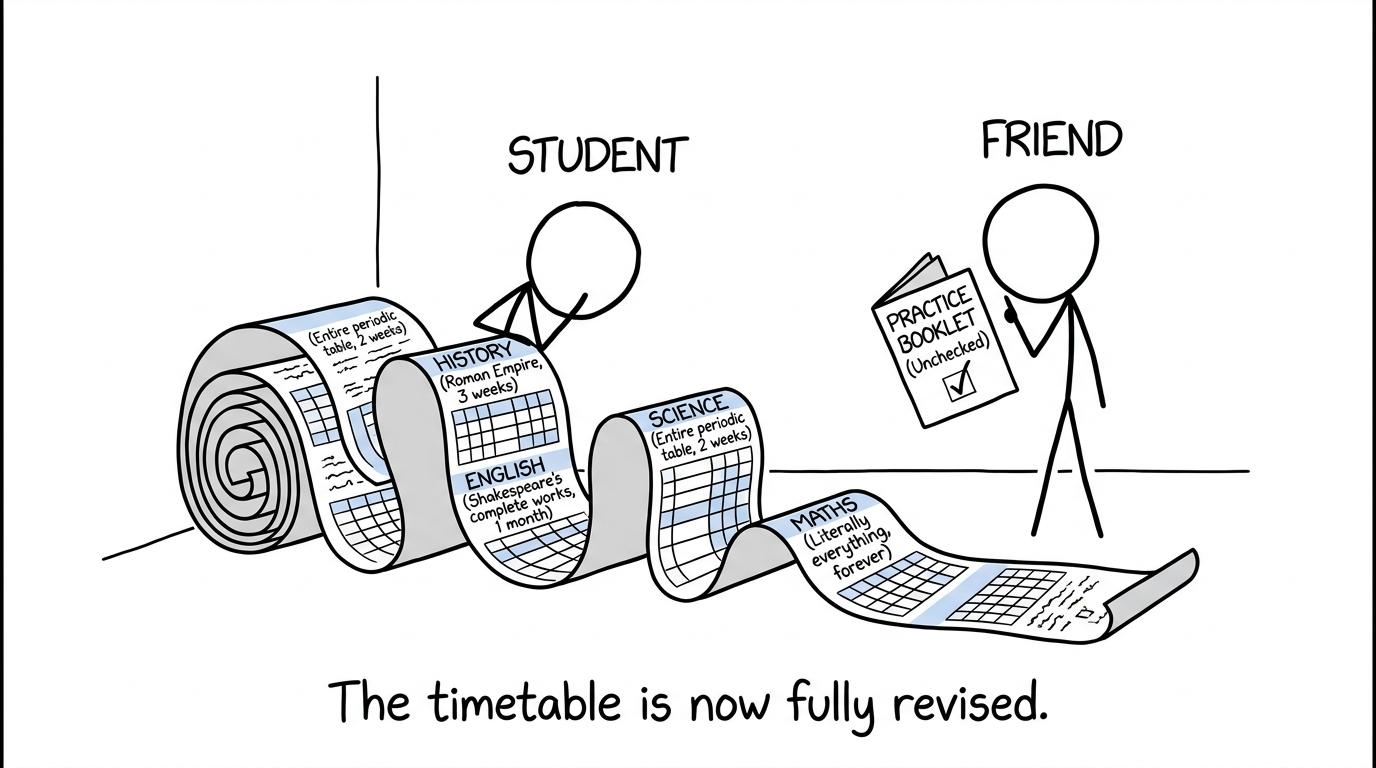 A student admiring an enormous revision timetable while the practice booklet waits
What your Bengali timetable actually needs to cover
Before assigning times, check your own exam board and qualification. Do not assume that a friend's course has the same assessment structure.
For the current AQA GCSE Bengali specification, students are assessed in four skills: listening, speaking, reading and writing. Each contributes 25%25\%25% of the qualification. It is a linear GCSE, so the assessments are completed in the same exam series, and students take either foundation or higher tier across all papers.
That structure matters. A timetable filled with vocabulary copying and reading may feel busy while leaving half the assessment neglected. Your plan should include:
- Listening: understanding spoken Bengali and identifying precise details;
- Speaking: role-play, photo-card preparation and conversation practice;
- Reading: comprehension, inference and translation into English;
- Writing: accurate language, relevant responses and translation into Bengali;
- Vocabulary and grammar: supporting all four assessed skills;
- Feedback: checking errors and deciding what to revisit.
A student taking an International GCSE may face a different format. Confirm the specification, tier, assessment components and official materials with your teacher before building the plan.
Why a written timetable can change revision outcomes
A timetable helps indirectly. It changes the conditions in which useful work is more likely to happen.
It removes the daily negotiation
Without a plan, every evening begins with a question: what should I revise? That small choice can become ten minutes of browsing, followed by the easiest available task. A timetable answers the question in advance.
The best entries are concrete. “Revise Bengali” is vague. “Complete one listening section, mark it and record unfamiliar vocabulary” tells you when the session is finished.
This is equally important in maths. “Do algebra” leaves too much room for avoidance. Opening the MathsGenie GCSE maths revision hub, selecting one weak topic, completing its practice questions and checking the solutions creates a visible outcome.
It makes spacing more likely
Bengali depends on knowledge and skills that need repeated retrieval. One long monthly session gives you fewer opportunities to recall vocabulary, form accurate sentences or respond aloud than several shorter encounters spread across the month.
A timetable can deliberately return you to the same area. You might retrieve vocabulary in one session, use it in speaking later and meet it again in a reading task. The schedule is not the learning technique. It simply creates room for the technique.
For maths, the same idea means returning to weak methods after the first correction. The MathsGenie active-recall guide explains why recalling and applying a method is more revealing than repeatedly reading notes.
It prevents one subject consuming the week
Students often allocate time according to emotion. The approaching test gets everything. The subject that feels uncomfortable gets delayed. Maths can quietly consume every revision evening because its syllabus feels large, while Bengali becomes a weekend promise that rarely happens.
A weekly plan makes that imbalance visible. It protects regular Bengali contact while still giving maths enough time for topic practice and exam papers. Fair does not mean equal: a weak subject or an earlier assessment may need more sessions. The important point is that the decision is deliberate.
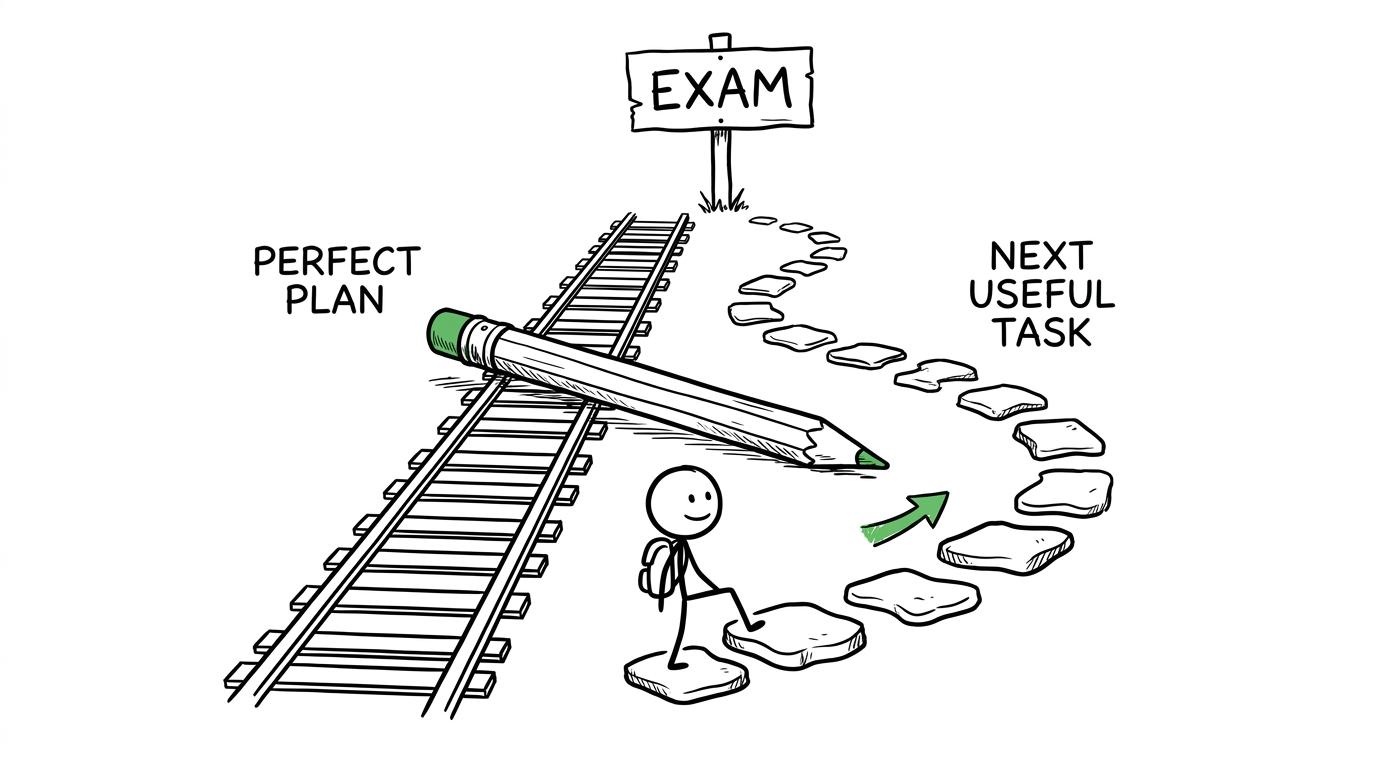 A flexible stepping-stone revision path going around a blocked perfect plan
When flexible revision works just as well
A rigid timetable is not automatically superior. If you spend Sunday assigning every half-hour and abandon the plan after one disrupted Tuesday, the timetable has become another source of failure.
Flexible revision works when it still contains three forms of structure:
- a short list of weekly outcomes;
- a rule for choosing the next task;
- a record of what was completed and what needs attention.
For example, your weekly Bengali priorities might be one listening task, two short speaking practices, one reading section and one marked writing response. You choose the exact day according to workload and energy, but everything must be reviewed by the end of the week.
This is not improvisation. It is structured flexibility.
A useful rule is to choose the task with the nearest deadline or greatest weakness, then select a version that fits the time available. A short evening might hold vocabulary retrieval or speaking practice. A quieter weekend can hold timed reading or writing.
Maths can follow the same system. Use a mini test when time is limited, targeted questions when a weakness is known and a full paper when you need exam stamina. The guide on when to start GCSE past papers explains how paper practice can develop gradually rather than arriving all at once.
How to build a timetable you will actually follow
Start with assessments, not colours
Write down your confirmed exam board, tier, assessment components and dates supplied by your school. Add mock exams, speaking assessments and other fixed commitments. Bengali speaking may require preparation before the main written papers, so do not organise everything around the final exam alone.
Diagnose before allocating time
Use teacher feedback, marked work and appropriate assessment materials to identify where marks are being lost. Separate weaknesses by skill. “Bengali” is too broad; “understanding details in listening” or “accuracy in extended writing” is useful.
Do the same for maths by using short tests or a paper from the correct board and tier. If you take Edexcel, the Edexcel GCSE maths past papers include official mark schemes and worked solutions where available. The result should determine your next topic rather than merely becoming a score.
Plan outputs rather than hours
Time matters, but an output keeps the session honest. Useful Bengali outputs include:
- a completed and checked listening task;
- a recorded speaking response reviewed for hesitation and accuracy;
- a marked reading section with corrections;
- one writing task improved after feedback;
- a vocabulary set recalled without notes.
Useful maths outputs include a completed topic worksheet, a marked mini test or a corrected paper section. MathsGenie's revision planner, lessons and practice questions help connect each scheduled block to something you can finish and check.
Leave deliberate gaps
Do not book every available evening. Keep spare capacity for homework, illness and tasks that take longer than expected. A good plan survives reality; a perfect plan usually does not.
Include a weekly review block. Ask what was completed, what improved and what should move into next week. If the exams are close, the one-week GCSE maths revision plan provides a useful model for prioritising practice without trying to relearn an entire course.
Balance Bengali and maths without weakening either
Bengali and maths require different forms of attention. Speaking practice benefits from frequent, active use. Maths requires you to choose methods, show working and respond to unfamiliar questions. Simply alternating “Bengali day” and “maths day” may not provide the right variety.
A stronger week contains different session types:
- short Bengali retrieval and speaking sessions;
- longer Bengali reading or writing tasks;
- targeted maths lessons and practice questions;
- one timed maths mini test or paper section;
- review sessions for corrections in both subjects.
Near the maths exams, use official past papers first and add GCSE predicted papers as fresh exam-style practice. Predicted papers are useful rehearsal, not a guarantee of what will appear.
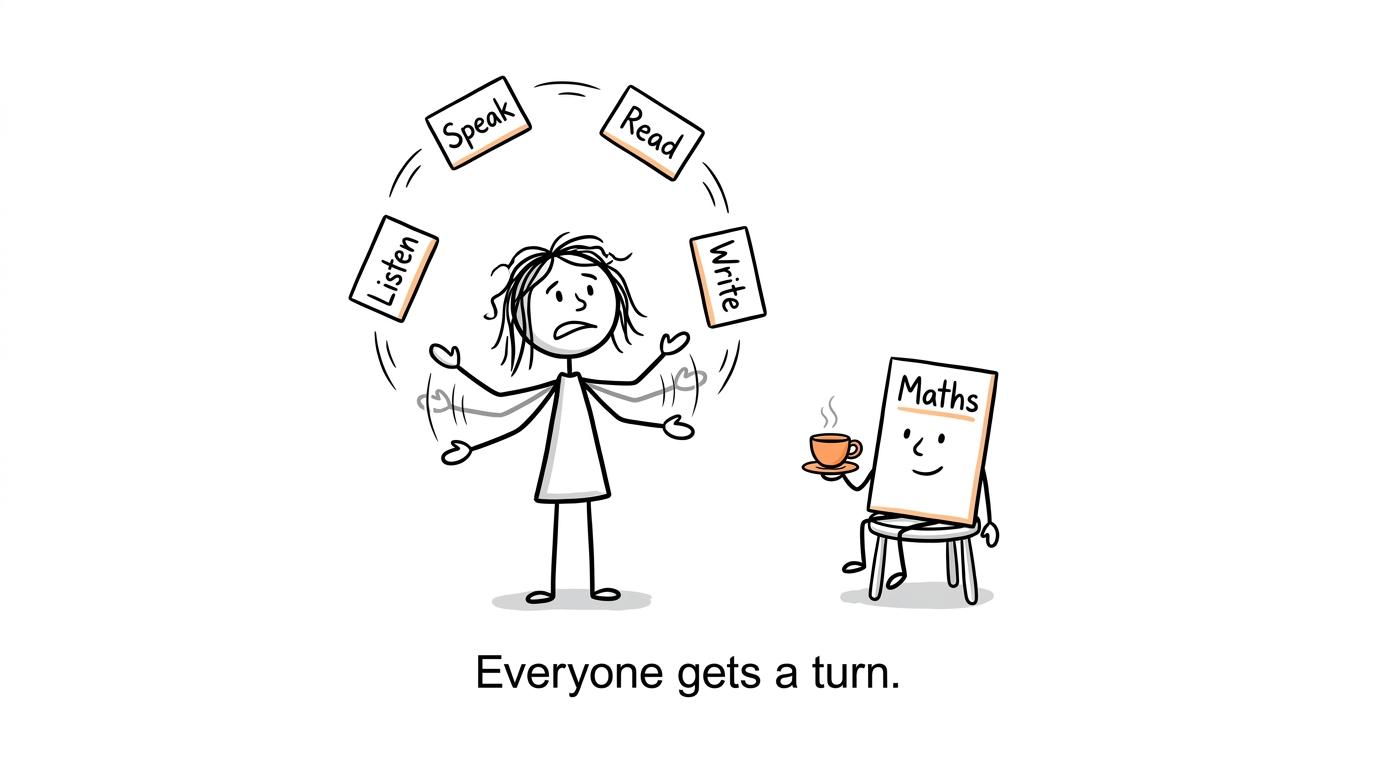 A student juggling Bengali skill cards while maths waits with tea
Common revision timetable mistakes
Making the plan too detailed
Planning every minute creates fragility. Use blocks and outcomes, then allow the exact task to change when feedback reveals a more urgent weakness.
Treating planning as revision
Creating the timetable should be quick. If the design takes longer than the first practice session, stop formatting and begin working.
Scheduling only comfortable activities
Reading familiar notes and copying vocabulary can feel smooth. Your timetable also needs listening without subtitles, speaking without a script, timed writing and questions completed without help.
Ignoring marking and correction
Completion is not the same as improvement. Every substantial Bengali or maths task should produce feedback. Use mark schemes, teacher comments or video solutions, then revisit the error.
The process described in how to use GCSE maths past papers properly is valuable beyond one exam board: complete the work, mark it honestly, diagnose the problem and practise the weakness.
Abandoning the timetable after a missed session
One missed block does not require a new colour-coded master plan. Move the essential task, remove a lower-priority task and continue. Flexibility is not evidence that the timetable failed. It is what makes the timetable usable.
A timetable should guide the work, not become the work
A GCSE Bengali revision timetable is worth making when it protects regular practice, covers every assessed skill and helps you act on feedback. Flexible revision can be equally effective when it retains clear weekly outcomes, priorities and review.
Choose the lightest structure that keeps you consistent. Then begin with a real task.
For maths, make MathsGenie's free GCSE revision resources the practical centre of your plan. Use revision lessons to rebuild weak methods, practice questions and mini tests to check them, past papers and mark schemes to understand lost marks, and predicted papers with video solutions for final exam-style rehearsal. Open the revision planner, choose the next useful task and let completed work, not a perfect calendar, measure your progress.