GCSE Bengali Grade 9 Meaning: Ability and A*
GCSE Bengali grade 9 meaning explained: the ability it represents, how it compares with A*, and what it teaches students about effective revision.
A result can be only one character long and still carry years of questions. Is it exceptional? Is it equivalent to an A*? Does it mean complete fluency? And what did the student actually prove in the examination?
The GCSE Bengali grade 9 meaning is straightforward at first: grade 9 is the highest available grade and represents exceptional performance across the assessed Bengali course. For the current AQA GCSE, it can only be awarded through Higher tier. It indicates highly developed listening, speaking, reading and writing skills, but it does not certify perfect Bengali or guarantee native-level fluency.
That distinction matters. A grade describes performance against an examination specification. It is powerful evidence of ability, but it is not the whole story of someone’s relationship with a language.
The short answer: what a grade 9 represents
A grade 9 in GCSE Bengali means that the student:
- achieved the highest grade available on the grades 9-1 scale;
- took the Higher-tier assessments, because Foundation tier does not offer grade 9;
- performed exceptionally well across listening, speaking, reading and writing;
- demonstrated detailed understanding and effective communication under examination conditions;
- reached the required overall boundary for that particular examination series;
- performed within the top grading category, above grades 8 and 7.
It does not mean that every answer was correct. Nor does it mean the student speaks, reads or writes without mistakes in every real-life situation. It means their combined examination performance met a very demanding standard.
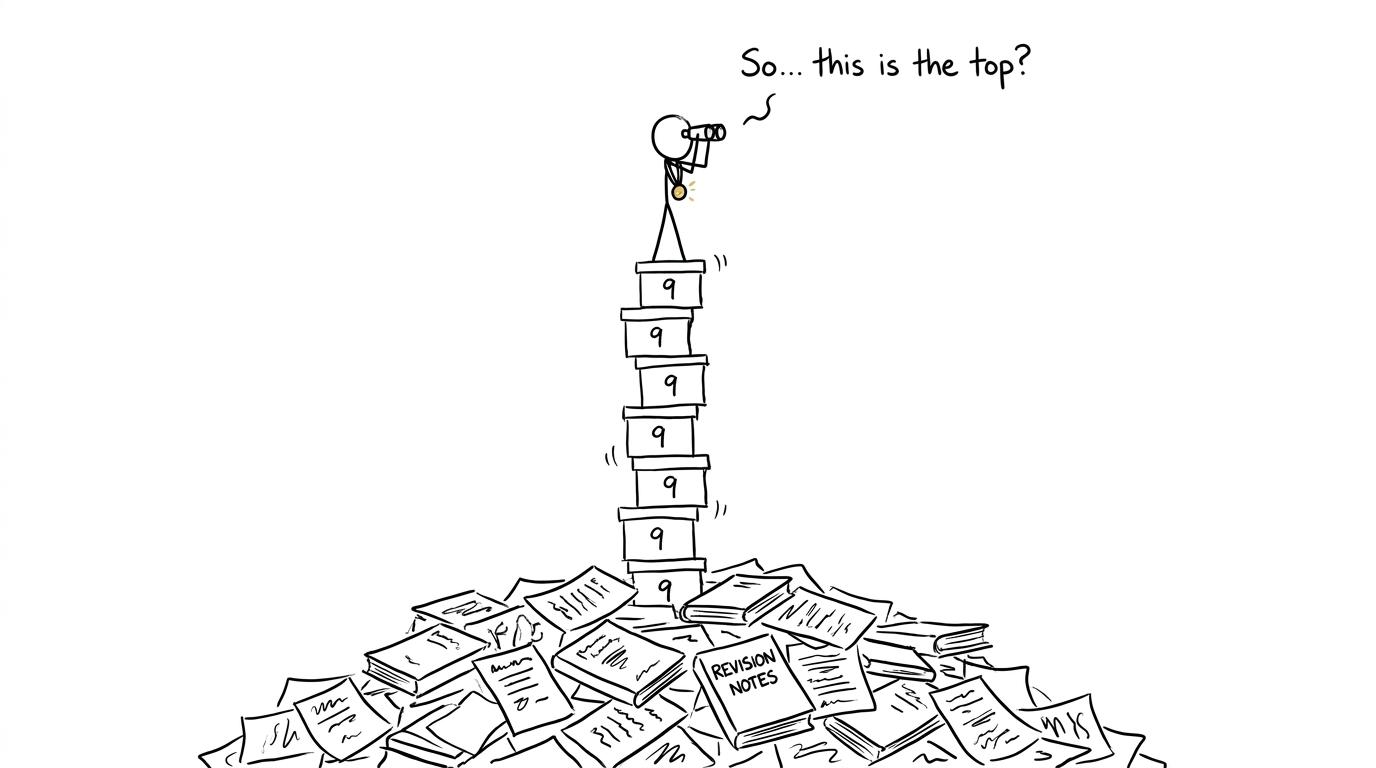 A student discovers that the top GCSE grade still comes with a mountain of revision
What abilities does GCSE Bengali assess?
The current AQA GCSE Bengali qualification assesses four language skills. Each contributes approximately 25%25\%25% of the overall qualification:
- Listening: understanding and responding to spoken Bengali.
- Speaking: communicating and interacting effectively in speech.
- Reading: understanding and responding to different forms of written Bengali.
- Writing: communicating effectively in written Bengali.
Students enter either Foundation or Higher tier and must take all four assessments at the same tier. Foundation tier offers grades 1-5, while Higher tier offers grades 4-9. Therefore, a student aiming for grade 9 must be entered for Higher tier.
This structure explains why the grade is broader than a simple vocabulary test. Knowing many words helps, but top performance also requires students to process unfamiliar material, select relevant detail, communicate ideas clearly and sustain accuracy when time is limited.
Receptive ability at grade 9
In listening and reading, a grade 9 result suggests that the student can deal successfully with demanding material across the specification. They are likely to recognise detail, follow ideas across a passage and distinguish the central message from distracting information.
They also need to cope when the answer is not supplied in exactly the same words as the question. Strong language performance often depends on recognising paraphrase, interpreting context and understanding how meaning changes through tense, tone or qualification.
A student does not need to know every word. In fact, one sign of advanced examination ability is knowing how to continue when a word is unfamiliar. Context becomes a bridge rather than a reason to stop.
Productive ability at grade 9
Speaking and writing ask a different question: can the student create language rather than merely recognise it?
At the highest level, this means communicating developed ideas, using an appropriate range of language and maintaining strong accuracy. In speaking, the student must also respond, interact and show spontaneity. A memorised paragraph may sound polished, but it cannot cover every follow-up question.
In writing, quality involves more than length. The response must address the task, organise ideas and use language with control. Effective communication remains central. Complicated sentences that obscure the message are less useful than ambitious language handled accurately.
Is grade 9 the same as an old A*?
Not exactly. This is the most important point when comparing the current scale with the former letter grades.
England replaced the A*-G GCSE scale with grades 9-1. The scales have official comparison points, but they are not direct translations at every grade. The bottom of grade 7 was aligned with the bottom of the old grade A, the bottom of grade 4 with the bottom of grade C, and the bottom of grade 1 with the bottom of grade G.
| Current grade | Comparison with the former scale |
|---|---|
| Grade 9 | Highest current grade; within the former A*/A region but with extra differentiation at the top |
| Grade 8 | Falls within the broad area previously covered by A* and A |
| Grade 7 | Its lower boundary is aligned with the lower boundary of the former grade A |
| Grade 4 | Its lower boundary is aligned with the lower boundary of the former grade C |
| Grade 1 | Its lower boundary is aligned with the lower boundary of the former grade G |
Grades 7, 8 and 9 collectively provide more distinction across the area previously occupied by A and A*. Fewer students attain grade 9 than attained the old A*, so calling a 9 simply “the new A*” loses an important part of its meaning.
The safest description is that grade 9 is the highest GCSE grade and represents performance at the very top of the former A*/A range. It is not a renamed letter grade with a perfectly matching boundary.
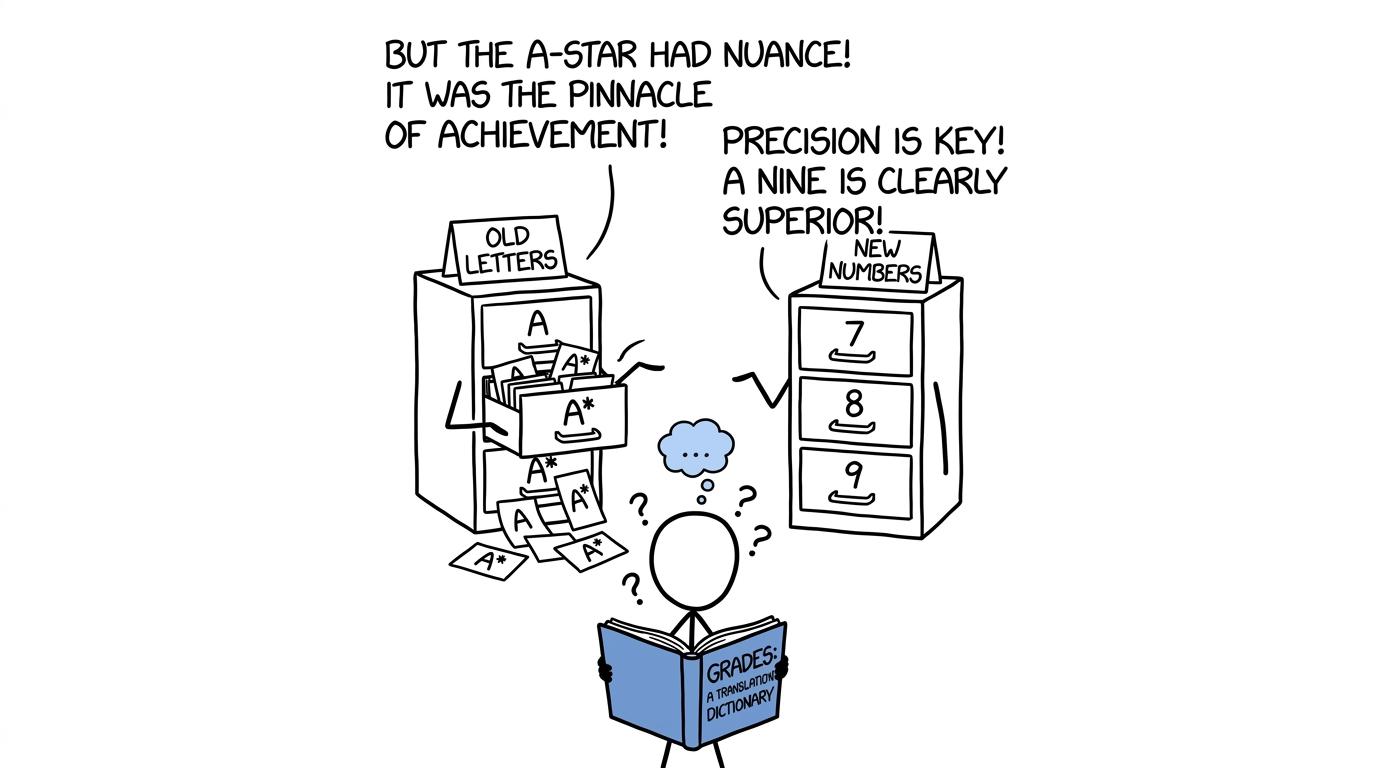 Old letter grades and new number grades attempt a difficult filing-cabinet translation
How grade boundaries affect the result
A grade 9 is awarded when a student’s total mark reaches the grade 9 boundary for that examination series. That boundary is not a permanent percentage that students can assume in advance.
Exam boards set boundaries after the papers have been taken and marked. They consider the demand of the assessments and use evidence to maintain comparable standards. If one series is more demanding than another, the raw-mark boundary can differ. This is intended to prevent students being advantaged or disadvantaged by the precise difficulty of a paper.
The practical lesson is simple: historical boundaries provide context, not a safe target. A student should not stop revising because a mock mark exceeded last year’s threshold. Building a margin for unfamiliar questions, mistakes and examination pressure is wiser than trying to land on one predicted number.
This principle also applies in maths. Students can use the MathsGenie GCSE Maths revision hub to identify the correct exam board and tier, but previous boundaries should never replace secure topic knowledge.
What grade 9 does not tell you
A grade carries useful information, but its limits deserve equal attention.
It does not mean perfect fluency
GCSE Bengali examines a defined range of themes, skills and assessment tasks. Everyday fluency may involve regional varieties, cultural references, rapid informal conversation and vocabulary beyond the specification.
A grade 9 student has demonstrated outstanding GCSE performance. That is not identical to proving mastery of every form of Bengali in every setting.
It does not reveal an identical skill profile
The final grade combines performance across four components. Two students can receive the same result through slightly different strengths. One might be especially confident in spontaneous speech, while another may be strongest when interpreting written material.
Because the components are combined, the certificate reports the overall outcome rather than a complete portrait of the learner.
It does not measure effort or personal background
The grade records assessed performance, not the route taken to reach it. It does not show how much progress someone made, how often Bengali is used at home or what obstacles accompanied their preparation.
Recognising this does not reduce the achievement. It simply keeps the claim accurate.
What maths students can learn from the result
Bengali and maths test different knowledge, but strong preparation in both subjects rests on the same quiet habit: turn feedback into a specific next action.
A vague plan says, “Revise more.” A useful plan says, “My listening errors come from missing tense changes,” or, in maths, “I lose marks when rearranging formulae containing fractions.” Specific errors can be repaired. Vague anxiety cannot.
For maths revision, begin with a timed assessment from the GCSE mini tests or the Edexcel GCSE Maths past papers. Mark it carefully and identify whether each lost mark came from missing knowledge, inaccurate execution, a misread question or time pressure.
Then use the same cycle that supports high-level language learning:
- isolate one weak skill;
- revisit the relevant lesson;
- practise it actively rather than rereading notes;
- check the mark scheme or video solution;
- return to the skill after a gap;
- test it later inside a mixed paper.
The guide to using GCSE past papers properly explains why the most valuable revision often happens after the paper. The score identifies the gap; correction changes the next score.
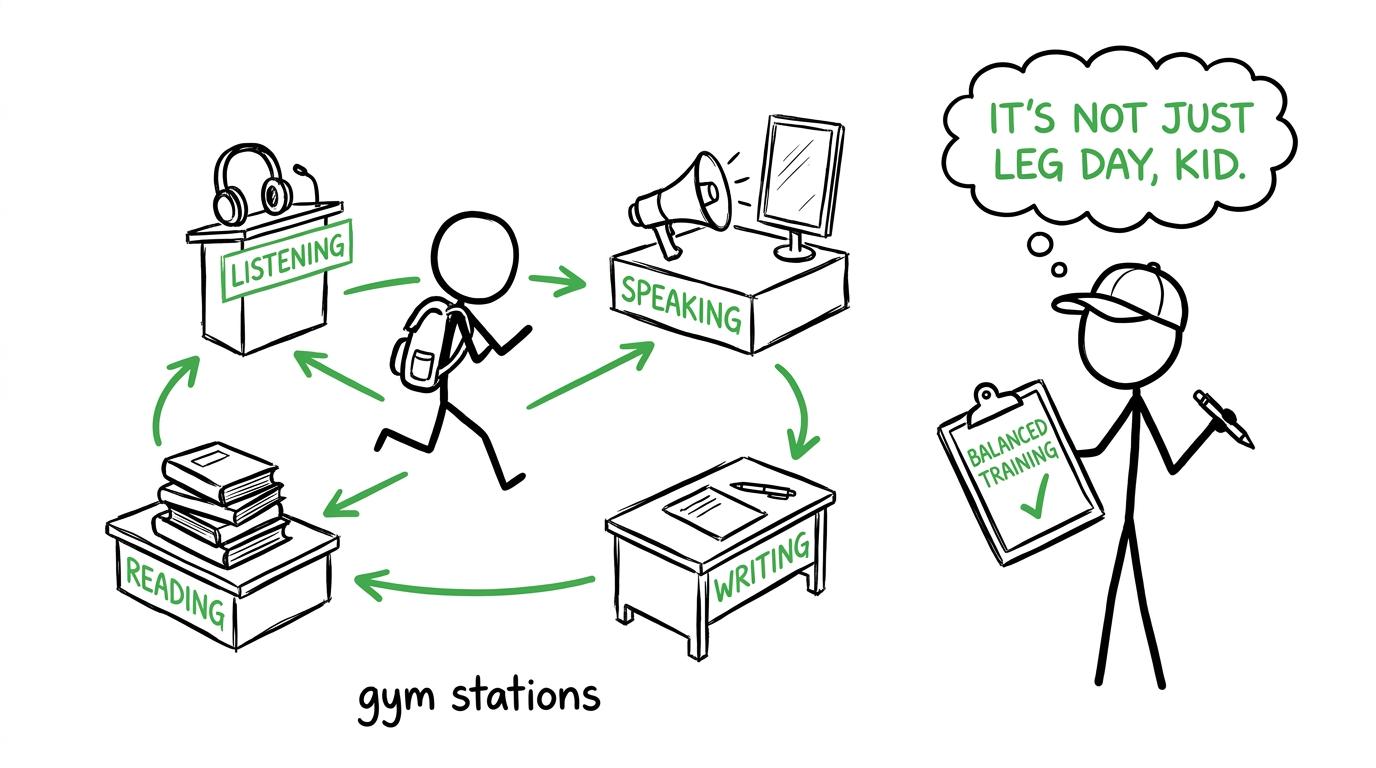 A student trains listening, speaking, reading and writing like four balanced gym stations
Common mistakes when interpreting a Bengali grade 9
Calling it an exact A* equivalent
Grade 9 occupies the highest part of the scale, but the old and new systems do not map grade-for-grade. Say that it offers greater differentiation at the top rather than treating it as a relabelled A*.
Assuming there is one permanent mark requirement
Grade boundaries can change between examination series. Previous boundaries are useful evidence, not promises about a future paper.
Forgetting the tier restriction
AQA Foundation-tier Bengali offers grades 1-5. Grade 9 is available only through Higher tier, with all four skills entered at that tier.
Treating home use as automatic exam preparation
Speaking Bengali outside school can provide valuable familiarity, but the examination also rewards specification coverage, careful reading, controlled writing and knowledge of task requirements. Familiarity and exam readiness overlap, but they are not identical.
Revising strengths while avoiding weaknesses
Students naturally return to tasks that feel comfortable. Grade 9 preparation demands balance. The four Bengali skills each matter, just as a high maths grade requires attention across number, algebra, ratio, geometry, probability and statistics.
A structured plan can prevent this drift. The GCSE one-month maths revision plan shows how to combine focused practice, retrieval and timed papers without trying to repair everything at once. The MathsGenie mark-scheme guide can then help turn lost marks into precise corrections.
A grade is evidence, not an identity
The gcse Bengali grade 9 meaning is ultimately this: the student demonstrated exceptional command of the knowledge and skills assessed by the qualification and reached the highest grade category. The result reflects advanced listening, speaking, reading and writing performance under controlled conditions. It is above the standard represented by grades 8 and 7, and it creates more distinction at the top than the old letter system allowed.
That is worth celebrating. But the number is evidence of performance, not a limit placed on the future or a complete definition of the person who earned it.
If maths is the next examination on your timetable, bring the same discipline to it. Start with the GCSE Maths topics by exam board and tier, choose one genuine weakness and practise it today. MathsGenie brings together free revision lessons, practice questions, mini tests, past papers, predicted papers, mark schemes and video solutions so that every result, even a disappointing mock, can become a clear next step.