

GCSE Bengali Exam Dates 2026: Test-Day Guide
GCSE Bengali exam dates 2026: check AQA paper dates, timings, speaking arrangements, contingency day and what to prepare before each exam.
An exam date can look like a small detail until it sits beside three other papers in the same week. Then the timetable becomes part of the revision itself.
The key GCSE Bengali exam dates 2026 for AQA are Wednesday 3 June for Listening and Reading, and Thursday 11 June for Writing. Both written papers on 3 June are in the afternoon session; Writing is in the morning. Your school arranges your Speaking test separately and had to submit it to AQA by Monday 18 May 2026.
These dates come from AQA's final May/June 2026 timetable. Always treat your school or college's personalised timetable as the final instruction because it will confirm your room, arrival time, tier and speaking appointment.
GCSE Bengali exam dates 2026 at a glance
The dates below apply to AQA GCSE Bengali, specification 8638.
| Component | Date or arrangement | Session | Foundation duration | Higher duration |
|---|---|---|---|---|
| Paper 1: Listening | Wednesday 3 June 2026 | Afternoon | 35 minutes, including reading time | 45 minutes, including reading time |
| Paper 2: Speaking | Set by your school within AQA's speaking arrangements | School appointment | 7-9 minutes, plus supervised preparation | 10-12 minutes, plus supervised preparation |
| Paper 3: Reading | Wednesday 3 June 2026 | Afternoon | 45 minutes | 1 hour |
| Paper 4: Writing | Thursday 11 June 2026 | Morning | 1 hour | 1 hour 15 minutes |
The Speaking submission deadline was Monday 18 May 2026, but that was an administrative deadline for centres rather than a universal student test date. Your own appointment may have been earlier.
Keep these details together:
- your full candidate timetable;
- your candidate number and centre number;
- confirmation of foundation or higher tier;
- the room and required arrival time for each component;
- your individual Speaking appointment;
- details of approved access arrangements;
- an emergency contact for your exams officer.
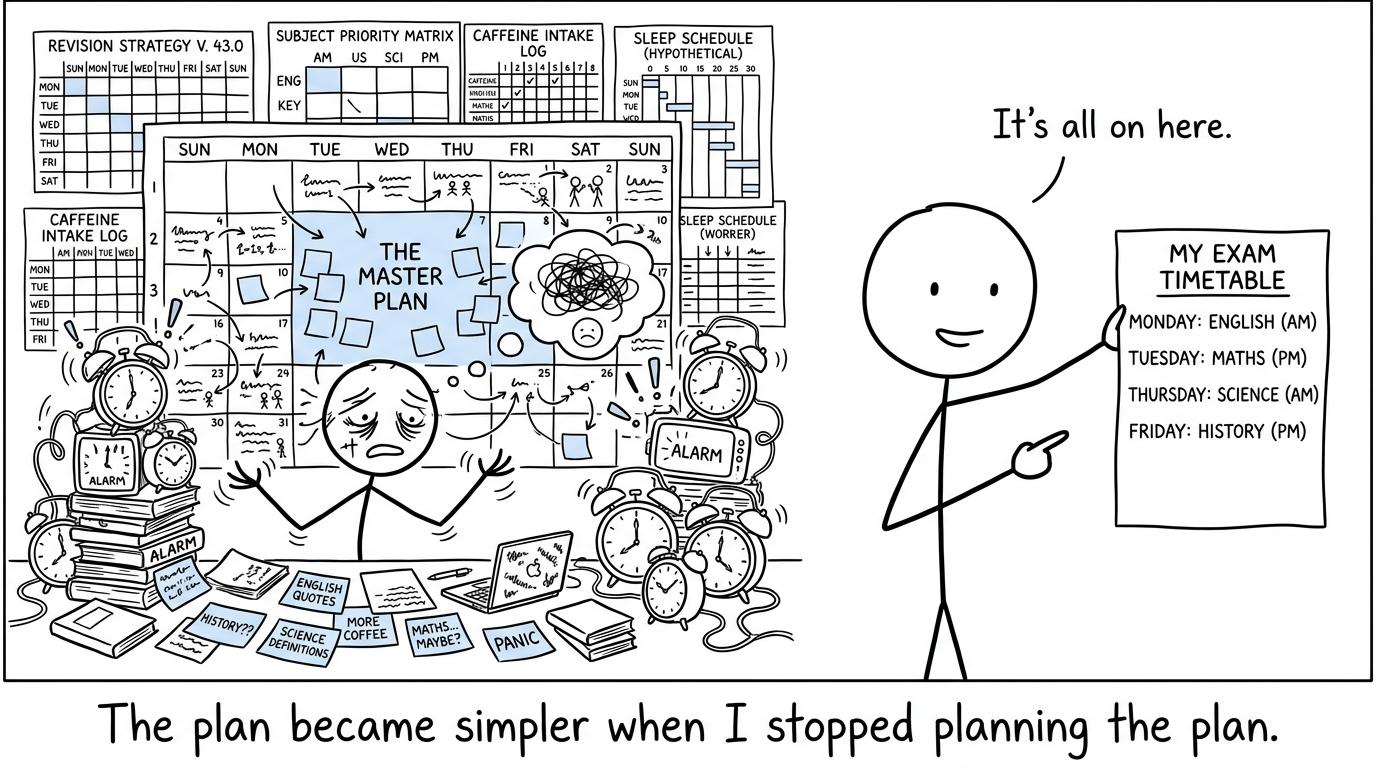 A student simplifies an elaborate exam planning system into one clear personal timetable
Check that you are taking GCSE Bengali, not International GCSE Bangla
Names matter here. AQA's qualification is GCSE Bengali 8638, with separate Listening, Speaking, Reading and Writing components. Students enter either foundation or higher tier and take the same tier across all four skills. Each skill contributes approximately 25%25\%25% of the qualification.
Pearson Edexcel's International GCSE Bangla 4BA0 is a different qualification. It uses one externally examined Reading, Writing and Translation paper lasting 2 hours 30 minutes. Its timetable and assessment structure are therefore not interchangeable with AQA's GCSE dates.
Look at the entry code on your timetable. If it begins with 8638, the AQA dates above are relevant. If it says 4BA0, ask your exams officer to confirm your Pearson International GCSE arrangements. Do not rely on the subject name alone.
Why Wednesday 3 June needs extra planning
For many students, 3 June was not simply Bengali day. AQA, Pearson Edexcel and OCR scheduled a GCSE Maths paper in the morning, while AQA Bengali Listening and Reading were in the afternoon.
That creates a long examination day. The danger is not necessarily a lack of knowledge; it is spending all your energy on the first paper and reaching the afternoon mentally tired.
If you had this combination, the sensible plan was simple:
- verify both rooms and arrival times in advance;
- bring an appropriate lunch and water according to school rules;
- avoid discussing answers after the maths paper;
- use the break to reset rather than attempt heavy last-minute revision;
- take only permitted materials into each exam room.
For board-specific maths preparation, use the GCSE Maths revision hub to select your exam board and tier. Students taking AQA can work through AQA GCSE Maths revision lessons and questions, while Eduqas students can use the dedicated Eduqas GCSE Maths revision pathway.
A double-exam day rewards preparation that has already been done. It rarely rewards a frantic hour with a revision guide between papers.
What each AQA Bengali component involves
Listening and Reading
Listening and Reading were held in the same afternoon session on 3 June. They remain separate components, so check that the paper code and tier on each question paper match your entry.
The Listening assessment measures how well you understand and respond to spoken Bengali. Reading assesses comprehension across different written sources. The precise start and finishing sequence is managed by the centre, which is another reason to follow your school's timetable rather than calculating your own departure time from the published durations.
Speaking
The Speaking test is an individual appointment organised by your school. Under the specification, it includes a role-play, a photo-card task and a general conversation. Students receive supervised preparation time before the recorded assessment.
Arrive at the time your school gives you. A national submission deadline does not tell you when your personal test begins, and a missed school appointment cannot simply be replaced by turning up on the submission date.
Writing
Writing was scheduled for the morning of 11 June. It assesses communication in written Bengali, including translation. The foundation paper lasts 1 hour, while the higher paper lasts 1 hour 15 minutes.
Check your tier before beginning. The front of the paper should match the component code on your entry: WF for foundation Writing or WH for higher Writing. If anything appears wrong, do not open or begin the paper. Raise your hand and tell an invigilator.
What the morning of an exam usually looks like
For the Writing paper, AQA's published morning session time was 9.00 am. JCQ rules permit centres some flexibility around published session times, so the arrival time printed by your school takes priority. For afternoon exams, the nationally published session time is normally 1.30 pm, but again your centre may instruct you to arrive earlier or use an adjusted start.
A calm exam morning generally follows this pattern:
- eat and drink as you normally would;
- check your personalised timetable one final time;
- arrive at least ten minutes before the instructed start, or earlier if your school requires it;
- leave your phone, watch, earbuds and notes outside the exam room as directed;
- find your assigned seat and check the paper details;
- listen to the invigilator before writing or opening the question paper;
- fill in your candidate information carefully;
- raise your hand if you receive the wrong paper or feel unwell.
JCQ requires written answers to be completed clearly in black ink unless a paper instructs otherwise. A transparent pencil case and a clear, unlabelled water bottle may be permitted. Watches of every kind, including ordinary analogue watches, are prohibited in the exam room.
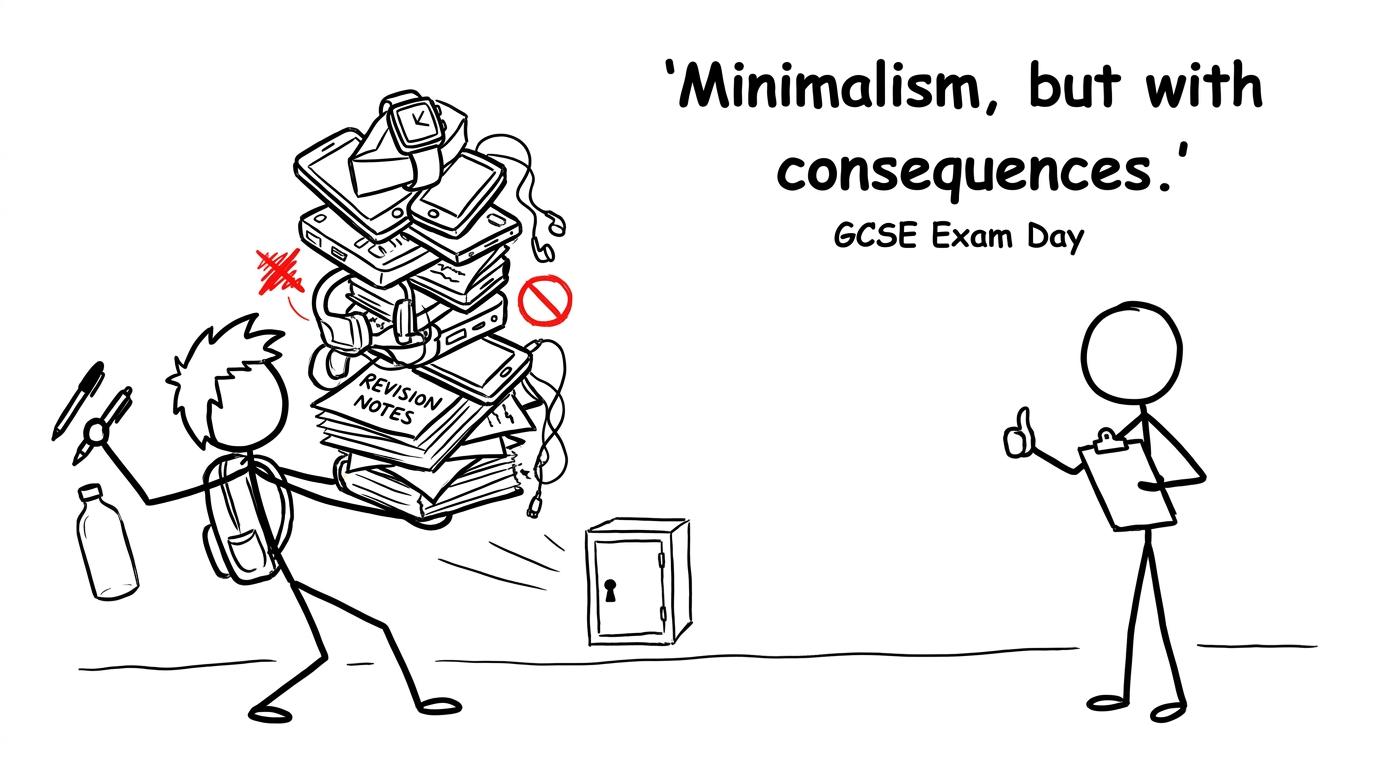 A student hands prohibited gadgets to a locker before entering an exam with only permitted equipment
Your test-day equipment checklist
Pack the evening before rather than making decisions while rushing out of the door.
Bring or prepare:
- at least two working black pens;
- permitted pencils and an eraser in a transparent pencil case;
- a clear water bottle with its label removed, if your centre allows one;
- any approved access-arrangement materials;
- your timetable or candidate card if your school asks for it;
- the telephone number for your school or exams office.
Do not take notes, a mobile phone, earbuds, smart glasses, a tablet or any type of watch into the exam room. Possessing unauthorised material can be treated as malpractice even when you did not intend to use it.
How to organise Bengali alongside GCSE Maths revision
A full GCSE timetable is a resource-allocation problem. One subject can feel urgent because its exam is tomorrow, while another quietly loses a week of useful practice.
Start by placing every confirmed exam and speaking appointment in one calendar. Then work backwards, scheduling short Bengali skill sessions around maths practice rather than allowing either subject to disappear.
For maths, a reliable cycle is:
- learn or revisit one method;
- answer exam-style questions;
- mark the work immediately;
- record the exact reason for each lost mark;
- retest that weakness on another day.
The GCSE maths revision timetable guide explains how to build this into a manageable week. When time is limited, the 20-minute maths revision routine provides a shorter structure.
As exams approach, use GCSE predicted papers as a rehearsal rather than a replacement for topic revision. Follow them with mark schemes, video solutions and targeted questions. The principle is the same in language revision: feedback matters more than simply completing another task.
Common mistakes before the Bengali exams
Confusing the speaking deadline with your appointment
The AQA timetable's submission deadline was for schools. Your personal Speaking test was set by your centre and could have taken place earlier.
Using International GCSE dates by accident
GCSE Bengali 8638 and International GCSE Bangla 4BA0 have different structures and timetables. Check the qualification and component code.
Missing that Listening and Reading share one afternoon
Both papers were scheduled on 3 June. Prepare for the whole session and do not assume you can leave after the first component.
Assuming the published session time is your arrival time
A published morning or afternoon session is not permission to arrive at that exact moment. Follow the earlier arrival time given by your school.
Treating the contingency day as a personal resit date
JCQ reserved Wednesday 24 June 2026 for national or significant local disruption. It was not a resit day for an individual who overslept, travelled late or chose not to attend. If illness or an emergency affects attendance, contact your centre immediately.
Revising only the next subject
A Bengali paper may be closest on the calendar, but maths still needs regular retrieval and question practice. Short maintenance sessions are better than abandoning maths and trying to rebuild it later. Use Edexcel GCSE Maths mini tests or equivalent board-specific resources for focused timed practice.
Turn the timetable into a calm plan
Dates do not improve a grade by themselves. Their value is that they remove uncertainty. Once you know the paper, session, tier, room and arrival time, your attention can return to the work that earns marks.
Confirm your qualification code and personal timetable with your school. Pack permitted equipment the night before. Keep 24 June free if instructed for the contingency arrangements, and contact the exams office immediately if illness, lateness or an emergency occurs.
Then make MathsGenie your free maths revision base. Start with revision lessons and practice questions, use mini tests to keep skills active, and move into past papers and predicted papers when you are ready for timed rehearsal. Mark every attempt with the mark scheme, watch the video solutions and turn each mistake into the next thing you practise.











