GCSE Bengali 6 to 9: A Practical Revision Plan
GCSE Bengali 6 to 9 guidance: discover what separates the grades and how better vocabulary, accuracy, exam technique and feedback raise marks.
A grade 6 often feels close to a grade 9. You already understand much of the Bengali. You can express ideas, recognise familiar language and complete the papers. Yet the final marks reveal a stubborn gap.
The route from gcse bengali 6 to 9 is not simply learning more words. It means producing more precise, varied and convincing language under exam conditions. You must understand detail rather than only the general message, develop answers rather than list facts, and control grammar when the question becomes unfamiliar.
For students balancing Bengali with GCSE maths, the same principle applies to both subjects: progress comes from completing work, marking it honestly and fixing the reason each mark was lost.
The grade 6 to grade 9 checklist
Focus on these changes:
- Confirm your qualification, exam board and tier.
- Replace general vocabulary revision with theme-based retrieval.
- Develop opinions using reasons, contrasts and consequences.
- Use past, present and future time frames accurately.
- Practise responding to unfamiliar listening and reading material.
- Improve spontaneous speech instead of memorising complete scripts.
- Mark writing and translation against the actual assessment criteria.
- Keep an error log and revisit recurring weaknesses.
- Complete timed sections before moving to full papers.
This is not a promise that following a checklist guarantees a particular grade. Grade boundaries are set for each exam series, and your final grade depends on performance across the qualification. The checklist identifies the habits most closely aligned with the demands of top-band work.
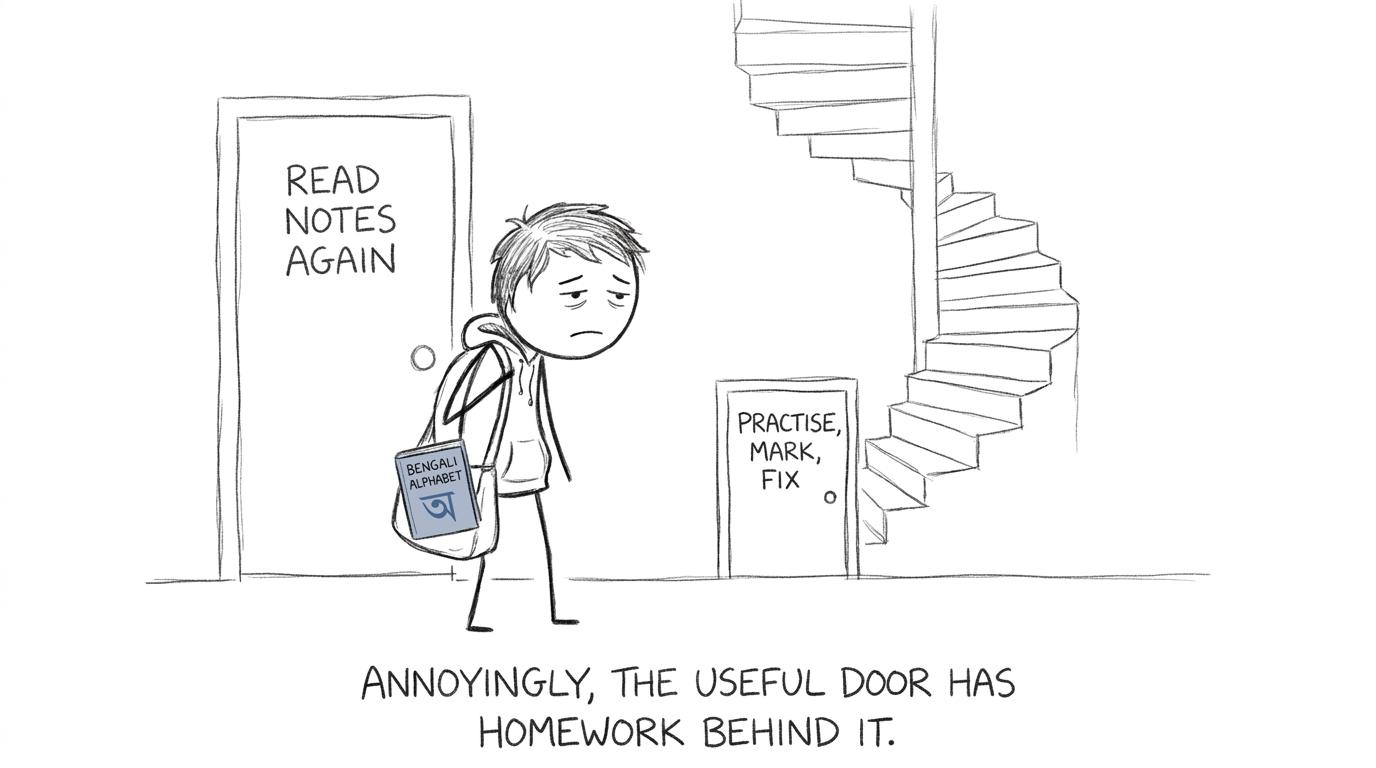 A student choosing between rereading and useful practice
Check which Bengali qualification you are taking
Before changing your revision, check the specification used by your school. The assessment structure determines what you need to practise.
AQA GCSE Bengali has foundation and higher tiers. Foundation targets grades 1 to 5, while higher targets grades 4 to 9, so a student aiming for grade 9 must take higher tier. Its four assessment objectives are listening, speaking, reading and writing, each worth approximately 25%25\%25% of the qualification.
Pearson Edexcel International GCSE Bangla is a different qualification. Its assessment centres on reading, writing and translation in one externally examined paper. Do not build a speaking timetable merely because another Bengali specification includes speaking.
The practical lesson is simple: use the specification named on your school’s entry information. Check the paper structure, permitted materials, themes and mark schemes rather than relying on advice written for a different course.
MathsGenie does not currently provide Bengali-specific papers. However, its guide to using GCSE past papers properly explains a paper mark fix, retest process that transfers directly to language revision.
What separates a grade 6 from a grade 9 in GCSE Bengali?
There is no single piece of vocabulary or grammatical structure that turns a grade 6 response into a grade 9 response. Grades are awarded from the overall mark, while individual tasks use their own assessment criteria. Still, the difference is visible in several recurring qualities.
Grade 6 performance is usually competent but uneven
A grade 6 student may communicate successfully but rely heavily on familiar phrases. Opinions can be understandable yet brief. Present-tense language may be secure while references to past or future events are less reliable.
In receptive papers, the student often understands the main idea but loses marks on detail, inference, changes of viewpoint or less familiar vocabulary. In speaking, prepared material may sound confident until an unexpected follow-up question appears.
This is a solid foundation. The issue is not that the student knows nothing. It is that performance changes too much when the language, context or time pressure changes.
Grade 9 performance shows control and adaptability
Top responses communicate substantial relevant information, use a wide range of vocabulary and select structures that suit the message. References to different time frames are confident. Errors may still occur, particularly when ambitious language is attempted, but they are limited and do not repeatedly damage communication.
In speaking, stronger candidates sustain interaction, respond spontaneously and justify their views. In reading and listening, they connect details, distinguish fact from opinion and infer meaning from context. In translation, they preserve key messages while applying grammar accurately rather than replacing difficult phrases with vague alternatives.
The decisive word is control. Ambition matters, but controlled ambition earns more than complicated language used inaccurately.
The specific changes that move students up a grade band
Turn vocabulary lists into usable language
Knowing that you have seen a word is not the same as being able to retrieve it in an exam. Organise vocabulary around your specification themes, then practise it in short spoken and written responses.
For each theme, build clusters containing:
- precise nouns and verbs;
- positive and negative opinions;
- reasons and consequences;
- language for comparison;
- expressions linked to past and future events;
- formal and informal wording where appropriate.
Test recall in both directions. Recognition helps reading, but independent production is what writing and speaking demand. Revisit difficult words after a gap rather than copying them repeatedly in one sitting.
Develop every important point
A grade 6 answer may state an opinion. A stronger answer explains why it is held, adds an example, considers an alternative or describes a consequence.
Before writing, reduce each bullet point to a small planning chain:
answer the point, justify it, develop it, check the time frame.
This keeps the response relevant while creating depth. It also prevents a common problem: spending too long on the opening point and rushing the remaining compulsory content.
Make tense control dependable
Top-band criteria reward successful references to past, present and future events. This does not mean forcing every possible structure into every paragraph. It means choosing time frames naturally and forming them securely.
Create a personal grammar list from marked work. Include recurring difficulties such as verb forms, word order, agreement, connectives and sentence boundaries. Practise one weakness in several short sentences, then use it in a timed paragraph without notes.
The MathsGenie guide to finding weak GCSE topics uses the same evidence-led idea for maths: diagnose weaknesses from lost marks, not from feelings.
Train for inference, not just recognition
In listening and reading, do not stop when you recognise the topic. Ask what the speaker or writer believes, whether that view changes and which detail proves your answer.
During review, classify each lost mark:
- vocabulary was unknown;
- a known word was missed at speed;
- the question was misunderstood;
- a negative or contrast was overlooked;
- an inference was unsupported;
- too much information was included.
Each cause needs a different repair. More vocabulary will not fix careless question reading, just as replaying easy audio will not prepare you for near-normal speech.
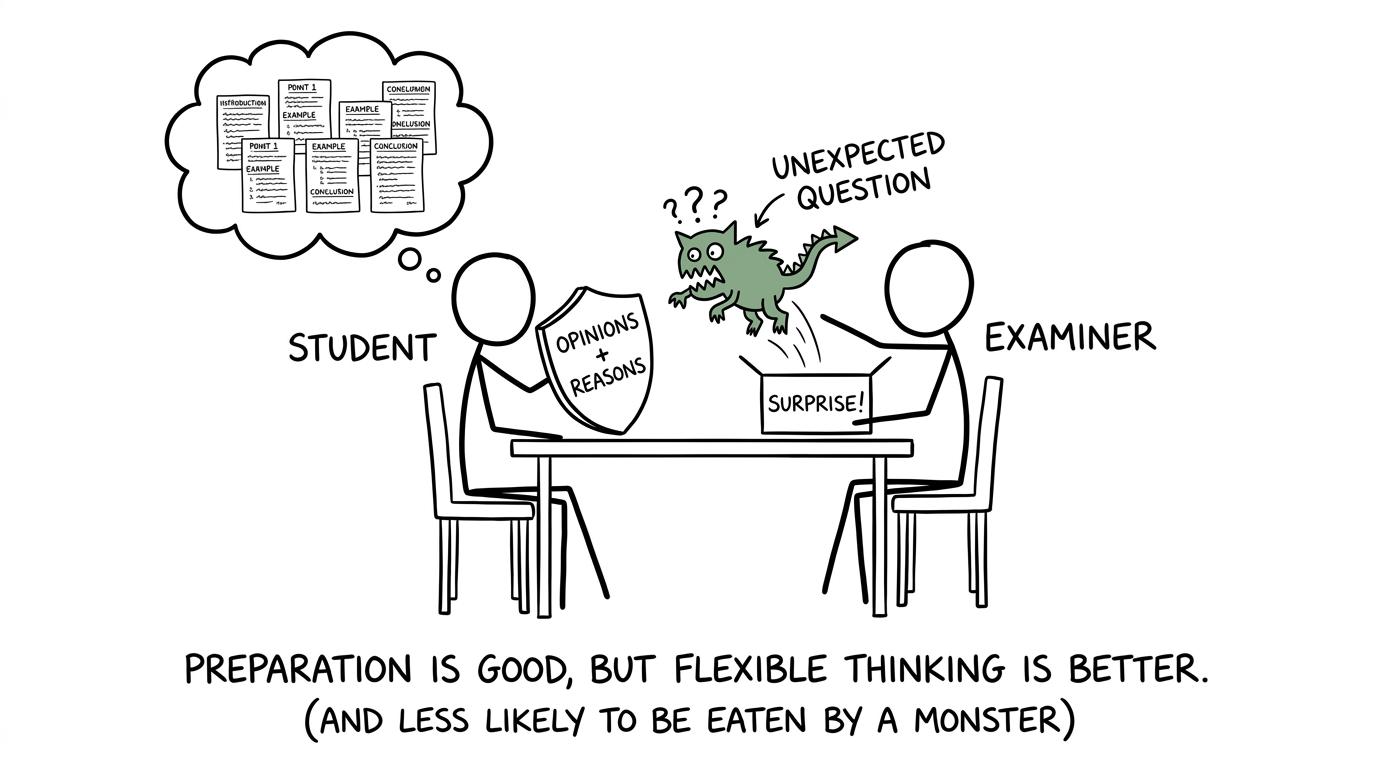 A prepared student meeting an unexpected speaking question
Replace speaking scripts with flexible building blocks
A memorised answer can sound impressive, but it becomes fragile when the examiner changes direction. Prepare flexible components instead: an opinion, a reason, a past event, a future intention, a comparison and a way to clarify meaning.
Record short responses to unseen questions. Listen back for hesitation, repetition, pronunciation and grammatical accuracy. Then answer the same question again with fewer pauses and one better-developed idea.
The goal is not speech without any hesitation. It is sustained communication that survives an unexpected question.
Treat translation as meaning plus structure
Translation is not a word-for-word substitution exercise. First identify the key messages, relationships and time references. Then choose accurate Bengali that preserves them.
After marking, separate errors into omitted meaning, inaccurate vocabulary and faulty grammar. A sentence that sounds elegant but loses a key message is not a successful translation. Conversely, a simple accurate construction may be more valuable than an ambitious guess.
Build a weekly revision system that creates evidence
A reliable week contains retrieval, production, feedback and timed work. One possible structure is:
- Monday: theme vocabulary and a short writing task;
- Tuesday: listening practice followed by transcript analysis;
- Wednesday: spontaneous speaking and pronunciation review;
- Thursday: reading, inference and translation;
- Friday: grammar repair using the week’s mistakes;
- Weekend: one timed paper section, strict marking and corrections.
Keep sessions focused enough to repeat. The 20-minute GCSE revision routine is designed for maths, but its retrieval, practice, and feedback rhythm works well when Bengali must fit around other subjects.
If your whole week feels crowded, use the principles in the GCSE revision timetable guide to protect short, specific sessions. You can then keep maths preparation organised through the free GCSE Maths revision hub, rather than allowing one subject to displace another.
Use an error log like a grade 9 candidate
An error log should change your next revision session. For every lost mark, record the task, the cause, the corrected form and the date you will retest it.
Avoid labels such as “careless”. They do not tell you what to change. Write something precise: missed a negative, used an insecure verb form, omitted a compulsory point or gave an unsupported inference.
Review the log weekly. If one category appears repeatedly, make it the priority. Short retesting matters because recognising a correction immediately after seeing the mark scheme is not proof that you can reproduce it later.
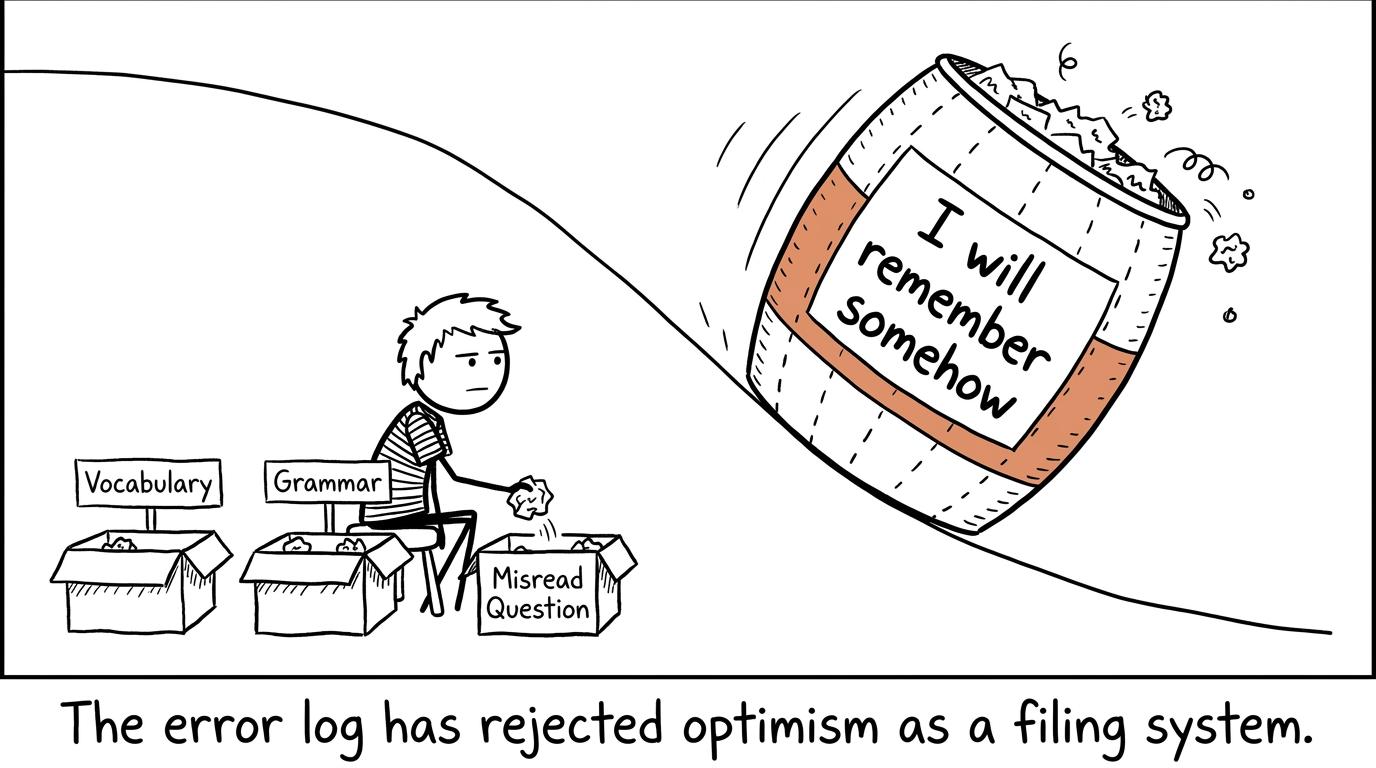 A student filing mistakes while optimism rolls away
Common mistakes when aiming for grade 9
Collecting impressive phrases without controlling them
Memorised expressions can add range, but only when they answer the question and fit grammatically. Secure varied language is more useful than decoration.
Ignoring compulsory bullet points
A polished response can still lose substantial content marks if part of the task is missing. Plan briefly and tick off each point before checking accuracy.
Writing beyond your control
Longer does not automatically mean better. Excess writing consumes checking time and creates more opportunities for errors. Follow the guidance for your paper and prioritise relevance, development and accuracy.
Revising only the productive skills
Speaking and writing can feel more urgent, but listening and reading contribute heavily in AQA GCSE Bengali. A weak receptive paper can limit the overall grade even when writing is strong.
Completing papers without repairing mistakes
A paper measures performance; the improvement happens afterwards. Mark it, classify lost marks, repair the weaknesses and retest them. This is also why MathsGenie pairs Edexcel GCSE Maths past papers with mark schemes and worked solutions, then offers shorter GCSE Maths mini tests for focused retesting.
Treating predicted material as certainty
No predicted paper can guarantee the content of a live exam. Use predictions for additional timed practice, not as a replacement for the full specification. The same principle applies when using MathsGenie GCSE predicted papers for maths.
Make the next mark visible
The journey from grade 6 to grade 9 is rarely one dramatic leap. It is a series of smaller changes: one answer developed properly, one tense made secure, one inference supported and one recurring error removed.
Begin with a timed section from the correct Bengali specification. Mark it against the official criteria, identify the three largest sources of lost marks and build next week around them. Then repeat the process until your stronger performance appears under time pressure, not only in familiar classwork.
For the maths part of your GCSE timetable, make MathsGenie your free revision base. Use its revision lessons and guides to rebuild understanding, practice questions and mini tests to strengthen skills, and past papers, predicted papers, mark schemes and video solutions to prepare for the real exam. Better grades become more realistic when every revision session leaves evidence of what improved.