GCSE Bengali 4 to 7: A Practical Revision Plan
GCSE Bengali 4 to 7: discover the skill changes, Higher-tier strategy and focused revision habits that can turn stronger language into more exam marks.
A grade 4 often feels close enough to a grade 7 to be imaginable, yet far enough away to be confusing. You can understand Bengali. You can answer many questions. But the marks do not yet reflect what you know.
The route from GCSE Bengali 4 to 7 is not simply to learn more vocabulary. It is to move to Higher tier, strengthen all four language skills and replace understandable but limited answers with precise, developed and increasingly accurate communication. You also need to practise the actual assessment rather than Bengali in the abstract.
There is no single raw-mark target that guarantees a grade 7 because grade boundaries can change between exam series. What you can control is the quality of evidence you give the examiner.
The grade 4 to grade 7 checklist
Before changing your revision, check that you are doing the following:
- Confirm your qualification and tier with your teacher or exams officer.
- If you are taking AQA GCSE Bengali, understand the demands of listening, speaking, reading and writing.
- Prepare for Higher tier, which is necessary for access to grade 7.
- Build vocabulary as phrases and structures, not isolated words.
- Develop answers with reasons, opinions, time frames and relevant detail.
- Record recurring errors in spelling, grammar and interpretation.
- Complete timed tasks and mark them against official criteria.
- Revisit weak skills instead of repeatedly practising your favourite one.
This resembles effective maths revision. A student does not improve algebra by reading the same notes more carefully. They answer questions, expose errors and correct them. The same feedback loop sits behind MathsGenie's guide to finding your weakest GCSE topics.
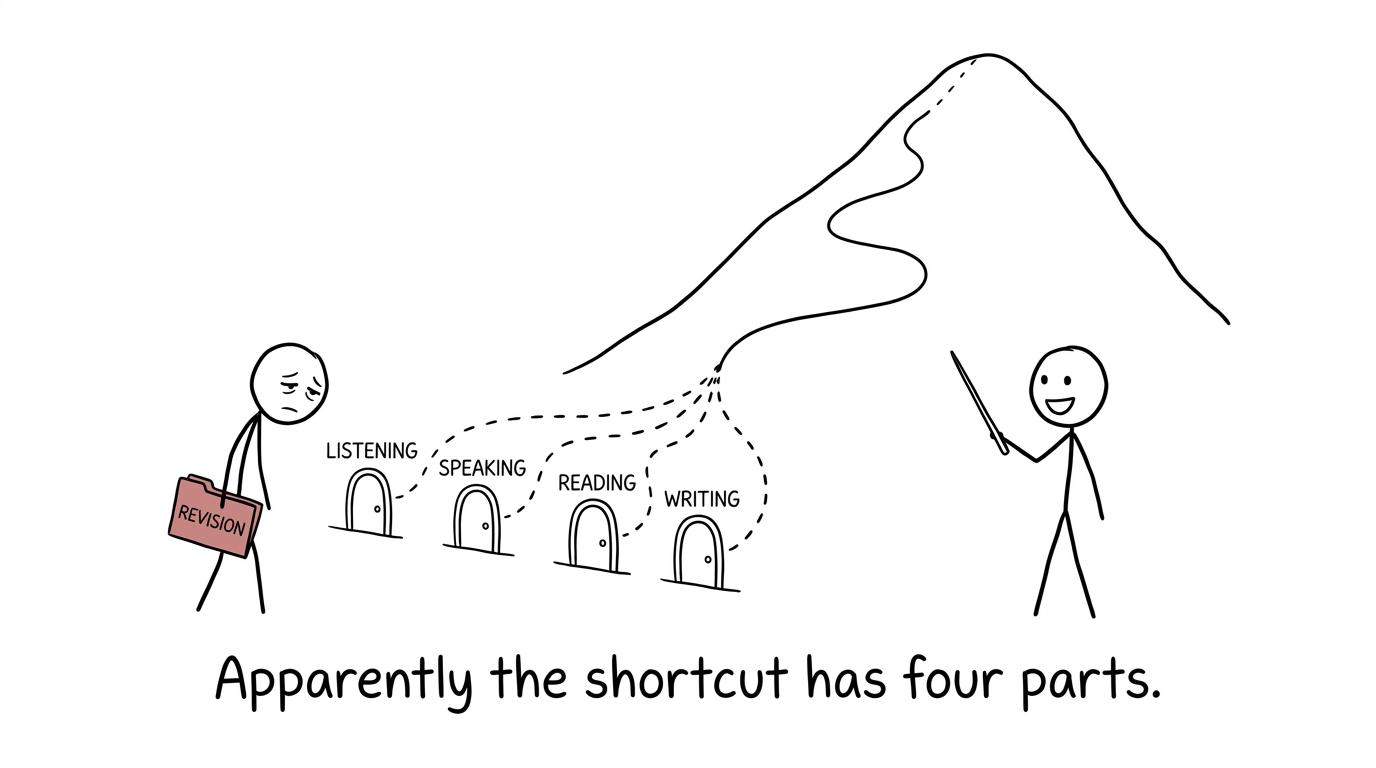 A student discovers that the supposed shortcut has four parts
Know which Bengali qualification you are taking
This matters because similar qualification names can hide different assessments.
AQA GCSE Bengali, specification 8638, assesses four skills: listening, speaking, reading and writing. Each contributes approximately 25%25\%25% of the qualification:
4×25%=100% 4 \times 25\% = 100\% 4×25%=100%Students enter the same tier for all four skills. Foundation tier does not provide access to grade 7, so a student aiming for that grade must be entered for Higher tier.
Pearson Edexcel International GCSE Bangla is a different qualification with a different assessment structure. Do not revise from an AQA checklist simply because both courses assess Bengali or Bangla. Confirm the exact specification, paper format and permitted materials before building your plan.
This article focuses primarily on the skills needed for AQA GCSE Bengali. If you take International GCSE Bangla, the principles of accurate translation, developed writing and mark-scheme analysis still help, but you must apply them to your own specification.
What separates a grade 4 from a grade 7 in GCSE Bengali?
A grade is awarded for performance across the qualification, so there is no official description saying that every grade 4 student makes one particular mistake. Still, mark schemes reveal several practical differences that commonly separate secure pass-level work from stronger Higher-tier performance.
A grade 4 response usually communicates the main idea
At this level, students may understand familiar language and communicate relevant information, but performance is often uneven. Typical limitations include:
- recognising the general message but missing qualifying details;
- relying on short, rehearsed answers in speaking;
- using a narrow range of vocabulary and structures;
- writing accurately in simple sentences but losing control when attempting complexity;
- answering most bullet points briefly rather than developing them;
- translating the broad meaning while omitting tense, tone or detail.
Communication is taking place. The problem is that it may be too thin or inconsistent to reach the higher bands.
A grade 7 response shows control as well as understanding
A stronger student does more than convey the gist. They can usually:
- identify precise details, viewpoints and changes of time;
- respond spontaneously rather than relying entirely on memorised material;
- give and justify opinions;
- use more than one time frame appropriately;
- vary sentence structures and vocabulary;
- maintain accuracy when attempting more ambitious language;
- cover every part of a task with relevant development;
- recover sensibly when an unfamiliar word appears.
The important word is control. Complexity only helps when the meaning remains clear. One accurate, well-connected response is more valuable than an impressive phrase inserted where it does not belong.
The specific changes that move students up a grade band
Turn passive vocabulary into usable language
Recognising a word in a reading passage is not the same as being able to retrieve it during speaking or writing. Grade improvement depends on closing that gap.
Organise vocabulary by communicative purpose: expressing an opinion, giving a reason, comparing situations, describing the past, discussing future plans and introducing a contrasting view. Learn common words inside short, adaptable phrases.
Test both directions. Seeing Bengali and recalling English mainly supports recognition. Seeing an English meaning or prompt and producing Bengali tests active recall. The second task is harder, but it is closer to what writing and speaking require.
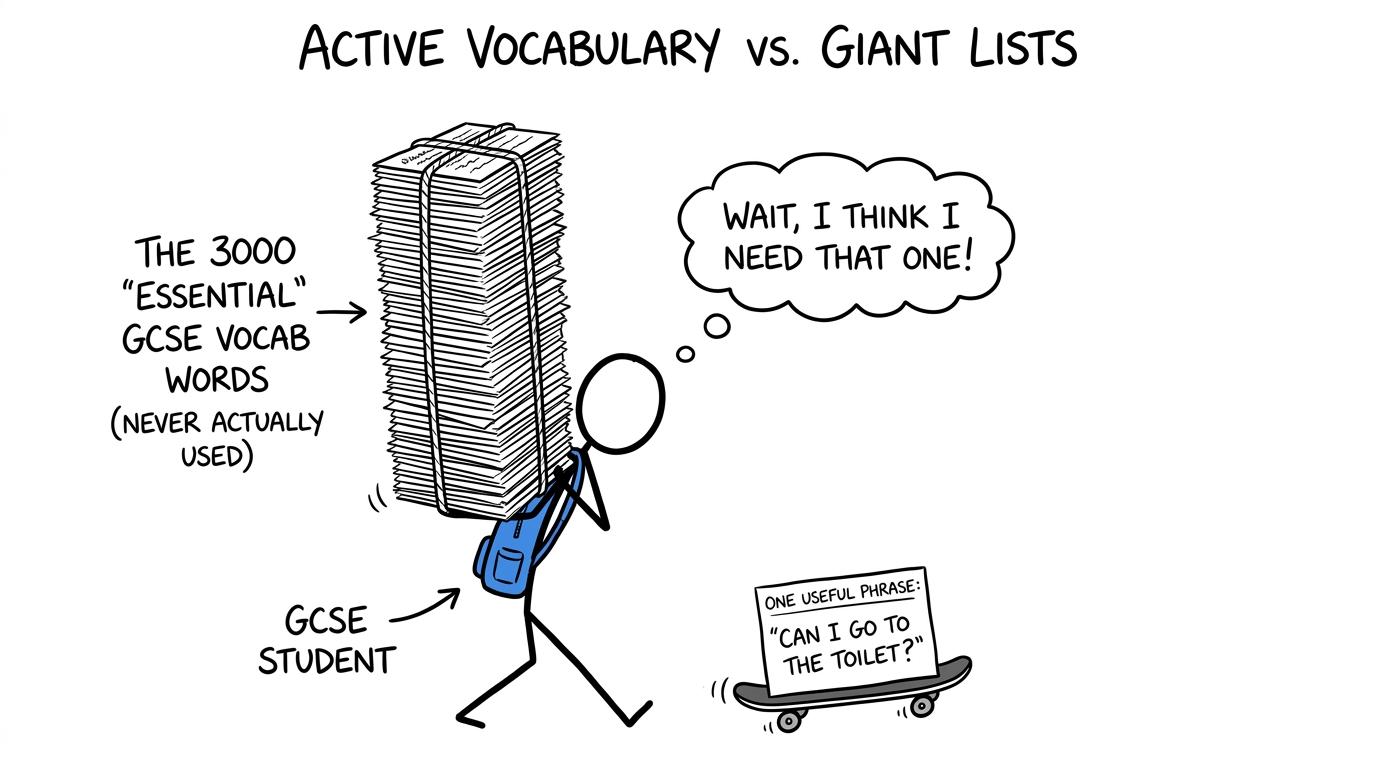 A vocabulary tower loses a race to one useful phrase
Develop answers without drifting off task
Longer is not automatically better. Development means adding information that directly answers the question.
A useful mental sequence is:
- make the point;
- add a reason;
- give a relevant detail;
- introduce another time frame or perspective where appropriate.
Before writing, underline every bullet point. After writing, check each one again. Missing part of the task creates a ceiling that ambitious vocabulary cannot repair.
Make grammar practice diagnostic
Do not spend every session copying complete verb tables or grammar notes. Use your marked work to find patterns.
Keep an error log with four categories:
- tense or time reference;
- word order and sentence construction;
- spelling or script accuracy;
- agreement, particles or other recurring grammatical features.
For each error, record the corrected form and the reason for the correction. Then use that structure in fresh sentences during later revision. This is the language equivalent of correcting a mathematical method rather than merely changing the final answer.
Improve listening through repeated, purposeful passes
Listening becomes difficult when students try to understand every word at once. Give each pass a job.
On the first pass, identify the topic, speaker and overall attitude. On the second, listen for names, negatives, quantities, time references and reasons. On the final review, use the question wording to decide which detail actually earns the mark.
Afterwards, distinguish between three problems: you did not know the language, you knew it but did not recognise it at speed, or you understood it but answered imprecisely. Each problem needs different practice.
Make speaking sound responsive, not recited
Memorised material can provide foundations, but Higher-tier speaking rewards effective interaction, relevant communication, pronunciation, fluency and the ability to respond.
Practise with unpredictable follow-up questions. Record short answers, listen back and notice where hesitation obscures meaning. If you forget an ambitious expression, use simpler accurate Bengali and keep communicating. Silence earns less than a clear recovery.
Read for evidence, not familiarity
A passage may feel familiar because you recognise its topic. That does not mean you have found the answer.
Underline the exact words supporting your response. Watch for negatives, contrasts and changes between past, present and future. In translation, preserve the meaning before trying to make the English elegant. Never add a plausible detail that the source does not contain.
Build a revision week around all four skills
Because the AQA skills are equally weighted, a balanced plan is safer than spending most of the week on writing.
Use four focused sessions for listening, speaking, reading and writing, followed by one mixed timed session. Each session should contain retrieval, exam-style practice, marking and a correction task. The structure matters more than an exhausting timetable.
You can borrow the planning logic from MathsGenie's best order for learning GCSE maths topics: secure foundations, add demanding material and then test performance under exam conditions. MathsGenie's GCSE Maths revision hub also shows how lessons, short tests and full papers can occupy different stages of revision.
If you are preparing for Bengali alongside Edexcel, AQA, OCR or Eduqas maths, place both subjects in one revision planner. Alternate language retrieval with mathematical problem-solving rather than assigning an entire evening to one subject. Short, defined tasks are easier to complete and review.
Use papers as evidence, not as a judgement
A paper should tell you what to do next. Begin with selected tasks, then progress towards complete timed assessments as the examination approaches. MathsGenie's advice on when to start GCSE past papers explains this phased approach clearly.
After each Bengali task, classify every lost mark:
- knowledge gap;
- inaccurate language;
- misunderstood instruction;
- omitted task detail;
- timing problem;
- weak exam technique.
Then choose a specific repair. A vocabulary gap needs retrieval practice. An omitted bullet point needs a checking routine. Poor timing needs another timed task, not another hour of reading notes.
Use official Bengali materials from your school or exam board for subject-specific assessment. MathsGenie's past-paper review method is designed for maths, but its cycle transfers well: complete, mark, diagnose, repair and reattempt.
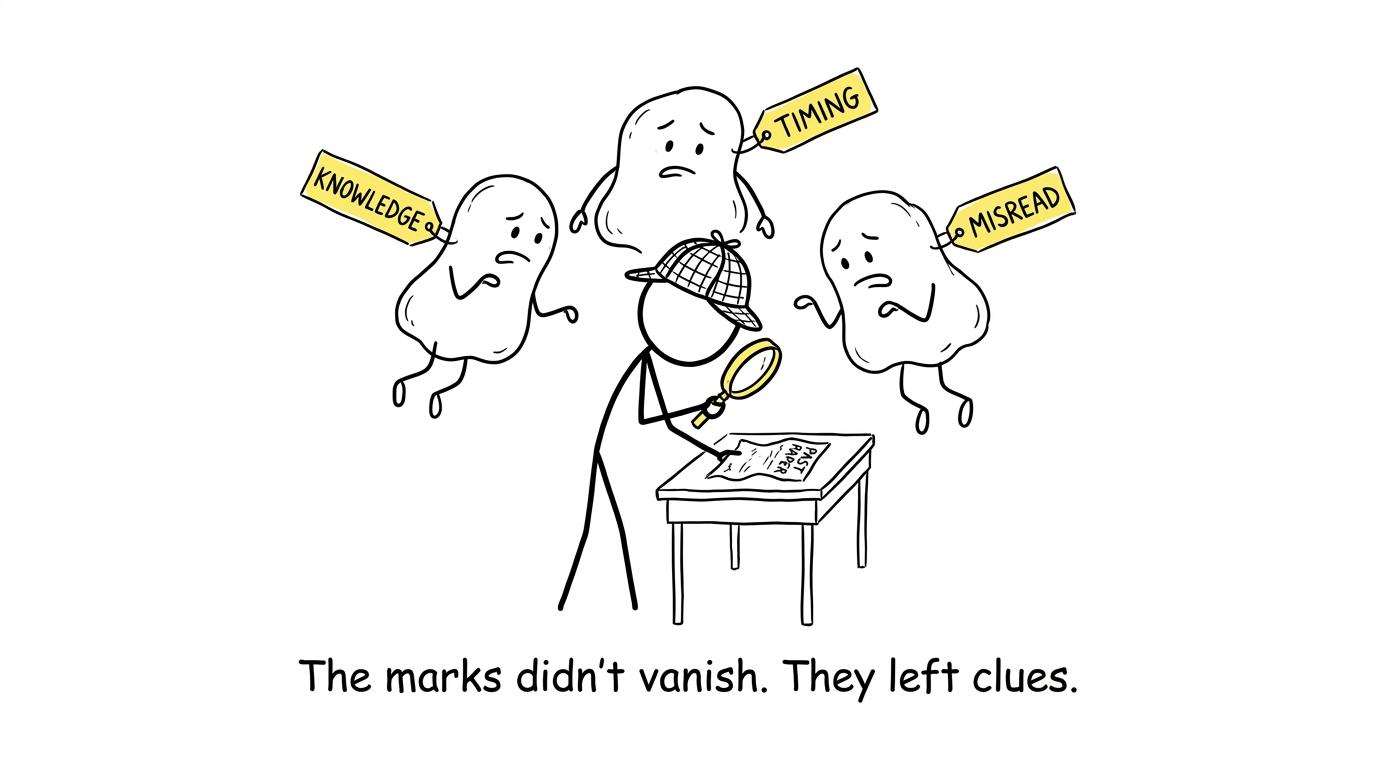 A student detective follows the clues left by lost marks
Common mistakes when aiming for grade 7
Revising only your strongest skill
Students who speak Bengali confidently at home may assume speaking requires little preparation. Everyday fluency does not automatically cover formal topics, role-play demands, precise reading or accurate writing. Treat each assessment skill separately.
Memorising essays word for word
A memorised response may not match the question. Build flexible phrases and structures that can be adapted while keeping every sentence relevant.
Choosing complexity over clarity
Ambition is valuable, but uncontrolled complexity can obscure meaning. Expand your range gradually and keep secure structures active alongside newer ones.
Ignoring the mark scheme
Completing tasks without studying how marks are awarded encourages repetition rather than improvement. Compare your work with the criteria and examiner commentary available for your qualification.
Treating one mock grade as a fixed identity
A mock is a sample of performance on one set of tasks. Analyse it carefully, but do not confuse it with a limit. The useful question is not, “Am I a grade 4 student?” It is, “Which language behaviours are keeping this response in that band?”
Using predicted papers as a forecast
Predicted materials are practice tools, not promises about what will appear. MathsGenie's GCSE predicted papers follow the same principle in maths: use them to practise timing and diagnose gaps, while covering the full specification.
Turn the grade gap into a repeatable system
Moving from grade 4 to grade 7 in GCSE Bengali is not one dramatic leap. It is a series of smaller changes: entering the correct tier, understanding all four assessments, retrieving language actively, developing answers, marking honestly and correcting recurring weaknesses.
Start with one timed task this week. Identify the three clearest causes of lost marks, repair them and reattempt a similar task. Then repeat the cycle.
MathsGenie remains your free home for GCSE and A Level maths revision. Use its GCSE revision resources, revision lessons, practice questions, mini tests, past papers, predicted papers, mark schemes and video solutions alongside your Bengali plan. The subjects are different, but the principle is the same: improvement becomes much less mysterious when every practice session produces a clear next step.