

GCSE Astronomy Weekend Revision: A Calm Routine
GCSE astronomy weekend revision made manageable: plan focused sessions, practise maths, use past papers and turn mistakes into an exam-ready checklist.
The final weekends before an exam can feel strangely unhelpful. There is enough time to improve, but not enough time to relearn an entire course. Open every textbook and the task feels enormous; choose nothing and the weekend quietly disappears.
A productive GCSE astronomy weekend revision routine is smaller and more deliberate: diagnose weak areas, repair two or three of them, complete timed questions, mark everything and schedule a short retest. You are not trying to cover the universe in two days. You are trying to make your next paper better than your last one.
For the current Pearson Edexcel GCSE Astronomy qualification, each of the two written papers lasts 111 hour 454545 minutes and is worth 100100100 marks. Mathematical skills account for at least 20%20\%20% of the qualification, so astronomy revision and maths practice belong in the same weekend plan.
Your weekend revision checklist
Use this as the backbone of the routine:
- Check whether your next exam is Paper 111 or Paper 222.
- Complete a short closed-book diagnostic.
- Choose no more than three priority areas.
- Include one astronomy topic, one observational skill and one maths skill.
- Work in focused blocks with proper breaks.
- Mark questions on the day you attempt them.
- Record the cause of every lost mark.
- Retest the weakest skill on Sunday.
- Finish with a short plan for the following week.
Start from the Edexcel GCSE Astronomy revision hub, where you can find astronomy lessons, questions, past papers and mark schemes in one place.
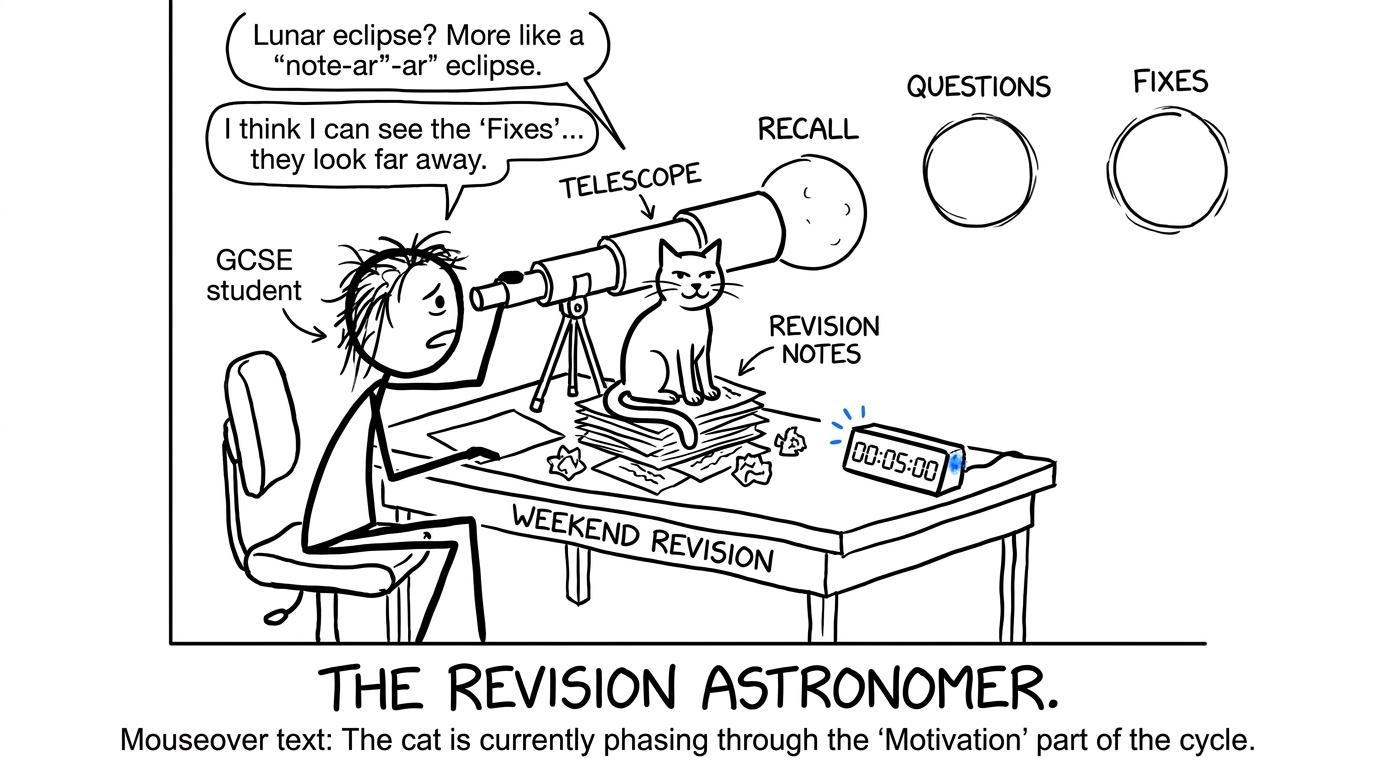 A student uses a cardboard telescope to focus weekend revision on recall, questions and fixes while a cat blocks the notes
Begin by matching the right astronomy paper
GCSE Astronomy is currently offered through Pearson Edexcel specification 1AS01\text{AS}01AS0. It is untiered, so there is no foundation or higher paper to select. This differs from GCSE Maths, where students may be entered for different boards and tiers.
Paper 111, Naked-eye Astronomy, assesses Topics 111-888. These include the Earth, Moon and Sun; time and astronomical cycles; celestial observation; early Solar System models; and planetary motion and gravity.
Paper 222, Telescopic Astronomy, assesses Topics 999-161616. Its content includes lunar and solar exploration, planetary systems, starlight, stellar evolution, the Galaxy and cosmology.
Before starting, write the relevant paper at the top of your plan. That simple decision prevents a common form of wasted revision: spending Saturday polishing a comfortable Paper 222 topic when Paper 111 is the immediate priority.
Saturday morning: diagnose before revising
Begin with a 353535-454545 minute closed-book section from an astronomy past paper. Use a calculator and the materials permitted for the real assessment, but do not consult notes or pause to search for an explanation.
This is not your final performance. It is evidence.
Mark the section immediately and classify each lost mark:
- Recall: a fact, definition or process was missing.
- Application: you knew the content but could not use it in context.
- Maths: the astronomy was understood, but the calculation failed.
- Observation: you could not plan, interpret or evaluate a method.
- Technique: you misread a command word, omitted units or rounded incorrectly.
Pearson’s assessment objectives place 40%40\%40% on knowledge and understanding, 40%40\%40% on application and 20%20\%20% on analysis, interpretation and evaluation. Your routine therefore needs more than flashcards. It must include unfamiliar questions and data.
MathsGenie’s past-paper library and exam timer can help you reproduce realistic conditions. The important part comes afterwards: use the mark scheme to decide what must change.
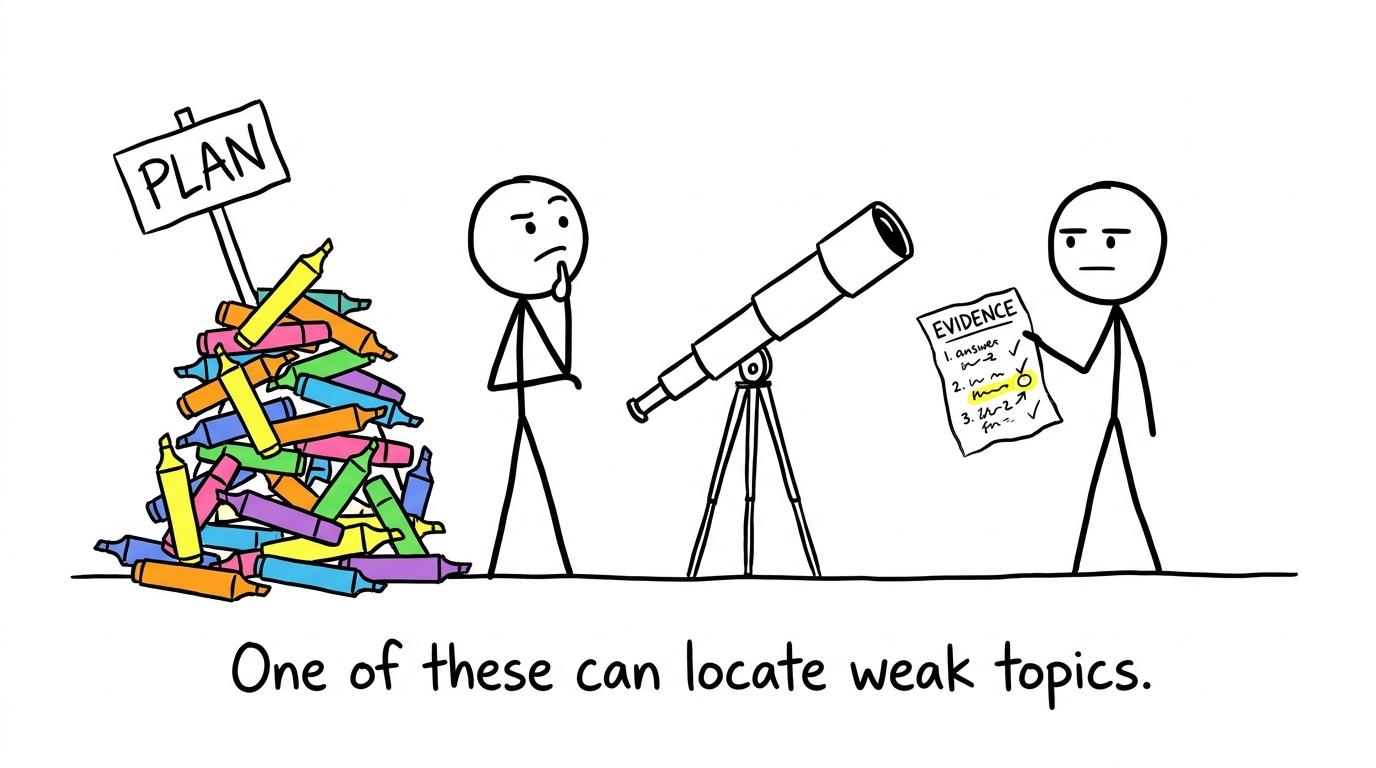 Two astronomers compare a giant pile of highlighters with one completed practice paper as evidence of weak topics
Saturday afternoon: repair the biggest gaps
Choose the two areas responsible for the most lost marks. Do not write broad targets such as “cosmology” or “maths”. Make each target observable:
- explain evidence for an astronomical model without notes;
- interpret a light curve or other unfamiliar graph;
- convert astronomical quantities using standard form;
- describe how an observation could be made safer or more reliable;
- rearrange a supplied formula before substituting values.
For each area, use a three-stage block:
Rebuild for 202020 minutes
Read a concise revision lesson or watch a video solution. Close the resource and write down the main idea from memory. If you cannot explain it simply, revisit only the missing part.
Practise for 252525 minutes
Attempt relevant questions without copying a model answer. Astronomy questions can combine factual knowledge, calculations, graphical interpretation and extended responses, so include more than one question style.
Review for 151515 minutes
Mark the work and write one correction rule. “Be more careful” is not a useful rule. “Convert both distances into the same unit before dividing” is.
The wider GCSE Maths revision hub is useful when an astronomy error is really a maths weakness. Choose the page for your own maths exam board where appropriate.
Give astronomy maths its own session
Mathematical skills contribute at least 20%20\%20% of GCSE Astronomy marks and are assessed within an astronomical context. A student may understand stellar distances perfectly yet lose marks through an exponent, unit or rearrangement error.
Set aside one Saturday block for these recurring skills.
Standard form and significant figures
Astronomical scales often involve very large or very small quantities. You should recognise the structure
a×10n,1≤a<10,a \times 10^n, \qquad 1 \leq a < 10,a×10n,1≤a<10,compare powers of ten, calculate using them and present an answer to an appropriate number of significant figures. Use the standard form revision guide if exponent rules are costing marks.
Formulae, substitution and units
The astronomy examination provides a Formula and Data Sheet containing key equations and data. This reduces the need to memorise equations, but it does not remove the need to select the correct relationship, substitute accurately and show a clear method.
Practise keeping units beside values and checking that the final unit answers the question. If rearranging is the obstacle, revisit changing the subject of a formula.
Ratios and inverse-square relationships
Brightness, intensity and gravitational contexts can involve inverse-square reasoning. The general relationship
y∝1x2y \propto \frac{1}{x^2}y∝x21means that increasing xxx reduces yyy according to the square of the change. Do not treat this as ordinary inverse proportion. Strengthen the distinction using the direct and inverse proportion resources.
Graphs and angular measures
Be ready to translate between numerical and graphical information, plot data, calculate a gradient and interpret an intercept. The specification also includes angles in degrees, minutes and seconds of arc, along with coordinates on the celestial sphere.
These skills reward calm working. Label axes, include units, use sensible scales and take gradient readings from widely separated points on a line of best fit.
Sunday morning: practise observational thinking
Observational work is not a decorative part of the course. Students undertake at least one unaided and one aided astronomical observation, while knowledge and application of observational skills are assessed in the written examinations. At least 15%15\%15% of qualification marks relate to observational skills.
Your school handles the formal observation requirements, so the final revision weekends are not the time to invent an unapproved replacement task. Instead, practise explaining:
- what equipment and location would be suitable;
- how variables could be controlled;
- how observations could be recorded consistently;
- how risks, including solar observation risks, should be managed;
- what limits the quality of the data;
- how reliability and validity could be improved;
- what conclusion the evidence supports.
Build answers around a clear chain: decision, astronomical reason and effect on the evidence. This is more useful than memorising a generic paragraph about accuracy.
Sunday afternoon: complete a timed retest
Return to the two weakest areas from Saturday, but use fresh questions. A correction copied beside the original answer can create confidence without proving that the method is secure.
Spend approximately 303030 minutes on the retest, then mark it. Compare the type of mistake, not merely the total. If standard form errors have disappeared but observational evaluation remains vague, you now know where the next weekday session should begin.
Follow the wider method in how to use GCSE past papers properly: attempt, mark, diagnose, repair and retest. Past papers reveal weaknesses; the improvement happens when you act on them.
 A student launches a distracting phone in a tiny rocket while keeping a timer and calculator on the desk
Adapt the routine as the exam approaches
In the earlier final weeks, spend more time repairing individual topics. In the last two weekends, shift towards mixed and timed work.
| Stage | Main weekend focus |
|---|---|
| Several weeks remaining | Topic diagnosis, revision lessons and focused questions |
| Around two weeks remaining | Mixed paper sections, maths repair and observational responses |
| Final weekend | One realistic paper or paper section, careful marking and light review |
Do not exhaust yourself with several complete papers on the final Sunday. The purpose is to arrive able to think, not merely able to say you revised for many hours. The GCSE one-month revision plan offers a useful framework for fitting weekend work into the rest of your subjects.
Common GCSE astronomy weekend revision mistakes
Revising only favourite topics
Familiar material feels fluent, which makes the session pleasant but less valuable. Let past-paper evidence choose at least half of your targets.
Reading for hours without retrieval
Reading can rebuild understanding, but it does not test whether you can retrieve and apply knowledge. Close the notes, answer a question and then check.
Ignoring the supplied Formula and Data Sheet
Do not wait until the exam to understand its layout. Practise locating relevant information quickly, while remembering that selecting and manipulating a formula remains your responsibility.
Treating every lost calculation mark as an astronomy problem
Sometimes the real issue is standard form, proportion, graph reading or algebra. Repair that underlying skill rather than rereading the astronomy chapter.
Marking without writing a correction
A total mark records the past. A specific correction changes the future. Keep a short error log containing the question type, cause and next-time rule.
Sacrificing sleep for one more session
A tired late-night paper often measures fatigue rather than knowledge. Set a finish time, prepare equipment for Sunday and stop when the planned work is complete.
Finish the weekend with a smaller target
A good weekend does not end with “revise more”. It ends with a precise next action: redo graph interpretation on Tuesday, review stellar evolution on Wednesday or complete a timed Paper 111 section next Saturday.
That is how a large course becomes manageable. One paper reveals the gap. One lesson repairs it. Practice questions make the method usable, and a retest proves whether it has lasted.
Use the free MathsGenie GCSE Astronomy resources as your starting point, then strengthen calculation skills through MathsGenie’s revision lessons, practice questions, mark schemes, video solutions and mini tests. Past papers should test your preparation; predicted papers can provide fresh rehearsal where available. Plan the weekend, complete the first diagnostic and let the evidence decide what comes next.











