

GCSE Astronomy Time Pressure Mistakes to Avoid
GCSE astronomy time pressure mistakes explained: avoid lost marks from units, signs, graphs and rushed answers with a calm, practical exam plan.
The clock rarely causes a student to forget astronomy. It causes something subtler: knowledge becomes hurried. A correct equation is used with inconsistent units. A carefully drawn orbit has no labels. An answer describes what happens when the command word asks why.
The most common GCSE astronomy time pressure mistakes are misreading instructions, hiding working, reversing signs, mishandling units, rushing graphs and leaving straightforward questions unanswered. The solution is not simply to work faster. It is to use a short routine that protects marks when your attention is stretched: read, set up, answer, check, move on.
This article focuses on Pearson Edexcel GCSE Astronomy specification 1AS01\mathrm{AS}01AS0. The current qualification is untiered, with two written papers worth 100100100 marks each and lasting 111 hour 454545 minutes. Its mathematical demands also make the advice useful for GCSE maths and science revision.
Your quick time-pressure checklist
Before moving away from a question, ask:
- Have I followed the command word?
- Have I used every relevant value supplied?
- Are my units consistent?
- Is my equation and substitution visible?
- Does the final answer include a unit where required?
- Have I rounded only at the end?
- Are diagrams, axes and plotted points labelled clearly?
- Does my answer make physical and astronomical sense?
This takes seconds once rehearsed. It is a safety rail, not another task.
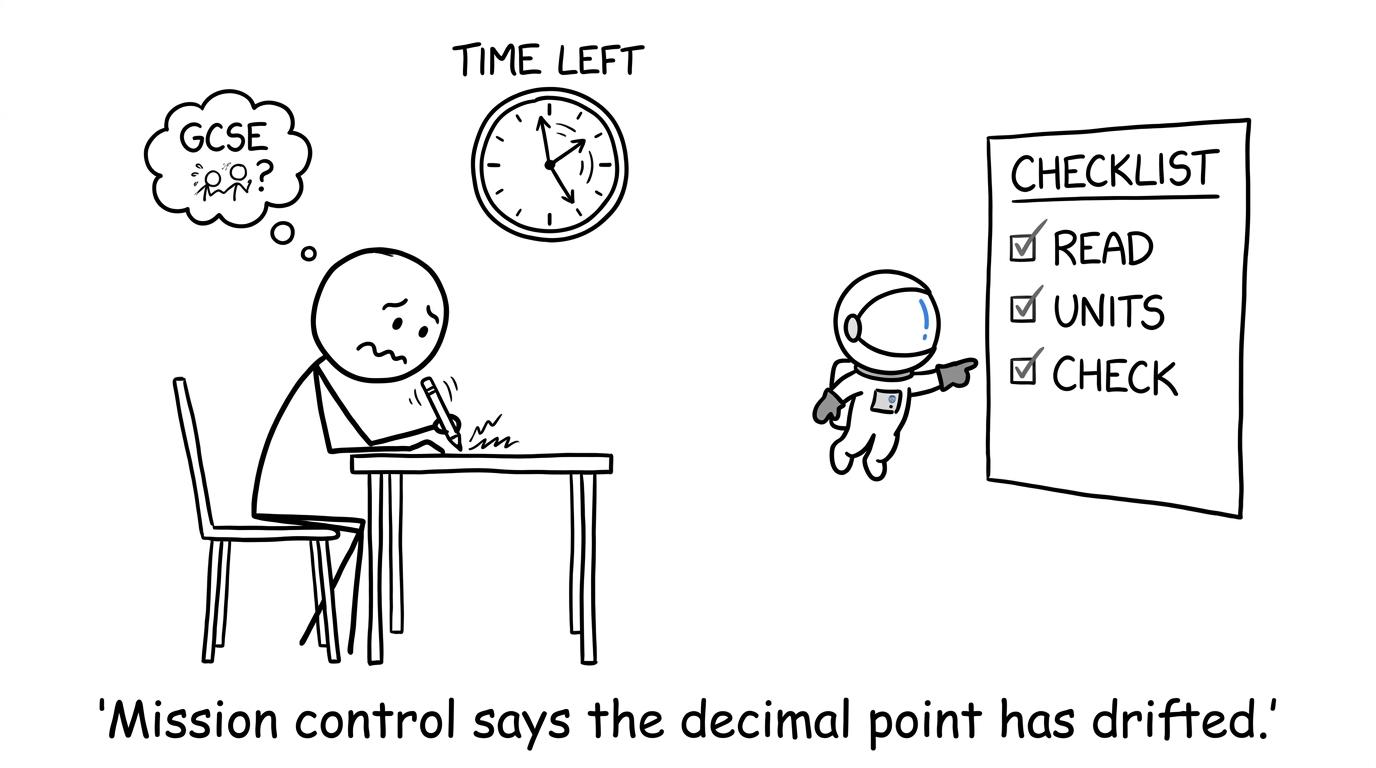 A student races the exam clock while mission control warns that the decimal point has drifted
Why time pressure changes otherwise good answers
Each Astronomy paper gives 105105105 minutes for 100100100 marks. That is an average of
105100=1.05 minutes per mark.\frac{105}{100}=1.05\text{ minutes per mark}.100105=1.05 minutes per mark.Treat this as a rough pacing signal rather than a rigid rule. A multiple-choice item may take less time, while an extended response or multi-stage calculation deserves longer. The danger is spending several minutes trying to perfect one stubborn answer while accessible marks remain elsewhere.
Use two passes. On the first, collect the marks you can reach reliably. Mark difficult parts and return to them. On the second, tackle longer calculations and explanations with the time that remains. This is calmer than allowing one question to control the whole paper.
You can rehearse that rhythm with the timed tools in MathsGenie’s past papers library. Although GCSE Astronomy papers should come from Pearson, timed GCSE maths and science papers are useful for developing decisions about when to persist and when to move on.
Common mistakes that lose avoidable marks
Answering a different command word
Pearson’s Astronomy taxonomy distinguishes between commands such as describe, explain, compare, evaluate, calculate and show. Under pressure, students often recognise the topic and write everything they remember. The answer may be scientifically correct but still fail to perform the requested task.
A description states what happens. An explanation gives a reason. A comparison must address both objects or situations. An evaluation considers relevant evidence and reaches a judgement. For a “show” question, the reasoning is the answer because the final value is already supplied.
Circle or underline the command word before writing. Then glance at the available marks. Together, they indicate the shape and depth of the response.
Giving only the calculator answer
Astronomy calculations can involve standard form, logarithms, squares, cubes and rearranged equations. Pearson examiner reports emphasise clear, structured working, particularly where several marks are available.
Use this visible sequence:
equation→substitution→calculation→unit.\text{equation}\rightarrow\text{substitution}\rightarrow\text{calculation}\rightarrow\text{unit}.equation→substitution→calculation→unit.The examination provides the required astronomical formulae and data sheet, so the main challenge is selecting and using the correct relationship. Relevant formulae include
Equation of Time=AST−MST,\text{Equation of Time}=\mathrm{AST}-\mathrm{MST},Equation of Time=AST−MST, T2r3=constant,\frac{T^2}{r^3}=\text{constant},r3T2=constant,and
M=m+5−5logd.M=m+5-5\log d.M=m+5−5logd.Do not compress all the thinking into one calculator entry. Visible steps make checking easier and give the mark scheme evidence of your method. If rearranging is a weak point, use the changing the subject revision guide, followed by changing the subject practice questions.
Mixing units and powers of ten
Astronomy moves between kilometres, astronomical units, light-years, parsecs and megaparsecs. It also uses hours, minutes and seconds, as well as degrees, arcminutes and arcseconds. A familiar calculation can therefore produce an answer that is wrong by a large factor.
Remember the angular relationships
1∘=60 arcmin,1^\circ=60\text{ arcmin},1∘=60 arcmin, 1 arcmin=60 arcsec.1\text{ arcmin}=60\text{ arcsec}.1 arcmin=60 arcsec.Do not treat time or angles as ordinary base-101010 decimals unless you have deliberately converted them. Likewise, write quantities in compatible units before substitution. MathsGenie’s guide to units, significant figures and standard form brings these connected skills together.
 A student discovers a missing unit by using a calculator as a telescope
Reversing signs and directions
Sign mistakes are especially common in time corrections, longitude questions, redshift calculations and changes involving “earlier” or “later”. Pearson examiner reports have noted students adding when they should subtract in Equation of Time questions and moving an object in the wrong temporal direction.
The safest defence is not a memorised slogan. Return to the defined equation:
Equation of Time=AST−MST.\text{Equation of Time}=\mathrm{AST}-\mathrm{MST}.Equation of Time=AST−MST.Write it first, rearrange it visibly, and only then substitute signed values. For positional questions, annotate the prompt with a small word such as “earlier”, “west” or “approaching” before drawing or calculating. One written cue can stop the question from reversing in your head.
Rounding too early or too aggressively
The specification expects an appropriate number of significant figures. Rounding every intermediate value can create avoidable drift, while copying every calculator digit suggests unjustified precision.
Keep the calculator’s full value during the method and round once at the end. Follow any explicit instruction in the question. If no precision is specified, choose a sensible number of significant figures based on the data supplied. The standard form revision guide is useful for practising powers of ten without losing control of the coefficient or exponent.
Rushing graphs and data displays
Graph questions can feel easy, which makes them dangerous under pressure. Common losses include reversing the axes, overlooking a non-zero scale, plotting a point in the wrong square, omitting units or drawing an unsuitable line.
Before plotting anything, identify:
- the independent and dependent variables;
- the quantity and unit on each axis;
- the scale interval;
- whether the question requires points, a line, a curve or a line of best fit.
After plotting, check the most awkward point rather than the easiest one. Finally, inspect whether the pattern is plausible. Astronomy questions may ask you to translate between graphical and numerical information, so presentation is part of the reasoning rather than decoration.
Drawing diagrams without useful labels
A rushed diagram may contain the right idea but leave the examiner guessing which line represents the ecliptic, orbit, axis, light ray or celestial object. Pearson examiner reports explicitly warn that unlabelled features can prevent marks from being awarded.
Draw large enough to show the relationship clearly. Add arrowheads where direction matters and label every feature needed by your explanation. Artistic quality is irrelevant; unambiguous communication is not.
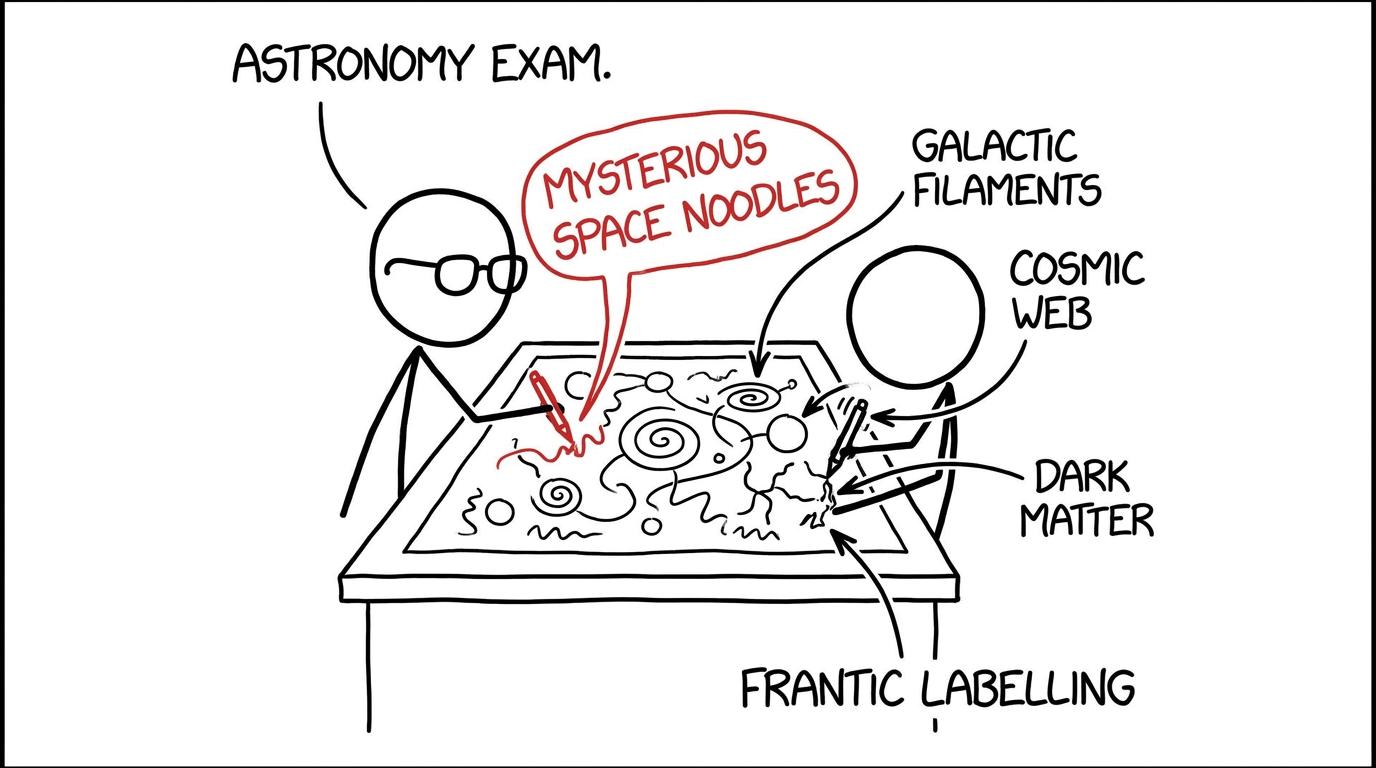 An examiner calls an unlabelled astronomy diagram mysterious space noodles
Forgetting to compare both sides
When asked to compare telescopes, models, observations or astronomical objects, students sometimes write a detailed account of only one. A comparison needs linked statements. Useful structures include “whereas”, “both” and “in contrast”.
For an evaluation, go one step further: weigh relevant strengths and limitations, then state a justified conclusion. Do not spend most of the available time listing facts and leave the judgement unfinished.
Leaving blanks because an answer feels incomplete
A blank response cannot show partial understanding. If time is short, write the relevant formula, label the known values, state one correct comparison or add the missing labels to a diagram. This is not permission to guess randomly. It is a reminder to put relevant knowledge where it can be assessed.
A checking routine for the final minutes
Reading the whole paper again is rarely the best use of a short checking window. Search for high-risk errors in a fixed order:
- unanswered questions and missed subparts;
- command words and requested numbers of reasons;
- units and conversions;
- negative signs and direction words;
- copied data and calculator entries;
- significant figures;
- graph axes, scales and labels;
- final judgements in evaluate questions.
Then perform a reasonableness check. A telescope magnification should follow
magnification=fofe,\text{magnification}=\frac{f_o}{f_e},magnification=fefo,with compatible focal-length units. A standard-form answer should have a coefficient aaa satisfying
1≤a<10.1\leq a<10.1≤a<10.A redshift result should agree with the direction of the wavelength change. You are not repeating the full solution; you are asking whether the answer belongs in the right universe.
MathsGenie’s GCSE exam-week checklist provides a broader routine for calculator preparation, timed sections and focused checking.
How to practise accuracy before the examination
Pressure exposes habits. It does not create them from nothing. If your untimed working hides units, your timed working will probably hide them faster.
After each practice section, classify every lost mark as one of four types:
- knowledge;
- method;
- interpretation;
- careless execution.
Write a one-line prevention rule beside each error, such as “convert before substituting” or “compare both objects”. Then redo that question after a gap without viewing the solution. The aim is not to remember an answer; it is to install a safer process.
Use short, timed maths drills for recurring Astronomy skills: standard form, formula rearrangement, ratios, graph reading, rounding and unit conversion. MathsGenie’s article on revision mistakes that waste time explains how to turn marking into an error log rather than a simple score.
Make calm technique automatic with MathsGenie
Astronomy rewards curiosity, but the examination also rewards disciplined communication. The difference between knowing an idea and earning the mark can be one label, one unit, one sign or one visible line of working.
Start with a MathsGenie revision lesson on your weakest mathematical skill. Move immediately to practice questions, check your work against the mark scheme and use video solutions when your method is unclear. Then test the repair through mini tests, past papers and predicted papers, using the revision planner to revisit the skill before it fades.
You do not need to outrun the clock. You need a process that still works while the clock is running. Open MathsGenie’s past paper tools, set a realistic timer and practise protecting the easy marks first.











