

GCSE Astronomy Grade 5 Meaning: What It Shows
GCSE astronomy grade 5 meaning explained: understand the ability it represents, old letter-grade comparison, boundaries and how to improve your score.
A result can look wonderfully precise while leaving you unsure what it says about you. You open the envelope, see a grade, and immediately wonder whether it counts as good, average or merely enough.
The gcse astronomy grade 5 meaning is best understood as secure, broadly competent performance. It indicates that you can recall and apply mostly accurate astronomical knowledge, use maths in multi-step calculations, interpret data, draw plausible conclusions and evaluate observational methods. It is above the standard associated with the bottom of the old grade C, but it is not cleanly equivalent to one old letter grade.
That last detail matters. A grade is not simply a percentage translated into a label. It reflects the standard demonstrated across the complete qualification in that examination series.
Grade 5 at a glance
A grade 555 in GCSE Astronomy means that you can generally:
- use mostly accurate astronomical knowledge and terminology;
- explain ideas in familiar and unfamiliar situations;
- apply knowledge rather than only repeat memorised facts;
- complete multi-step mathematical calculations;
- analyse qualitative and quantitative data;
- reach plausible conclusions supported by evidence;
- identify weaknesses in observational methods and suggest improvements.
For the current Pearson Edexcel GCSE Astronomy qualification, the result comes from two equally weighted written papers. The course is untiered, so there is no foundation or higher paper and the full grade range from 999 to 111 is available to every candidate.
You can explore the course resources through the Edexcel GCSE Astronomy revision hub.
 A student asks whether grade 5 is halfway to the Moon
What ability does a grade 5 actually represent?
Official grade descriptors do not describe every student perfectly. They indicate the typical standard of performance around the middle of a grade, rather than acting as a checklist in which every statement must be satisfied equally.
Still, the descriptor reveals something important: grade 555 performance is not based on recall alone.
Mostly accurate knowledge and explanations
A grade 555 student should know much of the course content and use appropriate astronomical language with reasonable accuracy. This covers the ideas examined across naked-eye and telescopic astronomy, including the Earth, Moon, Solar System, stars, galaxies and cosmology.
The word mostly is useful. It does not mean flawless. You may confuse a detail, omit part of an explanation or lose accuracy in a longer response. But your answers should usually show that you understand the underlying scientific idea.
A grade 555 also suggests that you can use knowledge in an unfamiliar context. Examiners may provide a diagram, observation or set of data you have not seen before. The task is then to recognise which part of your knowledge applies.
Secure application, not perfect independence
Pearson weights the assessment objectives across the qualification as follows:
| Assessment objective | Weighting | What it tests |
|---|---|---|
| AO1 | 40%40\%40% | Knowledge and understanding of scientific ideas, techniques and procedures |
| AO2 | 40%40\%40% | Application of that knowledge and understanding |
| AO3 | 20%20\%20% | Analysis, evaluation, conclusions and improvements to observations |
This balance explains why memorising a revision guide is not enough. Knowing a fact may earn credit through AO1, but a large proportion of the qualification asks you to use what you know or reason from evidence.
At grade 555, that application is generally sound, although harder questions may expose gaps. You might select the right principle but miss a link in the explanation, or begin a calculation correctly before making an accuracy error.
Mathematical confidence across several steps
At least 20%20\%20% of the marks in GCSE Astronomy assessments must test mathematical skills in an astronomical context. These include standard form, ratios, percentages, inverse-square relationships, significant figures, unit conversions, algebra, graphs, gradients and angular measures.
The official grade 555 descriptor specifically refers to performing multi-step calculations. That means being able to connect stages rather than relying on one calculator operation. Typical demands include choosing relevant information, selecting or rearranging an equation, converting units and presenting the result appropriately.
Students preparing for GCSE maths therefore have a genuine advantage. Strengthening standard form, changing the subject of a formula and ratio skills supports both subjects.
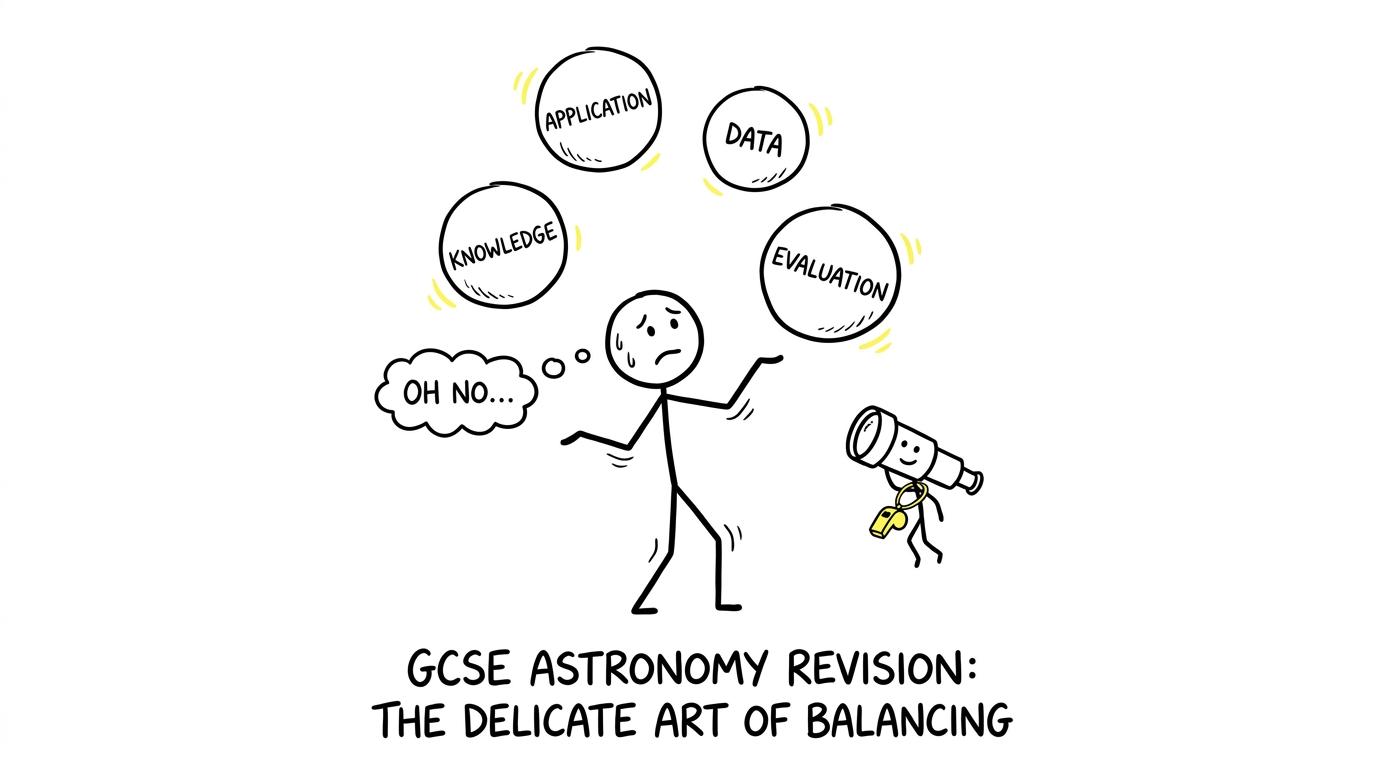 A student balances the four planets of astronomy performance
Data analysis and sensible conclusions
A grade 555 student can usually interpret graphs, tables, images and written observations. They should identify patterns and use evidence to reach plausible conclusions.
“Plausible” does not necessarily mean complete. A conclusion might be scientifically reasonable but supported by only some of the available evidence. Moving towards grades 666 and 777 often requires more precise use of data, stronger links between evidence and conclusion, and better consideration of uncertainty.
Evaluation of observations
GCSE Astronomy requires students to undertake at least two astronomical observations: one aided and one unaided. Teachers certify their completion, but these activities are not a separately marked coursework component in the current qualification. Knowledge and understanding developed through observational work are assessed in the written examinations.
At grade 555, you should be able to comment on an observational method and suggest realistic improvements. That may involve accuracy, reliability, viewing conditions, equipment, repeated observations or sources of random and systematic error.
The strongest responses do more than say “repeat the observation”. They explain what should change and why that change would improve the evidence.
How grade 5 compares with the old letter grades
The numbered and letter scales do not have exact one-to-one equivalents. Official comparison points are:
- the bottom of grade 777 is comparable with the bottom of the old grade A;
- the bottom of grade 444 is comparable with the bottom of the old grade C;
- the bottom of grade 111 is comparable with the bottom of the old grade G.
Grade 555 sits between the anchored grades 444 and 777. When the numbered scale was designed, it was positioned broadly across the upper part of the old C range and the lower part of the old B range.
So the fairest short description is:
A grade 555 is stronger than the minimum standard associated with an old grade C, but it should not automatically be called an old grade B.
You may hear grade 555 described as a “strong pass”. That term is used particularly in the Department for Education’s school performance measures for GCSE English and maths. It should not be treated as a universal entry rule for Astronomy. Schools, colleges and employers set their own subject requirements.
Grade boundaries are not fixed percentages
A common misunderstanding is that grade 555 always means the same percentage. It does not.
Pearson sets an overall qualification boundary for each examination series after the papers have been taken and marked. Boundaries can move because the difficulty of the papers is not identical every year. The aim is to maintain a comparable standard, not to preserve one percentage forever.
Recent confirmed Edexcel GCSE Astronomy grade 555 boundaries were:
| Summer series | Maximum mark | Grade 555 boundary |
|---|---|---|
| 202220222022 | 200200200 | 959595 |
| 202320232023 | 200200200 | 949494 |
| 202420242024 | 200200200 | 949494 |
| 202520252025 | 200200200 | 103103103 |
These are overall boundaries across both papers. Individual papers do not receive separate qualification grades. Historical figures are useful for interpreting past performance, but they cannot tell you the boundary for a future series.
MathsGenie keeps the confirmed figures together on the Edexcel GCSE Astronomy grade boundaries page. For a broader explanation of how awarding works, read GCSE grade boundaries explained.
What separates grade 5 from the grades around it?
The difference is often consistency rather than one dramatic leap in intelligence.
A grade 444 response may show sound knowledge in straightforward situations but become less secure when several ideas must be combined. At grade 555, knowledge is generally more accurate, mathematical work can be sustained across multiple stages, and conclusions are more likely to use supporting evidence.
A grade 666 or 777 candidate typically brings greater precision. Their explanations connect causes and consequences more completely. Their calculations are less vulnerable to unit or rounding errors. Their evaluations identify specific limitations and explain the likely effect on results.
This is encouraging because consistency is trainable. You do not need to become a different kind of student. You need to make fewer avoidable errors and improve the quality of the reasoning already present.
How to move beyond a grade 5
Start with evidence, not a feeling. Complete an Astronomy paper or mixed set under timed conditions and mark it carefully. Then sort every lost mark into one of four categories:
- missing knowledge;
- weak application;
- mathematical error;
- incomplete analysis or evaluation.
Patterns usually appear quickly. If calculations are the problem, use targeted GCSE maths revision before returning to Astronomy questions. If evaluation marks disappear, practise identifying a limitation, its effect and a specific improvement.
A reliable revision cycle is:
- learn or retrieve one small topic;
- answer questions without notes;
- mark them using the mark scheme;
- record the exact reason for each lost mark;
- repair the weakest skill;
- retest it several days later.
Short practice can be more revealing than another hour of reading. The Edexcel GCSE Maths mini tests help sharpen transferable calculation skills, while the guide to using GCSE past papers properly explains how to turn marks into a useful revision plan.
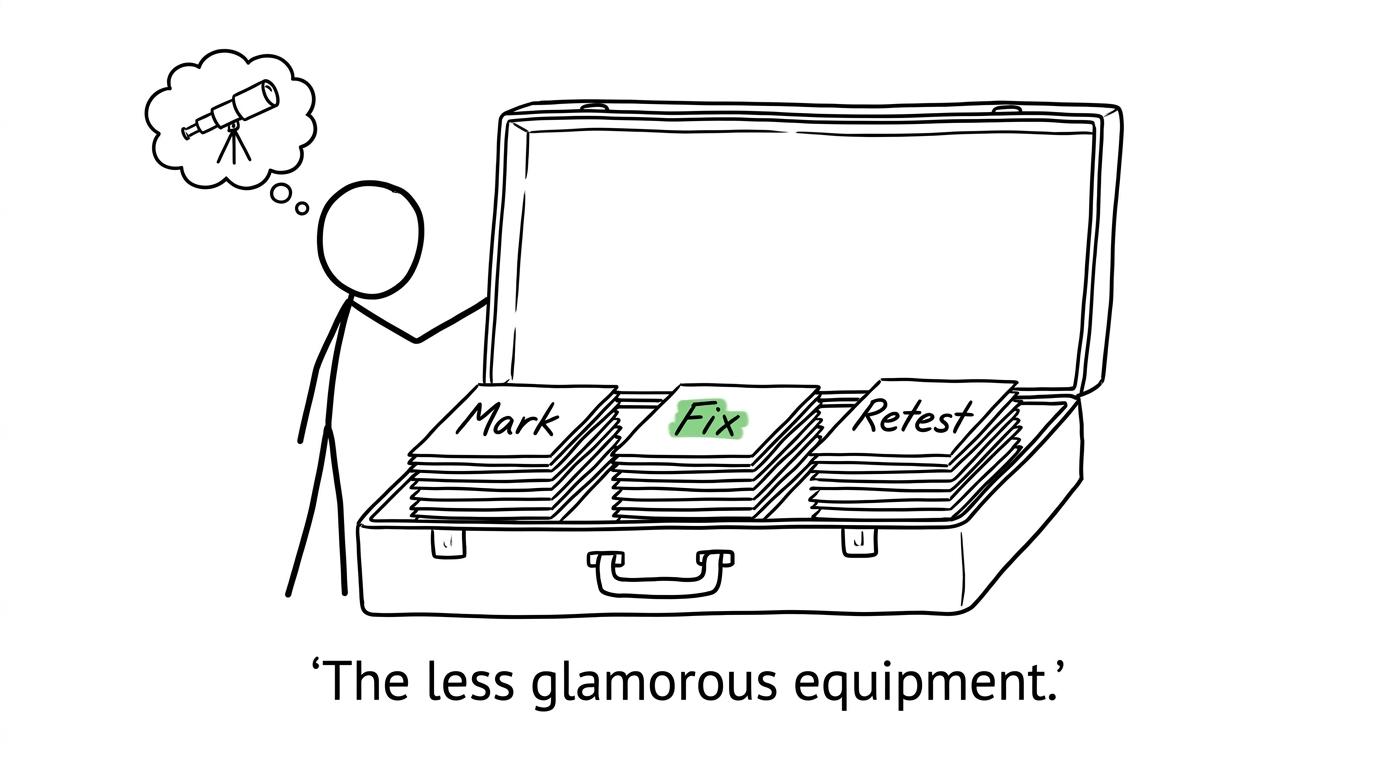 The less glamorous equipment inside a telescope case
Common mistakes when interpreting or targeting grade 5
Treating grade 5 as a fixed percentage
Past boundaries are evidence, not predictions. Use them to understand previous series, but do not build your revision around one assumed future mark.
Calling it exactly an old grade B
Grade 555 overlaps the broad territory previously covered by grades B and C. The scales were designed differently, so an exact conversion is misleading.
Revising facts but ignoring application
AO2 carries the same weighting as AO1. You must practise using knowledge in diagrams, calculations, unfamiliar situations and observational contexts.
Dropping easy mathematical marks
Astronomy calculations often become difficult because of notation, units or several connected steps rather than advanced maths. Show your method, keep units visible and avoid rounding too early.
Giving generic evaluation answers
“Use better equipment” is rarely enough. Name the limitation, explain its likely effect and propose a feasible improvement.
A grade is a snapshot, not a ceiling
A grade 555 in GCSE Astronomy represents meaningful scientific ability. It shows that you can combine mostly accurate knowledge with application, mathematical reasoning, data interpretation and evaluation. It is above the old grade C threshold, but it is not an exact substitute for an old B.
More importantly, it tells you where improvement is likely to come from. The journey beyond grade 555 is usually built from precision: one clearer explanation, one correct unit conversion and one better-supported conclusion at a time.
Use the free MathsGenie GCSE Astronomy resources to find papers and mark schemes, then strengthen the mathematics underneath your science with revision lessons, practice questions, mini tests and video solutions. When preparing for your maths examinations, add Edexcel GCSE Maths predicted papers to test whether those skills remain secure under pressure.
Start with one paper. Mark it honestly. Let every lost mark choose what you revise next.











