GCSE Astronomy Coursework Deadlines: Stay Calm
GCSE astronomy coursework deadlines explained: pace observations, allow for cloudy nights and complete your analysis without a stressful last-minute rush.
The deadline can look comfortably distant until clouds cancel an observation, a photograph will not open and three other GCSE assignments arrive in the same week. That is why GCSE astronomy coursework deadlines need more than a date in your calendar. They need a plan that accounts for weather, equipment, analysis and your wider maths revision.
The essential answer is simple: find your school's internal deadline first, then plan backwards from it. For Pearson Edexcel GCSE Astronomy (1AS0), centres must submit an Observation Statement by 15 April in the year students sit their examinations. Your school will normally set earlier deadlines so teachers can check completion and deal with problems. Follow the date given by your teacher rather than treating Pearson's centre deadline as your personal submission date.
Your deadline checklist
Before worrying about the finished report, confirm these details:
- Write down your school's deadline for the plan, observations, draft and final submission.
- Check which unaided and aided observational tasks you are completing.
- Confirm when equipment and teacher support are available.
- Reserve several possible observation nights, not just one.
- Create folders for plans, raw observations, photographs, analysis and drafts.
- Protect regular time for GCSE maths revision alongside the project.
- Aim to finish a complete draft at least one week before your final school deadline.
A deadline becomes less frightening when it stops being one large event and becomes a sequence of smaller appointments.
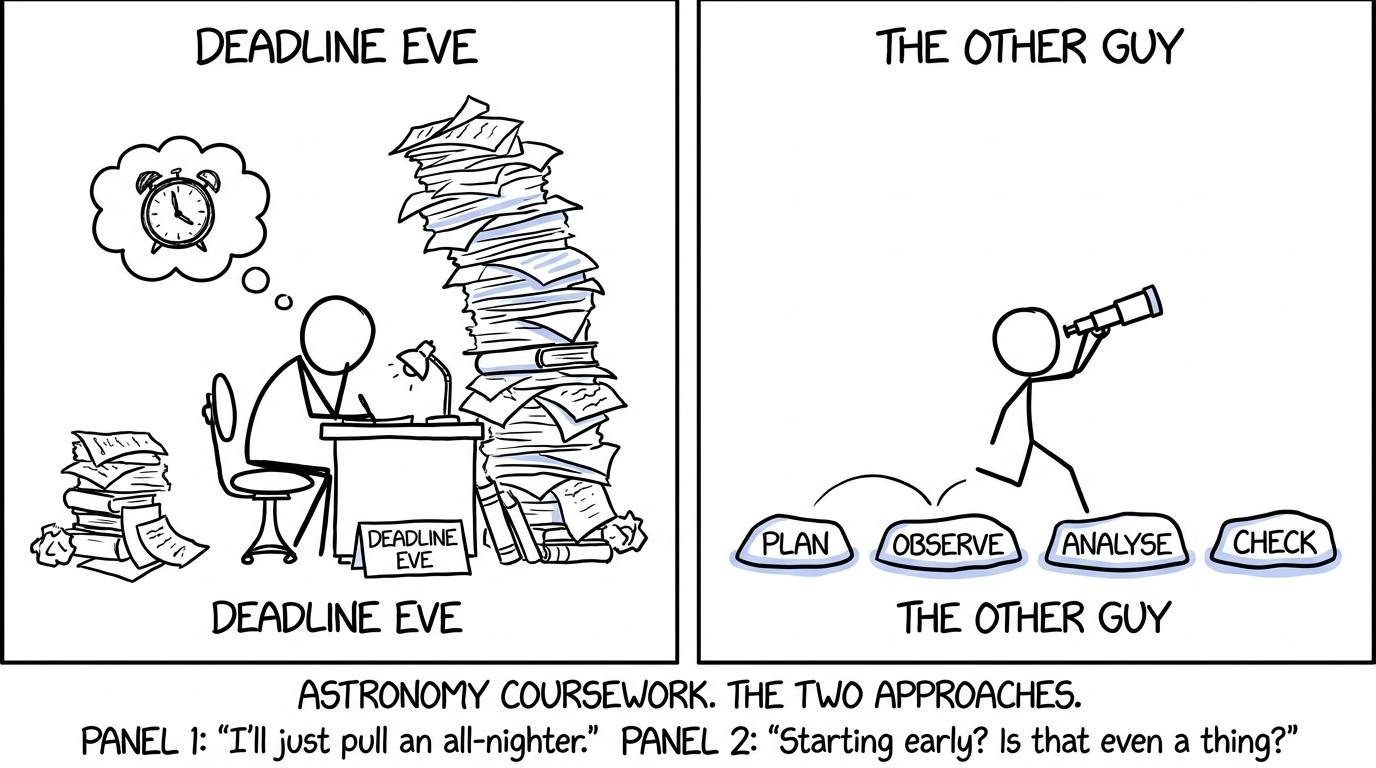 A student choosing stepping stones instead of facing a deadline mountain
What is the official GCSE Astronomy deadline?
The current Pearson Edexcel GCSE Astronomy specification requires every candidate to undertake at least one unaided and one aided observation. The two selected tasks cannot come from the same row of the specification's observational task table.
The school or examination centre must then confirm that reasonable steps have been taken to ensure candidates completed their own observations. Pearson's specification states that this Observation Statement must be submitted by 15 April in the examination year. Failure by a centre to provide it is treated as malpractice or maladministration.
This does not mean a student can work until 14 April. The official date applies to the centre. Your teacher needs time beforehand to confirm completion, resolve missing evidence and follow the school's assessment procedures. An internal deadline in February or March may therefore be entirely reasonable.
The observational requirement also sits alongside two written papers: Paper 1 covers naked-eye astronomy and Paper 2 covers telescopic astronomy. Each paper is worth half of the written assessment. Observational work should therefore be completed early enough that it does not consume the final weeks needed for examination revision.
Dates and administrative arrangements can change. Check the current Pearson specification and subject guidance through your teacher each examination year. If a school document conflicts with something remembered from an older class or online post, ask your examinations officer or astronomy teacher.
Build backwards from your school's deadline
Planning forwards encourages optimism: I will begin next week. Planning backwards creates decisions.
Start with the final internal deadline and reserve the preceding week for checking. Before that, allocate time for editing and evaluation. Analysis must come earlier, while observations and equipment practice belong near the beginning.
A useful structure is:
Final week: check and submit
Use this period for proofreading, file checks and any corrections permitted by your teacher. Confirm that graphs have titles, axes have labels, units are consistent and every required section is present.
This is a safety margin, not spare time. If nothing goes wrong, you finish calmly. If something does go wrong, you still finish.
Two to three weeks before: analyse and evaluate
Turn raw observations into organised tables, charts or other representations required by your chosen task. Discuss patterns, limitations and the quality of the observations. Keep original records rather than replacing them with tidier versions.
Maths skills matter here. Astronomy may require you to work confidently with scales, angles, averages, graphs, percentages or rates. The GCSE Maths revision hub provides free lessons and practice questions when one of those methods needs refreshing.
Earlier weeks: collect observations
Schedule several suitable sessions. Some tasks require observations over time, so they cannot honestly be compressed into one evening. Record the date, time, location, conditions, equipment and method as your teacher requires.
Write notes immediately after observing. Memory feels reliable in the moment and becomes surprisingly vague several days later.
First stage: understand and rehearse
Read the task instructions, identify the evidence needed and learn how to use the equipment safely. A short equipment rehearsal during daylight can reveal flat batteries, storage problems or an unfamiliar tripod before a valuable clear night arrives.
This backwards approach resembles a good GCSE maths revision timetable: the plan begins with the outcome, breaks it into repeatable sessions and leaves room to correct mistakes.
Make the schedule weather-proof
Astronomy contains a planning problem that many other subjects avoid: the sky does not care about your calendar.
A single observation night is not a plan. It is a gamble. Reserve a window containing several possible nights and agree with your teacher what to do if poor conditions continue. Do not invent, alter or reconstruct observations that were not made.
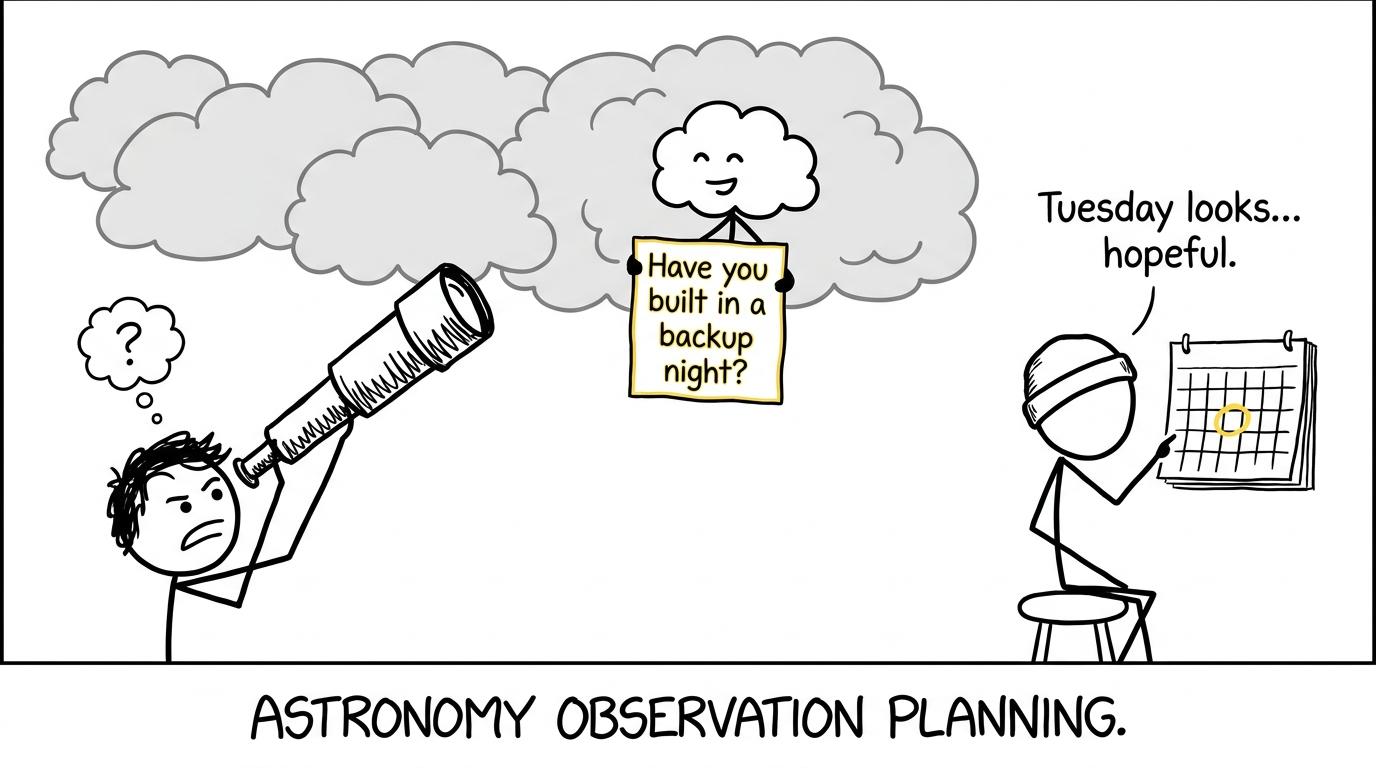 A cloud asks whether the student planned a backup observation night
Your contingency plan should answer four questions:
- Which alternative dates are available?
- How much notice is needed to borrow equipment?
- Who must supervise or approve access?
- When should persistent weather problems be reported to your teacher?
Check forecasts close to the proposed session, but do not depend on a long-range forecast as if it were a promise. If your task relies on a particular object, phase or event, establish its visibility and timing during the planning stage with teacher-approved sources.
Safety takes priority over a deadline. Follow school instructions for observing locations, supervision, darkness, electrical equipment and solar observations. Never improvise unsafe solar-viewing methods.
Divide the project into short, visible tasks
“Do astronomy coursework” is too vague for a useful revision timetable. A better list contains actions that can be completed:
- confirm the selected task;
- read the assessment guidance;
- prepare an equipment list;
- rehearse the method;
- reserve observation windows;
- organise raw records;
- produce graphs or tables;
- write analysis;
- evaluate limitations;
- check and submit.
Estimate each task, then add contingency time. If the visible work is expected to require TTT hours, a simple planning allowance is:
Tplanned=1.5TT_{\text{planned}} = 1.5TTplanned=1.5TThat allowance is not a promise that every project takes exactly half as long again. It is a practical buffer for failed files, cloudy evenings, corrections and slower-than-expected analysis.
Use short sessions for jobs that do not require darkness. A 252525-minute block can organise files, check labels or revise graph skills. Longer sessions can be reserved for observation and sustained writing. If you need a broader structure, adapt the rhythm in MathsGenie's one-month GCSE revision plan.
Protect your GCSE maths revision
Coursework panic is rarely isolated. It spills into everything else. An unfinished astronomy task can consume the evening intended for algebra, geometry or a timed paper.
Keep two separate plans:
- an astronomy project tracker for observations, analysis and submission;
- a maths revision timetable for lessons, topic practice and papers.
During observation-heavy weeks, use shorter maths sessions rather than abandoning maths completely. A mini test or focused set of questions keeps methods familiar. Once the observational work is secure, return to longer timed practice.
MathsGenie's recommended order for GCSE maths topics can help you choose what to revise next. For graphing, proportion, trigonometry and statistics, use the relevant revision lesson followed by practice questions and solutions.
Closer to the examinations, move towards GCSE predicted papers and past-paper practice. Predicted papers are practice tools rather than guarantees of examination content, but they can reveal weaknesses while there is still time to act.
Keep evidence organised from the first observation
Disorganisation creates invisible work. A photograph saved under an unclear filename may technically exist, yet finding it at the deadline can take longer than producing it did.
Create a simple folder structure containing:
- task instructions and planning;
- original observation records;
- photographs or exported data;
- processed tables and graphs;
- draft writing;
- the checked final version.
Use filenames containing the date and a short description. Retain original files and make backups in a location allowed by your school. Do not rely on one device, one memory card or an email draft as your only copy.
After every observation, spend a few minutes checking that files open and written records are legible. This tiny habit closes the gap between “I took the observation” and “I have usable evidence”.
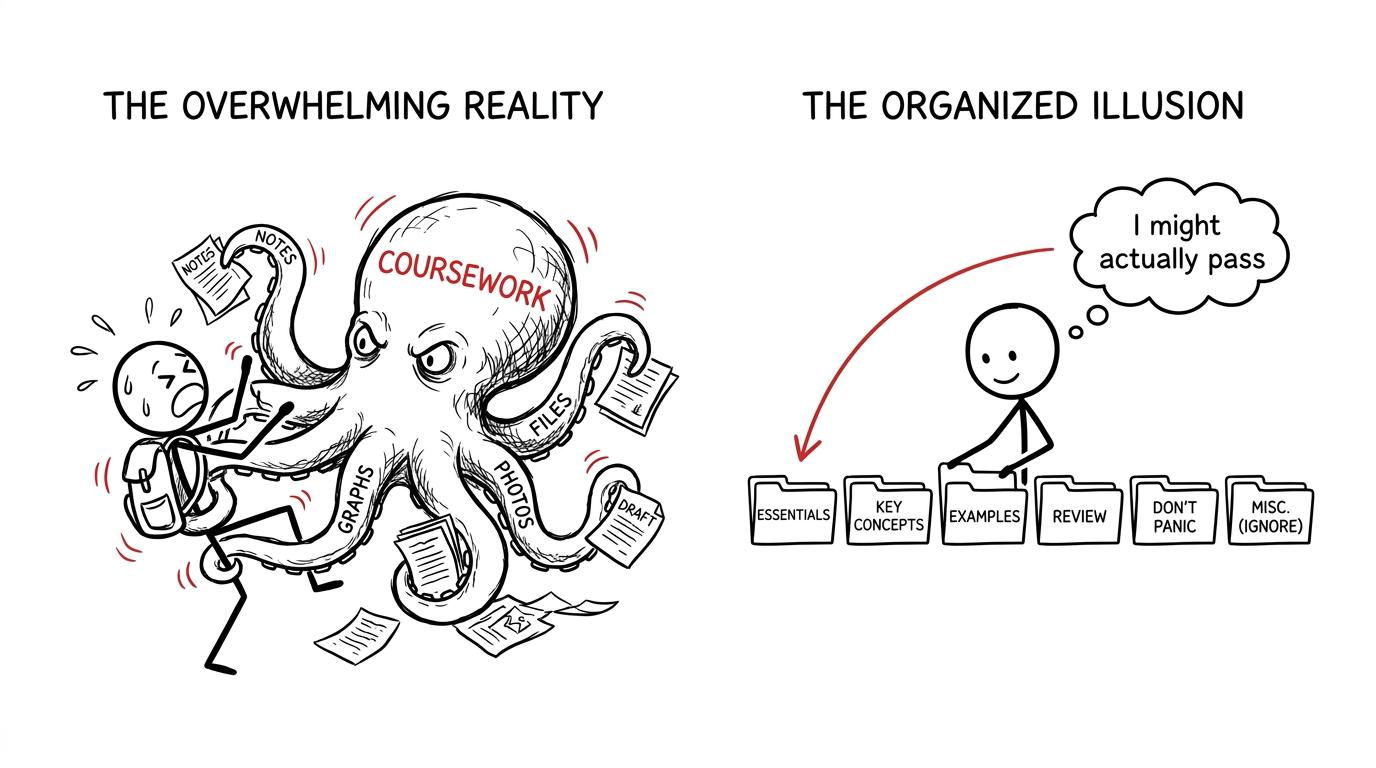 One student wrestles a coursework octopus while another uses organised folders
Common mistakes with astronomy coursework deadlines
Treating Pearson's date as the student's deadline
The 15 April requirement concerns the centre's Observation Statement. Your school's earlier internal deadlines give staff time to verify that the observational requirement has been completed.
Planning only one observation night
Cloud, equipment trouble or poor visibility can remove that opportunity. Build a window of possible dates and report difficulties early.
Leaving analysis until every observation is finished
Organise and inspect evidence after each session. Early checking can expose missing labels, unusable images or a method that needs clarification.
Spending all available time on presentation
A polished title page cannot repair weak records or missing analysis. Secure the required evidence and reasoning before improving appearance.
Allowing coursework to replace exam revision
GCSE Astronomy still includes two written papers, while maths has its own substantial specification. Keep small, regular revision sessions running. The GCSE Maths night-before plan is useful in an emergency, but a weekly routine is far more effective than depending on one final evening.
Waiting quietly when something goes wrong
Tell your teacher promptly about weather, access, illness, lost work or equipment problems. Schools can only advise on legitimate next steps when they know the situation.
Finish early enough to think clearly
Last-minute panic is usually not caused by laziness. More often, the project contains hidden dependencies: suitable weather, available equipment, accurate records and time for analysis. Once those dependencies are visible, the deadline becomes manageable.
Write down your school's actual dates today. Work backwards, reserve backup observation nights and protect the final week for checking rather than creation. Then keep your maths moving through short, consistent sessions.
When the astronomy work is safely submitted, use MathsGenie's free GCSE maths resources to return your attention to the examinations. Follow a revision lesson, complete the practice questions, check the mark scheme or video solution, and build towards mini tests, past papers and predicted papers. Calm preparation is rarely dramatic. That is precisely why it works.