

GCSE Astronomy Careers: Jobs and Apprenticeships
GCSE astronomy careers explained: discover relevant jobs, apprenticeships, useful skills and the qualifications employers are most likely to notice.
A telescope can make the future look wonderfully clear. Careers are rarely so obliging.
If you are researching GCSE astronomy careers, the honest answer is that the qualification does not lead directly to one particular job. Employers and universities usually place more weight on GCSE Maths, English and science, followed by relevant post-161616 qualifications. But GCSE Astronomy can still strengthen your application. It demonstrates sustained interest in space, scientific observation, data analysis and mathematical problem-solving.
That combination is relevant far beyond becoming an astronomer. It can support routes into aerospace engineering, satellite technology, software, geospatial work, meteorology, education and scientific communication. The key is knowing where the grade is genuinely useful, and where it must be supported by stronger qualifications in maths, physics or engineering.
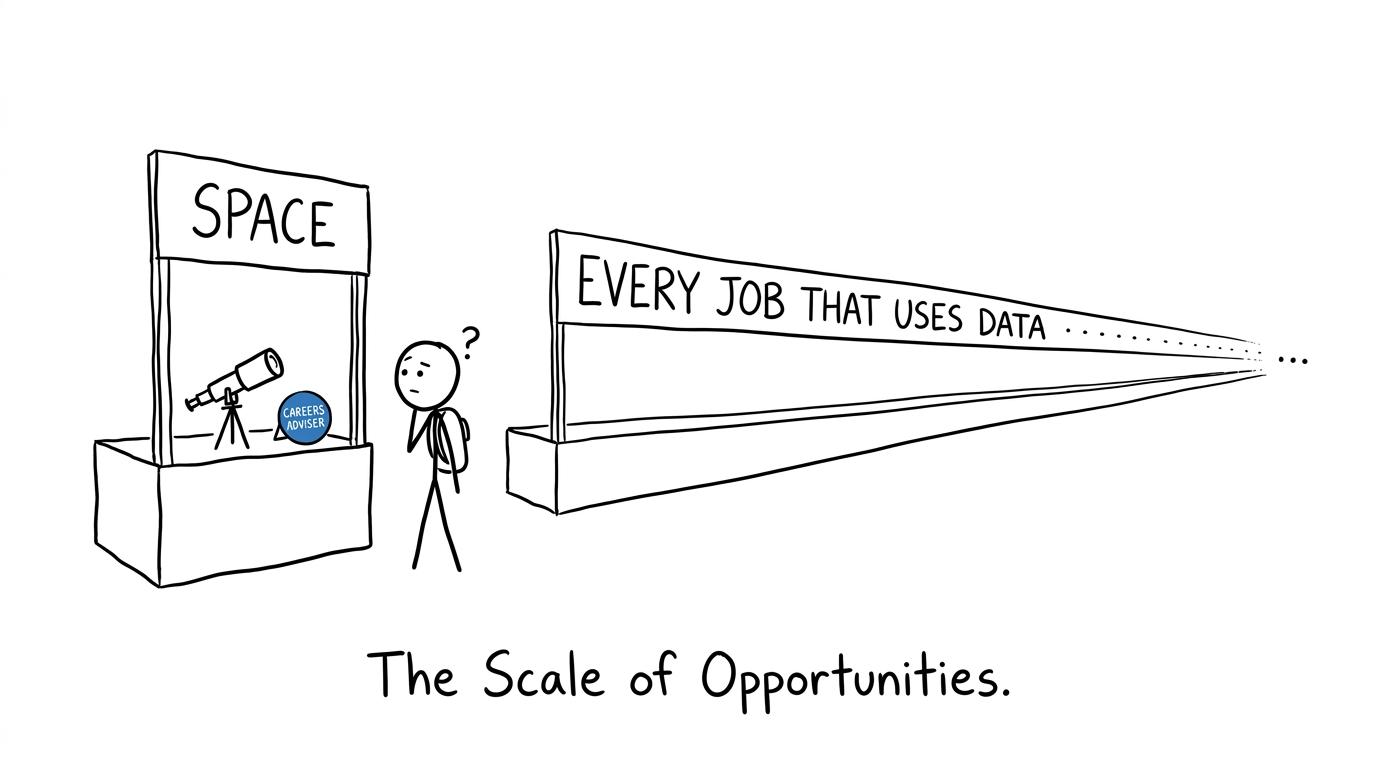 A student discovers that space careers overlap with a much larger world of data careers
The short answer: where does GCSE Astronomy help?
GCSE Astronomy is most useful in four ways:
- Showing genuine subject interest: it provides evidence that your interest in space goes beyond watching documentaries.
- Developing transferable skills: observations, calculations, graph interpretation and evaluation matter in many technical careers.
- Supporting post-161616 choices: it can help explain why you want to take A Level Physics, A Level Maths, engineering or a related technical course.
- Making an application more distinctive: when two applicants meet the essential requirements, a relevant additional GCSE may provide a useful conversation point.
It is not normally a substitute for GCSE Maths or science. Current careers guidance for professional astronomers typically points towards A levels in maths and physics, a relevant degree and, for many research roles, postgraduate study. Technical and degree apprenticeships also tend to specify Maths, English, science and later STEM qualifications rather than GCSE Astronomy itself.
Think of the qualification as evidence, not a passport. It shows the direction of your curiosity, but other subjects usually provide the entry ticket.
Careers where GCSE Astronomy is particularly relevant
Astronomy and astrophysics
This is the most obvious route, but also the one requiring the longest academic journey. Professional astronomers analyse observations, construct models, write software and communicate findings. Only part of the job involves looking through telescopes; much of modern astronomy is built around data and computation.
GCSE Astronomy gives you an early foundation in celestial observations, planetary systems, stars and cosmology. However, someone aiming for professional research will normally need strong post-161616 results in maths and physics, followed by a relevant degree. Many research posts expect postgraduate qualifications.
For a student considering this route, the practical next step is therefore not simply to collect astronomy facts. It is to make algebra, graphs, trigonometry and scientific notation dependable. Standard form revision is especially valuable because astronomical distances and measurements routinely involve extremely large or small quantities.
Aerospace and space engineering
Aerospace engineers work on aircraft, spacecraft, propulsion, structures, control systems and related technology. GCSE Astronomy can make your motivation credible, particularly when applying for engineering courses, work experience or space-sector apprenticeships.
Yet engineering selection is likely to focus more closely on your maths, physics and design or technical ability. An astronomy grade may get noticed because it explains why you are interested. Your core STEM grades help prove that you can handle the training.
The mathematical habits matter: rearranging formulae, interpreting graphs, working with vectors and checking whether an answer is sensible. Students can develop these habits through OCR GCSE Maths revision guidance, even if their own board is Edexcel, AQA or Eduqas, because the underlying discipline of targeted practice is transferable.
Satellite operations and space systems
Satellites support communications, navigation, weather forecasting, environmental monitoring and scientific research. Careers in this area include mission operations, systems engineering, electronics, software development and data processing.
GCSE Astronomy helps you understand the wider context: orbital behaviour, observation, the electromagnetic spectrum and the reasons different instruments are used. It will not, by itself, qualify you to operate a satellite. But it can support an application for a relevant college course, T Level, apprenticeship or later degree by showing informed interest.
Computer science becomes increasingly important here. A student who combines astronomy with maths, physics and coding has a broader foundation than one who treats space as a purely descriptive subject.
Geospatial, surveying and Earth-observation careers
Not every space career faces away from Earth. Earth-observation satellites collect information used in mapping, agriculture, climate monitoring, emergency response and infrastructure planning.
Relevant roles include geospatial technician, surveyor, remote-sensing analyst and geographic information systems specialist. Astronomy develops useful habits for these areas: interpreting images, understanding scale and coordinates, managing uncertainty and drawing conclusions from incomplete observations.
Geography and computer science can be valuable alongside maths. The important insight is that your interest in telescopes may lead towards analysing Earth rather than distant galaxies.
Meteorology and climate science
Meteorologists use observations, physical models, statistics and computing to understand the atmosphere and produce forecasts. Astronomy is not the standard entry qualification, but its combination of physics, observation and data interpretation overlaps with the way atmospheric science is approached.
Strong maths remains essential. Graphs are not merely pictures; they describe change. Statistics are not simply calculations; they help scientists judge whether patterns are meaningful. If this direction interests you, the Edexcel A Level Maths revision hub shows how pure maths, statistics and mechanics develop after GCSE.
Software, data science and scientific computing
Astronomy produces substantial quantities of data. Researchers and space organisations need people who can write code, automate processes, identify patterns and test models.
GCSE Astronomy may therefore support a future story that leads into software engineering or data analysis, even when the eventual employer is not part of the space sector. The transferable value lies in asking a precise question, processing evidence and recognising the limits of a conclusion.
This route usually requires stronger computing and mathematical qualifications later. At A Level, topics such as mechanics, statistics and calculus begin to formalise the ideas behind modelling. Students curious about that progression can explore A Level differentiation revision.
Teaching, observatories and science communication
Planetariums, museums, observatories, schools and media organisations need people who can make difficult ideas understandable. Possible careers include physics teacher, planetarium presenter, museum educator, science writer and public-engagement officer.
Here, GCSE Astronomy offers two useful signals: subject knowledge and sustained enthusiasm. Communication skills matter just as much. You need to explain uncertainty honestly, select an appropriate level of detail and avoid turning a fascinating subject into a wall of terminology.
Apprenticeships where an astronomy grade may get noticed
Apprenticeships are one of the most practical answers to the question. Relevant opportunities can appear in aerospace engineering, space systems, software, laboratory science, electronics, manufacturing and geospatial work.
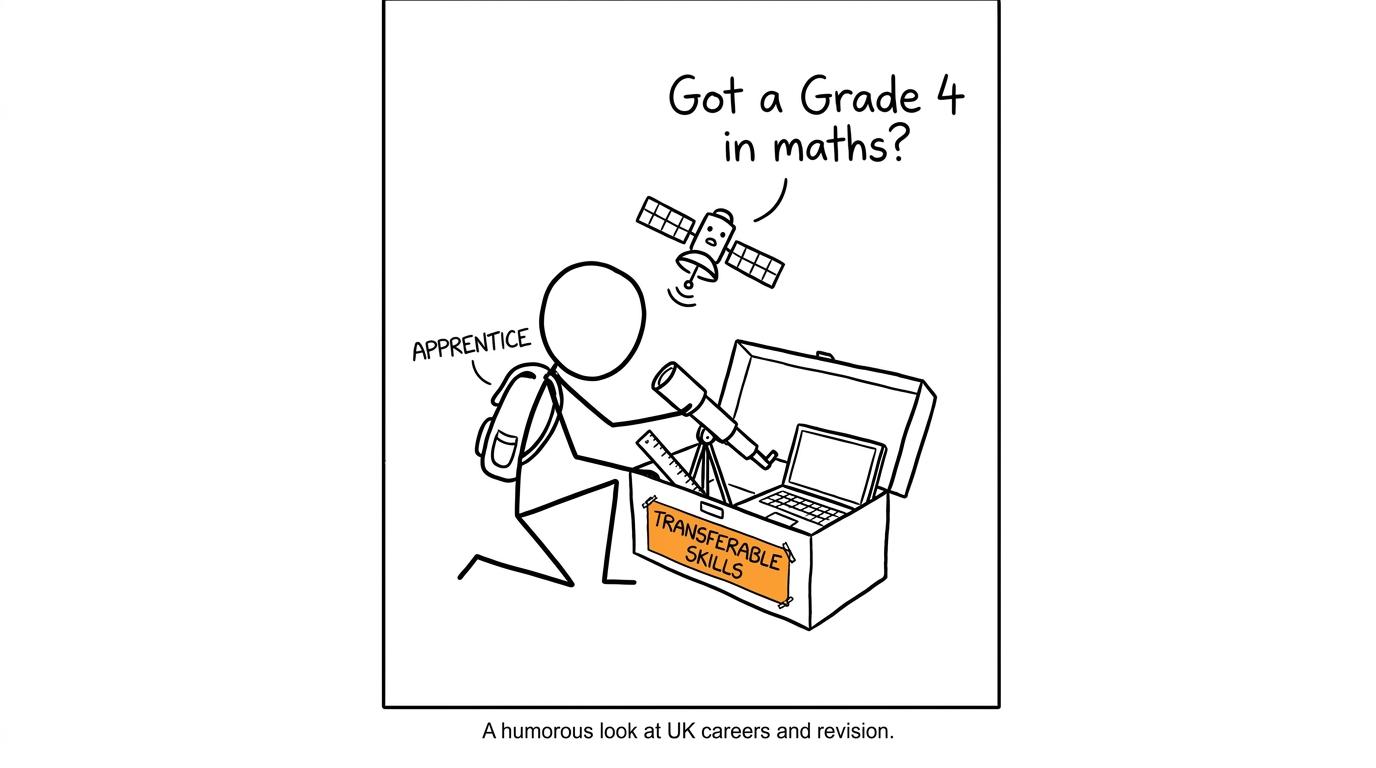 An apprentice discovers that transferable skills belong in every space-sector toolbox
Entry requirements vary by employer and programme. Technician apprenticeships commonly ask for GCSEs including Maths, English and a science, while degree apprenticeships normally require suitable Level 333 qualifications such as A levels or a BTEC. Individual vacancies may set higher subject or grade requirements, so always read the current advert rather than relying on a general careers page.
GCSE Astronomy is most likely to be noticed in:
- aerospace engineering technician applications;
- space engineering degree apprenticeship applications;
- satellite or communications engineering routes;
- software and digital technology apprenticeships with space-sector employers;
- geospatial and surveying apprenticeships;
- laboratory and scientific technician programmes;
- electrical, electronic and advanced manufacturing apprenticeships.
Its strongest use is in your supporting statement or interview. You might discuss observational planning, handling data, evaluating limitations or maintaining accuracy over a long task. Do not merely say that you enjoy space. Explain what you did, what skill it required and why that skill transfers to the apprenticeship.
The maths skills that make the qualification valuable
Astronomy becomes employable when interest is joined to reliable technique. Useful GCSE Maths areas include:
- standard form and orders of magnitude;
- ratio, proportion and scale;
- rearranging formulae;
- coordinates and graphs;
- angles and trigonometry;
- probability, averages and interpreting data;
- units, bounds and estimation.
The same skills appear in GCSE Maths specifications from Edexcel, AQA, OCR and Eduqas. Strengthening them improves both your exam performance and your readiness for technical training.
A productive revision loop is simple: attempt questions, mark them honestly, diagnose the lost marks and repair the underlying topic. The guide to using Edexcel GCSE Maths past papers explains how to turn a completed paper into useful evidence about what to practise next. The broader advice on turning GCSE Physics notes into active recall is also useful when astronomy revision involves equations, definitions and observations.
How to make GCSE Astronomy count on an application
A grade becomes more persuasive when you can explain what sits behind it. Keep a brief record of relevant experiences, including observations, projects, coding, reading, clubs, competitions or work experience. Only include activities you genuinely completed.
Use a three-part structure:
- Activity: what you studied, observed, designed or analysed.
- Skill: the mathematical, practical or communication ability involved.
- Relevance: how that skill connects to the course, role or apprenticeship.
For example, observational work may demonstrate planning and evaluation. Analysing measurements may show patience and data awareness. Revising independently may show organisation. The subject provides the evidence; your explanation makes the evidence visible.
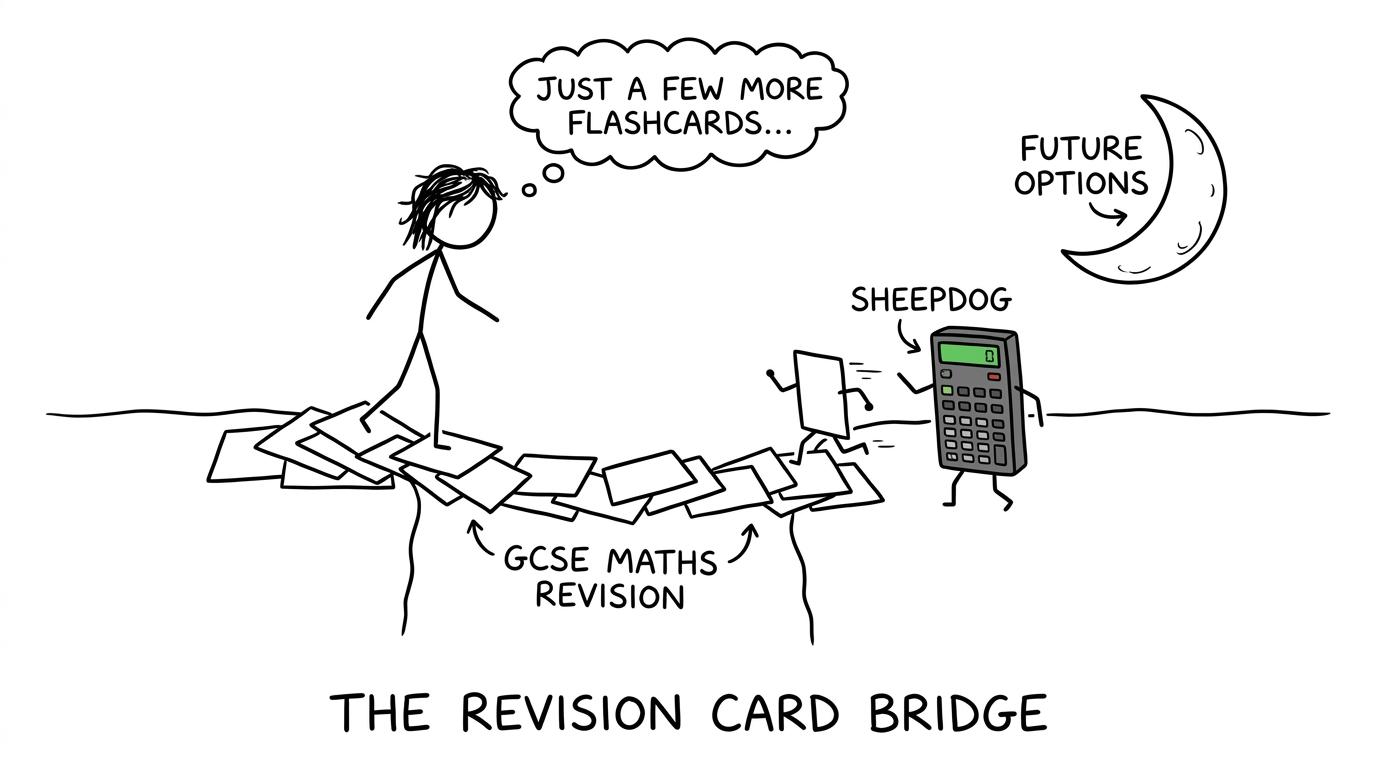 A calculator herds revision cards into a bridge towards future opportunities
Common mistakes when planning astronomy-related careers
Assuming the GCSE guarantees a space job
No single GCSE guarantees employment. Astronomy is a helpful supporting qualification, while Maths, English and science are more frequently named as essential entry requirements.
Neglecting maths because astronomy feels more interesting
Space science depends heavily on maths. Avoiding algebra or graphs now can narrow your later options. Use revision lessons and practice questions to fix weak areas before they become barriers at A Level or during apprenticeship assessments.
Searching only for jobs called “astronomer”
The space sector also needs engineers, programmers, technicians, project managers, communicators and data specialists. Search by skill and industry, not only by one dream job title.
Treating predicted papers as predictions of your future
Predicted papers are revision tools, not forecasts of exact exam content. Use them after topic practice, then mark carefully and revisit weaknesses. The MathsGenie Edexcel revision strategy shows how predicted papers, mini tests and past papers can fit into a balanced plan.
Quoting entry requirements without checking the vacancy
Apprenticeship requirements can change between employers and recruitment years. Check the live advert for required subjects, grades, residency conditions, security checks and application deadlines.
Build the foundation before choosing the destination
GCSE Astronomy can help your career, but usually as part of a larger pattern. It shows curiosity about space, experience with scientific ideas and a willingness to work with observation and data. It becomes considerably stronger beside secure GCSE Maths and science grades, relevant post-161616 choices and evidence that you can apply what you know.
You do not need to decide your entire career while preparing for GCSE exams. You need to preserve good options. Begin with the maths skills that space, engineering and data careers share, then test those skills under exam conditions.
MathsGenie gives you the free structure to do that: revision lessons for understanding, practice questions and mini tests for fluency, video solutions and mark schemes for feedback, and past papers and predicted papers for exam readiness. Choose one weak topic today, practise it carefully, and let each corrected mistake make your next step a little clearer.











