

GCSE Astronomy 20 Minute Study Routine
GCSE astronomy 20 minute study routine for daily recall, maths practice and exam technique, helping you revise consistently without last-minute cramming.
Revision often becomes difficult long before the subject does. You arrive home with maths homework, other GCSEs and perhaps an evening commitment. Astronomy matters, but it feels too large to begin. So it is postponed until “later”, and later slowly becomes the night before the exam.
A gcse astronomy 20 minute study routine offers a calmer alternative. Spend a few minutes retrieving knowledge, practise one tightly defined skill, mark the work and record your next step. You are not trying to cover the universe every evening. You are making sure that tomorrow’s starting point is slightly stronger than today’s.
This routine is designed around the current Pearson Edexcel GCSE Astronomy specification, while strengthening mathematical skills that also matter in GCSE maths examinations.
Your 20-minute astronomy revision checklist
Use the same structure each day so that little time is lost deciding what to do:
| Time | Task | Purpose |
|---|---|---|
| First 333 minutes | Recall facts without notes | Find what you genuinely remember |
| Next 777 minutes | Review one narrow astronomy idea | Repair a specific knowledge gap |
| Next 777 minutes | Answer questions or practise a mathematical skill | Turn recognition into usable knowledge |
| Final 333 minutes | Mark, correct and choose tomorrow’s topic | Make mistakes useful |
Before starting, put your phone out of reach, open only the resource you need and write a precise target. “Revise astronomy” is too broad. “Recall the causes of lunar phases” or “practise converting astronomical distances in standard form” gives the session a finish line.
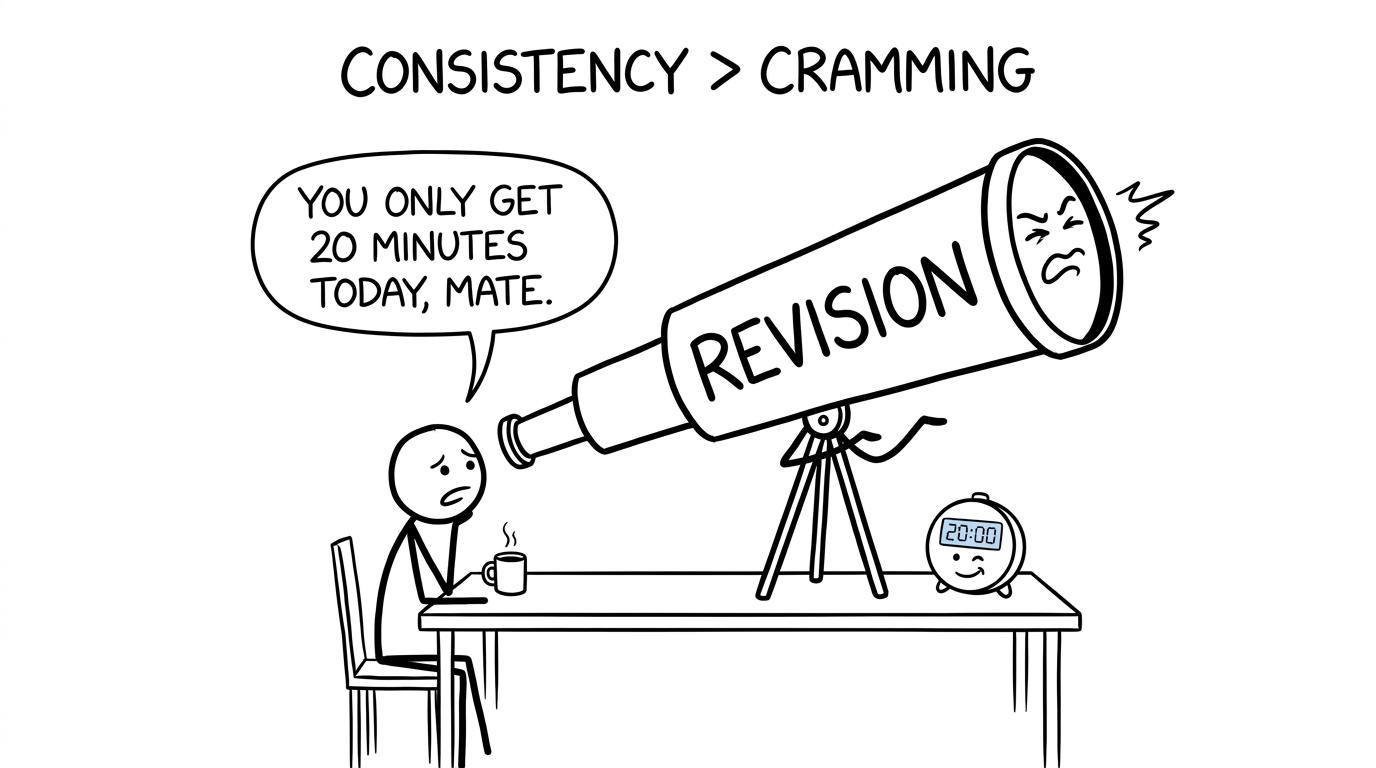 A student negotiating a short revision session with an enormous telescope
Why short daily astronomy revision can work
A long session can feel productive because it consumes an evening. That does not necessarily mean every minute was useful. Short sessions force a decision: what is the one thing worth improving today?
They also make retrieval practical. Closing the book and writing what you know exposes missing details that rereading can hide. Immediate question practice then reveals whether you can apply the idea rather than merely recognise the page on which it appeared.
Twenty minutes is not a complete revision programme by itself. You will still need longer sessions for full papers, extended responses and observational reports. Its purpose is different: it keeps the subject active between lessons and prevents the backlog that encourages all-night cramming.
Consistency also makes starting easier. The task is bounded. You know when it ends, and you do not need perfect motivation before beginning.
Match the routine to GCSE Astronomy assessment
Pearson Edexcel GCSE Astronomy is an untiered qualification, unlike foundation and higher tier GCSE maths. The current specification divides the course into 161616 topics.
Paper 111, Naked-eye Astronomy, assesses Topics 111 to 888. Paper 222, Telescopic Astronomy, assesses Topics 999 to 161616. Each written paper lasts 111 hour 454545 minutes, is worth 100100100 marks and contains multiple-choice, short-answer, calculation, graphical and extended-open-response questions.
The specification requires mathematical skills to account for at least 20%20\%20% of the written assessment. At least 15%15\%15% of the marks assess knowledge, understanding and application of observational skills. Students must also complete at least one unaided and one aided astronomical observation, with completion certified through their centre. Follow your teacher’s current instructions for these tasks and any submission arrangements.
Those requirements suggest that daily revision should rotate between three strands:
- knowledge, including celestial objects, processes and models;
- mathematics and data, including formulae, graphs, units and calculations;
- observational thinking, including planning, safety, analysis and evaluation.
If every session is just reading facts, two important parts of the qualification remain untouched.
Build a weekly GCSE astronomy 20 minute study routine
A fixed weekly rhythm removes unnecessary choices while still covering the whole course.
Monday: naked-eye astronomy
Choose one concept from Topics 111 to 888. Begin with blank-page recall, then check your notes and answer a small number of relevant questions.
Keep the focus narrow: the lunar disc, the Earth-Moon-Sun system, time cycles or planetary motion, rather than an entire paper. Finish by writing one sentence explaining the idea clearly enough that another student could follow it.
Tuesday: astronomical mathematics
Astronomy uses large and small values, specialist units, ratios, graphs, angular measures, algebra and calculator skills. The official subject content includes standard form, significant figures, inverse-square relationships, logarithms, rearranging equations and interpreting gradients.
Choose one mathematical tool and practise it in isolation before reconnecting it to astronomy. MathsGenie’s free standard form revision resources are useful for values written as
a×10n,1≤a<10,a \times 10^n, \qquad 1 \leq a < 10,a×10n,1≤a<10,while the changing the subject of a formula guide helps when the required quantity is not already isolated.
Wednesday: telescopic astronomy
Move to one idea from Topics 999 to $16`, such as solar astronomy, exploring the Solar System, starlight, stellar evolution, the Galaxy or cosmology.
Use a simple sequence: define the key term, describe the process, then identify the evidence or observation connected with it. This stops revision becoming a disconnected list of definitions.
Thursday: data and observations
Select an unfamiliar graph, table, diagram or observational scenario. Ask:
- What was the observation designed to measure?
- Which variables should be controlled or recorded?
- What pattern does the evidence show?
- How reliable is the conclusion?
- What practical improvement would make the evidence stronger?
For graph-based questions, revisit gradient of a line revision. Remember that a gradient represents
gradient=change in ychange in x.\text{gradient}=\frac{\text{change in }y}{\text{change in }x}.gradient=change in xchange in y.Observational revision is not a substitute for completing the required activities. It prepares you to explain and evaluate the methods in a written examination.
Friday: mixed retrieval
Shuffle questions from earlier in the week. Do not reread the notes first. The aim is to discover what survived after a delay.
Mark every answer and classify each error as one of the following:
- missing knowledge;
- incorrect mathematical method;
- unit or rounding error;
- weak explanation;
- misread command word.
This classification tells you what to do next. A knowledge gap needs relearning. A calculator mistake needs practice. A vague extended response needs better structure.
Weekend: repair or extend
Use one 202020-minute session to revisit the week’s weakest area. If you have more time, add a separate timed paper section rather than stretching the daily routine indefinitely.
The MathsGenie GCSE maths revision hub provides board-specific maths lessons, questions and papers for Edexcel, AQA, OCR and Eduqas. These resources do not replace astronomy-specific materials, but they can repair the mathematical methods that astronomical questions depend upon.
Use maths revision to strengthen astronomy calculations
Astronomy can make familiar GCSE maths look unfamiliar because the context involves enormous distances, tiny angles and specialist units. The underlying operations are often manageable once the wording is stripped back.
Practise these habits:
- identify the required quantity before selecting a formula;
- convert values into compatible units;
- substitute with brackets where necessary;
- keep unrounded calculator values until the final line;
- give the requested significant figures and final unit;
- check whether the scale and size of the answer are plausible.
For unit confidence, use the conversions and units revision page. If a question involves angles or right-angled geometry, the SOHCAHTOA revision resources can refresh the relevant calculator and trigonometric skills.
Keep the astronomy formula and data sheet beside you when practising if it will be supplied under the conditions of the paper. The challenge is not simply recalling symbols. It is recognising the correct relationship, rearranging it when necessary and using the data accurately.
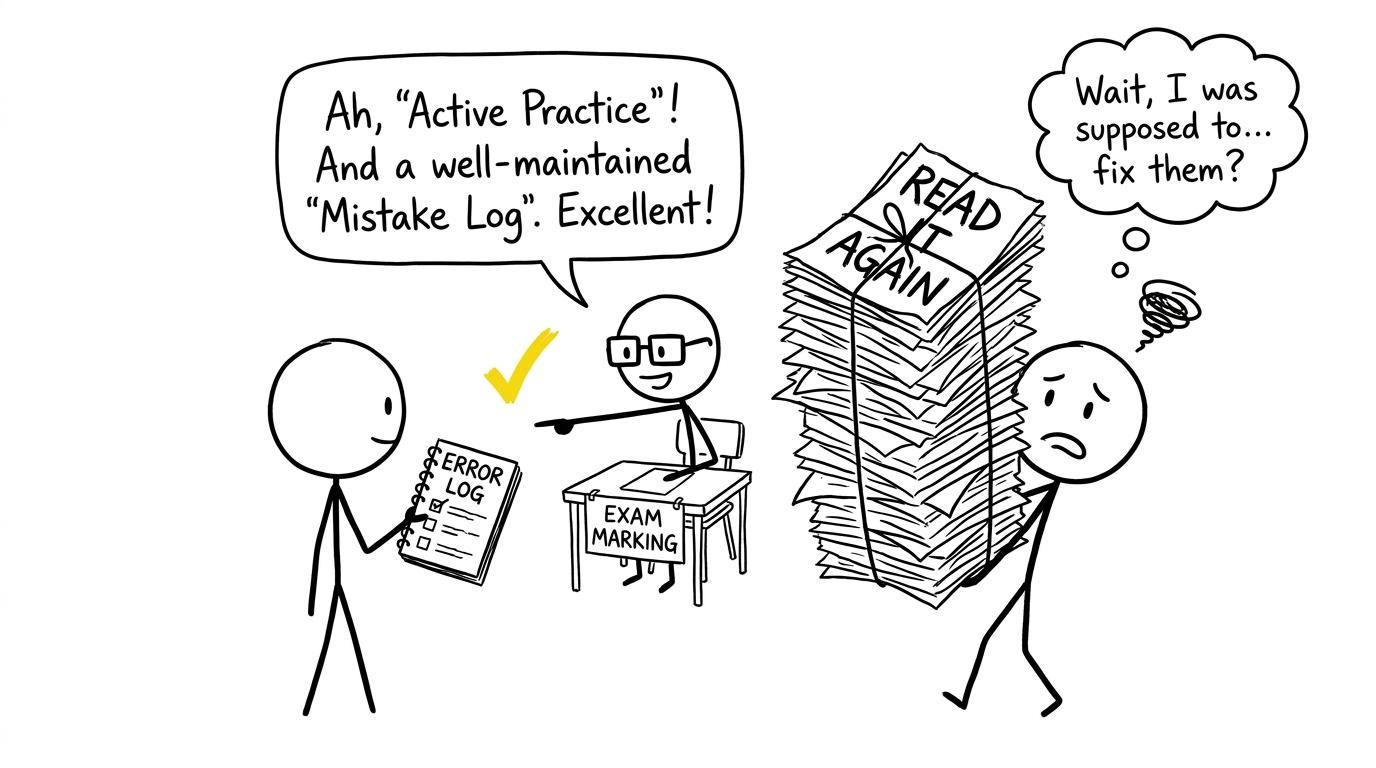 Planets discovering that an error log is more useful than rereading
Make marking part of the routine
Unmarked questions create activity, not feedback. In the final 333 minutes, compare your answer carefully with the available mark scheme or model guidance.
Keep a small “marks leak” log with four details:
| Record | What to write |
|---|---|
| Topic | The precise concept or skill |
| Error | What actually went wrong |
| Correction | The correct fact, method or explanation |
| Return date | When you will try it again |
Do not copy the entire mark scheme. Write the smallest useful correction. Then reattempt the question later without looking at the answer.
For maths exam preparation, MathsGenie explains how to use past papers properly: attempt, mark, diagnose, repair and reattempt. The same feedback loop is valuable when using official astronomy papers supplied by your teacher or exam board.
Common mistakes that weaken the routine
Choosing a topic that is too large
“The Solar System” cannot be revised properly in 202020 minutes. Choose one relationship, process or question type. Small targets make completion visible.
Spending the whole session making notes
Notes can organise knowledge, but copying is not the same as retrieving or applying it. Include at least one closed-book task and one checked answer.
Ignoring units and calculator settings
Astronomical calculations are sensitive to unit conversions, standard form and angular measures. Write units throughout, check that your calculator is in the required mode and round only when the question asks.
Revising only favourite topics
Confidence can become camouflage. Use your marks leak log and the specification to choose sessions, not whichever chapter feels most comfortable.
Treating a missed day as failure
Do not repay one missed session with a late-night marathon. Resume the routine the next day. A sustainable plan survives imperfect weeks.
Using predicted papers as predictions of certainty
Predicted papers are fresh practice, not a promise of what will appear. For GCSE maths, use MathsGenie predicted papers after topic revision, then mark them and repair the gaps they expose. For Astronomy, prioritise the current specification and official past or sample assessment materials.
A calm routine that keeps the subject moving
The universe is vast. Your next revision task should not be.
Set a timer for 202020 minutes. Retrieve one idea, repair one gap, answer a few focused questions and record tomorrow’s target. Across the week, rotate through naked-eye astronomy, telescopic astronomy, mathematical skills and observational reasoning. Add longer timed practice when the examination is closer, but protect the short daily habit from turning into another exhausting evening.
Use MathsGenie as your free base for the mathematical side of the plan. Start with a revision lesson, move into practice questions and mini tests, then build exam confidence with past papers, predicted papers, mark schemes and video solutions. Open the GCSE maths revision hub, choose the one skill that is slowing down your astronomy calculations, and make today’s 202020 minutes count.











