Gradient of a Line
x

Revision notes for Edexcel GCSE Maths Gradient of a Line. Open the guide for explanations and worked examples. Written against the Edexcel GCSE Maths (1MA1) specification, so the content matches what's examinable rather than general Maths background.

Gradient of a Line

What you'll learn

  • What gradient tells you about a straight line.
  • How to find gradient by counting squares on a grid.
  • How to use the coordinate formula for gradient.
  • How to work backwards when one coordinate is unknown.

Coordinates: the starting point

A straight line on a grid often passes through points with coordinates like (2,5)(2, 5)(2,5).

The first number is the x-coordinate: how far across.
The second number is the y-coordinate: how far up or down.

Definition

Coordinate

A coordinate is an ordered pair written as (x,y)(x, y)(x,y). The xxx value tells you the horizontal position, and the yyy value tells you the vertical position.

Example

Reading movement between two points

A line passes through (1,2)(1, 2)(1,2) and (4,8)(4, 8)(4,8). Describe the movement from the first point to the second.

Movement from (1,2) to (4,8) is 3 squares right and 6 squares up.

  1. Start at (1,2)(1, 2)(1,2).

  2. Compare the x-values: from 1 to 4 means move 3 squares to the right.

  3. Compare the y-values: from 2 to 8 means move 6 squares up.

  4. So the movement is: right 3, up 6.

What gradient means

The gradient of a line tells you how steep it is.

A line with a larger gradient is steeper. A positive gradient slopes upwards as you move from left to right. A negative gradient slopes downwards.

Definition

Gradient

The gradient is the amount a line goes up or down for each 1 unit it goes across.

Gradient compares the vertical change with the horizontal change: rise over run.

Key Idea

Rise over run

Gradient means:

gradient=change in ychange in x\text{gradient}=\frac{\text{change in }y}{\text{change in }x}gradient=change in xchange in y​

You may also hear this as “rise over run”.

Finding gradient from a grid

When a line is drawn on a coordinate grid, choose two clear points on the line. Then count:

  • the run: how far across
  • the rise: how far up or down
Example

Gradient from a grid

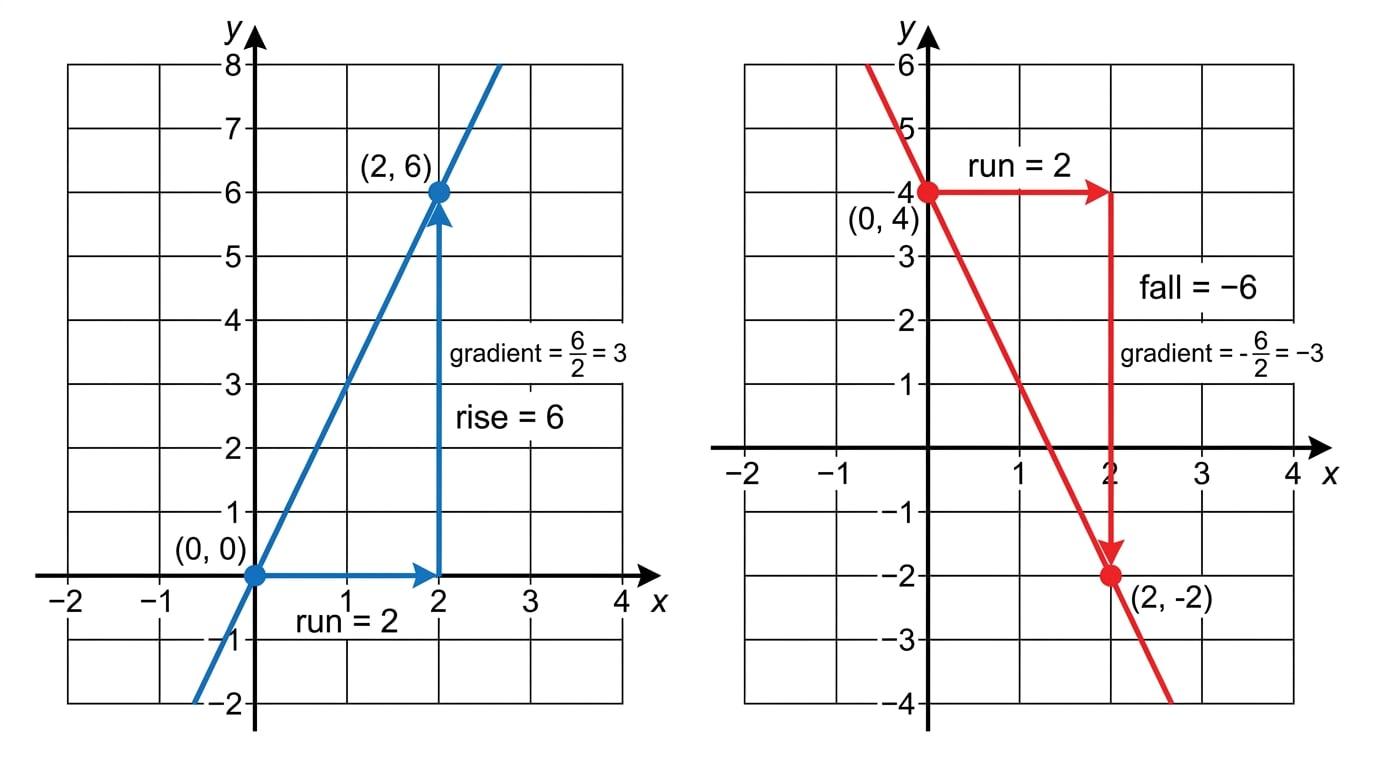
A straight line passes through (0,0)(0, 0)(0,0) and (2,6)(2, 6)(2,6). Find its gradient.

The line rises 6 squares for a run of 2 squares, giving a positive gradient.

  1. Choose two clear points on the line: (0,0)(0, 0)(0,0) and (2,6)(2, 6)(2,6).

  2. Count the change in x: from 0 to 2 is 2 squares across.

  3. Count the change in y: from 0 to 6 is 6 squares up.

  4. Use rise over run:

    gradient=62=3\text{gradient}=\frac{6}{2}=3gradient=26​=3
Tip

Choose easy points

On a grid, pick points where the line goes exactly through grid intersections. Avoid estimating halfway points unless the question forces you to.

Positive and negative gradients

If the line goes up as you move from left to right, the gradient is positive.

If the line goes down as you move from left to right, the gradient is negative.

Example

A negative gradient

A line passes through (0,4)(0, 4)(0,4) and (2,−2)(2, -2)(2,−2). Find its gradient.

Moving left to right, the line goes down 6 squares and across 2 squares, so the gradient is negative.

  1. Move from the left point (0,4)(0, 4)(0,4) to the right point (2,−2)(2, -2)(2,−2).

  2. The change in x is 2, because the line moves 2 squares to the right.

  3. The change in y is -6, because the line moves down 6 squares.

  4. Use rise over run:

    gradient=−62=−3\text{gradient}=\frac{-6}{2}=-3gradient=2−6​=−3
Common Mistake

Forgetting the negative sign

If the line slopes down from left to right, the gradient must be negative. Counting “down 6” means the change in y is -6, not 6.

Using the gradient formula

If you are given two coordinates, you do not need a grid. You can subtract the coordinates.

Definition

Gradient formula

For two points (x1,y1)(x_1, y_1)(x1​,y1​) and (x2,y2)(x_2, y_2)(x2​,y2​), the gradient mmm is:

m=y2−y1x2−x1m=\frac{y_2-y_1}{x_2-x_1}m=x2​−x1​y2​−y1​​

The top is the change in y.
The bottom is the change in x.

Example

Gradient from two coordinates

Find the gradient of the line through (3,2)(3, 2)(3,2) and (7,10)(7, 10)(7,10).

The coordinate formula matches the diagram: change in y is 8 and change in x is 4.

  1. Label the points:

    (x1,y1)=(3,2),(x2,y2)=(7,10)(x_1,y_1)=(3,2), \quad (x_2,y_2)=(7,10)(x1​,y1​)=(3,2),(x2​,y2​)=(7,10)
  2. Substitute into the formula:

    m=10−27−3m=\frac{10-2}{7-3}m=7−310−2​
  3. Work out the numerator and denominator:

    m=84m=\frac{8}{4}m=48​
  4. Simplify:

    m=2m=2m=2
Example

Gradient with negative coordinates

Find the gradient of the line through (−4,1)(-4, 1)(−4,1) and (2,4)(2, 4)(2,4).

With negative coordinates, the horizontal change from -4 to 2 is 6 while the vertical change is 3.

  1. Label the points:

    (x1,y1)=(−4,1),(x2,y2)=(2,4)(x_1,y_1)=(-4,1), \quad (x_2,y_2)=(2,4)(x1​,y1​)=(−4,1),(x2​,y2​)=(2,4)
  2. Substitute into the formula:

    m=4−12−(−4)m=\frac{4-1}{2-(-4)}m=2−(−4)4−1​
  3. Be careful with subtracting a negative:

    m=36m=\frac{3}{6}m=63​
  4. Simplify the fraction:

    m=12m=\frac{1}{2}m=21​
Tip

Order does not matter if you are consistent

You can start with either point, but the y-values and x-values must be subtracted in the same order. Do not swap the order halfway through.

Common Mistake

Vertical lines

The formula does not work for a vertical line because the change in x is 0, so you would be dividing by 0. At GCSE, a vertical line has an undefined gradient.

A vertical line has no horizontal change, so its gradient is undefined.

Finding a missing coordinate

Sometimes you are given the gradient and one coordinate contains a missing value such as kkk.

Use the same gradient formula, then solve the equation.

Example

Finding a missing y-coordinate

A line passes through (1,−2)(1, -2)(1,−2) and (5,k)(5, k)(5,k). Its gradient is 3. Find kkk.

The given gradient of 3 means the rise is three times the run from (1,-2) to (5,k).

  1. Write the gradient formula:

    m=y2−y1x2−x1m=\frac{y_2-y_1}{x_2-x_1}m=x2​−x1​y2​−y1​​
  2. Substitute the known values:

    3=k−(−2)5−13=\frac{k-(-2)}{5-1}3=5−1k−(−2)​
  3. Simplify:

    3=k+243=\frac{k+2}{4}3=4k+2​
  4. Multiply both sides by 4:

    12=k+212=k+212=k+2
  5. Subtract 2:

    k=10k=10k=10
Example

Finding a missing x-coordinate

A line passes through (−2,3)(-2, 3)(−2,3) and (k,15)(k, 15)(k,15). Its gradient is 4. Find kkk.

  1. Substitute into the gradient formula:

    4=15−3k−(−2)4=\frac{15-3}{k-(-2)}4=k−(−2)15−3​
  2. Simplify the numerator and denominator:

    4=12k+24=\frac{12}{k+2}4=k+212​
  3. Multiply both sides by k+2k+2k+2:

    4(k+2)=124(k+2)=124(k+2)=12
  4. Divide by 4:

    k+2=3k+2=3k+2=3
  5. Subtract 2:

    k=1k=1k=1
Common Mistake

Mixing up x and y

The y-values always go on the top of the fraction. The x-values always go on the bottom. If you reverse them, you find the reciprocal instead of the gradient.

Exam technique

In the exam

  1. If there is a grid, choose two exact points on the line and use rise over run.

  2. If there are coordinates, write the formula before substituting values.

  3. Check the sign: upward left to right means positive, downward left to right means negative.

Self review

Check yourself

  • Can you explain why a line sloping down from left to right has a negative gradient?

  • Can you find the gradient between two coordinates without drawing a graph?

  • If the gradient and one coordinate are given, can you set up an equation to find the missing value?

Recap questions

Test yourself with 5 quick questions on this guide. Answer them all correctly to complete it.

You've reached the end

Test yourself on this topic, or move on to the next guide.

Practice questionsTake a quick quiz on this topicFlashcardsSelf-test with active recall
Equation of a LineUp next

How was this guide?

Gradient of a Line Revision Guide

  1. GCSE
  2. /Maths
  3. /Gradient of a Line