GCSE Art and Design Revision Bootcamp: Worth It?
GCSE art and design revision bootcamp costs explained: what courses offer, when paying makes sense, and how to protect your GCSE maths revision time.
A holiday course can sound like a rescue plan when your sketchbook is unfinished, your final piece feels uncertain and your maths exams are getting closer. But is a GCSE art and design revision bootcamp genuinely worth paying for?
The short answer is: sometimes. A well-matched course can provide specialist equipment, focused feedback and uninterrupted making time. It is less valuable when it promises a dramatic grade rise, offers generic activities or consumes the time and money you need for more urgent subjects. Before booking, identify the precise problem you want the course to solve and ask whether the provider can solve it without conflicting with your school’s assessment rules.
This guide explains what art bootcamps normally offer, what to check and how to protect your GCSE maths revision alongside a demanding practical subject.
Your bootcamp decision checklist
Before paying, check whether the course offers:
- teaching relevant to your art specialism and exam board
- individual feedback rather than only group demonstrations
- time to develop your own project, not a prescribed class outcome
- access to equipment or materials unavailable at home
- clear safeguarding arrangements and suitable tutor experience
- transparent fees, including materials and travel costs
- guidance that supports independent work rather than completing it for you
- a schedule that leaves enough time for maths and other GCSE subjects
If several of these details are missing, pause before booking.
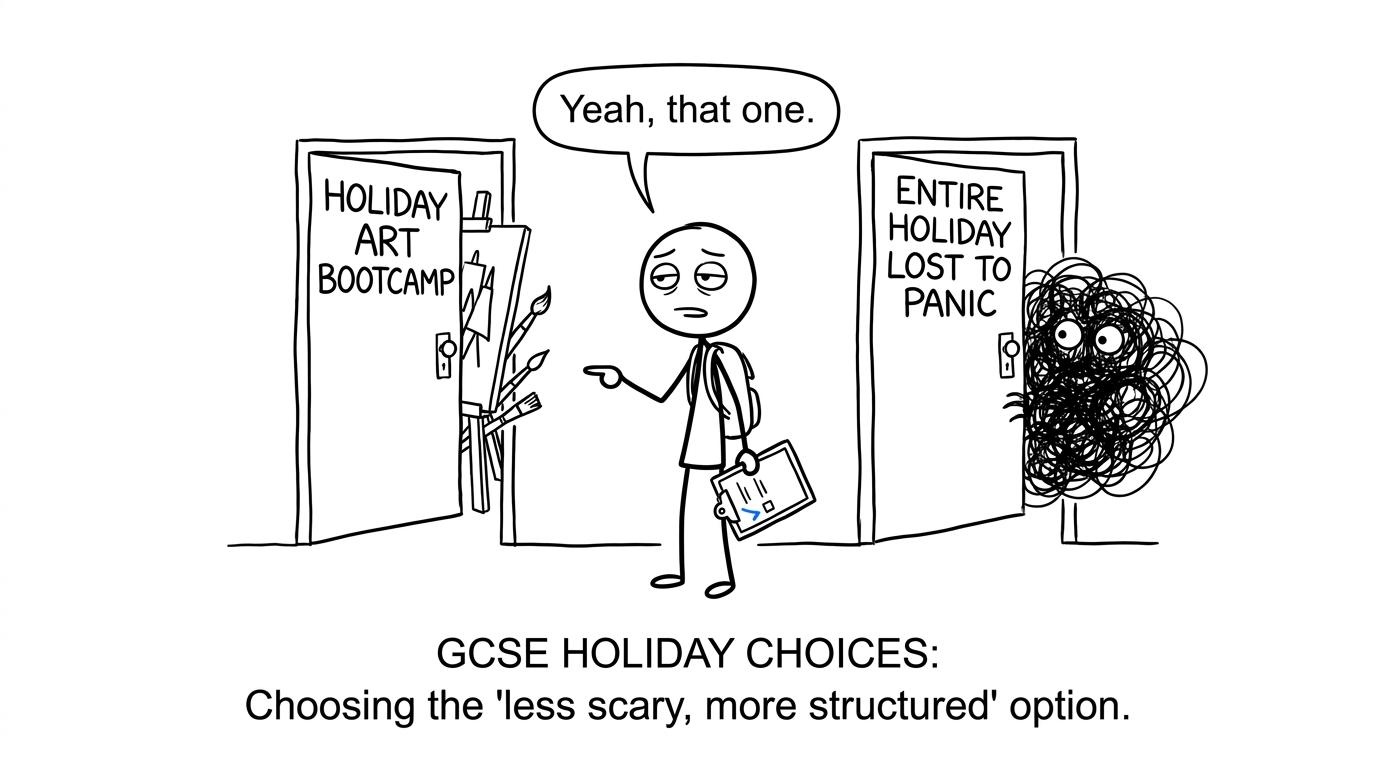 A student calmly chooses between a useful art course and holiday panic
What does a GCSE art and design revision bootcamp offer?
The word bootcamp is not an official exam-board term. Providers use it for everything from a single workshop to a week-long holiday programme. Course quality and purpose therefore vary considerably.
A useful course may include:
- observational drawing or photography sessions
- experimentation with unfamiliar media and processes
- support organising a sketchbook or portfolio
- discussion of artists, designers and other relevant sources
- feedback on how ideas develop across a project
- planning for a final response
- studio space and access to specialist equipment
- structured working time with fewer distractions
Some programmes are broad creative courses rather than GCSE revision. Producing an attractive painting during a holiday workshop is not automatically the same as improving assessed work. The important question is whether the teaching helps you make your own creative journey clearer, more purposeful and better evidenced.
Understand what GCSE Art and Design assesses
Current specifications from AQA, Pearson Edexcel, OCR and Eduqas organise assessment around four shared objectives. In simplified terms, students must:
- AO1: investigate sources and develop ideas
- AO2: experiment with materials, techniques and processes, then refine work
- AO3: record observations, ideas and insights as work progresses
- AO4: produce a personal and meaningful response that realises their intentions
These objectives are equally weighted overall. That matters because a course focused almost entirely on polishing a final piece may leave important gaps in investigation, experimentation and recording.
Across the specifications reviewed, the portfolio or personal portfolio contributes 60%60\%60% of the qualification and the externally set component contributes 40%40\%40%. The externally set component includes preparatory work followed by 101010 hours of supervised work. Precise administration differs by board and centre, so your teacher and current specification should always be your final reference.
A bootcamp cannot replace this process. It can help you practise techniques, explore possibilities and use time more deliberately, but your submitted evidence must remain your own work. Ask your teacher before taking live assessed work to an external tutor. Your school must be able to authenticate what you submit, and special conditions apply once supervised work begins.
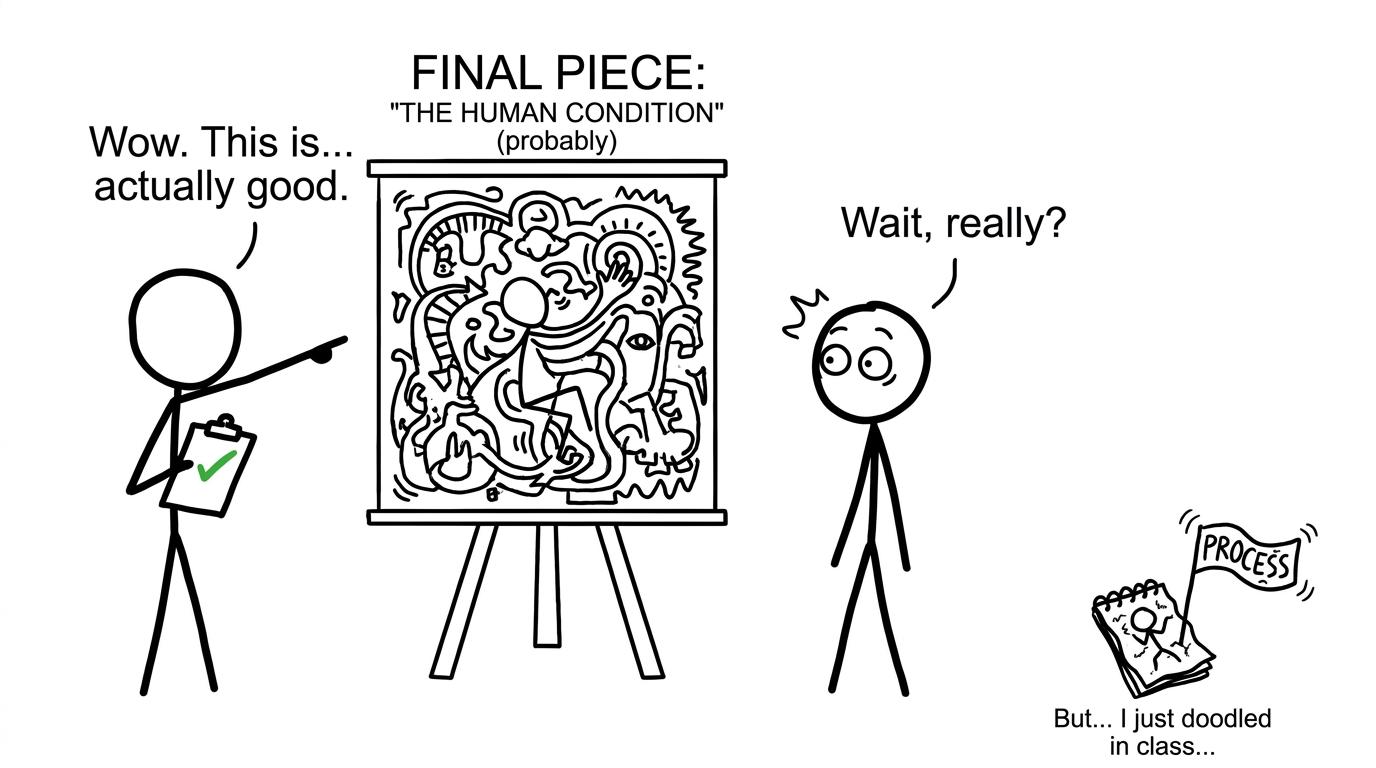 A neglected sketchbook reminds a student that the creative process matters
When a GCSE art and design revision bootcamp is worth it
You have a specific technical barrier
Paying for specialist help can make sense if you know exactly what is holding you back. Perhaps you need supervised access to printmaking equipment, photography lighting, ceramics facilities or digital design software. A tutor who regularly teaches that process may help you work safely and understand what effective experimentation looks like.
The narrower the problem, the easier it is to judge whether the course provides value.
You need structured studio time
Art coursework expands to fill the space around it. A student may spend an entire evening choosing reference images without making a meaningful decision. A structured studio day can remove distractions and create a clear sequence: review intentions, experiment, record decisions and plan the next stage.
That structure is valuable only if you continue afterwards. One intense day cannot compensate for weeks of avoiding the project.
The feedback is genuinely individual
Good feedback connects your intentions to visible evidence. It should help you notice what is missing, compare possible directions and decide what to do next. It should not dictate an idea or redesign the project in the tutor’s preferred style.
Before booking, ask how much individual feedback each student receives and how many students attend. A polished course description tells you less than a clear answer to those questions.
The facilities justify the cost
Specialist materials, safe working space and equipment can be expensive or impractical to arrange at home. In that situation, the fee is partly paying for access rather than simply for advice.
Check whether materials are included. Travel, food and extra supplies can turn an apparently affordable course into a much larger commitment.
When paying is probably unnecessary
A bootcamp is unlikely to be the best choice if you mainly need to finish routine tasks, improve time management or act on feedback your school has already provided.
Your first step should usually be a conversation with your art teacher. Ask:
- Which assessment objective currently has the weakest evidence?
- What is the most important improvement I can make next?
- Is the problem technical, conceptual or organisational?
- Can I access the necessary equipment through school?
- Is external tuition appropriate for this stage of the component?
School holiday sessions, lunchtime access, public galleries, libraries and materials you already own may solve the problem without a commercial course. Paying more does not automatically make feedback more relevant to your project or specification.
Be cautious of providers promising a guaranteed grade. Art assessment considers a body of evidence produced over time, and no short course can guarantee how that evidence will be marked and moderated.
Protect your GCSE maths revision time
Art deadlines feel immediate because unfinished pages remain physically visible. Maths weaknesses are quieter. They often become obvious only when a timed paper exposes them.
That creates a risk: a student spends most of the holiday on art because it feels urgent, then returns to school having done no sustained maths practice. The solution is not to choose one subject and neglect the other. It is to give each a defined role.
Use a realistic GCSE maths revision timetable before booking the course. Put the bootcamp, travel and recovery time into the plan first. Then reserve shorter maths sessions around it. A focused session with questions and careful marking is more useful than vaguely promising to revise after a full studio day.
A sensible holiday pattern might include:
- art bootcamp days for practical work and feedback
- short maths topic sessions on selected evenings
- one timed section or mini test on a free morning
- a longer maths paper after the course, when concentration has recovered
- protected rest rather than filling every available hour
If your maths exam is close, follow a one-week GCSE maths revision plan rather than improvising. Students preparing for Edexcel can combine topic revision with Edexcel GCSE Maths past papers and Edexcel predicted papers.
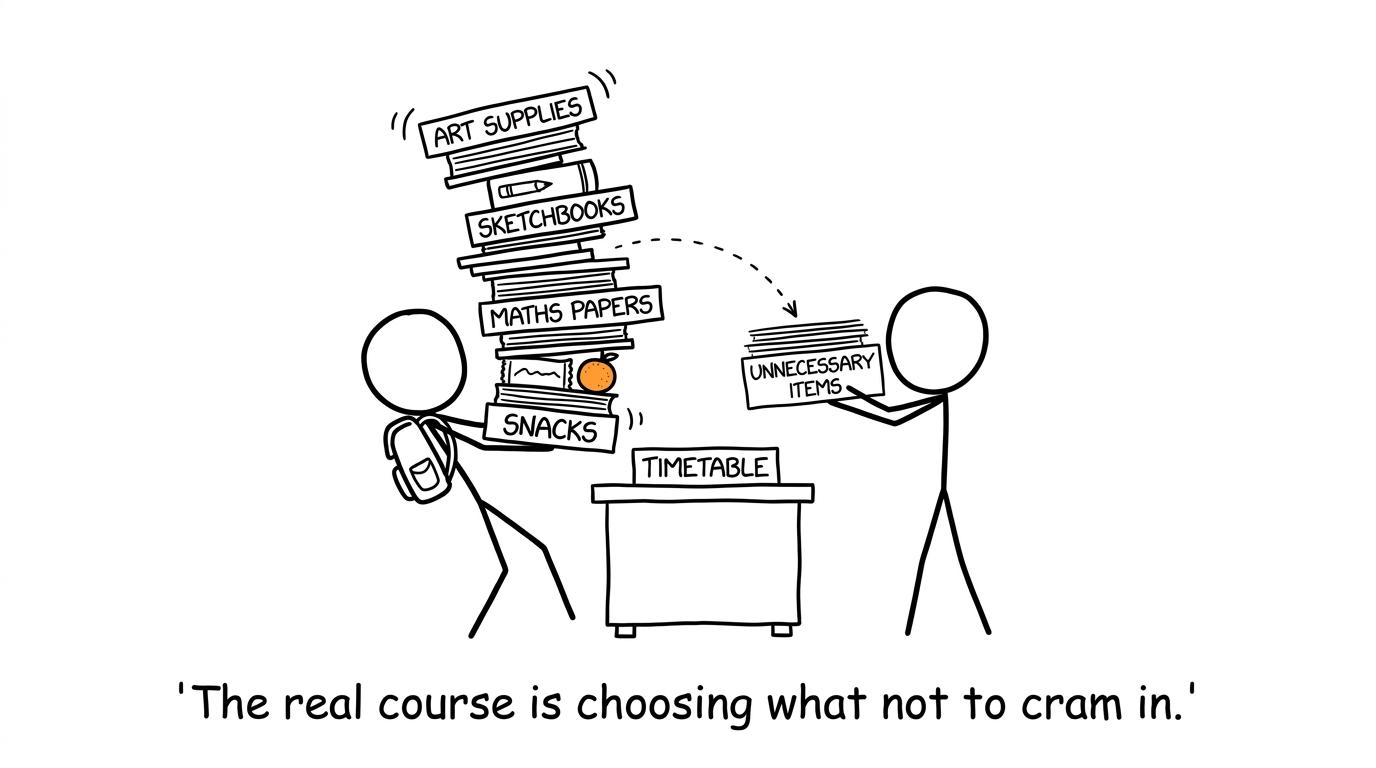 A student tries to squeeze art supplies, maths papers and snacks into one tiny timetable
How to compare courses before booking
Ask what students will actually do
Look beyond phrases such as intensive support and portfolio development. Request a timetable or session outline. A credible provider should be able to explain whether students receive demonstrations, independent making time, project reviews or general creative activities.
Check the tutor’s relevant experience
A talented practising artist is not automatically familiar with GCSE assessment. Ask whether the tutor understands current Art and Design specifications and whether the course supports your specialism, such as fine art, photography, textiles or graphic communication.
Clarify ownership and permitted support
The tutor should guide, question and demonstrate techniques without producing assessed work for you. Confirm that you will retain control over your ideas and outcomes. Then check the proposed activities with your school.
Calculate the complete commitment
Consider the course fee, materials, travel, food and the time displaced from other revision. Also compare it with the alternative: school support, a shorter workshop or independent studio time with a precise task list.
The cheapest option is not always best, but neither is the longest. Value comes from solving the right problem.
Common mistakes when choosing an art revision course
Booking before diagnosing the problem
Feeling behind is not a precise diagnosis. Identify the missing evidence or technical difficulty first, then find targeted support.
Focusing only on the final outcome
A striking final piece cannot by itself demonstrate the full development process. Investigation, experimentation, recording and refinement all need visible evidence.
Assuming every art course is GCSE-specific
A general drawing class may improve confidence without addressing your assessed project. That can still be worthwhile, but it is a different purchase.
Ignoring your teacher’s guidance
Your teacher understands your project, centre arrangements and exam-board requirements. External advice should complement that guidance, not pull your work in a contradictory direction.
Sacrificing all other revision
A full holiday devoted to one practical subject may create avoidable problems elsewhere. Keep maths active through brief, deliberate practice. Learn when to begin using GCSE past papers, and use mark schemes to improve your methods rather than simply collecting scores.
The final verdict
A GCSE art and design revision bootcamp is worth the cost when it provides something specific that you cannot readily obtain elsewhere: specialist facilities, relevant technical teaching, focused working time or thoughtful individual feedback. It is poor value when its promises are vague, its activities are generic or it disrupts more urgent exam preparation.
Start with your teacher, identify the exact gap and compare the complete cost with realistic alternatives. If you book, arrive with clear intentions and leave with an achievable next-action list.
Then keep your wider revision moving. Use MathsGenie’s free GCSE and A Level maths revision resources for revision lessons, practice questions, mini tests, past papers, predicted papers, mark schemes and video solutions. A good holiday plan does not ask one subject to consume everything. It gives each subject the focused time it needs.