

GCSE Art and Design Results Day Wrong Grade?
GCSE Art and Design results day wrong grade? Learn what to check in the first hour, who to contact and how reviews of results and moderation work.
A results slip can turn months of patient work into one small line of text. If the grade beside Art and Design is much lower than your mock or predicted grade, the first reaction is often disbelief. Then panic arrives.
If you searched for gcse art and design results day wrong grade, the immediate answer is this: speak to your school's exams officer or Art and Design teacher before leaving, request your component marks, and ask whether moderation changed the centre's original marks. Do not contact the exam board independently or assume that a disappointing result must be an error. Your school or college normally has to submit any post-results request for you.
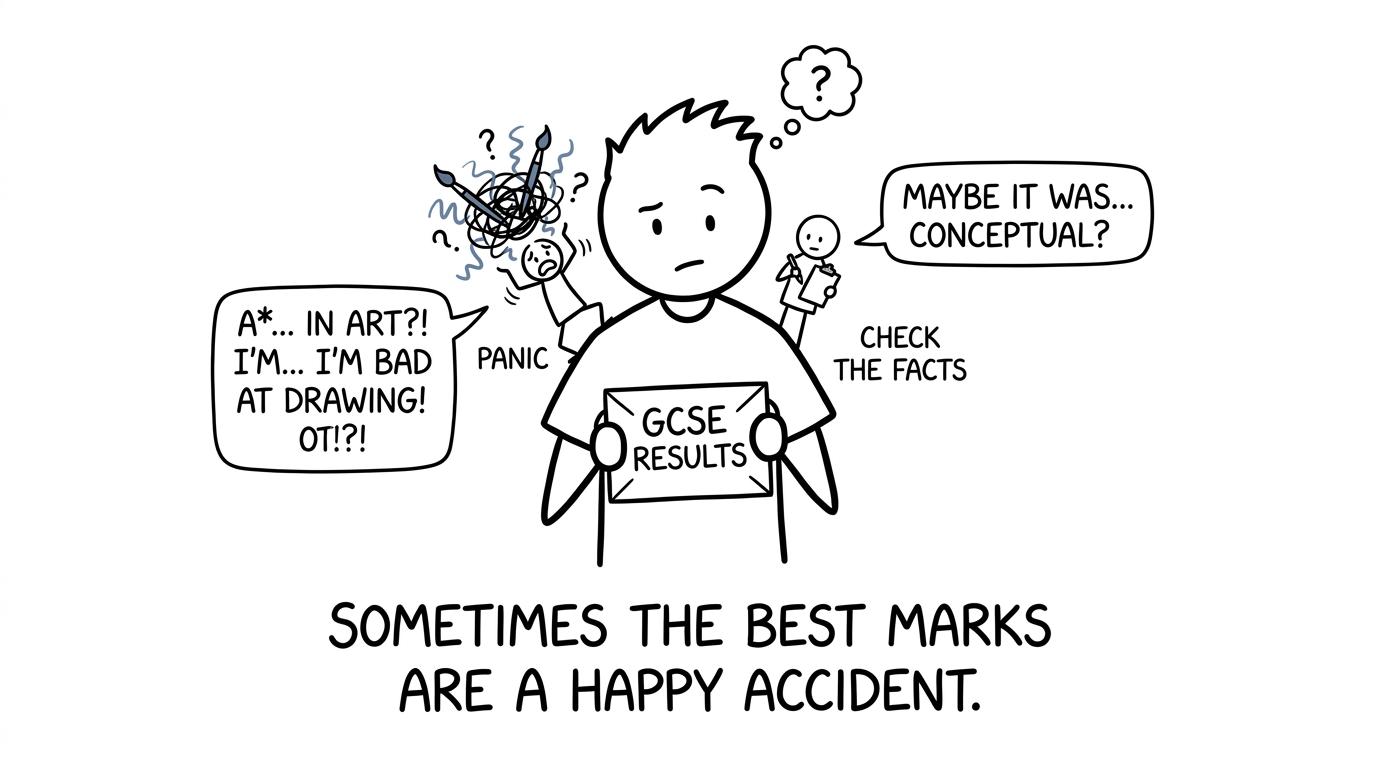 A student choosing facts over panic after opening an unexpected GCSE result
Your first-hour checklist
Use the first hour to collect facts rather than make a rushed decision:
- Check your name, candidate number, qualification title and Art and Design endorsement.
- Photograph or securely save your results statement.
- Ask for the marks recorded for each component, where available.
- Ask whether the school's marks were adjusted during external moderation.
- Tell staff immediately if the grade affects sixth-form, college or apprenticeship entry.
- Find out who is handling post-results enquiries and how they will contact you.
- Ask for the centre's deadline, available services, possible fees and consent form.
- Do not sign a review request until the likely route and risk have been explained.
Your predicted grade is useful context, but it is not proof that the awarded grade is wrong. The useful question is not simply, “Why is this lower?” It is, “Does the result information suggest an administrative, marking or moderation problem?”
What to do during the first hour
First ten minutes: check the basic information
Read the result carefully. Make sure it belongs to you and names the correct qualification and endorsement, such as Fine Art, Photography, Graphic Communication or Textile Design, depending on your course.
If the result is missing, shown as pending, or attached to an unfamiliar entry, take it directly to the exams officer. These problems need investigation by the centre rather than a debate about artistic judgement.
Keep your result private enough to think clearly. A busy group chat can produce ten confident explanations and no reliable information.
The next twenty minutes: ask for the mark breakdown
Ask your Art and Design teacher or exams officer:
- What marks were submitted by the school?
- What marks appear in the final results data?
- Was either component adjusted through moderation?
- Was the school's work included in the moderator's sample?
- Does the result sit close to a grade boundary?
- Which post-results service, if any, applies to this specification?
Art and Design is not processed in exactly the same way as a conventional written GCSE paper. Specifications from Edexcel, AQA, OCR and Eduqas include practical or portfolio-based components, and assessment arrangements vary. Work may be internally assessed and then externally moderated, even where a task is externally set.
That distinction matters. An individual review of marking may not be the correct route for a component that was marked by your centre and moderated as part of a cohort.
The final half-hour: record the next action
Before leaving, write down:
- the name and email address of the staff member handling your query;
- your centre's internal deadline;
- whether it will examine the result before requesting a formal service;
- whether you need to provide written consent;
- when you should expect an update.
If a college place depends on the grade, contact the admissions team calmly and explain that the result is being investigated. Do not promise that it will change. Ask what evidence or timescale they need.
 An exams officer guiding a results question away from rumours
Why an Art and Design grade can differ from predictions
A predicted grade is a teacher's informed estimate. A mock grade may come from incomplete work, an earlier assessment point or a task that did not represent the complete specification. Neither guarantees a final grade.
The final result may differ because:
- the completed portfolio did not match the standard suggested by earlier work;
- different assessment objectives performed at different levels;
- the externally set component changed the overall outcome;
- external moderation adjusted some or all of the centre's marks;
- the final grade boundaries differed from assumptions made during the course;
- an administrative or assessment error occurred.
The first five possibilities can produce a surprising but valid result. The last possibility is why post-results procedures exist.
Being close to a boundary is also not evidence of an error. It can, however, help the school decide whether an appropriate review is proportionate. The strength of the evidence matters more than the size of the disappointment.
Which post-results service might apply?
Current JCQ and Ofqual guidance distinguishes between administrative checks, reviews of marking and reviews of moderation. Your centre should determine which service is available for the relevant exam board and component.
Administrative error review or clerical re-check
This checks whether assessed material was processed correctly, including whether marks were recorded and totalled accurately. It does not replace academic judgement merely because a student expected a higher grade.
This may be relevant if the component marks do not add up as expected, a mark appears missing or there is another clear processing concern.
Review of marking
For an eligible externally assessed component, a review considers whether the original mark scheme or assessment criteria were applied correctly. It is a review of the existing assessment, not an entirely fresh mark awarded without reference to the original decision.
Written candidate consent is required because the mark and final subject grade can go down, stay the same or go up. Only the school or college normally submits the request for an internal candidate.
Review of moderation
A review of moderation asks whether moderation of the centre's internal assessment was carried out correctly. It applies to the centre's cohort rather than one student requesting an individual reconsideration.
The school decides whether there is evidence to support this request. An individual student cannot normally order a review of moderation independently. Under current JCQ arrangements, marks can change following the review, but published subject grades are protected from being lowered in that examination series.
This is why asking, “Was the centre's marking adjusted?” is so useful. It identifies whether the issue concerns your individual record or the moderation applied to the centre.
A formal appeal
An appeal is not normally the first step. It may become available after the relevant review of results where the centre believes the exam board did not follow its procedures or made an error in applying the assessment framework.
Students should ask their centre for its appeals policy. The centre generally decides whether there are valid grounds and submits the appeal. Simple disagreement with the academic judgement is not automatically sufficient.
For the summer 202620262026 series, current JCQ information says reviews of marking will not be available after 24 September 202620262026. Schools often impose earlier internal deadlines so they have time to examine evidence and submit requests. Always use the date given by your exams officer rather than waiting for the final awarding-body deadline.
Questions to ask before giving consent
A calm decision needs more than the phrase “get it remarked”. Ask:
- Is this component eligible for an individual review?
- Does the evidence suggest a recording error, marking issue or moderation issue?
- Could my grade be lowered through this service?
- Is there a charge, and who pays it?
- Will the fee be refunded if the grade changes?
- Could the outcome affect my next course or application deadline?
- What happens if the result stays the same?
Fee and refund arrangements can vary by exam board and centre policy. Confirm them with your school rather than relying on another student's experience.
Written consent for a clerical re-check or review of marking must be collected after results have been published. Signing it confirms that you understand the result may move in either direction.
Keep one unexpected grade from consuming every subject
Uncertainty is mentally expensive. It makes concentration feel irresponsible, as though worrying continuously might somehow improve the outcome. It will not.
Once you have checked the result, contacted the right person and recorded the next deadline, the useful work is temporarily finished. Put the issue in an “action taken” category and return to what you can control.
 A student puts an unexpected Art grade into an action tray before returning to revision
For students still preparing for maths assessments or resits, MathsGenie provides a clear next step. Begin with the free GCSE Maths revision hub, where exam-board resources, videos and practice questions are organised in one place.
If full papers feel overwhelming, use the shorter Edexcel GCSE Maths mini tests to diagnose individual gaps. When you are ready for realistic timed work, move to Edexcel GCSE Maths past papers with mark schemes and available solutions.
The same principle applies to both revision and results queries: separate the feeling from the evidence, then take the smallest useful action.
Common mistakes when challenging an unexpected grade
Treating a predicted grade as a guaranteed result
Predictions are estimates, not awarded qualifications. Use them to explain why you want the result checked, but look for component marks, moderation information or an administrative inconsistency.
Asking the exam board directly
For students entered through a school or college, post-results requests are normally made by the centre. Start with the exams officer, even if you know your exam board.
Assuming every Art component can be individually remarked
Art and Design often involves centre assessment followed by external moderation. The appropriate route may be a cohort-level review of moderation rather than an individual review of marking.
Missing the school's deadline
Awarding bodies publish final deadlines, but centres need time to collect consent, review evidence and process applications. Your school's deadline may be significantly earlier.
Ignoring the risk of a lower result
A clerical re-check or review of marking can lower, confirm or raise a mark and grade. Read the consent information before deciding.
Letting the query stop all revision
Once the request is with the appropriate member of staff, repeated checking adds no evidence. Rebuild routine with a short task. MathsGenie's guide to starting GCSE past papers explains how to move from topic practice to timed papers, while the one-month GCSE maths revision plan provides a manageable weekly structure.
Turn uncertainty into a clear process
An unexpected GCSE Art and Design grade deserves attention, but not instant conclusions. Check the entry, obtain the component information, ask whether moderation changed the centre's marks and let the exams officer identify the correct service. If progression depends on the result, tell both your centre and the receiving institution immediately.
Then return to the subjects still within your control. Use MathsGenie's free revision lessons and practice questions to repair weak topics, GCSE predicted papers to sharpen final preparation, and past papers, mark schemes and video solutions to build exam confidence.
Results day can feel like a verdict. Often, it is better understood as information: something to verify, respond to and then use to choose the next sensible step.











