GCSE Art and Design Predicted Grade Process
GCSE art and design predicted grade process explained: learn how teachers use portfolios, assessment objectives, grade boundaries and professional judgement.

A predicted grade can feel strangely final. It appears on a report as a single number, even though your sketchbook contains months of experiments, revisions, abandoned ideas and finished work. Yet the GCSE art and design predicted grade process is not a teacher glancing at your best piece and choosing a grade. It is an evidence-based estimate of the standard you are currently demonstrating.
Teachers normally consider your work against the assessment objectives in your exam board's specification, use the evidence completed so far, compare marking across the department and refer cautiously to previous grade boundaries. The exact method and reporting schedule can vary by school, so your teacher should be able to explain what evidence informed your prediction.
The predicted grade process at a glance
A teacher will usually:
- identify the relevant specification and assessment criteria;
- assess the portfolio evidence completed so far;
- judge performance across all four assessment objectives;
- consider how consistently that standard is demonstrated;
- use internal standardisation to compare marking between teachers;
- consult previous grade boundaries without assuming they will remain unchanged;
- apply professional judgement to estimate the most likely grade.
The important word is estimate. A predicted grade is not your awarded GCSE grade, and it does not permanently limit what you can achieve.
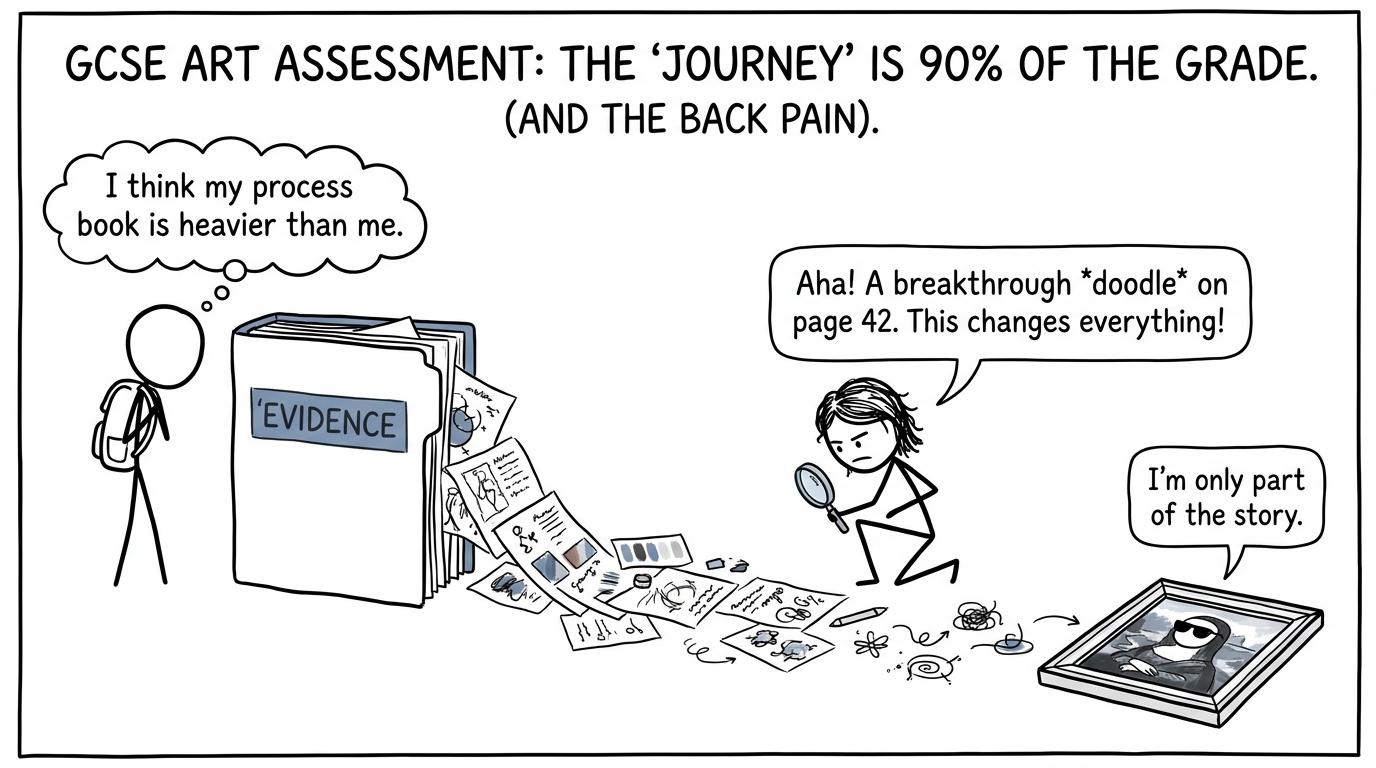 A finished artwork discovers that the whole portfolio matters
What evidence do teachers actually use?
The strongest predictions come from evidence that resembles the work used for formal assessment. In Art and Design, that means your teacher is interested in the journey as well as the destination.
Portfolio work completed so far
Across the major English exam boards, GCSE Art and Design normally has two components: a portfolio component worth 60%60\%60% and an externally set assignment worth 40%40\%40%. Both are non-exam assessment, although the externally set assignment includes a supervised period in which students produce their personal response.
Early predictions may be based largely on portfolio work because the externally set assignment has not yet been completed. A teacher might examine sustained projects, supporting studies, research into relevant sources, experiments with materials, observational recording, annotations, refinement and final responses.
An impressive final piece helps, but it cannot reveal everything. The specification asks for evidence of how ideas developed, how choices were tested and refined, and how intentions were realised. A sketchbook showing purposeful decisions can therefore be more informative than several polished images with little visible development.
Performance against the assessment objectives
Although exam boards phrase their criteria in slightly different ways, the four national assessment objectives broadly require students to:
- AO1 Develop: investigate sources and develop ideas with critical understanding;
- AO2 Refine: experiment with and select suitable media, materials, techniques and processes;
- AO3 Record: record ideas, observations and insights relevant to intentions;
- AO4 Present: produce a personal and meaningful response that realises intentions.
Each objective contributes 25%25\%25% of the qualification. A useful way to picture the overall assessment is:
Overall evidence=0.25(AO1)+0.25(AO2)+0.25(AO3)+0.25(AO4).\text{Overall evidence}=0.25(\text{AO1})+0.25(\text{AO2})+0.25(\text{AO3})+0.25(\text{AO4}).Overall evidence=0.25(AO1)+0.25(AO2)+0.25(AO3)+0.25(AO4).This is not a calculation students should use to invent their own grade. Exam boards have different raw-mark systems and component scaling arrangements. It simply shows why one excellent outcome cannot fully compensate for missing evidence elsewhere.
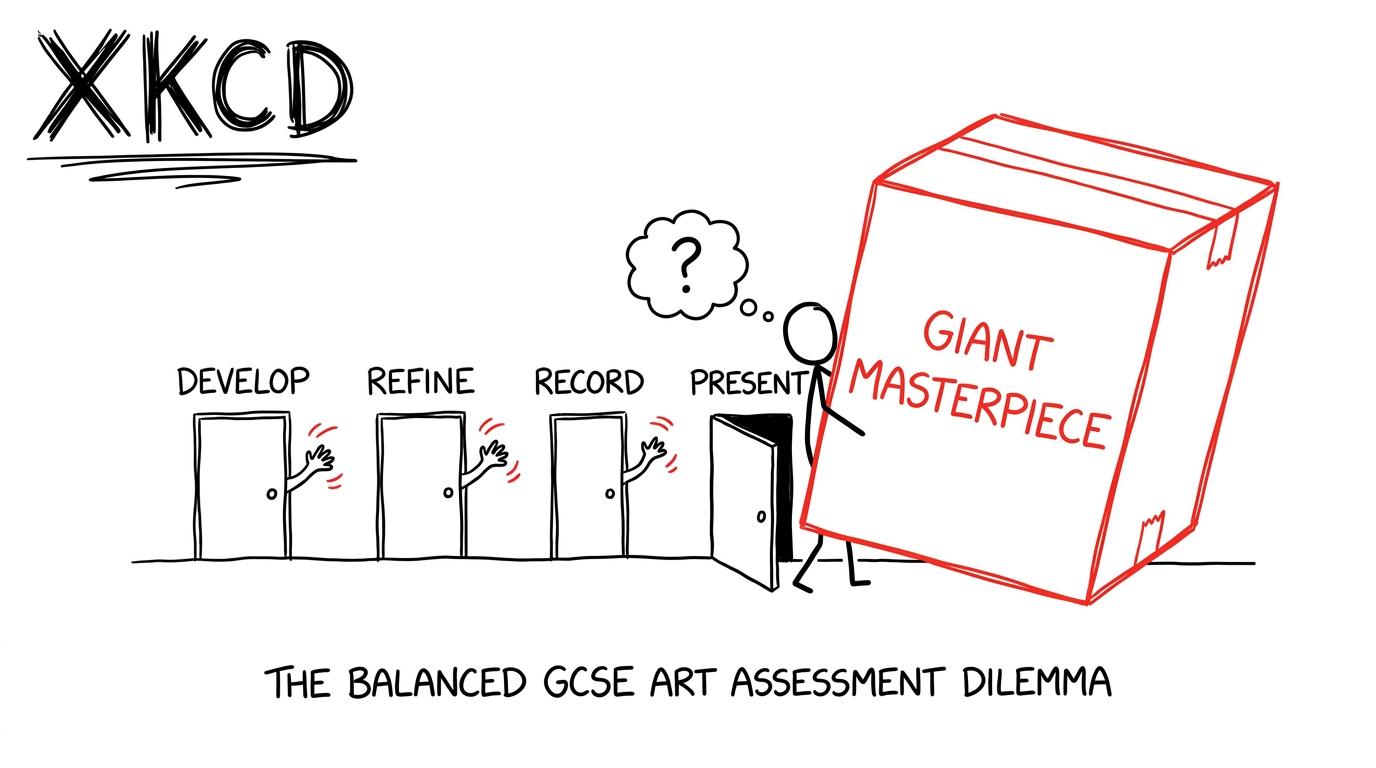 Four assessment objectives wait for their share of attention
Classroom assessments and interim marking
Departments may hold formal portfolio reviews or assessment points during the course. Teachers can mark a completed project using the board's assessment grid, then consider whether that performance is representative of the student's wider work.
Draft work, homework and classroom observations may provide supporting context, but predictions should be anchored in demonstrable attainment. Effort matters enormously to improvement, yet effort alone is not an assessment objective. The grade estimate must reflect the quality of the evidence currently available.
Consistency over time
One unusually strong page does not necessarily establish a new working standard. Equally, one unsuccessful experiment should not erase months of stronger evidence. Teachers look for patterns: Is the student repeatedly developing ideas with purpose? Is refinement visible across projects? Can the student record observations skilfully in appropriate forms?
This resembles good maths diagnosis. One correct answer proves less than a pattern across unfamiliar questions. Maths students can build that pattern through GCSE revision lessons and practice questions, where repeated evidence makes strengths and gaps easier to see.
How marks become a predicted grade
Teachers assess the evidence using their board's mark bands or assessment grid. The precise raw marks differ. For example, AQA currently marks each component out of 969696, with up to 242424 marks available for each assessment objective. Pearson Edexcel uses a different grid, awarding up to 181818 marks for each objective and 727272 marks for each component before applying the component weightings.
Those differences are why students should use the documents for their own board rather than borrowing a mark total seen online.
After arriving at an indicative mark, teachers may compare it with previous grade boundaries. This requires care. Final grade boundaries are set after assessment evidence from the examination series is available, and they can move from year to year. Last year's boundary is a reference point, not a promise about this year's result.
The teacher then combines the available information:
- the assessed standard of completed work;
- coverage of all assessment objectives;
- the amount of the course completed;
- previous boundaries and published grade descriptions;
- professional judgement about the most defensible current estimate.
If part of the course remains unfinished, the prediction contains more uncertainty. A teacher should not simply assume that every unfinished section will eventually reach its ideal standard.
Why internal standardisation matters
Art involves professional judgement, but that does not mean marking is arbitrary. Departments usually standardise by reviewing examples together, discussing how the criteria apply and adjusting judgements when teachers have interpreted a mark band differently.
Schools may also use exemplars and guidance supplied by the exam board. For the final qualification, centre-assessed work is externally moderated. Moderation checks whether the centre has applied the board's standard appropriately; it is distinct from the earlier school prediction.
This distinction matters:
- Predicted grade: the school's estimate before final results are known.
- Centre-assessed mark: the mark awarded to completed components using the specification.
- Final grade: the grade issued after marks, moderation and that series' grade boundaries have been applied.
A predicted grade is therefore neither a miniature final result nor an informal opinion. It sits between the two: structured judgement based on incomplete evidence.
Can your predicted grade change?
Usually, yes. Schools issue predictions at particular reporting points, but your demonstrated standard can improve afterwards. Whether an official prediction is updated depends on school policy and timing.
The most useful response is to ask precise questions:
- Which assessment objective currently limits my mark most?
- What evidence is missing or underdeveloped?
- Which completed section best represents the required standard?
- What would stronger refinement or recording look like in my project?
- When will the next formal assessment take place?
“Work harder” is difficult to act upon. “Show how these material tests changed the final composition” is specific evidence you can create.
The same principle can steady your maths revision. Use a GCSE Maths self-diagnosis routine rather than revising every topic equally. Then organise the next steps with a realistic GCSE maths revision timetable.
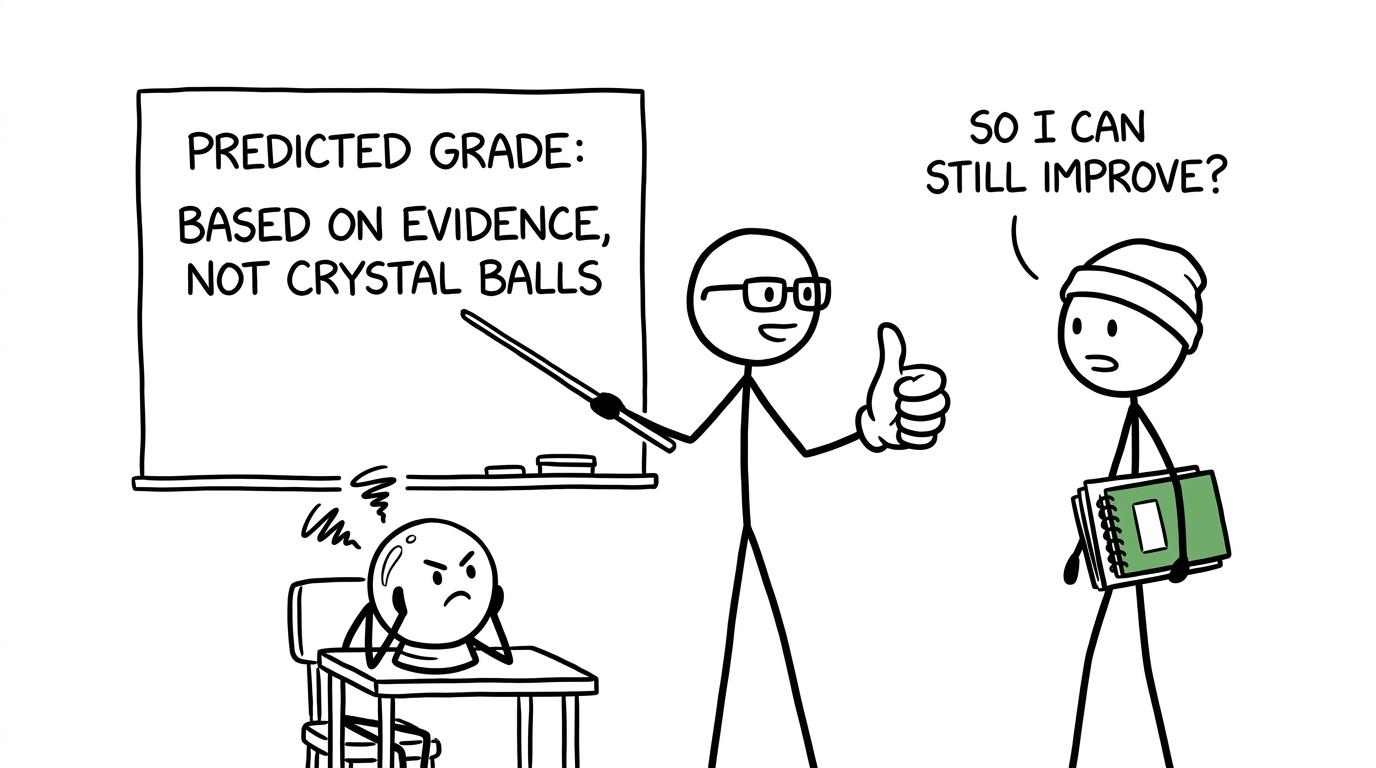 A crystal ball learns that predicted grades come from evidence
What students can do with the prediction
Treat the prediction as a diagnostic snapshot. First, obtain the assessment breakdown if your school provides one. A total grade tells you where you are; performance by assessment objective suggests where to go next.
Next, protect the evidence already working well. Students sometimes respond to feedback by redesigning everything. That can consume time without addressing the weakest objective. Improve the smallest important gap first: clearer source analysis, broader experiments, more purposeful recording or a stronger connection between development and the personal response.
Finally, create a manageable schedule across subjects. Art benefits from sustained project time, while maths improves through frequent retrieval and question practice. The one-month GCSE revision plan can help you distribute maths work without allowing it to swallow every evening. Use GCSE mini tests for quick checks when a longer session must be reserved for portfolio development.
Common mistakes about predicted Art and Design grades
Assuming the final piece decides everything
AO4 matters, but it represents only one quarter of the assessment objectives. Development, experimentation and recording need visible evidence too.
Treating last year's boundary as fixed
Grade boundaries can change between examination series. Previous boundaries help teachers estimate a grade, but they cannot reveal the future boundary exactly.
Confusing prediction with final marking
A prediction may use incomplete work and professional judgement. Final component marks must be based on the submitted evidence and are subject to the board's moderation process.
Believing effort automatically earns marks
Commitment often leads to better work, but assessment is based on how successfully the submitted evidence meets the criteria. Ask how to convert effort into stronger evidence.
Comparing raw marks across exam boards
AQA, Pearson Edexcel, OCR and Eduqas do not all organise raw marks identically. Compare your work only with the correct specification, grid and guidance for your entry.
Ignoring other subjects because Art has no written paper
Portfolio deadlines can make Art feel urgent every day. Your maths preparation still needs protected time. Use past papers with mark schemes and follow a repeatable paper-mark-fix-retest cycle explained in how to use GCSE past papers properly.
Turn one number into a useful next step
The GCSE Art and Design predicted grade process is best understood as a careful forecast. Teachers assess the evidence available against the four objectives, check the consistency of their marking, consider previous boundaries and apply professional judgement. The number may matter for reports and applications, but its most immediate value is the conversation it starts.
Ask what evidence shaped it. Find the weakest objective. Improve that evidence deliberately. Then repeat the same calm process across your other subjects.
For maths, make MathsGenie's free GCSE revision hub your next stop. Use revision lessons and practice questions to repair weak topics, mini tests to check progress, and past papers, predicted papers, mark schemes and video solutions to turn a forecast into marks you can actually earn.