GCSE Art and Design Part-Time Job Balance Guide
GCSE art and design part-time job balance made realistic: plan shifts, protect coursework time and keep GCSE maths revision moving without burnout.
A part-time shift does not only occupy the hours printed on the rota. It can take the energy before it, the journey around it and the quiet recovery afterwards. Add an unfinished sketchbook and a maths paper approaching on the calendar, and even a well-organised student can feel permanently behind.
The answer to GCSE art and design part time job balance is not to squeeze work into every available minute. It is to protect a few high-value blocks, make your shifts predictable where possible and give each subject the kind of time it actually needs. Art usually benefits from longer creative sessions. Maths can move forward through shorter, focused practice. Build your week around that difference.
Your quick balance checklist
Start with these decisions:
- Put school deadlines, examinations and confirmed shifts on one calendar.
- Reserve one or two longer blocks for practical art and design work.
- Use short, regular maths sessions on school days or after lighter shifts.
- Choose a weekly minimum that still works during a difficult week.
- Ask for rota changes early when major art deadlines or maths papers approach.
- Review your plan once a week rather than rebuilding it every evening.
- Protect sleep, meals and travel time instead of treating them as empty space.
- Tell a parent, carer or teacher if work is interfering with your education or wellbeing.
The GCSE maths revision hub can reduce planning time because lessons, practice questions and exam resources are already organised by board and topic.
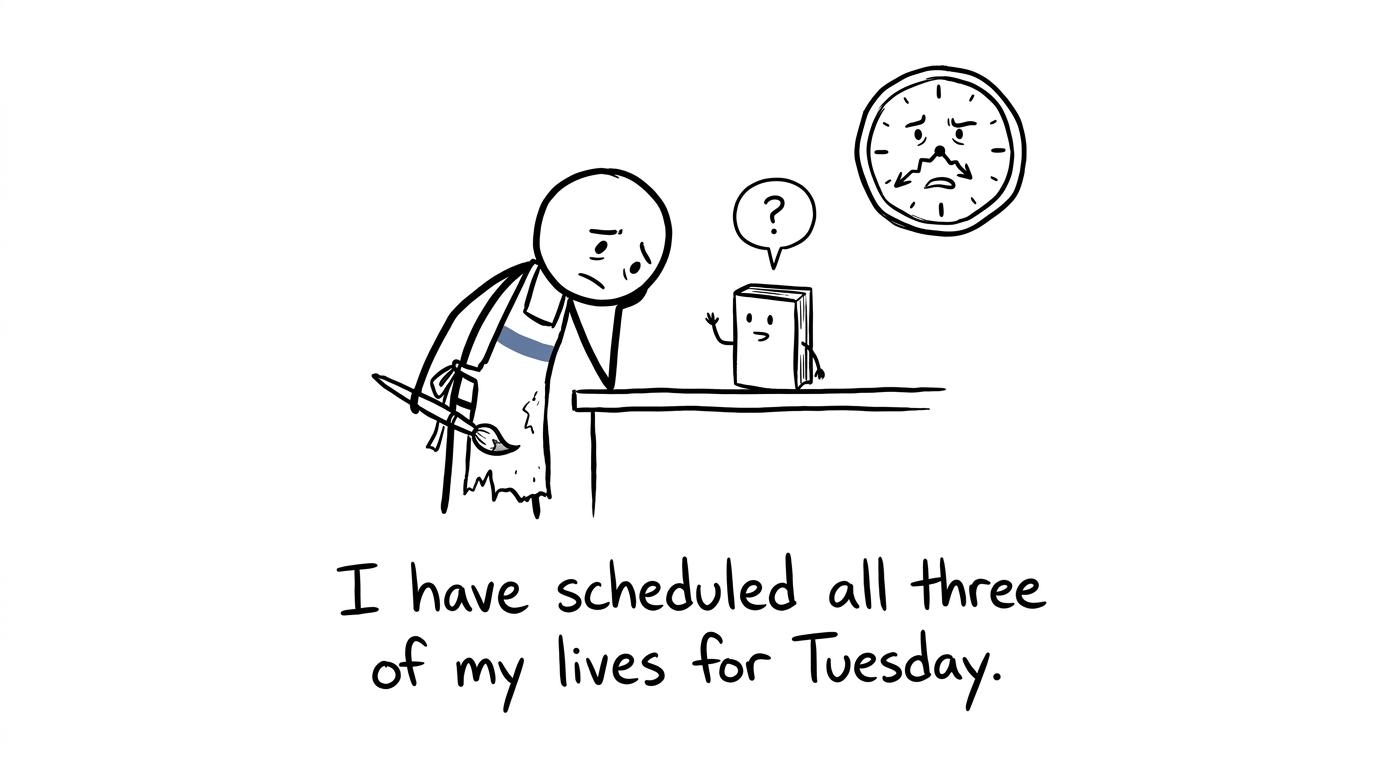 A student juggling art, shift work and maths revision
Understand why art and maths need different time
GCSE Art and Design is not simply an examination that can be revised for at the end. Under the current regulated structure, the portfolio contributes 60%60\%60% and the externally set assignment contributes 40%40\%40%. The four assessment objectives, developing ideas, refining work, recording observations and presenting a personal response, are each weighted at 25%25\%25%.
Current AQA and Edexcel specifications follow this structure, although students should always check the exact requirements and deadlines given by their school and exam board. OCR and Eduqas students should do the same. Your teacher’s deadline may be earlier than the awarding organisation’s deadline because the school needs time for marking, authentication and administration.
Art therefore accumulates. A rushed final piece cannot automatically replace missing investigation, experimentation or recording. This makes regular progress important.
Maths has a different rhythm. A focused 202020-minute session can be genuinely useful if it contains active questions, marking and one correction. The MathsGenie busy-day maths routine is particularly helpful when a shift leaves little time for revision.
The practical rule is simple:
- Give art fewer but longer protected sessions.
- Give maths shorter but more frequent sessions.
- Use weekends or non-shift evenings for timed papers and substantial portfolio work.
Equal time is not always sensible time.
Build the week around fixed commitments
Begin with what cannot move: lessons, travel, confirmed shifts, appointments and sleep. These are the walls of the week. Revision must fit inside the room that remains, not inside an imaginary week with no tiredness or interruptions.
Use three types of study block
Deep blocks last roughly 606060 to 120120120 minutes. Use these for developing a composition, experimenting with materials, photographing work, completing meaningful annotation or sitting a substantial maths paper section.
Focused blocks last around 252525 to 454545 minutes. They suit artist research, planning, a maths topic lesson or a targeted set of exam questions.
Maintenance blocks last around 101010 to 202020 minutes. Use them to organise reference images, label work, recall formulae, redo one maths mistake or complete a short set of questions.
Do not assign a deep block to the evening after your hardest shift unless experience tells you that you can genuinely manage it. A timetable should describe the person you are likely to be, not the person guilt imagines you ought to become.
The realistic GCSE maths revision timetable offers a useful structure for choosing repeatable weekly sessions around school and other commitments.
Set a minimum week and a stronger week
One timetable often fails because it assumes every week will be calm. Retail, hospitality and family schedules rarely cooperate so neatly.
Create two versions instead.
Your minimum week
This is the plan you can maintain during extra shifts, difficult coursework deadlines or a tiring school week. It might include:
- two short maths sessions;
- one maths mini test or paper section;
- one long art session;
- two art maintenance tasks;
- a brief Sunday review.
Your stronger week
When your rota is lighter, add another art block and a longer maths session. You might complete a timed paper, mark it and repair the weakest topic.
The minimum prevents a difficult week from becoming a lost week. The stronger version lets you use extra capacity without assuming it will always exist. For quick mathematical feedback, try the Edexcel GCSE Maths mini tests, or select equivalent resources through the main GCSE hub if you follow AQA, OCR or Eduqas.
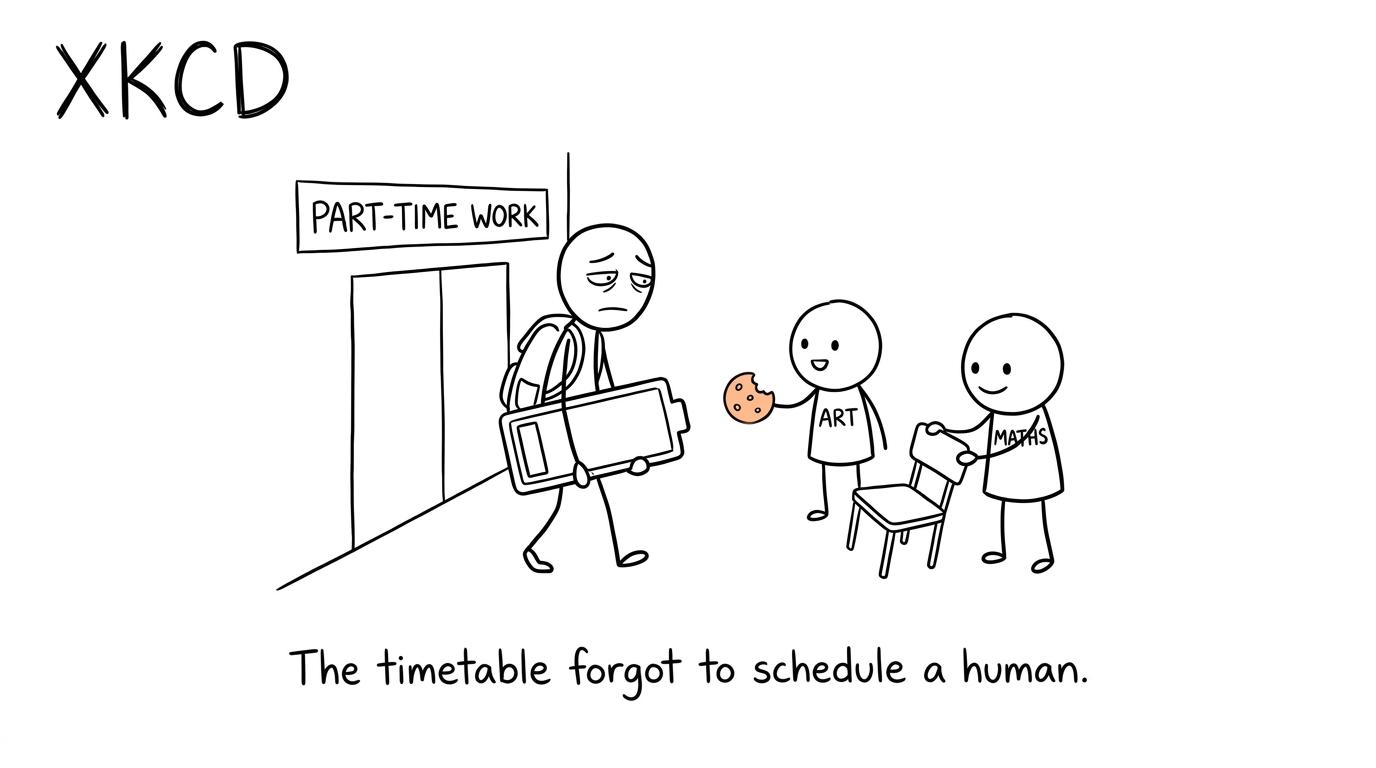 A tired student whose timetable forgot they were human
Plan art tasks by outcome, not vague hours
“Do art for two hours” can produce two hours of uncertainty. A better plan names the evidence you intend to create.
Useful task descriptions include:
- test two ways of applying the chosen medium;
- photograph and annotate the strongest experiment;
- compare one relevant artist’s choices with your own intentions;
- produce observational studies for a specific section;
- refine one composition after teacher feedback;
- prepare materials for the next school lesson.
Ask your art teacher which missing evidence would most improve your coverage of the assessment objectives. Finishing whatever looks most attractive is not necessarily the same as strengthening the portfolio.
Keep low-energy tasks available for shift days. Cropping photographs, organising files, writing concise annotations or preparing equipment may be possible when a fresh practical investigation is not. Follow your school’s rules about where work can be completed and how it must be authenticated as your own.
Make maths revision small enough to survive shift work
Busy students often postpone maths until they have time for a full paper. That can mean doing nothing for days. Instead, use a compact cycle:
- choose one weak skill;
- review the relevant lesson;
- answer a small set of questions;
- mark them immediately;
- write one specific correction;
- revisit the skill on another day.
Start with the free GCSE Maths revision resources, selecting your exam board and foundation or higher tier. If you are unsure what to revise, the guide to finding weak GCSE topics explains how to turn lost marks into a focused list.
On a non-shift weekend, move from topics to an appropriate paper from the GCSE past paper collection. Match the paper to your board, tier and calculator conditions. Marking matters as much as completing it: the past-paper revision method shows how to use mark schemes, identify errors and retest weak areas.
Near the examination, an Edexcel student can also use GCSE Maths predicted papers as a rehearsal. Predicted papers are practice resources, not guarantees of what will appear.
Talk to your employer before the pressure peaks
Do not wait until the evening before a deadline to mention that your GCSE workload has increased. Once your school publishes key dates, ask your manager how far ahead availability must be submitted. Be specific: request a particular evening or weekend rather than saying that you are “busy with exams”.
If you are under school leaving age in England, official child-employment restrictions generally limit work during term time to 121212 hours a week, with additional limits on school days, Sundays and Saturdays. Work cannot normally take place before 7 am7\text{ am}7 am or after 7 pm7\text{ pm}7 pm, and local council bylaws or permit requirements may also apply. Rules differ according to age, location and whether you have reached school leaving age, so check the current government guidance and your local council rather than relying on a colleague’s experience.
Whatever your age, work should not be allowed to damage your education, health or safety. If shifts repeatedly clash with lessons, deadlines, sleep or essential revision, involve a parent, carer, teacher or pastoral lead. This is not a failure of organisation. It is evidence that the workload needs changing.
Use energy as well as time
Two free hours are not always two useful hours. After standing through a busy shift, creative judgement and mathematical accuracy may both be lower.
Match tasks to energy:
- High energy: practical experimentation, composition decisions and timed maths papers.
- Medium energy: topic questions, artist research, annotation and correcting previous work.
- Low energy: preparing materials, organising images, formula recall and reviewing an error log.
Also build a transition after work. Eat, drink, change clothes and take a short break before deciding what you can do. A planned recovery period is part of the system, not time stolen from it.
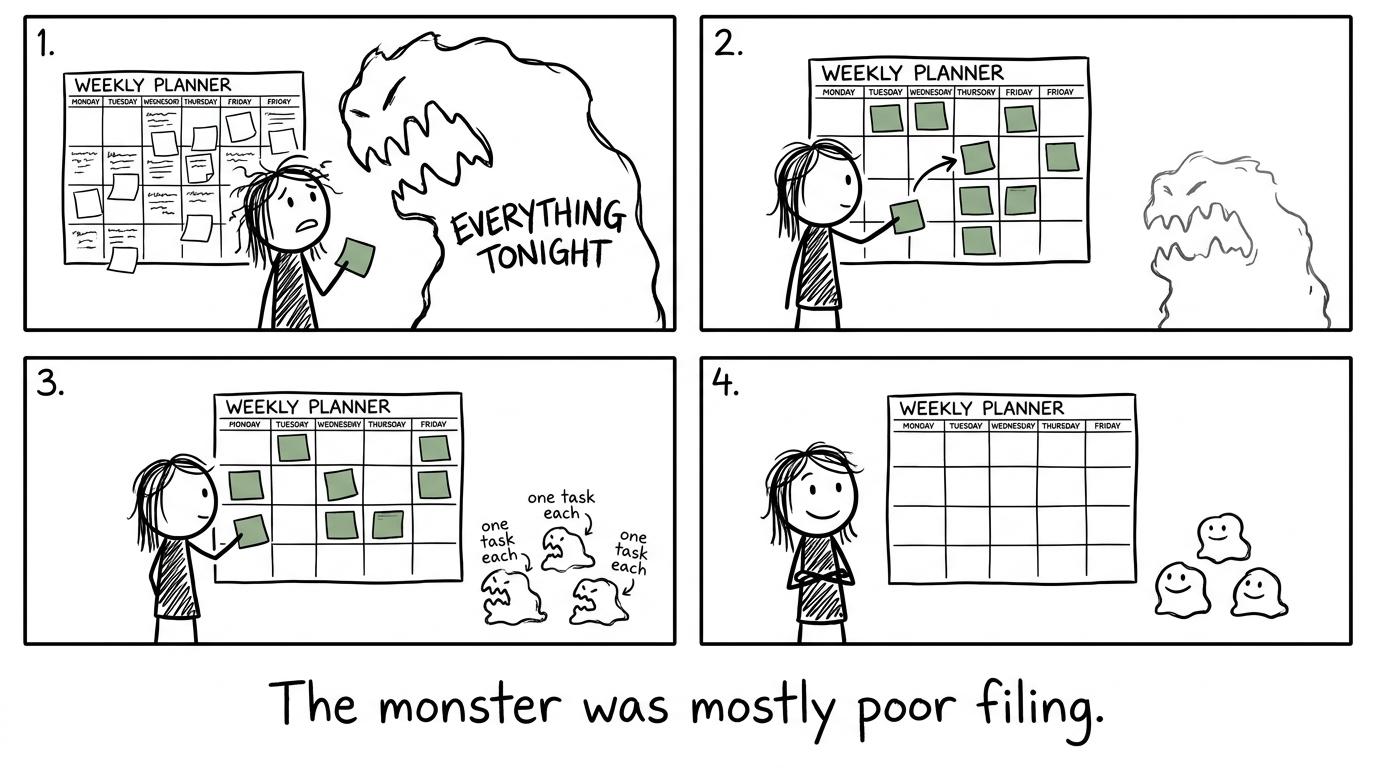 A large workload monster shrinking into manageable tasks
Common mistakes when balancing art, work and maths
Treating every evening as equally productive
A shift evening and a free evening are not interchangeable. Put demanding art work and timed maths practice where your concentration is strongest.
Leaving art until one marathon weekend
Long sessions can help, but they cannot reliably replace regular development, experimentation and recording. Portfolio evidence needs a visible journey.
Only doing comfortable maths topics
Busy revision should be selective, not easy. Use mini tests or past papers to identify where marks are actually being lost.
Forgetting marking time
A maths session is incomplete if the questions are never checked. Reserve part of the block for the mark scheme, corrections and a retest date.
Saying yes to every extra shift
An extra shift has a wider cost when it removes sleep, deadline time and the next day’s concentration. Check your calendar before accepting it.
Making a timetable with no buffer
Materials go missing, buses run late and shifts overrun. Leave at least one movable block each week so disruption does not collapse the entire plan.
A sustainable plan beats a perfect one
Balancing GCSE Art and Design with a part-time job is less about finding hidden hours and more about making honest choices. Protect longer sessions for creative development. Keep maths alive through short, active practice. Communicate early when shifts clash with important deadlines, and reduce the plan before exhaustion reduces it for you.
Start today by placing your next art deadline and confirmed shifts on one calendar. Then choose one art outcome and one weak maths topic for the coming week.
MathsGenie can take the uncertainty out of the maths side. Use the free revision lessons and practice questions to repair individual topics, mini tests for busy days, and past papers, predicted papers, mark schemes and video solutions when you are ready for exam practice. A plan does not need to look impressive. It needs to keep working when life becomes busy.