GCSE Art and Design Coursework Time Management
GCSE art and design coursework time management tips to balance portfolio deadlines with focused maths revision, past papers and proper rest each week.
A sketchbook has a peculiar way of making time disappear. You sit down to improve one annotation or adjust one photograph, then notice that an entire evening has gone. Meanwhile, maths, science and your other exam subjects are waiting.
Good GCSE art and design coursework time management means giving art protected periods for sustained practical work while preserving shorter, regular sessions for exam revision. Start with school deadlines, divide the remaining art work into specific tasks, and schedule maths before art expands to fill every available evening.
The goal is not to give every subject identical time. It is to give each subject the kind of time it needs.
Your balancing checklist
Use this checklist at the start of every week:
- Record your teacher's actual art deadlines, including interim checks.
- Identify the next visible outcome for each art session.
- Protect at least several short maths sessions across the week.
- Match all maths work to your exam board and foundation or higher tier.
- Use evidence from tests to prioritise weak topics.
- Include one timed maths task when the examination period approaches.
- Leave some unscheduled capacity for delays, illness or materials problems.
- Decide in advance when each evening will finish.
The last point matters. A timetable without stopping times is often just a hopeful list.
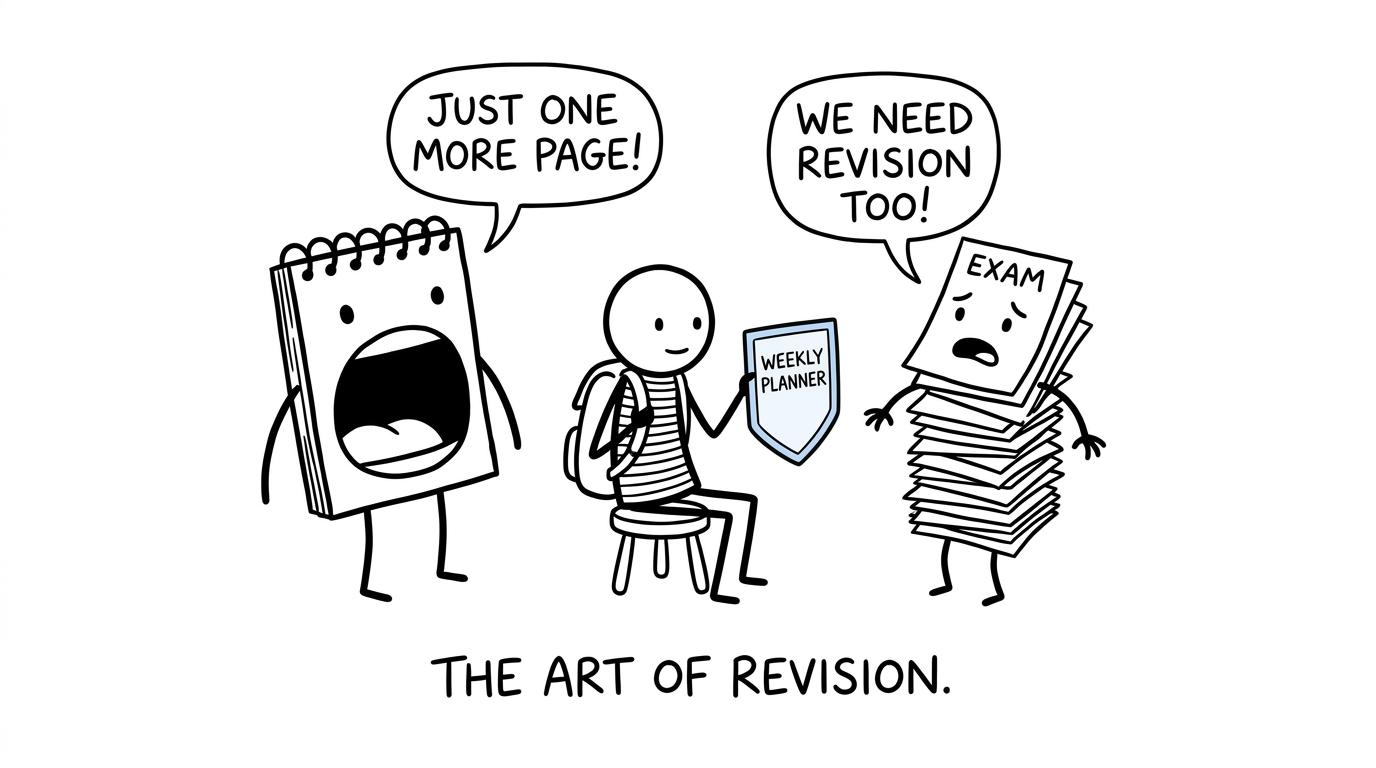 A student balancing a demanding sketchbook and exam papers with a weekly planner
Why art coursework needs a different kind of planning
GCSE Art and Design is untiered and assessed through non-exam assessment rather than a conventional written examination. Across the main English exam boards, including AQA, Edexcel, OCR and Eduqas, the portfolio contributes 60%60\%60% and the externally set component contributes 40%40\%40%. The externally set component includes preparatory work and a supervised period of 101010 hours.
The work is assessed against four equally weighted objectives. In broad terms, these concern developing ideas, refining work, recording observations and presenting a personal response. Your exam board's exact wording matters, so use your specification and your teacher's guidance when judging what remains unfinished.
This structure creates a time-management trap. An exam-only subject has a visible event at the end: the paper. Art creates a chain of smaller decisions over many weeks. Research, experiments, photographs, annotations, refinements and final pieces can all feel unfinished at once.
The answer is to stop scheduling vague activities such as “do art”. Schedule evidence instead:
- complete annotations for two experiments;
- photograph and print the latest development;
- compare one artist's methods with your own choices;
- test two materials and record what changed;
- prepare the composition for teacher feedback.
Each task should be small enough to finish or assess within one session. Ask your teacher which pieces of evidence would strengthen your submission most. Producing more work is not automatically the same as improving the work that will be assessed.
Build the week around fixed deadlines
Begin with facts rather than mood. Put school deadlines, examinations, appointments and lessons into one calendar. Your school's internal art deadline may arrive well before formal moderation arrangements, so follow the date given by your teacher.
Next, work backwards. If a portfolio checkpoint is three weeks away, list what must exist by that point and identify dependencies. You cannot annotate a material experiment that you have not completed, and you may not be able to print photographs late on a Sunday evening.
A useful priority score is:
priority=urgency×importance\text{priority} = \text{urgency} \times \text{importance}priority=urgency×importanceThis is a decision tool, not an exam formula. A task due tomorrow with consequences for the next stage should normally outrank optional polishing. A maths topic that repeatedly loses marks may outrank rewriting notes you already understand.
Keep roughly 10%10\%10% to 20%20\%20% of your available independent-work time unallocated. This buffer absorbs tasks that take longer than expected without forcing maths revision out of the week.
For a fuller structure, adapt the approach in the GCSE maths revision timetable guide. The principle is simple: plan around evidence, not around how productive you hope to feel.
Separate deep art sessions from short revision sessions
Art often benefits from longer blocks because setting up materials, reaching concentration and clearing away all take time. Maths can fit effectively into shorter sessions when each one has a precise purpose.
A balanced evening might contain:
- a focused maths block before dinner;
- a longer practical art block afterwards;
- a brief final check of tomorrow's materials and tasks.
This is not a worked timetable that everyone must copy. Adapt the order to your energy, travel and access to equipment. If practical art can only happen at school, use supervised studio time carefully and reserve home sessions for permitted research, annotation or planning.
For maths, a compact session can follow four steps:
- retrieve a method without notes;
- answer a short set of questions;
- check the mark scheme or solution;
- record the exact error to revisit.
The MathsGenie GCSE maths revision hub brings together lessons, exam questions, worksheets and board-specific papers. That reduces setup time, which matters when art already demands decisions about materials and presentation.
Keep maths alive during art-heavy weeks
When an art deadline approaches, the temptation is to stop maths completely and promise to restart later. The problem is not merely the missed hours. It is the loss of continuity.
Instead, use a minimum viable revision routine. On busy days, complete one short, active task: a mini test, several exam-style questions or a correction from your error log. Research on retrieval practice supports making an active attempt to recall knowledge, followed by feedback, rather than relying only on rereading.
Start by identifying the topics that actually need attention. The guide to finding your weakest GCSE topics explains how to turn lost marks into a focused revision list. Students taking Edexcel can also use short GCSE maths mini tests when a full paper would not fit around a major art deadline.
Once the deadline passes, increase the length of maths sessions again. The aim is flexible consistency: reduce the dose when necessary, but avoid letting the habit disappear.
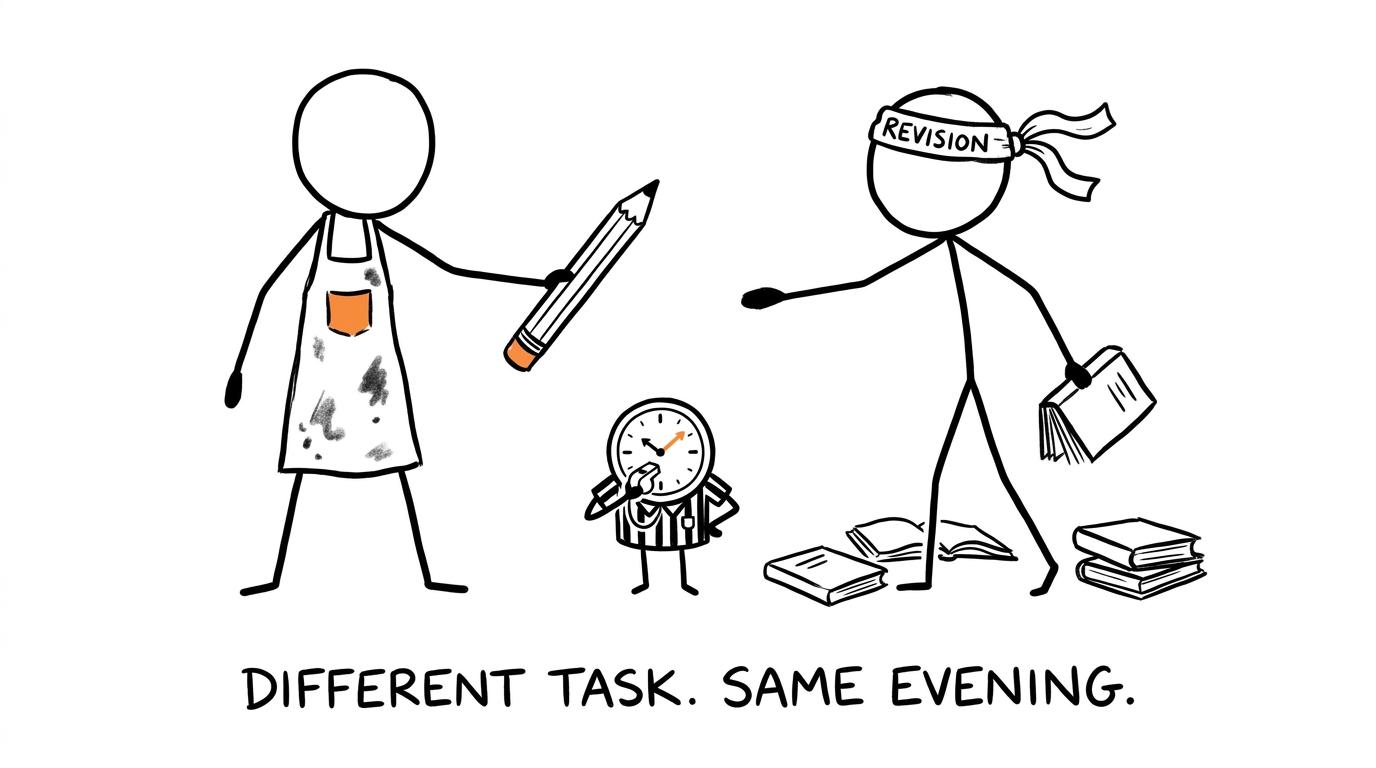 A student passing a pencil baton between art and revision versions of themselves
Make every maths session produce feedback
Time spent is a weak measure of revision. Feedback is stronger.
After a maths session, you should know at least one of the following:
- which method you can now use independently;
- which error is still recurring;
- whether timing caused a problem;
- which topic should appear in the next session.
Use revision lessons and practice questions when you are rebuilding a skill. Use mini tests when you need a quick check. Use complete papers when you need to practise selection, timing and stamina.
The article on using GCSE past papers properly sets out a useful cycle: sit, mark, diagnose, repair and retest. If you are unsure when full papers should enter your plan, read when to start GCSE past papers.
Predicted papers can provide additional unseen practice near the examination, but they should supplement official past papers rather than replace them. They are most valuable after topic weaknesses have already been identified.
Use stopping rules to control perfectionism
Art rarely announces that it is finished. There is almost always another edge to refine or another page that could be rearranged. That is why each session needs a stopping rule.
A stopping rule might be:
- stop when the planned evidence is complete;
- stop at the agreed time and photograph the current stage;
- stop after testing the chosen materials and recording conclusions;
- stop when further changes are unlikely to strengthen an assessment objective.
This does not mean accepting careless work. It means distinguishing purposeful refinement from endless alteration. Ask: “What assessment evidence will the next half-hour create?” If you cannot answer clearly, seek teacher feedback before investing more time.
Apply the same rule to maths. Mark the questions, write down the next action and stop at the planned time. Sleep and recovery are part of sustainable preparation, not time stolen from it.
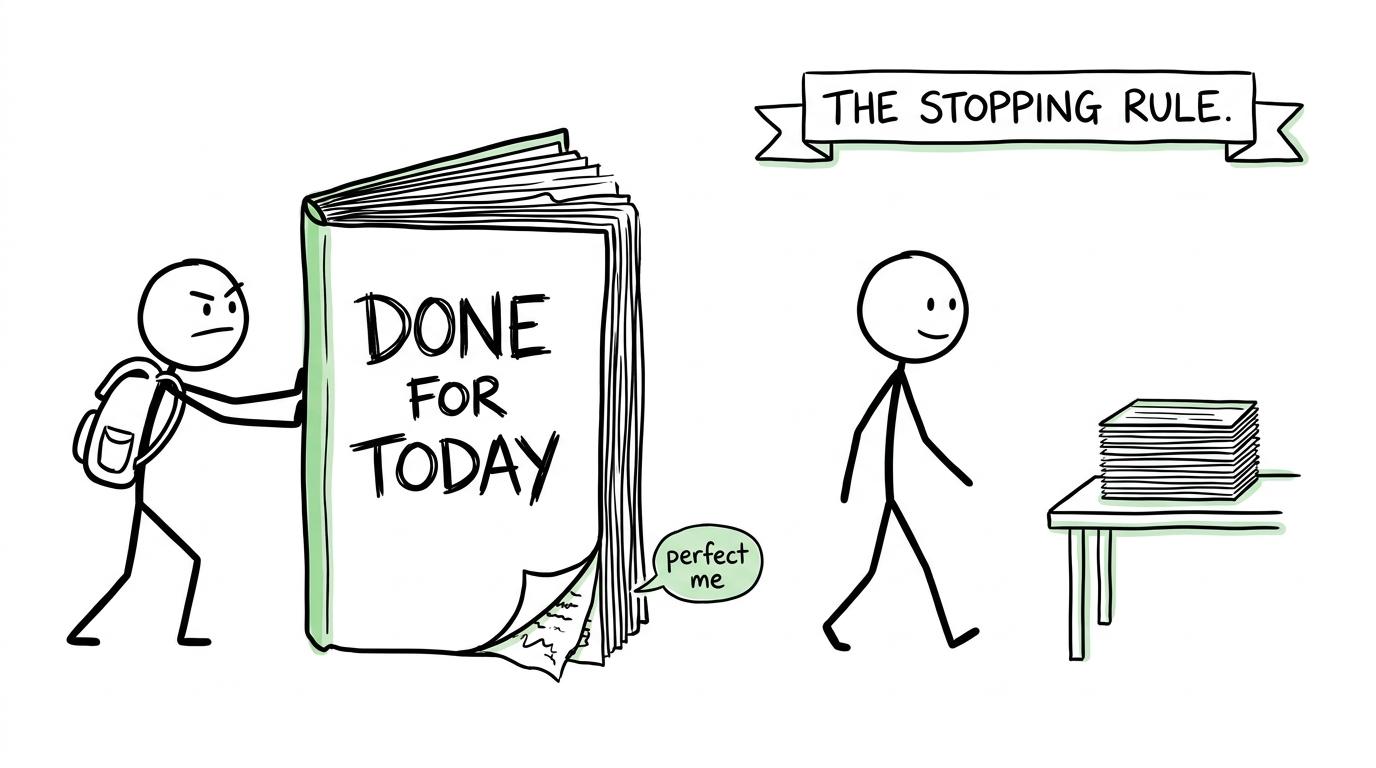 A student walking away from a sketchbook after defeating the urge to perfect one more corner
Common mistakes when balancing coursework and revision
Treating every unfinished art page as equally urgent
Some gaps affect several assessment objectives or block later work; others are mostly cosmetic. Ask your teacher to help identify the highest-value improvements.
Planning subjects but not tasks
“Maths for one hour” leaves too many decisions until the session begins. Choose the topic, resource and intended outcome in advance.
Abandoning maths until the art deadline passes
Maintain short retrieval and question practice. A small continuous routine is easier to expand than one that has stopped completely.
Making a beautiful but impossible timetable
Do not allocate every minute. Include meals, travel, setup, clearing away and a buffer. A plan should survive an ordinary difficult day.
Completing questions without marking them
Unmarked practice hides misconceptions. Use mark schemes and video solutions to find where method marks are being lost. The one-month GCSE maths revision plan shows how focused practice and review can fit together as exams approach.
Ignoring exam board and tier
Maths practice should match Edexcel, AQA, OCR or Eduqas and your foundation or higher tier. Confirm both before selecting papers. The GCSE maths topics by board and tier guide provides a useful starting map.
A calmer way to reach both finish lines
Art and exam revision do not need to compete every evening. They need boundaries. Give art sustained blocks with visible outcomes, keep maths active through short feedback-rich sessions, and adjust the balance as genuine deadlines move closer.
Start today by writing down your next art checkpoint and your three weakest maths topics. Then open MathsGenie's free GCSE maths revision hub and choose one precise task for your next session.
MathsGenie can support the whole revision cycle with free revision lessons, practice questions, mini tests, past papers, predicted papers, mark schemes and video solutions. Fewer decisions leave more attention for the work itself, both in the sketchbook and on the exam paper.