GCSE Art and Design Weak Topic: How to Fix It
GCSE art and design weak topic? Follow a practical diagnose, practise, review and retest plan to improve difficult skills across your portfolio confidently.
A weak area in Art and Design can become strangely powerful. You avoid it because it feels unreliable; then, because you avoid it, it never improves. Soon the phrase GCSE art and design weak topic starts to feel like a permanent label rather than a solvable problem.
The practical answer is to make the weakness smaller and more specific. Do not write “drawing” or “painting” on a revision list. Identify the exact difficulty, produce a short piece of evidence, ask for focused feedback, refine one feature and test the skill again. The goal is not an instantly perfect outcome. It is visible, purposeful development.
That principle will feel familiar if you use MathsGenie's GCSE maths revision hub: diagnose the gap, learn what is missing, practise it and check whether the problem has actually changed.
Your weak-topic repair checklist
Use this sequence whenever an Art and Design skill, process or assessment objective keeps causing trouble:
- Define the weakness precisely.
- Connect it to the relevant assessment objective.
- Find evidence in your current portfolio or preparatory work.
- Ask your teacher one narrow question.
- Complete a short, controlled experiment.
- Annotate what happened and what you will change.
- Refine the work rather than simply starting again.
- Repeat the skill after a short gap.
- Show the development clearly in your submission.
This is deliberately practical. “Get better at art” is too vague to act upon. “Improve tonal contrast in observational studies” gives you somewhere to begin.
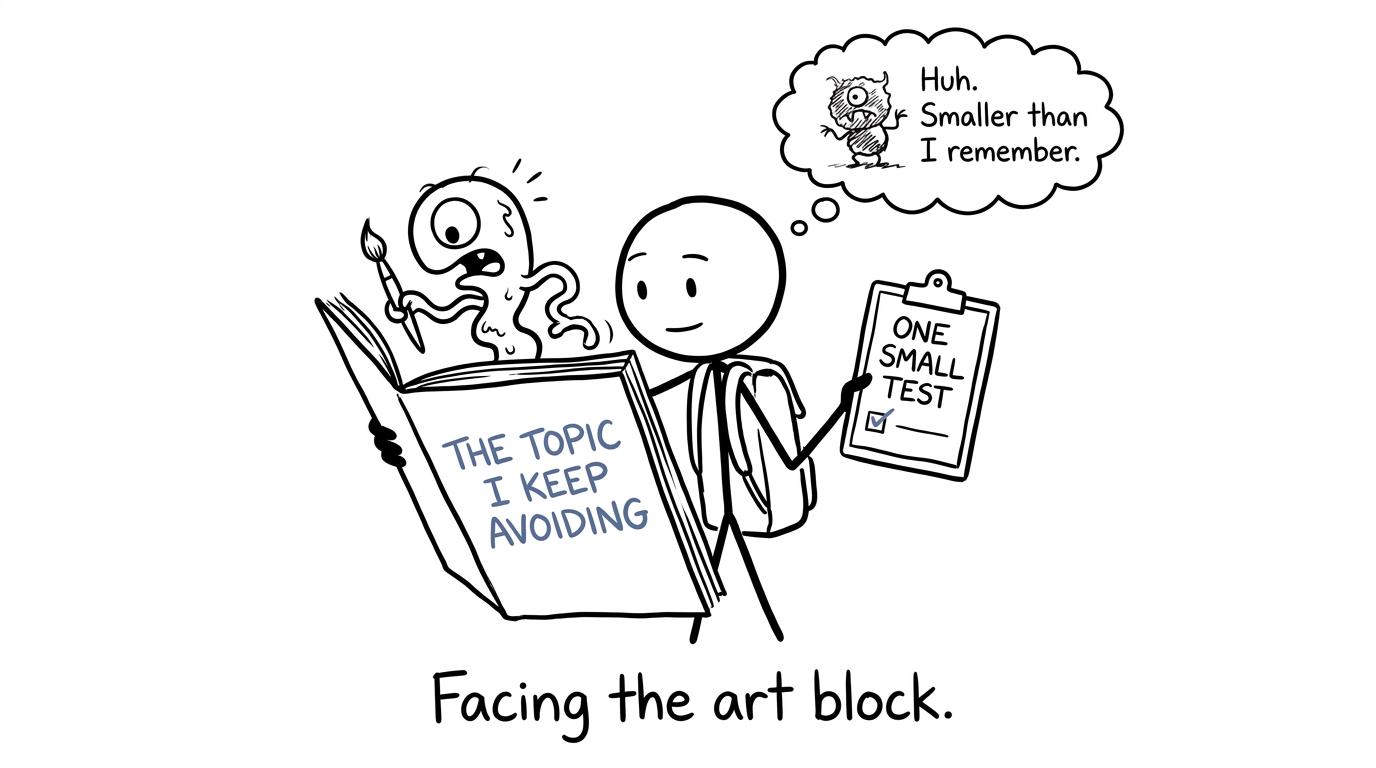 A student calmly confronting the tiny monster of an avoided art topic
Find the real weakness before trying to fix it
Students often confuse a disappointing outcome with a weak topic. One unsuccessful page does not necessarily mean that you cannot use paint, develop compositions or analyse an artist. The problem may be narrower.
For example, a broad concern such as “my sketchbook development is weak” might actually mean:
- your source research does not influence later decisions;
- experiments are presented without evaluation;
- compositions change, but you do not explain why;
- observational recording lacks accuracy or variety;
- the final response is insufficiently connected to your preparation;
- annotation describes what you did without analysing its effect.
Look through your work and mark the point where progress becomes unclear. Is the problem visible in the making, the thinking or the presentation of your thinking? This distinction matters. Producing more pages will not repair missing analysis, just as writing more annotation will not repair an untested technique.
A useful question for your teacher is: “Which single change would make this evidence stronger against the assessment criteria?” That is more productive than asking whether the page is good.
The same diagnostic discipline helps in maths. MathsGenie's guide to finding your weakest GCSE topics explains why evidence is more useful than instinct when deciding what to practise.
Connect the weak topic to the assessment objectives
GCSE Art and Design is untiered and assessed through non-exam assessment rather than a conventional written examination. Although administrative details and mark totals vary between specifications, Ofqual's four assessment objectives apply across the main exam boards, including AQA, Edexcel, OCR and Eduqas.
Each objective contributes 25%25\%25% of the qualification:
- AO1: develop ideas through investigations and demonstrate critical understanding of sources;
- AO2: refine work by exploring ideas and experimenting with suitable media, materials, techniques and processes;
- AO3: record ideas, observations and insights relevant to your intentions as work progresses;
- AO4: present a personal and meaningful response that realises your intentions and demonstrates understanding of visual language.
The overall assessment structure allocates 60%60\%60% to the portfolio and 40%40\%40% to the externally set component. The externally set component includes preparatory work followed by a supervised period. Always follow your own exam board specification and your centre's instructions because submission arrangements differ.
This framework changes how you should think about weakness. If photography experiments look technically secure but seem disconnected from your intentions, the main issue may not be camera technique. It could be refinement under AO2 or the meaningful realisation of ideas under AO4.
Ask yourself:
- Which assessment objective is least visible in this work?
- What evidence would allow a moderator to see my decisions?
- Have I investigated, experimented, recorded and realised, or have I jumped between stages?
You are not trying to decorate a sketchbook with assessment language. You are making the creative journey legible.
Use a short repair loop instead of avoiding the work
A weak topic becomes less threatening when you stop treating it as one enormous project. Use a compact loop: attempt, inspect, change, refine and revisit.
Make the first attempt small
Choose a task you can complete while concentrating on one feature. If colour mixing is unreliable, do not begin another large final piece. If composition is the concern, do not spend hours perfecting surface detail before testing the arrangement.
A small study gives you information quickly. It also reduces the temptation to protect the work because you have invested too much time in it.
Change one variable
Keep most conditions stable and alter one element: scale, viewpoint, material, lighting, colour palette, surface, cropping or arrangement. If everything changes at once, you cannot tell which decision improved the result.
This is experimentation with a purpose. Several unrelated samples may demonstrate activity, but a connected sequence shows refinement.
Evaluate the effect
Useful annotation explains the relationship between intention, decision and outcome. Consider:
- What was I trying to communicate?
- Which visual quality changed?
- What succeeded, and what evidence supports that judgement?
- What will I retain, reject or alter next?
- How does this test affect the direction of my project?
Keep the writing concise and specific. The artwork remains central, but thoughtful annotation can reveal decisions that are not obvious from the image alone.
Revisit the skill
Do not judge improvement from the correction you made while feedback was beside you. Return later and attempt the process again with less support. That second encounter tells you whether the skill is becoming dependable.
This is similar to the learn, practise, mark and retest rhythm in MathsGenie's 20-minute GCSE revision routine. Art takes different forms, but improvement still depends on feedback followed by another attempt.
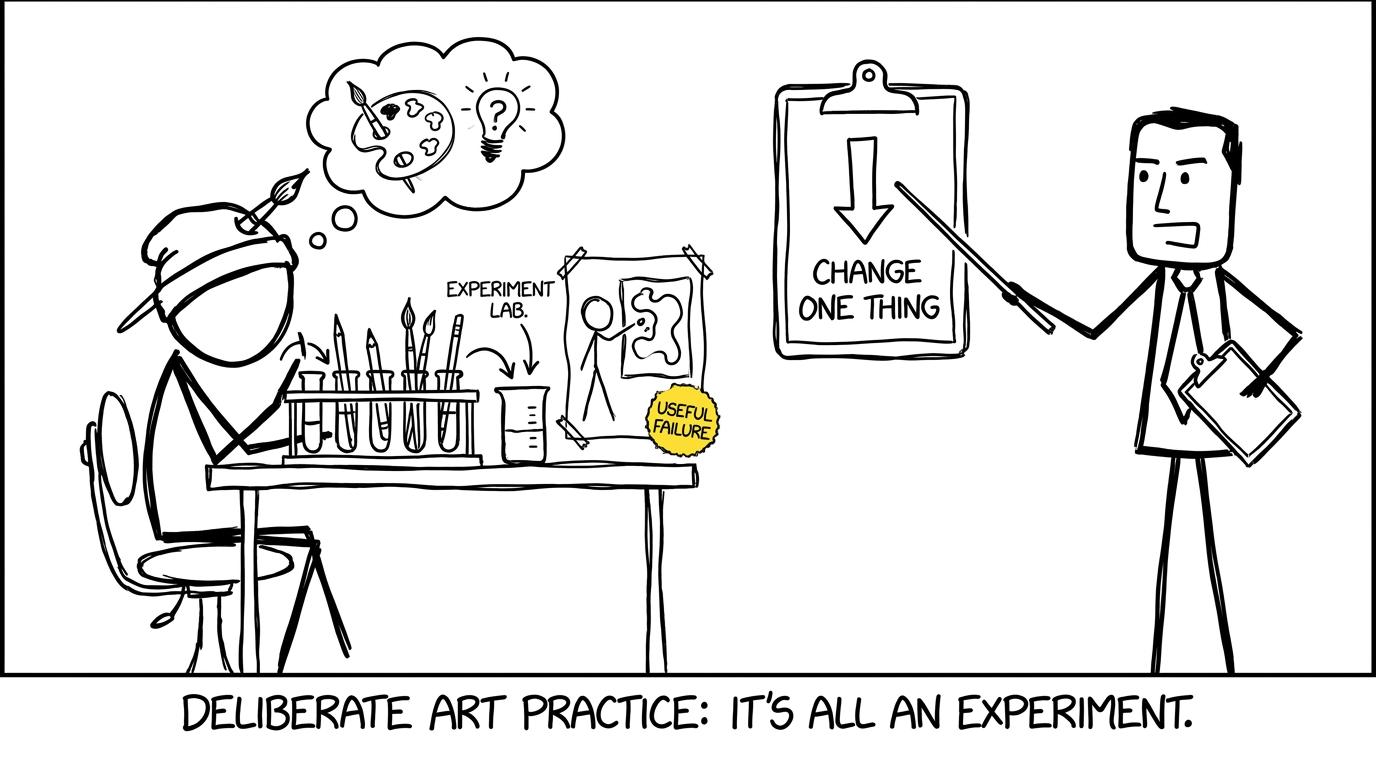 An art experiment laboratory where useful failure receives a badge
Turn mistakes into assessable development
In Art and Design, an experiment that does not produce the intended effect need not be wasted. It can become valuable evidence if you respond intelligently.
Keep the unsuccessful test when it helps show:
- a clear intention;
- a meaningful experiment;
- an informed evaluation;
- a justified change of direction;
- stronger refinement in the next stage.
However, displaying every unsuccessful attempt without selection or explanation can obscure the project. Curate your evidence. The important feature is not the quantity of mistakes but the quality of the decisions that follow them.
Compare earlier and later work directly. Use photographs where permitted, preserve relevant samples and explain the specific adjustment. Check with your teacher before removing, remounting or altering assessed work, particularly once it has been submitted or entered into controlled assessment conditions.
Teacher feedback is most useful when it leads to action. Record one precise instruction, apply it and then ask whether the change strengthened the relevant objective. Do not collect a page of advice that you never test.
Build the weak skill into your weekly revision plan
Avoidance usually hides inside planning. A student schedules “Art coursework” for two hours, feels uncertain about where to start and spends much of the session arranging materials. A better plan names the action and the evidence it should produce.
Try scheduling blocks such as:
- test three compositions using one source;
- compare two surfaces for the intended texture;
- improve the tonal range in one observational study;
- annotate how an artist's approach affected one decision;
- photograph and evaluate the latest refinement;
- ask the teacher to review evidence for one assessment objective.
Place the hardest task early enough that you still have attention and time to respond. End by writing the next physical action, such as preparing a particular material or printing a source image. That removes the starting decision from your next session.
If you are balancing Art with maths and other GCSE subjects, use a realistic timetable rather than allowing coursework to absorb every available evening. MathsGenie's guide to a GCSE revision timetable you can stick to helps you plan specific tasks, practise regularly and preserve catch-up time.
You can also use the GCSE maths topics by board and tier guide to separate foundation or higher maths priorities from your Art portfolio deadlines. Art itself is not divided into foundation and higher tiers.
Know when the topic is improving
Confidence is pleasant, but evidence is better. A weak topic is improving when you can:
- begin without waiting for step-by-step guidance;
- explain why you selected a particular process or material;
- compare outcomes using appropriate visual language;
- make a deliberate refinement rather than a random change;
- connect experiments to sources and intentions;
- apply the skill in a different part of the project;
- identify your next improvement independently.
Ask your teacher to check the evidence against your exam board's assessment grid. A piece can feel more attractive without demonstrating stronger investigation or refinement. Equally, a visually rough experiment can represent important progress if it drives an informed decision.
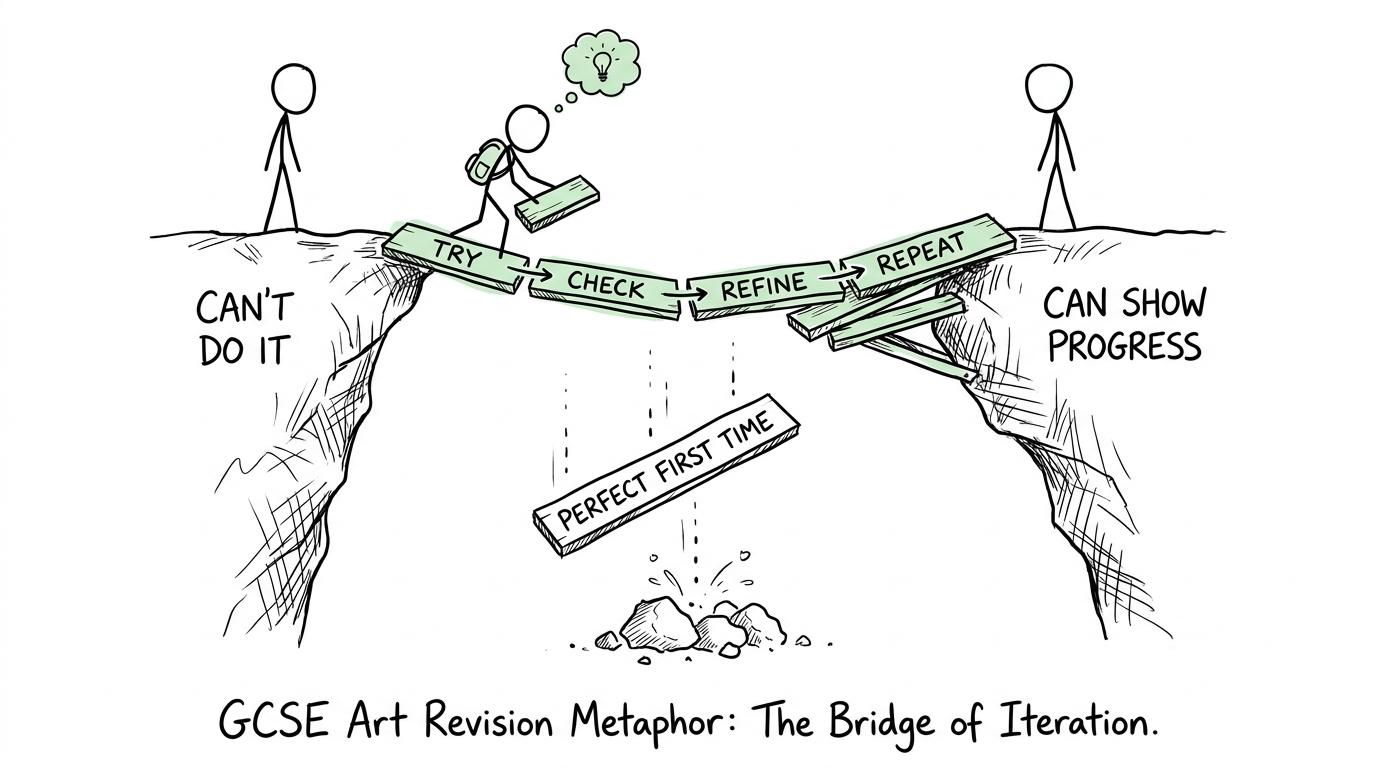 A student building a bridge from inability to visible progress
Common mistakes when fixing a GCSE Art and Design weak topic
Avoiding the process until the final outcome
A final piece is the worst place to discover that a material, composition or method is unreliable. Test important decisions during preparation, while change remains possible.
Repeating without refining
Making the same kind of study several times is not necessarily development. State what each attempt is testing and allow its result to shape the next one.
Copying a source without making personal decisions
Relevant artists, designers and craftspeople should inform your thinking. Their work should not replace it. Analyse what is useful, then transform that understanding through your own intentions and experiments.
Writing description instead of analysis
Listing materials and actions rarely explains development. Focus on effects, decisions, connections and consequences.
Hiding every unsuccessful attempt
A perfectly smooth sketchbook can conceal the thinking that assessment requires. Select useful failures and show how they produced refinement.
Ignoring specification or teacher guidance
The broad assessment objectives are shared, but centres and exam boards have detailed requirements concerning authentication, supervision and submission. Follow the instructions for your qualification rather than relying on generic online advice.
Letting Art displace all maths revision
Coursework expands to fill the time available. Protect short, regular maths sessions and use longer blocks for practical Art work. When you return to maths, GCSE past papers and mark schemes can reveal which skills need attention, while the guide to using GCSE past papers properly shows how to turn errors into focused revision.
Replace the label with a process
A topic you always get wrong can feel like part of your identity: “I cannot draw accurately”, “my ideas never develop” or “I am bad at annotation”. Those sentences are too broad to be useful.
Replace the label with a sequence. Define the exact problem. Connect it to an assessment objective. Run a small test. Seek focused feedback. Change one thing. Record the reason. Revisit the skill and show the resulting development.
That approach will not make every experiment successful. It does something more valuable: it makes each experiment informative.
For the maths side of your GCSE preparation, make MathsGenie your free revision base. Start with revision lessons and topic practice, then use mini tests, past papers, predicted papers, mark schemes and video solutions to expose and repair your weakest areas. Whether the challenge is a stubborn algebra method or an avoided creative process, progress begins when you stop circling the weakness and give it one clear, testable next step.