

GCSE Art and Design Remark Appeal: Worth It?
GCSE art and design remark appeal explained: understand moderation reviews, appeal grounds, fees, deadlines and when requesting one may be worthwhile.
Results day can turn two years of sketchbooks, experiments and sustained work into one painfully small symbol: a grade. If it is lower than expected, asking for a GCSE art and design remark appeal may feel like the obvious response. But Art and Design is not usually remarked like a written exam.
The short answer is that a request may be worthwhile when your school has evidence that external moderation was applied incorrectly across the cohort. It is less likely to help when one student simply feels that their individual portfolio deserved more marks. A review of moderation normally concerns the centre's original moderation sample, not one candidate's work, and an appeal can usually happen only after that review.
This guide reflects the JCQ and awarding-body arrangements published for the June 2026 series. Your school's internal deadline may be earlier than the official deadline, so contact the exams officer promptly.
Your results-day checklist
Before deciding whether to proceed:
- Ask for your component marks and confirm how far you are from the next grade boundary.
- Speak to your Art and Design teacher about the moderator's report.
- Find out whether the exam board changed your school's submitted marks.
- Check whether other candidates were affected in a similar way.
- Ask whether a review of moderation is available for your component.
- Request the school's current fee, internal deadline and appeals policy.
- Separate disappointment from evidence of a marking, moderation or procedural error.
That last distinction matters. A grade can feel wrong without the formal process having been wrong.
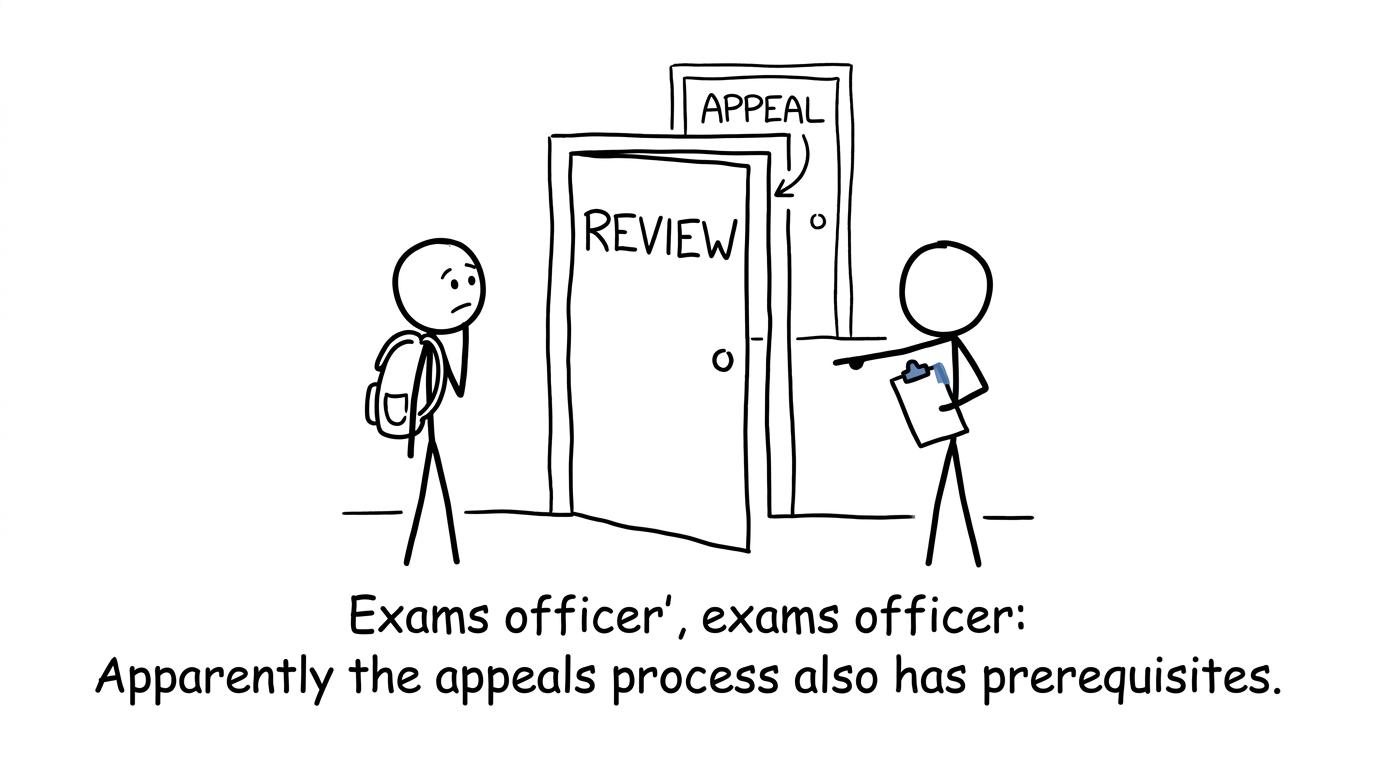 A student discovers that an appeal comes after a review
Why an Art and Design “remark” is different
For the main GCSE Art and Design specifications offered by AQA, Pearson Edexcel, OCR and Eduqas, work is normally marked by teachers and externally moderated by the exam board. The moderator examines a sample to decide whether the centre has applied the assessment criteria fairly and consistently.
If the centre's marking is judged to be too generous or too severe, the exam board may adjust marks. That adjustment can affect candidates whose work was not personally included in the sample.
This creates an important difference between Art and Design and a written GCSE Maths paper. A written paper can usually receive an individual review of marking. An Art and Design post-results request will commonly be a Service 3 review of moderation, made for the relevant component or subject cohort through the school.
It is not normally available for one student alone. It may also be unavailable where the exam board accepted the centre's marks without alteration. Pearson states that only review of moderation services are available for its GCSE Art and Design specifications, while the other boards also apply the wider JCQ moderation rules to centre-assessed work.
The word “remark” is therefore convenient but misleading. The reviewer is not simply giving your portfolio to a new person and asking, “What mark would you award?” The purpose is to check whether the original moderation applied the assessment criteria fairly, reliably and consistently.
How the review of moderation process works
Start with your teacher and exams officer
An internal candidate cannot normally submit the request directly to AQA, Edexcel, OCR or Eduqas. The school decides whether there are grounds for a review, and its exams officer submits the application.
Ask for a clear explanation of:
- the marks originally awarded by your teachers;
- any adjustments made during external moderation;
- the moderator's written feedback;
- whether the adjustment affected one component or more than one;
- whether the original sample and supporting records remain available.
The strongest question is not “Did I work hard enough for a higher grade?” It is “What evidence suggests that the moderation decision was unreasonable or incorrectly applied?”
The original sample is reviewed
The awarding body reviews the moderation using the original sample of candidates' work. It does not usually select only the student who is unhappy. Schools must retain the required work securely because a review may be impossible if the original sample is unavailable.
Under the JCQ arrangements, the service can take up to 35 calendar days after the reviewer receives the original sample. That clock does not necessarily start when you first email your teacher.
Marks may be confirmed, raised or lowered
A review can confirm the existing decision, restore the centre's original marks or produce another permitted outcome. Individual marks within the affected cohort may move.
Candidate consent is not normally required for a review of moderation. Although marks can be lowered, JCQ rules protect published subject grades from being lowered in the same examination series as a consequence of this service. This is different from an individual review of marking for a written paper, where informed consent is required because the grade can go down as well as up.
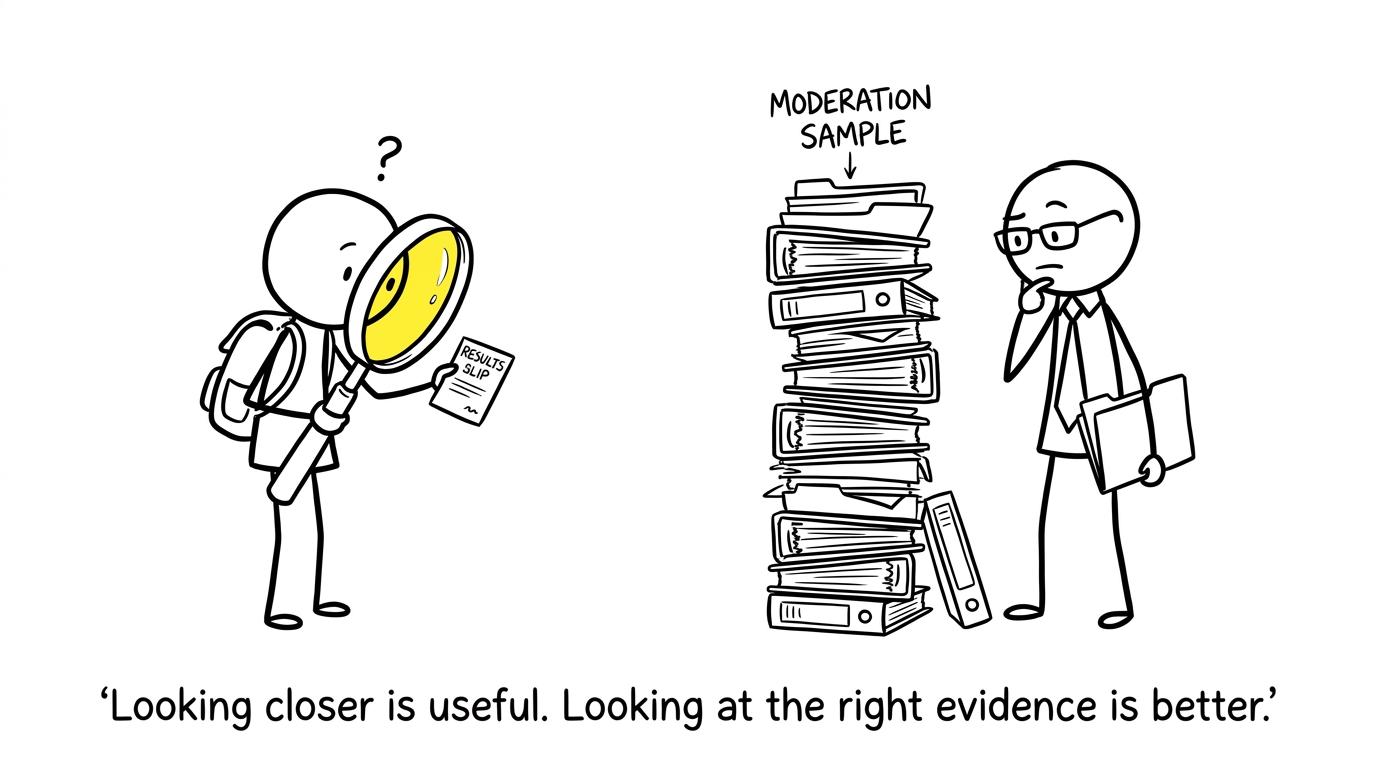 A student and teacher focus on the moderation sample rather than guesswork
When is a GCSE Art and Design remark appeal worth it?
A review is most defensible when several pieces of evidence point in the same direction.
The moderator changed the centre's marks
If the exam board accepted the submitted marks, a review of moderation is generally unavailable. If marks were adjusted, the moderator's report should help the department judge whether the adjustment appears consistent with the assessment criteria and the work in the sample.
A large or unexpected cohort-wide adjustment is not automatic proof of an error. It is, however, a reason for experienced teachers to examine the report carefully.
The concern affects the cohort, not only one portfolio
Service 3 is designed to test a moderation decision. It becomes more plausible when teachers can identify a shared issue, such as evidence in the original sample that appears inconsistent with the moderator's explanation.
One student's distance from a grade boundary still matters because a small mark increase could change their grade. But closeness alone does not establish grounds for reviewing the whole cohort.
Your teachers can identify a specific inconsistency
“Everyone expected higher grades” is weak evidence. More useful grounds might involve a clearly identified assessment criterion, a possible failure to consider available evidence or an apparent inconsistency between the report and the moderation outcome.
Artistic judgement has a legitimate range. The process is not intended to replace one reasonable professional judgement with another merely because the second is more generous.
The possible benefit justifies the fee and delay
Review-of-moderation charges vary by board and examination series and can run into hundreds of pounds for a component or cohort. The school may pay, ask families to contribute or apply its own policy. Some awarding bodies waive the charge when the centre's original marks are reinstated, but the precise charging rule must be checked before applying.
Ask the exams officer for the current written fee rather than relying on a figure shared online from an earlier year.
A review is more compelling when a changed grade would affect a sixth-form course, college offer or another concrete next step. Even then, evidence must drive the request. Importance raises the stakes; it does not lower the standard required.
Deadlines for the June 2026 series
For the June 2026 examination series, the JCQ deadline for awarding bodies to receive standard reviews of results, including reviews of moderation, is 24 September 2026. AQA and Eduqas also publish this date for their June 2026 services.
Do not treat that as your personal deadline. Schools usually set earlier internal dates so staff can review evidence, obtain approval, prepare the sample and submit the request correctly. Ask on results day or as soon afterwards as possible.
If your school declines to support a review, it must have a published internal appeals procedure. Ask the exams officer for that document immediately because its deadline may be short.
How a formal appeal works
A review of moderation and an appeal are separate stages. You cannot normally skip straight to the appeal.
Once the review outcome has been issued, the head of centre may appeal if there are grounds to believe that a marking or moderation error occurred, or that the awarding body failed to apply its procedures consistently, properly or fairly. For an internal candidate, the head of centre submits the appeal. Parents and students do not appeal directly to the exam board.
Under the JCQ rules effective for June 2026:
- the appeal must normally be submitted within 30 calendar days of the review outcome;
- the first stage is a preliminary appeal;
- if the centre remains dissatisfied, it may request an appeal hearing within 14 calendar days of the preliminary outcome;
- awarding bodies may charge for each stage, with the fee waived or refunded if the appeal is upheld.
An appeal is not a third opinion on the artistic quality of the work. It needs concise grounds supported by evidence. The question is whether an error occurred or whether the relevant procedure was followed fairly.
Common mistakes when considering a remark or appeal
Assuming one student's portfolio will be remarked alone
For centre-assessed Art and Design, the relevant post-results service normally reviews moderation across the original sample or component. It is not an individual portfolio remark.
Looking only at the grade boundary
Being one mark below a higher grade explains why a change would matter. It does not prove that the moderation was wrong. Combine boundary information with the moderator's report and your teacher's professional assessment.
Missing the school's internal deadline
The published awarding-body deadline is the final destination, not the time at which a student should begin asking questions. Schools need time to make an evidence-based decision.
Treating an appeal as another review
The appeal comes after the relevant post-results service. It must identify a possible error or procedural failure rather than repeat general disagreement with the outcome.
Paying before asking what the fee covers
Confirm whether the charge is per component, per cohort or subject to additional costs. Also ask what happens if the centre's marks are reinstated.
Protect the revision time you still control
Results disputes create a peculiar kind of waiting. The useful response is to pursue the evidence carefully, then return your attention to what you can change.
If you are preparing for GCSE Maths alongside this process, begin with the free MathsGenie GCSE revision homepage. Edexcel students can use the Edexcel GCSE Maths revision hub, while AQA students can find specification-focused lessons and questions in the AQA GCSE Maths revision area.
 A student sorts results-day uncertainty from actions they can control
Turn uncertainty into a repeatable routine: complete a paper, mark it honestly, repair the weakest topics and retest them. The Edexcel GCSE Maths past papers include mark schemes and worked solutions where available, while GCSE predicted papers provide additional unseen practice.
If results day has changed your plans, use the GCSE Maths resit results-day revision plan. For a shorter diagnostic process, the guide to finding your weakest GCSE topics helps turn lost marks into focused practice. Students facing an imminent paper can follow the GCSE one-week revision plan.
Make the decision from evidence, not hope
A GCSE Art and Design review of moderation is worth requesting when the school can point to a credible problem with the original moderation, the service is available and the likely benefit justifies the cost and delay. It is less worthwhile when the argument rests only on an unexpectedly low individual grade.
Ask quickly. Read the moderator's evidence. Understand the fee. Use the correct sequence: school discussion, review of moderation and then, only where justified, a formal appeal.
While the exams officer handles the process, keep building the results that remain in your hands. MathsGenie brings together free revision lessons, practice questions, mini tests, past papers, predicted papers, mark schemes and video solutions. Choose one weak maths topic today, practise it properly and let the next mark be one you earn before results day arrives.











