

GCSE Art and Design Easter Holiday Revision
GCSE art and design Easter holiday revision made manageable: move your project forward, protect your break and keep GCSE maths practice on track.
The Easter break can create a peculiar kind of pressure. Your sketchbook is open, your final piece is approaching, and every unfinished page seems to demand attention. Meanwhile, GCSE maths and your other exams have not gone away.
Effective GCSE art and design Easter holiday revision is not about spending the entire break making artwork. It is about identifying the next evidence your project needs, completing a few purposeful tasks and protecting enough time for rest and written-exam revision. The goal is visible progress, not endless activity.
This guide will help you balance Art and Design with maths, organise practical work safely and return to school knowing exactly what comes next.
Your Easter revision checklist
Before planning individual sessions, establish five things:
- Confirm your exam board, component and school deadline.
- Ask your teacher what work may be completed at home.
- Review your project against all four assessment objectives.
- Choose a small number of specific art outcomes for the holiday.
- Reserve separate sessions for maths and your other examined subjects.
Your teacher's instructions come first. Arrangements vary between schools and exam boards, particularly around externally set assignments, authentication and the timing of supervised work.
For your maths plan, open the GCSE Maths revision hub and select the correct exam board and tier. Having the right resources ready removes one more decision from each revision session.
Understand what your art project actually needs
GCSE Art and Design is assessed through a portfolio and an externally set component. For the main specifications offered by AQA, Edexcel, OCR and Eduqas, the portfolio contributes 60%60\%60% of the qualification and the externally set component contributes 40%40\%40%. The latter includes preparatory work followed by ten hours of supervised sustained work.
The exact language and marking grids vary, but the four assessment objectives broadly ask you to:
- develop ideas through investigation and engagement with sources;
- refine ideas through experimentation with media, materials and processes;
- record observations, ideas and insights as the work develops;
- present a personal, meaningful response that realises your intentions.
This matters because a sketchbook can look busy while still leaving an assessment objective underdeveloped. Ten decorative pages are not automatically more useful than one page showing a clear experiment, thoughtful evaluation and informed decision.
Before Easter, ask your teacher which assessment objective currently needs the strongest evidence. That answer should shape your holiday work.
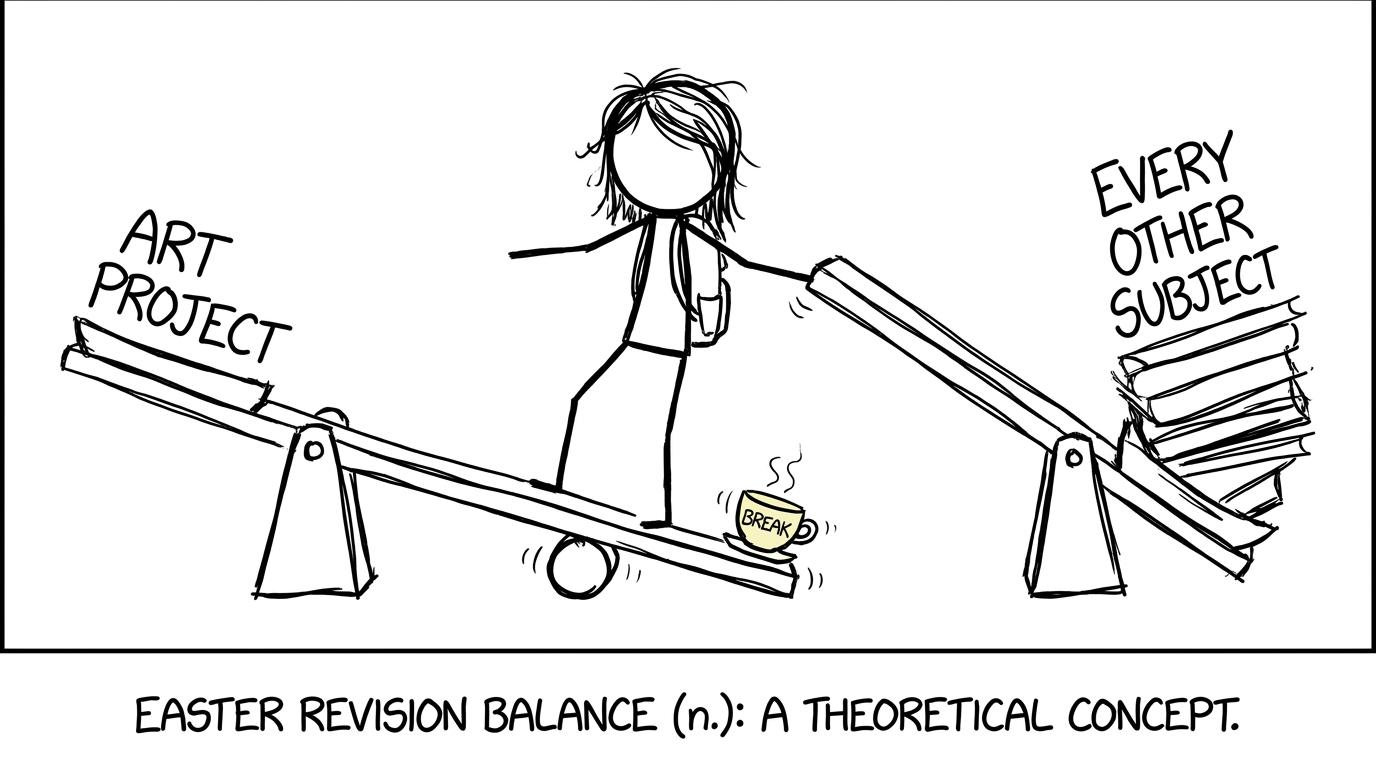 A student balancing art, other subjects and a protected Easter break
Set outcomes instead of counting hours
“Do art for three hours” is a timetable entry, but it is not a clear task. It leaves you vulnerable to rearranging materials, searching for inspiration and adding detail without knowing what the detail proves.
A useful outcome describes what will exist when the session ends. For example:
- produce observational studies from your own photographs;
- compare two relevant artists and explain how each could influence your response;
- test one composition using several quick alternatives;
- experiment with two suitable materials and record what changed;
- annotate a development page with decisions, not just descriptions;
- prepare a clear plan for the supervised final outcome.
Keep the list short. Three strong outcomes across the holiday may be more valuable than a sprawling list that makes every day feel unfinished.
A practical filter is to ask:
- Is it required? Has your teacher identified it as missing or weak?
- Is it assessable? Does it provide evidence for an assessment objective?
- Is it authentic? Is it genuinely your own investigation, recording or response?
- Is it safe and permitted? Can it appropriately be completed away from school?
If a task fails those checks, it probably should not consume a large part of your break.
Build a balanced Easter timetable
Art expands to fill the time available because creative work rarely produces an obvious stopping point. A maths question finishes. A painting can always be adjusted again.
The answer is to give art boundaries rather than waiting for it to feel complete.
Use three types of day
Divide the holiday into three broad categories:
- Art-focused days: one or two practical blocks, plus a short maths session.
- Exam-focused days: maths and other written subjects take priority, with only a brief art organisation task.
- Rest days: no assessed work, or only optional low-pressure activity.
Do not make every day an art-focused day. Rest days are part of the plan rather than evidence that the plan has failed.
If building a timetable feels harder than doing the work, use the principles in MathsGenie's GCSE revision timetable guide. Plan the task, resource and stopping time rather than writing vague labels such as “maths” or “art”.
Put a stop time on practical work
Choose a finish time before beginning. When that time arrives:
- photograph the current stage;
- write the next physical action on a note;
- clean and store materials;
- stop.
This makes restarting easier and prevents one art session from swallowing the evening. If you are waiting for paint, ink or clay to dry, switch tasks instead of hovering over the work and repeatedly changing it.
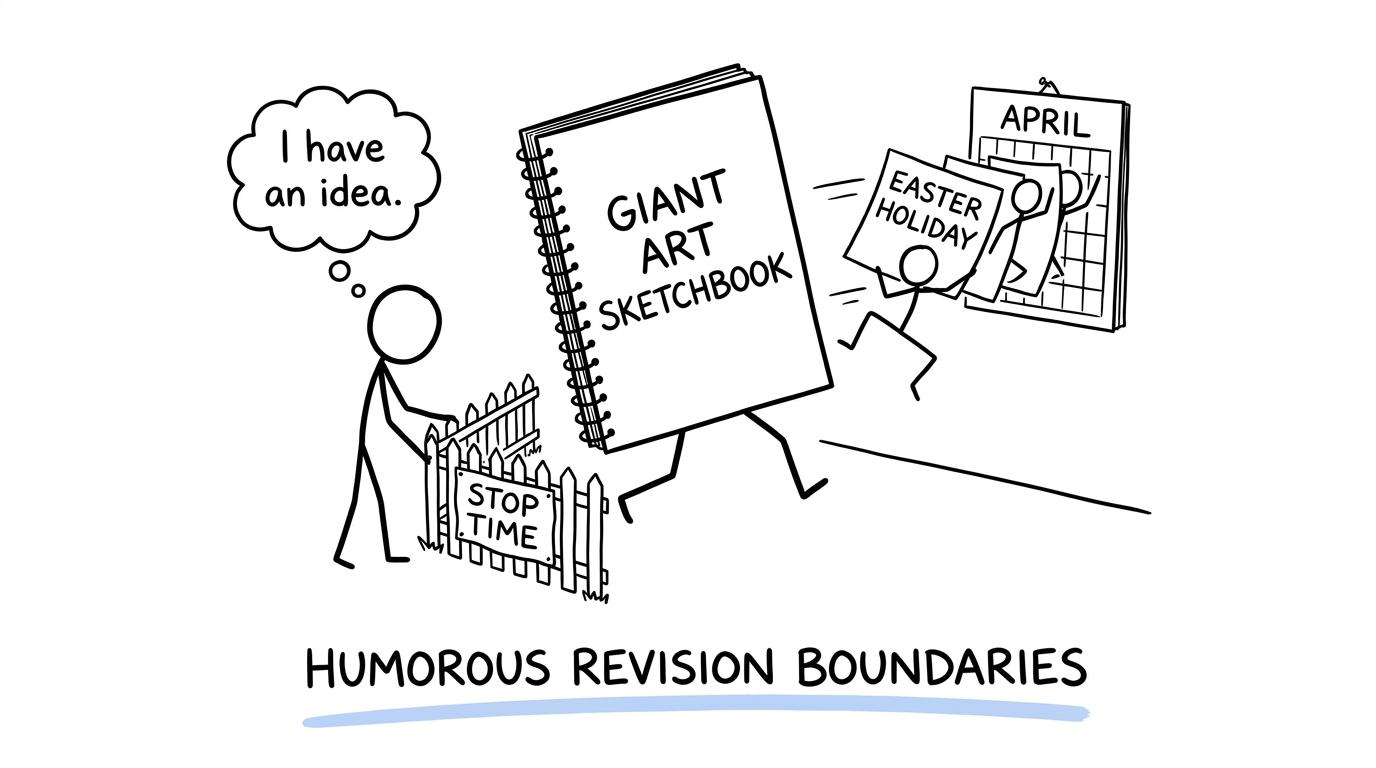 A runaway sketchbook contained by a sensible stopping time
Keep maths moving without taking over the holiday
Balance does not mean giving every subject identical time. Art may need longer practical blocks, while maths benefits from shorter, repeated contact. The useful question is not whether the hours are equal. It is whether each subject receives the kind of practice it needs.
On busy art days, use the twenty-minute GCSE maths routine: choose one precise topic, recall the method, answer exam-style questions, mark the work and record one correction.
On exam-focused days, complete a longer session:
- begin with a short retrieval task;
- revise one weak Foundation or Higher tier topic;
- complete practice questions without notes;
- mark them immediately;
- revisit the error using a lesson or video solution.
Choose weaknesses from evidence, not instinct. A mini test or paper section can reveal gaps more reliably than revising whichever chapter looks familiar. The guide to finding weak GCSE maths topics explains how to convert lost marks into specific next actions.
Towards the end of the break, add one timed paper section or half-paper. Full papers are useful, but only when you also make time to mark and repair the mistakes. MathsGenie's guide to when to start GCSE past papers can help you choose the right level of paper practice for this stage.
Make each art session produce evidence
A productive session usually follows a simple creative loop: investigate, try, evaluate and decide.
Investigate with a purpose
Research should change the direction of your work. When studying an artist, designer, photographer or craftsperson, consider:
- how they use composition, colour, texture, form or scale;
- which materials or processes create the effect;
- what ideas or context make the work meaningful;
- which feature could inform your response without being copied.
A page of downloaded images with biographical facts may show effort, but it does not necessarily demonstrate critical understanding. Use your own words, acknowledge sources and explain the connection to your intentions.
Experiment before polishing
Experiments do not all need to be beautiful. Their purpose is to test possibilities. Keep evidence of rejected options where it helps show how your decisions developed.
Record the material, process, result and next decision. Annotation should explain why something worked, what did not work and what you will change. “I like this” is a reaction; “the restricted colour palette makes the focal shape clearer, so I will carry it into the next composition” is a decision.
Prepare rather than prematurely finish
If your supervised assessment has not begun, Easter may be a valuable preparation period. However, do not assume that every part of the final response can be completed at home. Once supervised sustained work begins, access to preparatory and assessment work becomes tightly controlled.
Confirm with your teacher:
- when your preparatory period ends;
- what materials may be prepared in advance;
- what must be produced during supervised time;
- whether work can be taken home;
- how digital files and source material should be managed.
Your submitted work must be your own and capable of authentication. Do not copy online artwork, ask someone else to improve a piece or use generated material as if it were your original work.
Protect the final part of the holiday
The last day should not become an emergency reconstruction of your sketchbook. Aim to finish substantial practical work earlier, leaving a final review session for photographing work, checking annotations and packing materials.
Use the review to answer:
- Can someone see how my idea developed?
- Have I connected research to practical decisions?
- Is there evidence of observation and experimentation?
- Does my proposed outcome grow naturally from the preparation?
- Are all external sources acknowledged?
Then stop. A rested return to school is more useful than a final night spent making hurried additions.
For maths, the closing days of Easter are a good time to use GCSE predicted papers as fresh practice after topic revision. Treat them as rehearsal rather than a guarantee of what will appear. Mark the paper, identify the lost marks and return to the relevant revision lessons.
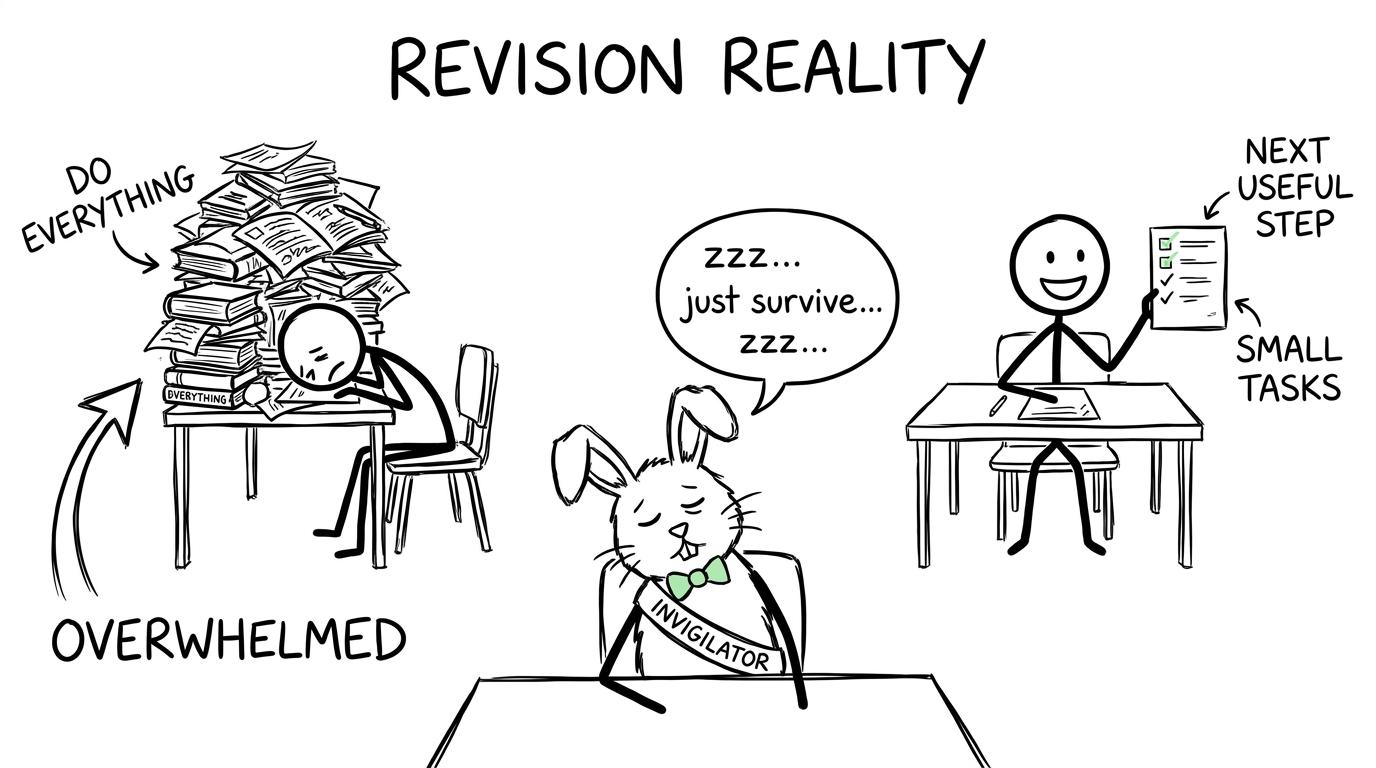 One student attempts everything while another chooses the next useful step
Common Easter revision mistakes
Trying to complete everything
A project is rarely improved by rushing every possible page. Prioritise missing evidence and the decisions needed before your final outcome.
Confusing decoration with development
Borders, headings and carefully arranged pages can improve presentation, but they do not replace investigation, experimentation, recording or reflection. Develop the work before decorating the evidence.
Leaving maths until art feels finished
Art may never feel completely finished. Give maths protected appointments throughout the break. If time is limited, use mini tests and short topic sessions rather than abandoning it entirely.
Revising maths without marking it
Completed questions do not reveal much until they are checked. Use mark schemes and video solutions, then correct the exact step that cost the mark. The one-week GCSE maths revision plan provides a useful attempt, mark and repair structure.
Ignoring school assessment rules
Do not rely on what a friend at another school has been told. Your centre sets key dates and administers the supervised period. Follow your teacher's instructions about home working, storage, authentication and preparatory studies.
Removing every genuine break
A holiday timetable with no free days is unlikely to survive contact with real life. Build in space for sleep, family plans, exercise and ordinary time away from assessed work.
Finish Easter with direction, not exhaustion
Good GCSE art and design Easter holiday revision should make the next stage clearer. You should know what your project is saying, which evidence supports it and what must happen when you return to school. You should also have kept maths alive through short, deliberate practice.
Choose a few meaningful art outcomes. Protect stop times. Keep at least one genuine rest day, and use your teacher's guidance whenever assessment conditions are involved.
For maths, let MathsGenie carry the structure. Start at the free GCSE Maths revision hub, choose your board and tier, then combine revision lessons and practice questions with mini tests, past papers, predicted papers, mark schemes and video solutions. A balanced Easter is not one in which you do everything. It is one in which the right work gets done and you still have enough energy for what comes next.










