

GCSE Art and Design 6 to 8: How to Improve
GCSE art and design 6 to 8 advice: strengthen investigations, refinement, recording and personal responses with focused, practical changes.
A sketchbook can look busy and still leave its owner wondering why the grade has not moved. The pages are full, the final piece is finished, and hours have disappeared into careful presentation. Yet the feedback still says: develop, refine, explain.
The route from GCSE art and design 6 to 8 is not simply to produce more work. It is to make your decisions more independent, your investigations more critical and your creative journey more convincing. Grade 8 work tends to show that sources, experiments, observations and outcomes are connected by a personal line of enquiry. The examiner can see not only what you made, but why the project developed as it did.
The grade 6 to grade 8 checklist
Use this short checklist before adding another page to your portfolio:
- Does each artist or contextual source genuinely influence your ideas?
- Have you explained why you selected particular visual qualities?
- Do experiments lead to changes rather than sit as isolated samples?
- Are observations recorded from relevant primary and secondary sources?
- Can the examiner follow your decisions from starting point to outcome?
- Does the final response feel personal rather than copied or predictable?
- Is the standard consistent across all four assessment objectives?
The central shift is from competent evidence to independent, perceptive decision-making.
What separates a grade 6 from a grade 8?
Official GCSE grade descriptors provide broad descriptions of performance rather than a guaranteed checklist for a particular mark. Exam boards award grades from the total qualification mark, and grade boundaries can change between exam series. Your teacher must apply the assessment grid for your specification.
Still, the difference in the descriptors is revealing. Grade 6 performance is broadly associated with coherent investigation, sound understanding, consistent technical application, considered observations and purposeful visual language. At grade 8, the emphasis rises: investigation becomes independent and in-depth, development becomes convincing, experimentation and innovation become effective, observations become perceptive, and visual language becomes advanced.
| Grade 6 tendency | Grade 8 tendency |
|---|---|
| Sources are understood and connected to the theme | Sources are investigated critically and transformed independently |
| Techniques are applied consistently | Techniques are selected, controlled and adapted with confidence |
| Experiments show a range of possibilities | Experiments answer questions and cause meaningful refinement |
| Observations support the project | Perceptive observations actively influence its direction |
| The outcome fulfils the brief | The outcome communicates a personal idea convincingly |
This does not mean every page must be spectacular. It means the complete project should demonstrate purposeful thinking with fewer weak links.
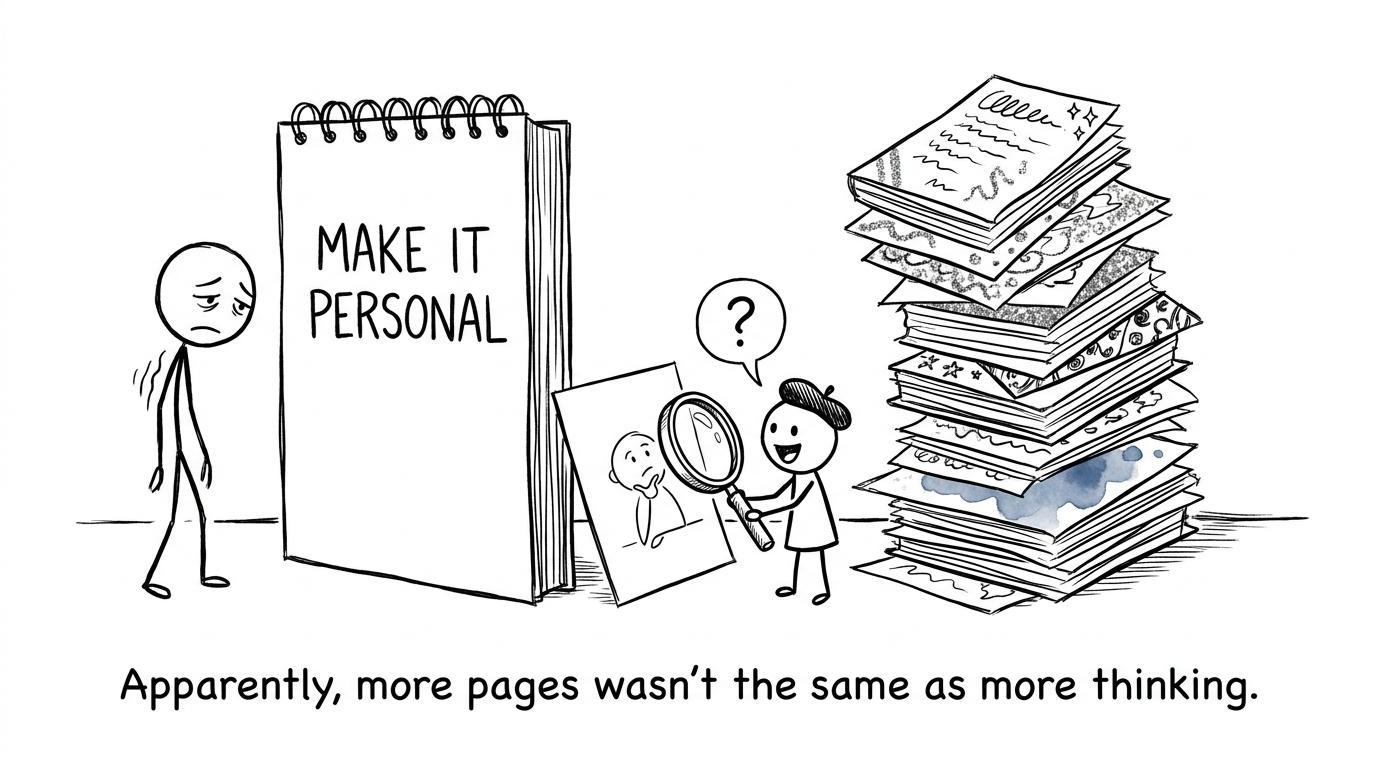 A student discovers that more sketchbook pages do not automatically mean more thinking
Improve each assessment objective
Across AQA, Edexcel, OCR and Eduqas, GCSE Art and Design uses four common assessment objectives. Each contributes 25%25\%25% of the assessment. The familiar component structure is normally a portfolio worth 60%60\%60% and an externally set component worth 40%40\%40%, although you should always follow your board's current specification and your teacher's instructions.
AO1: Turn artist research into critical investigation
A grade 6 project may identify an artist's subject matter, colour, media and style accurately. To approach grade 8, move beyond description. Investigate how and why the work communicates.
Ask sharper questions:
- How does composition control where the viewer looks?
- What emotional or cultural associations come from the materials?
- Which part of the artist's approach is relevant to your intention?
- What will you transform rather than imitate?
- How has this investigation changed your next decision?
The final question matters most. An artist page earns its place when it affects subsequent work. Select one or two useful qualities, test them with your own imagery and explain what you kept, rejected or adapted.
Research should also be selective. Five disconnected artist pages can be less convincing than two sources studied in depth and connected intelligently. Identify and acknowledge material that is not your own, following your school's guidance.
AO2: Make experimentation lead somewhere
Experimentation is not a collection of media samples. It is a process of asking questions through making.
Before an experiment, identify its purpose: perhaps you are testing whether scale creates tension, whether a limited palette supports the mood, or whether layering makes an image feel fragmented. Afterwards, record what succeeded, what failed and what must change.
Grade 8 evidence often shows a visible cycle:
- select a possibility;
- test it with suitable materials or processes;
- evaluate it against the intention;
- modify composition, technique, scale or imagery;
- retest the improved idea.
Do not hide every failure. A controlled experiment that fails can provide strong evidence when you diagnose the problem and make an informed adjustment. What matters is the quality of the refinement, not whether every trial looks display-ready.
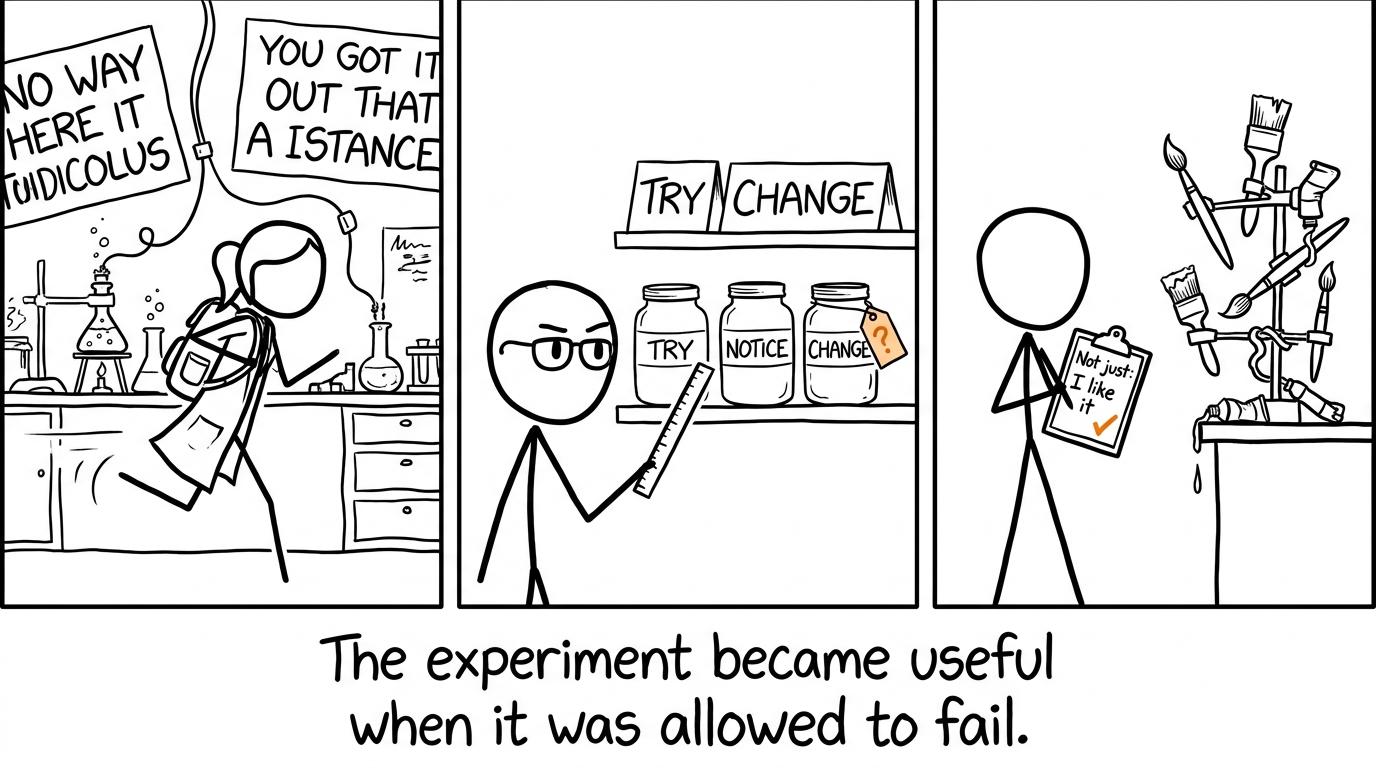 A GCSE student runs a laboratory where failed art experiments produce useful decisions
AO3: Record observations that influence ideas
Recording includes drawing, photography, studies, notes, diagrams and other appropriate forms. Written annotation and drawing are explicit requirements within current GCSE Art and Design specifications, but annotation should support visual evidence rather than smother it.
Improve AO3 by collecting sources that belong to your enquiry. If your theme concerns ageing, for example, generic internet images may reveal less than your own photographs of worn surfaces, family objects or changing local spaces. Primary observation often creates details and viewpoints that another student's project is unlikely to contain.
Your annotation should capture decisions. Replace vague comments such as “this went well” with precise evaluation:
- identify the visual result;
- explain how the technique produced it;
- connect it to your intention;
- state the next modification.
The strongest recording happens throughout the project. Pages assembled retrospectively may look tidy, but they rarely communicate the same authentic chain of thought.
AO4: Build the outcome throughout the project
AO4 is not just the final ten-hour piece or polished outcome. It concerns presenting a personal and meaningful response that realises your intentions and demonstrates visual understanding.
Start planning possible outcomes early. Produce compositional studies, test scale, rehearse difficult processes and compare alternatives. By the supervised period, the main uncertainty should not be what you intend to create. You should understand your materials, imagery, sequence and practical timings.
Personal does not have to mean autobiographical. It means that your response reflects your own investigation and choices. Two students might begin with the same externally set starting point, yet arrive at very different outcomes because they pursue different sources, meanings and visual solutions.
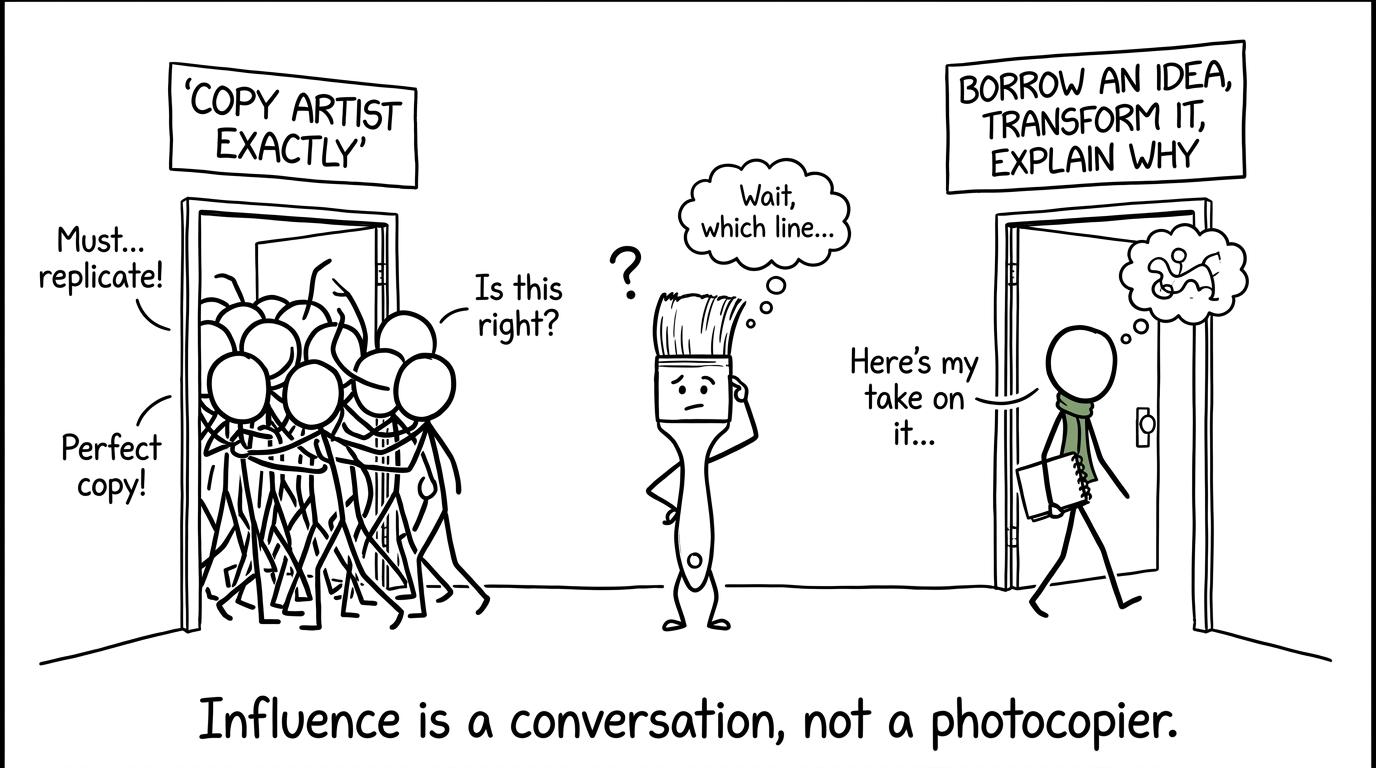 An art student chooses transformation over copying while a paintbrush supervises
Specific changes that tend to move work up a band
Replace decoration with evidence
Beautiful headings, borders and backgrounds are not substitutes for assessment evidence. Presentation should make your thinking easier to follow. If an hour of decoration does not strengthen an assessment objective, that hour may be better spent producing a compositional variation or refining a weak study.
Show alternatives before committing
A first idea can be competent but predictable. Generate several arrangements, crop images differently, reverse the visual hierarchy or test contrasting materials. Comparison creates evidence of judgement. Explain why one possibility serves your intention better than another.
Connect every stage
Think of the portfolio as an argument. Sources inform experiments; experiments influence observations; observations shape development; development leads to the final response. Abrupt jumps weaken that argument.
At the end of each session, write one sentence answering: What will I do next because of what I discovered today? That simple habit can make development much more visible.
Improve consistency, not just the best page
Because all four assessment objectives are equally weighted, one impressive outcome cannot entirely rescue thin investigation or weak recording. Ask your teacher which objective currently has the least convincing evidence. Work there first.
This resembles effective maths revision: improvement comes from diagnosing the specific weakness rather than repeating what already feels comfortable. MathsGenie's guide to revising without wasting time explains the same attempt, review and improve cycle for exam practice.
Plan art without sacrificing maths revision
Art coursework can expand to fill every available evening. Give each session a defined output rather than the loose instruction to “do art”. A useful target might be to complete three composition thumbnails, evaluate two material tests or take a focused set of primary photographs.
Protect maths time separately. The free MathsGenie GCSE Maths revision hub brings together revision lessons, practice questions, past papers, predicted papers, mark schemes, video solutions and mini tests for the main UK exam boards. Use the MathsGenie revision planner to place short maths sessions around portfolio deadlines.
If deadlines are close, adapt the structure in the one-week GCSE maths revision plan. With more preparation time, the one-month GCSE revision plan offers a calmer rhythm. The principle is the same in both subjects: define the task, complete it, review the evidence and decide the next action.
Common mistakes when aiming for grade 8
- Producing more without improving depth: extra pages only help when they strengthen relevant evidence.
- Copying an artist's final appearance: use an artist's choices as a starting point, then transform them through your own subject matter and intention.
- Writing biography instead of analysis: dates and background can provide context, but they do not replace critical visual investigation.
- Calling every trial an experiment: state what you tested and how the result changed the project.
- Leaving the outcome until the end: rehearse composition, scale, media and timing before supervised work.
- Using vague annotation: explain effects, intentions, decisions and next steps with appropriate art vocabulary.
- Ignoring weaker assessment objectives: an uneven portfolio can limit the overall result even when the final piece is strong.
- Treating grade boundaries as fixed targets: boundaries vary, so improve the quality of evidence rather than aiming at an old raw mark.
- Letting art consume every revision session: set stopping points and preserve regular maths practice. Even the minimum viable GCSE revision routine can keep mathematical skills active during a busy art week.
Turn a grade target into better decisions
The move from grade 6 to grade 8 is not a demand for perfection. It is a demand for stronger relationships: between research and ideas, experiments and refinement, observations and intentions, preparation and outcome.
Begin with your teacher's current assessment. Identify the least secure objective and choose one change that creates visible evidence. Analyse a source more critically. Retest an experiment. Gather stronger primary observations. Compare alternative compositions. Small decisions, connected over time, create the convincing journey associated with higher-grade work.
Then keep your wider GCSE preparation steady. Open the MathsGenie GCSE revision resources, choose your exam board and use revision lessons and practice questions to fix individual topics. Move on to mini tests, past papers and predicted papers when you need timed practice. Art improves when every page has a purpose. Maths improves in much the same way; every question should tell you what to practise next.











