

GCSE Art and Design 4 to 7: A Practical Guide
GCSE art and design 4 to 7: discover what separates the grades, strengthen every assessment objective and build a focused portfolio plan that works.
Moving from a pass to a strong grade can feel mysterious in Art and Design. You may have filled a sketchbook, researched artists and completed a final piece, yet still hear that your work needs “more development”. What does that actually mean?
The short answer to gcse art and design 4 to 7 is not simply to produce more work. A grade 777 portfolio usually communicates a more convincing creative journey: relevant research changes your ideas, experiments lead to decisions, observations support your intentions and the final response feels personal. Every page has a job.
There is no universal checklist that automatically guarantees a grade. GCSE Art and Design is assessed against four assessment objectives, while grade boundaries are set for each examination series. However, you can make specific changes that bring your evidence closer to the qualities associated with stronger work.
Your grade 444 to grade 777 checklist
Start with these priorities:
- Treat all four assessment objectives as equally important.
- Analyse sources instead of collecting attractive images.
- Show how research affects your own decisions.
- Experiment with purpose, then refine the strongest possibilities.
- Record from relevant first-hand sources where practical.
- Annotate decisions, discoveries and next steps.
- Build visible connections between research, development and outcomes.
- Review the whole project regularly with your teacher.
- Protect time for maths and other GCSE subjects with a realistic revision routine.
This is a shift from completion to communication. The moderator needs to see not only what you made, but how and why your ideas developed.
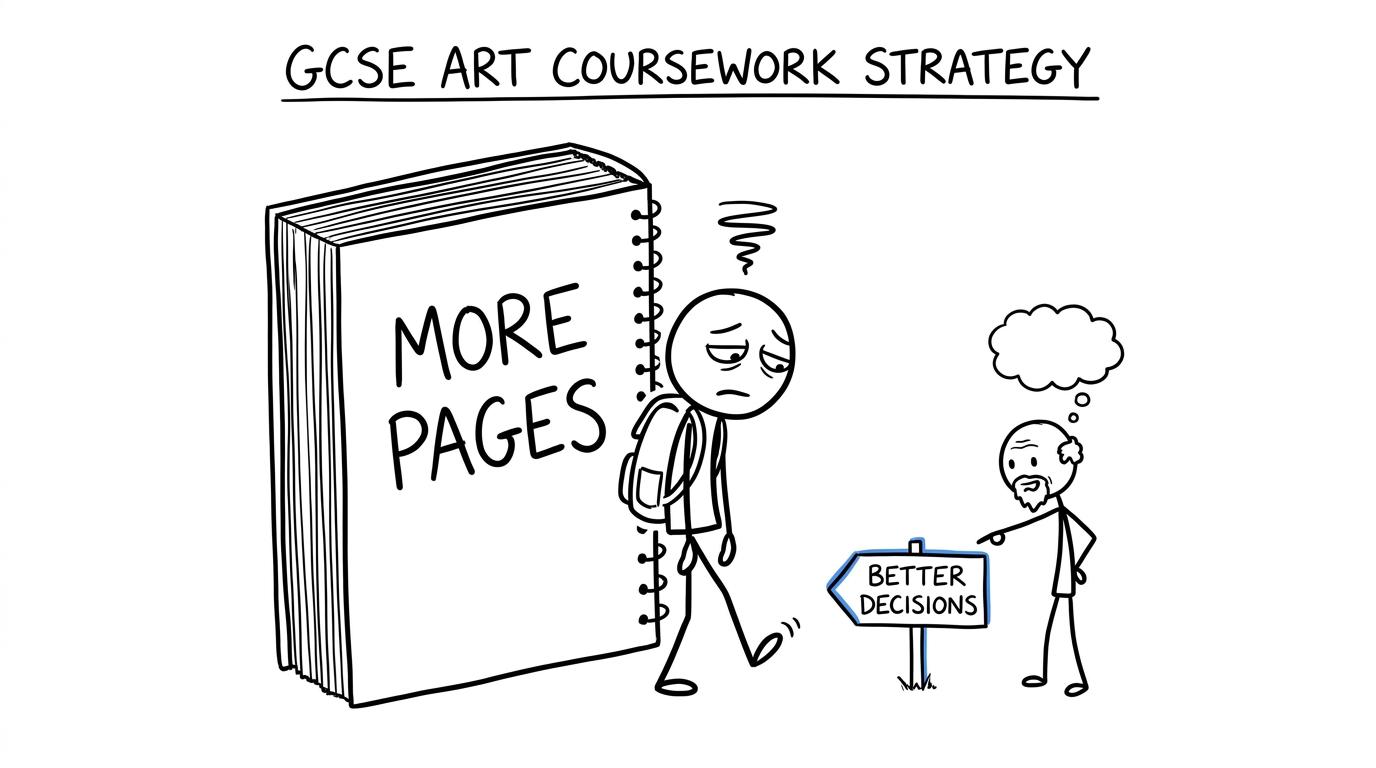 A student chooses better artistic decisions over simply adding more sketchbook pages
Understand how GCSE Art and Design is assessed
Across GCSE Art and Design specifications, the four assessment objectives are set nationally and carry equal weighting. Each contributes 25%25\%25% of the overall assessment:
| Assessment objective | What the examiner is looking for |
|---|---|
| AO1 | Developing ideas through investigations and showing critical understanding of sources |
| AO2 | Refining work by exploring ideas and experimenting with suitable media, materials, techniques and processes |
| AO3 | Recording relevant ideas, observations and insights as the work progresses |
| AO4 | Presenting a personal, meaningful response that realises intentions and understands visual language |
For current AQA and Pearson Edexcel specifications, the portfolio contributes 60%60\%60% and the externally set assignment contributes 40%40\%40%. Other boards, including OCR and Eduqas, use the same four objectives, but you should follow your own board's current specification and your teacher's instructions for submission arrangements.
Students taking AQA assessments from 202720272027 should also be aware that the minimum Component 111 requirement changes to one sustained project, with further work no longer compulsory. The four objectives and their equal weighting remain unchanged.
A crucial consequence follows from equal weighting: a polished final piece cannot fully rescue thin investigation, limited experimentation or weak recording. Equally, an enormous sketchbook does not guarantee high marks if the journey is repetitive or unclear.
What separates a grade 444 from a grade 777?
A grade 444 project can demonstrate sound basic skills and meet the assessment objectives. The work may contain artist research, experiments, drawings and an outcome, but links between them can remain straightforward or inconsistent.
Work moving towards grade 777 tends to be more sustained, connected and purposeful. This does not mean every drawing must be technically perfect. It means the student makes increasingly informed choices and provides convincing evidence of them.
| Moving from grade 444 | Moving towards grade 777 |
|---|---|
| Research describes what an artist made | Research analyses how and why the work communicates |
| Artist influence is copied quite directly | Relevant ideas are transformed for a personal intention |
| Materials are tested once | Tests are compared, evaluated and refined |
| Recording is mainly from downloaded images | Recording draws on relevant first-hand and contextual sources |
| Annotation reports what happened | Annotation explains decisions, meaning and next steps |
| The final outcome appears at the end | The outcome grows logically from earlier investigation |
| Presentation shows completed pages | Presentation makes the creative journey coherent and easy to follow |
These are tendencies, not fixed grade descriptors. Your final grade depends on the evidence across the submission, the assessment criteria and the boundaries applied in that examination series.
Strengthen AO1 by making research change your work
Weak artist research often becomes biography: dates, places and facts copied from a website. That may provide context, but it does not automatically demonstrate critical understanding.
For stronger AO1 evidence, select sources because they can help you solve a creative problem. Consider composition, colour, scale, symbolism, texture, process, mood and context. Then connect the analysis to your intention.
Useful annotations answer questions such as:
- What visual choice makes this source effective?
- What response does it create, and how?
- Which element is relevant to my theme?
- What might I adapt rather than imitate?
- How has this investigation changed my next step?
Research earns its place when it moves the project forward. Two sources explored critically may contribute more than many disconnected artist pages.
Improve AO2 through purposeful refinement
Experimentation is not a display of every material available in the art room. It is a process of finding out what best serves your intention.
Move beyond isolated samples by varying a meaningful feature: surface, scale, palette, viewpoint, lighting, layering or technique. Compare the results. Identify what worked, what failed and what you will alter next.
A useful refinement cycle is:
- set a clear creative question;
- test a small number of relevant possibilities;
- compare their visual and practical effects;
- select the strongest features;
- adapt them in a further study;
- explain how the result affects your direction.
Failure can be useful evidence when it leads to an informed change. A test that did not work is not wasted if your annotation explains the limitation and the next decision.
Make AO3 more than neat drawing
AO3 concerns recording ideas, observations and insights relevant to your intentions. Drawing matters, but recording can also include photography, written reflection, diagrams, colour studies, material samples and other appropriate forms.
First-hand recording is often powerful because you control the viewpoint, lighting, arrangement and details. Photograph your own subject matter where practical. Draw from objects, places or people connected to your theme. Collect textures and visual information that another student would not have in exactly the same form.
The word relevant matters. Ten unrelated drawings are less useful than a smaller group which genuinely develops your idea. Review whether each study reveals something needed by the project: structure, atmosphere, proportion, movement, pattern or meaning.
Build AO4 throughout the project
AO4 is not merely “make a final piece”. It asks for a personal and meaningful response that realises your intentions.
A strong outcome feels earned because earlier pages contain its foundations. Its imagery can be traced to recording. Its methods have been tested. Its composition has developed through studies. Its connection to sources is visible without becoming imitation.
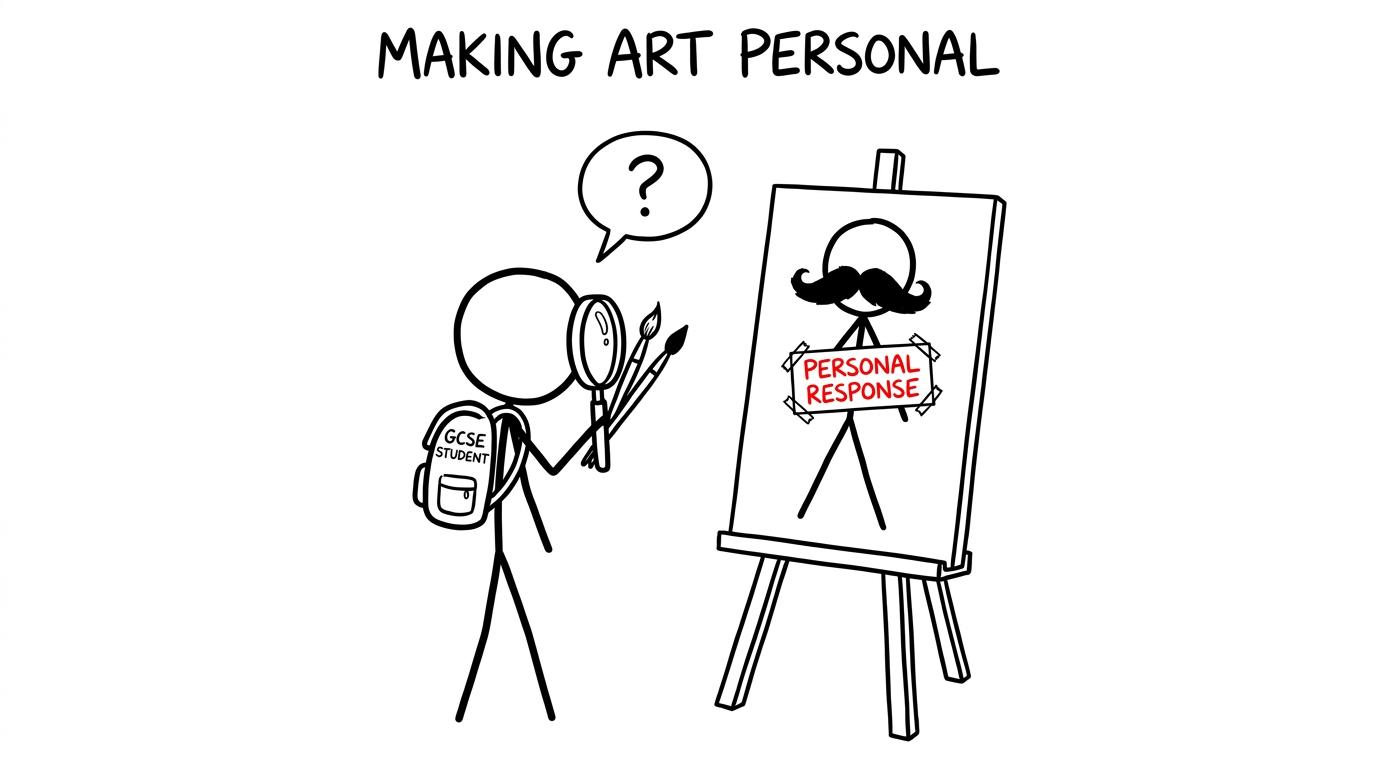 An artwork in disguise is investigated for whether it is genuinely a personal response
Before finalising, ask:
- Can I explain my intention in one clear paragraph?
- Which earlier studies directly shaped this response?
- Have I tested the difficult sections at a useful scale?
- Does the visual language support the intended meaning?
- What makes the response recognisably mine?
Personal does not have to mean autobiographical. It means that your selection, interpretation and combination of ideas show independent judgement.
Use annotation to reveal thinking
Annotation should make decisions visible, not decorate empty space. Avoid writing only that you like a colour or that an experiment “went well”. Explain the visual consequence.
A concise annotation can cover four things:
- intention: what you were trying to communicate or discover;
- decision: why you selected a source, material or method;
- evaluation: what was effective or limiting;
- direction: what you will retain, reject or change next.
Use appropriate specialist vocabulary, but do not make the writing needlessly complicated. Precise observations are more valuable than long paragraphs which never explain the development of the work.
Plan Art and Design without sacrificing maths revision
Art coursework can expand to fill every available evening. Maths revision can then become whatever time remains. Usually, that is not much.
Treat both subjects as a series of defined tasks. “Do art” is too vague. “Complete two composition studies and annotate the stronger arrangement” is measurable. In maths, “revise algebra” is equally vague. A better target is to complete one focused lesson, practise questions and mark the work.
Use the GCSE maths revision hub to identify specific skills, then build them around your art deadlines. The GCSE maths revision timetable guide can help you create a repeatable week rather than relying on last-minute effort.
On busy coursework days, the 20-minute maths revision routine keeps important skills active. Use Edexcel GCSE Maths mini tests for short checks if that is your board, or choose board-appropriate resources through the main hub.
As the maths examinations approach, move into GCSE past papers and mark schemes. MathsGenie's guide to using past papers properly explains the useful cycle: attempt, mark, diagnose, repair and retest. Nearer the examination, Edexcel predicted papers can provide a further timed rehearsal for Edexcel students.
Common mistakes that hold portfolios back
Producing quantity without development
More pages do not automatically mean stronger evidence. Remove repetition where your school permits, and use the time to deepen investigation, compare experiments or improve connections.
Copying an artist's finished style
A direct copy may demonstrate technique, but it does not by itself show a personal response. Extract useful principles, combine influences and transform them for your own intention.
Leaving annotation until the end
Retrospective writing often becomes vague because the real decisions have been forgotten. Add brief reflections while the work is progressing.
Treating the final piece as a separate task
If the outcome introduces completely new imagery, materials or composition, the supporting work may not justify it. Test the important decisions before the sustained final response.
Ignoring a weaker assessment objective
Because each AO carries 25%25\%25%, consistently weak evidence in one area can restrict the whole submission. Ask your teacher to identify the least convincing objective, then make that your next priority.
Guessing what your teacher means
“Develop this more” may refer to scale, composition, source analysis, experimentation or personal meaning. Ask which assessment objective needs better evidence and what visible change would demonstrate it.
Turn feedback into the next visible decision
The jump from grade 444 to grade 777 rarely comes from one dramatic final piece. It comes from a sequence of better choices: a more relevant source, a more revealing observation, a test compared honestly and an outcome with clear roots in the project.
Begin by placing your current work against AO1, AO2, AO3 and AO4. Find the weakest thread. Ask your teacher for precise feedback, then complete one action that makes the improvement visible.
Keep the rest of your GCSE preparation just as deliberate. MathsGenie gives you free revision lessons, practice questions, mini tests, past papers, predicted papers, mark schemes and video solutions, all organised to help you decide what to do next. Open the GCSE revision area, choose your exam board and turn your next free study block into a focused, finishable task.











