GCSE Arabic vs Modern Hebrew Sixth Form Guide
GCSE Arabic vs Modern Hebrew sixth form choices rarely differ in prestige. Learn what admissions teams check and how to choose the GCSE that suits you best.
Choosing a GCSE language can feel strangely high-stakes. You may enjoy one language more, expect a stronger grade in another, and still wonder whether an admissions team will quietly prefer the more impressive-looking option.
Here is the direct answer to GCSE Arabic vs Modern Hebrew sixth form applications: sixth forms do not generally treat one as more prestigious than the other. Both are regulated, recognised GCSE modern foreign language qualifications. Admissions decisions are normally driven by your grades, the institution's published entry criteria and any requirements for the A Levels you want to take.
There is one important qualification. Sixth-form policies vary. Some count every recognised GCSE, while others restrict which subjects can contribute to an entry score or exclude certain community-language qualifications. You must therefore check the actual policy of each sixth form rather than relying on a general rule.
The short admissions checklist
Before choosing or entering either language, check:
- whether your target sixth form counts the qualification towards its general GCSE requirement;
- whether it calculates an average grade or uses your best set of results;
- the required grades in English Language and GCSE Maths;
- the subject-specific requirements for your intended A Levels;
- whether externally studied or community languages are treated differently;
- which language gives you the best realistic chance of a strong grade;
- whether your school can provide suitable teaching and arrange every assessment.
That final point matters. A qualification can be academically valid but practically difficult if you have limited teaching, speaking practice or feedback on extended writing.
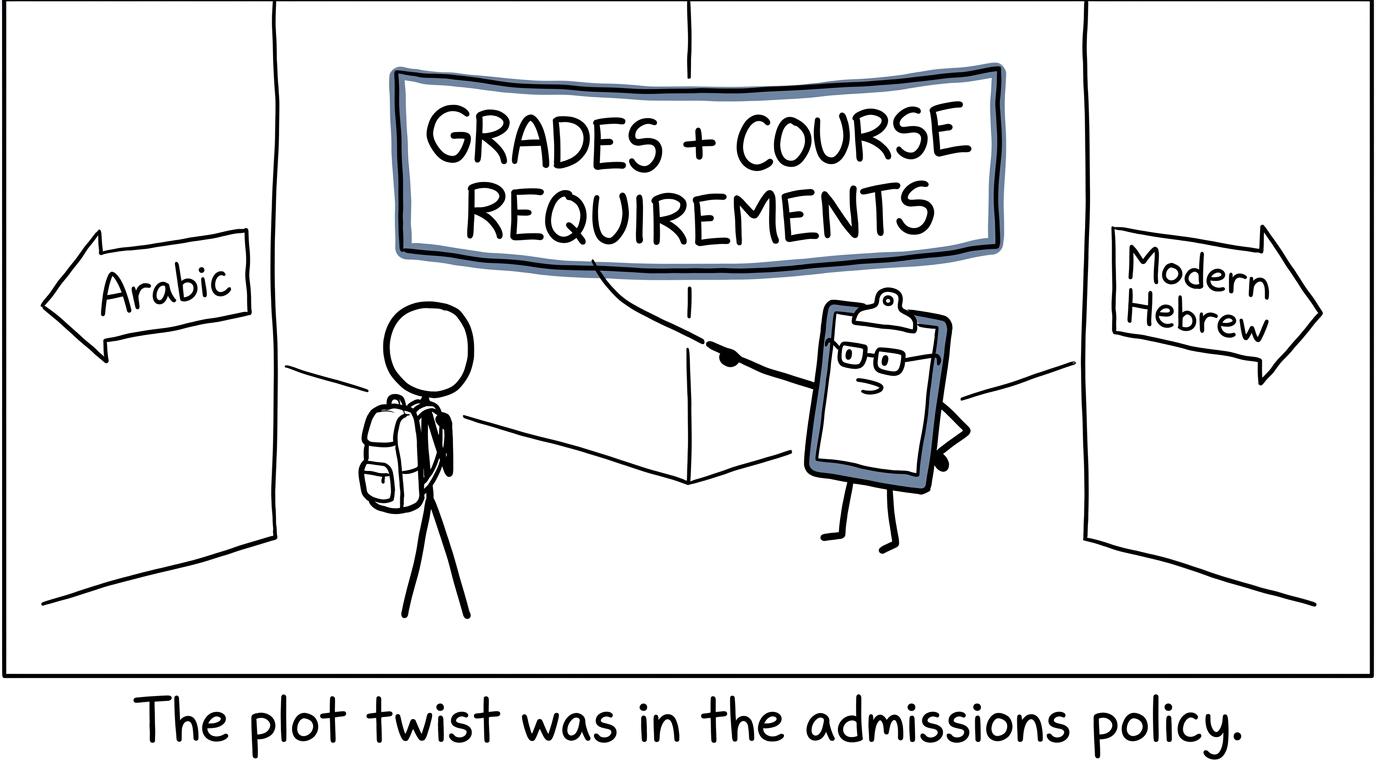 A student discovers that sixth-form admissions policies matter more than choosing between Arabic and Modern Hebrew
Do sixth forms favour GCSE Arabic or Modern Hebrew?
Usually, no.
Pearson Edexcel offers GCSE Arabic, while AQA offers GCSE Modern Hebrew. Both qualifications are regulated GCSEs graded from 999 to 111, and both are recognised as modern foreign languages for English Baccalaureate purposes. Each assesses the familiar language skills of listening, speaking, reading and writing.
A sixth form is therefore unlikely to look at two otherwise similar applications and decide that Arabic is inherently better than Modern Hebrew, or vice versa. There is no standard national prestige ranking placing one language above the other.
What admissions teams can evaluate objectively is the result. A grade 888 is evidence of stronger assessed performance than a grade 555, regardless of which of these two languages appears beside it.
However, sixth-form admissions policies are not identical. Current published policies show several approaches:
- requiring a minimum number of GCSEs at particular grades;
- calculating an average across a student's best results;
- specifying minimum grades in English and maths;
- imposing separate requirements for individual A Levels;
- limiting which GCSE subjects count towards the general threshold;
- excluding community languages or qualifications not taught in school.
The conclusion is subtle but useful: neither language normally has a universal advantage, yet either could be treated differently by a particular institution's written rules.
What matters more than the language name
Your achieved grade
A strong result can help you satisfy an overall GCSE requirement or improve an average grade calculation. This is usually more useful than choosing a subject because its title sounds unusual or demanding.
Ask which language you can use accurately under exam conditions. Consider your listening comprehension, vocabulary, grammar, reading speed, spoken fluency and ability to produce controlled extended writing. Familiarity alone is not enough if you have not practised the precise assessment format.
Your intended A Level subjects
Sixth forms frequently publish subject-specific thresholds. Students applying for A Level Mathematics may be asked for grade 666 or 777 in GCSE Maths, while Further Mathematics commonly has a higher threshold, such as grade 777 or 888. Requirements differ, so these figures are examples from current policies rather than national rules.
If you hope to take Mathematics, Further Mathematics, Physics, Chemistry, Computer Science or Economics, your GCSE Maths result may have considerably more direct admissions relevance than whether your language GCSE is Arabic or Modern Hebrew.
This is why subject choices should be viewed as a portfolio rather than a contest between isolated titles. A strong language grade is valuable, but it cannot replace a required maths grade for a mathematically demanding course.
Use the GCSE Maths revision hub to choose your exam board and work through revision lessons, practice questions, mini tests and papers. If you are uncertain about coverage, the GCSE maths topics by exam board and tier guide helps you identify what belongs on foundation or higher tier.
The published admissions policy
Never assume that every GCSE on your results sheet will be included in the same way.
Read the admissions policy and course booklet for the year in which you intend to enter. Search for phrases such as “community languages”, “externally studied qualifications”, “best GCSEs”, “average grade”, “approved subjects” and “subject-specific entry requirements”. If the wording remains unclear, ask the sixth-form admissions team in writing.
A brief, precise question is enough: will this full-course GCSE count towards the general entry requirement and any average-grade calculation?
Keep the reply. Admissions rules are too important to leave to corridor rumours.
Arabic and Modern Hebrew as GCSE qualifications
GCSE Arabic is currently offered by Pearson Edexcel under specification 1AA0. GCSE Modern Hebrew is offered by AQA under specification 8678. Both are linear qualifications, meaning the relevant assessments are completed in the final examination series rather than being converted into a running modular score.
Both offer foundation and higher tiers. Foundation targets grades 111 to 555, while higher targets grades 444 to 999. Students must be entered for one tier consistently across the language papers.
The broad structures are comparable, but the exam boards, detailed tasks, timings and mark schemes are not interchangeable. Choosing between them should depend on:
- your current command of the language;
- access to an experienced teacher or tutor;
- regular speaking and listening practice;
- familiarity with the correct specification;
- access to suitable past papers and marking feedback;
- the tier your centre is prepared to enter.
Do not confuse Modern Hebrew with Biblical Hebrew. They are distinct qualifications with different content and assessment purposes.
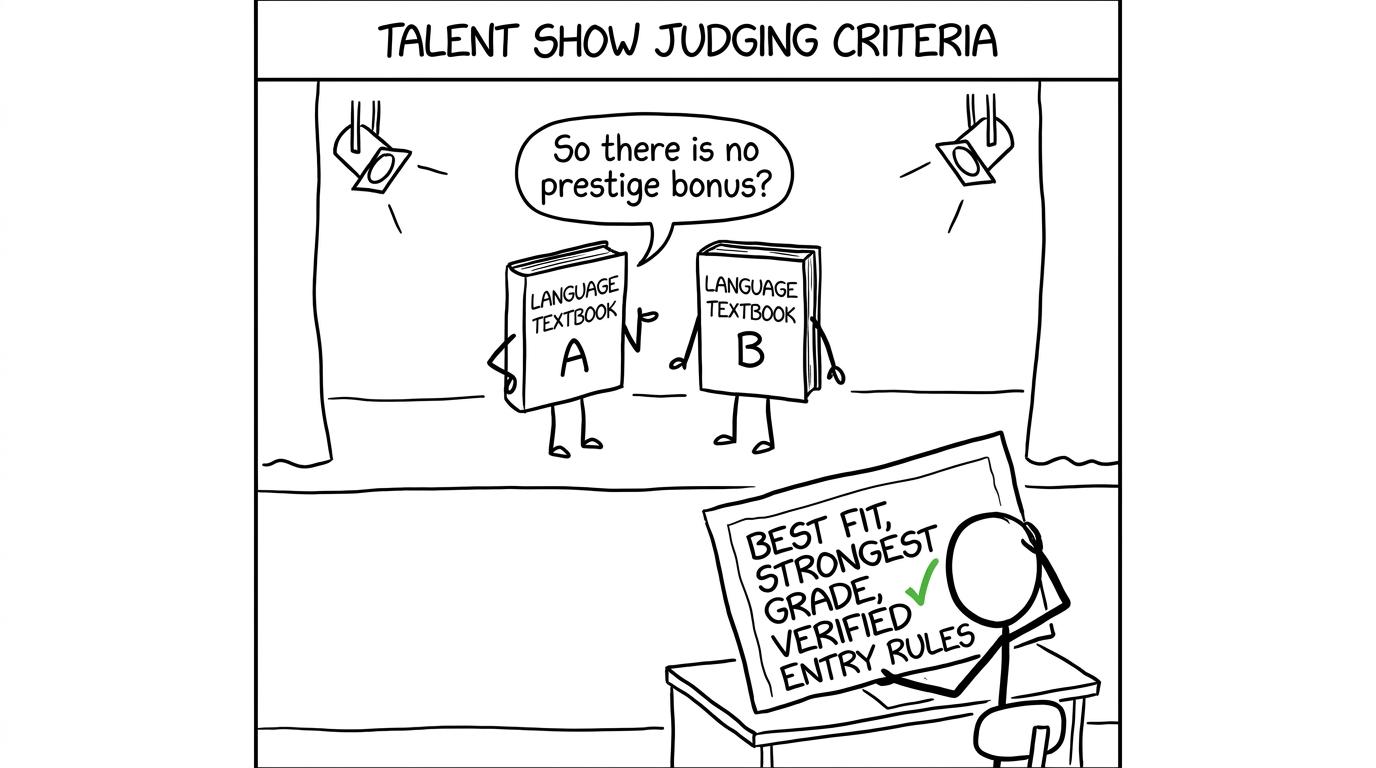 Two language textbooks learn that there is no automatic prestige bonus
How to make the decision sensibly
Choose probable performance over imagined prestige
The safer question is not “Which language looks harder?” It is “In which qualification can I demonstrate the assessed skills most reliably?”
Think in evidence. Review the specification, attempt representative listening and reading material, and ask for honest feedback on speaking and writing. A language spoken at home may provide a strong foundation, but formal register, spelling, grammar and examination technique still require preparation.
Check assessment access before committing
Your school or examination centre must be able to make the correct entry and arrange the required assessments. Confirm this early, particularly if the language is being studied outside your normal timetable.
Ask who will conduct or support the speaking assessment, which tier is appropriate, how mock work will be marked and when the centre needs your final entry decision. Administrative feasibility is not glamorous, but it can determine whether the qualification is genuinely available to you.
Protect the subjects tied directly to your next step
Every hour has an opportunity cost. If additional language preparation is consuming the time needed to reach an A Level entry grade in maths or science, rebalance your timetable.
A calm weekly plan might include language practice alongside short, consistent maths sessions. MathsGenie's guide to building a GCSE maths revision timetable can help you organise this without turning every evening into an endurance test. If examinations are close, the one-month GCSE maths revision plan provides a more focused structure.
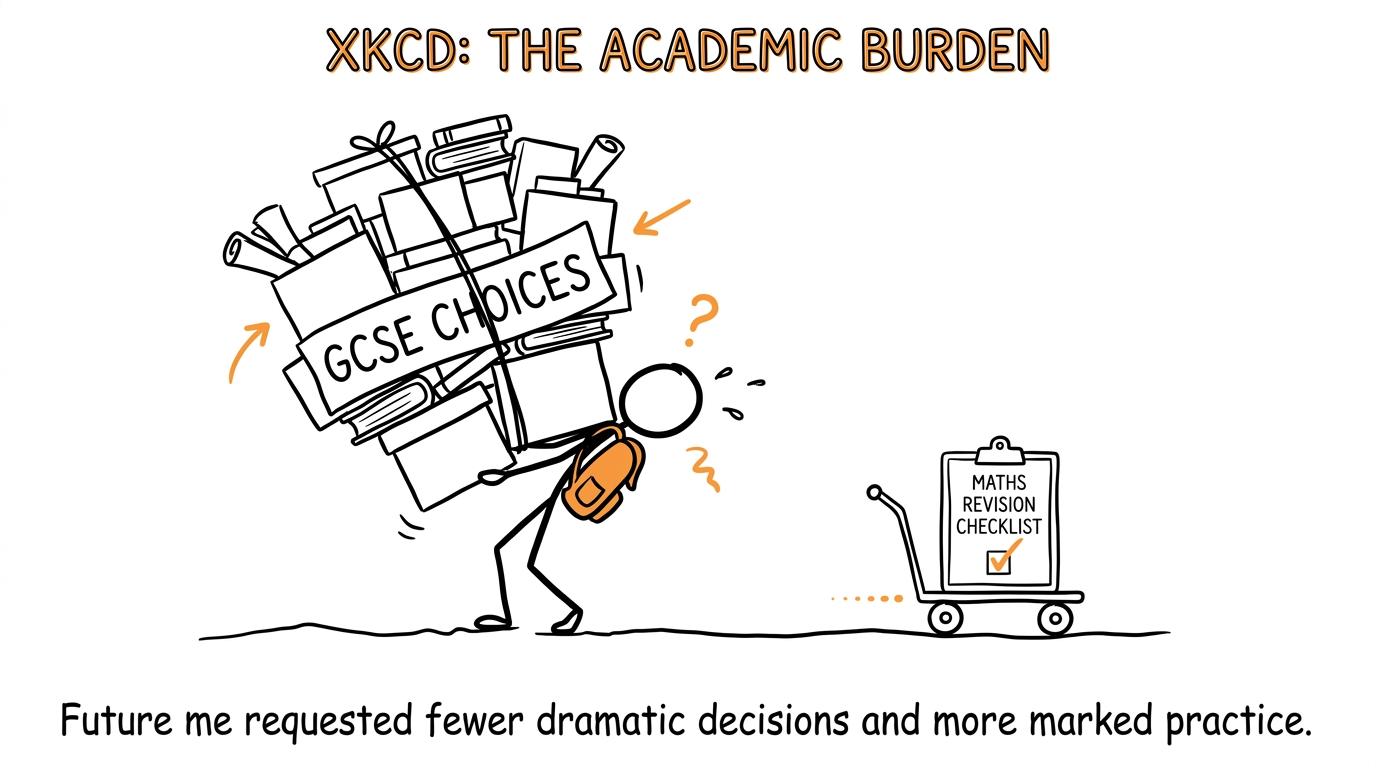 A student chooses organised revision over carrying every GCSE decision at once
Keep sixth-form ambitions connected to maths revision
Students often spend a great deal of energy optimising the label on one GCSE while overlooking the subject with an explicit admissions threshold.
If A Level Maths is part of your plan, start by identifying your present level and the grade required by each target sixth form. Then turn that gap into specific topics and regular exam practice. The best order for learning GCSE maths topics can prevent you from jumping randomly between unrelated skills.
Once the methods are secure, use authentic papers. Edexcel students can work through Edexcel GCSE Maths past papers with mark schemes and solutions. The aim is not merely to complete pages. It is to identify where marks disappear, revisit the relevant lesson and attempt similar questions again.
If you are unsure when to move from topic revision to complete papers, read when to start GCSE past papers. Nearer the examinations, predicted papers can supplement past-paper practice, but they should never replace full specification coverage.
Common mistakes when comparing the two GCSEs
Assuming one language automatically looks more impressive
There is no general admissions rule awarding extra credit because Arabic or Modern Hebrew appears rarer, harder or more prestigious. Concentrate on recognition, policy and performance.
Reading a generic prospectus instead of the admissions policy
A prospectus explains the institution. The admissions policy and subject-entry document explain how decisions are made. Check the version applying to your intended year of entry.
Ignoring community-language restrictions
Some sixth forms count these GCSEs normally; others exclude qualifications studied outside school from a minimum subject total or average. Verify the exact treatment before making plans around the result.
Treating home fluency as complete exam preparation
Conversation skills do not automatically secure marks in formal writing, translation, reading detail or timed listening. Revise the specification and practise every assessed skill.
Neglecting compulsory and course-specific grades
A language grade may strengthen your overall profile, but it will not usually override a missing requirement in GCSE Maths, English or a relevant science. Make those thresholds visible in your revision planner.
Choose evidence, then revise what matters
For most applicants, GCSE Arabic and GCSE Modern Hebrew stand on equal ground as recognised language qualifications. The better option is the one you can access properly, prepare for thoroughly and convert into the strongest credible result.
Then check the rules. Your chosen sixth form's current admissions policy is more authoritative than assumptions about which subject “looks better”.
Once that decision is settled, return your attention to the grades that open the courses you actually want. Use MathsGenie's free revision lessons, practice questions and mini tests to repair weak topics, then build exam confidence with past papers, mark schemes, video solutions and predicted papers. Start from the MathsGenie GCSE Maths revision area, add the resources to your revision planner, and make your next action specific enough to complete today.