GCSE Arabic Translation Questions: What Earns Marks
GCSE Arabic translation questions explained: learn what examiners reward, avoid meaning-changing errors and revise effectively in both directions.
A translation can look polished and still lose marks. One missed negative, a shifted tense or an unclear pronoun may change more meaning than several imperfect spellings. That is the central lesson behind GCSE Arabic translation questions: examiners reward accurate communication, not a mechanical word-for-word swap.
For Pearson Edexcel GCSE Arabic, translation is assessed in both directions. Arabic-to-English translation appears in the reading paper, while English-to-Arabic translation appears in the writing paper. The precise task and demand depend on your tier, so check the current specification and materials supplied by your school.
The strongest answers preserve the complete message, communicate it clearly and use language appropriate to the target audience. Accuracy matters, particularly when writing in Arabic, but perfection is not the same as precision.
What examiners are actually looking for
Before practising, keep this checklist beside you:
- Preserve the meaning of every important idea.
- Keep tense, time and sequence accurate.
- Notice negatives, comparisons and intensifiers.
- Make clear who is doing what to whom.
- Choose natural target-language phrasing rather than copying source-language order.
- Use an appropriate register.
- Avoid omissions, additions and unsupported guesses.
- Leave time to compare your answer with the source.
These priorities reflect the current Pearson Edexcel specification and sample assessment guidance. In Arabic-to-English tasks, communication is central: spelling or expression errors are less serious when the intended message remains unambiguous. In English-to-Arabic tasks, the marking guidance considers both communication of content and linguistic knowledge and accuracy.
That distinction matters. The two translation directions test related skills, but they do not reward exactly the same kind of performance.
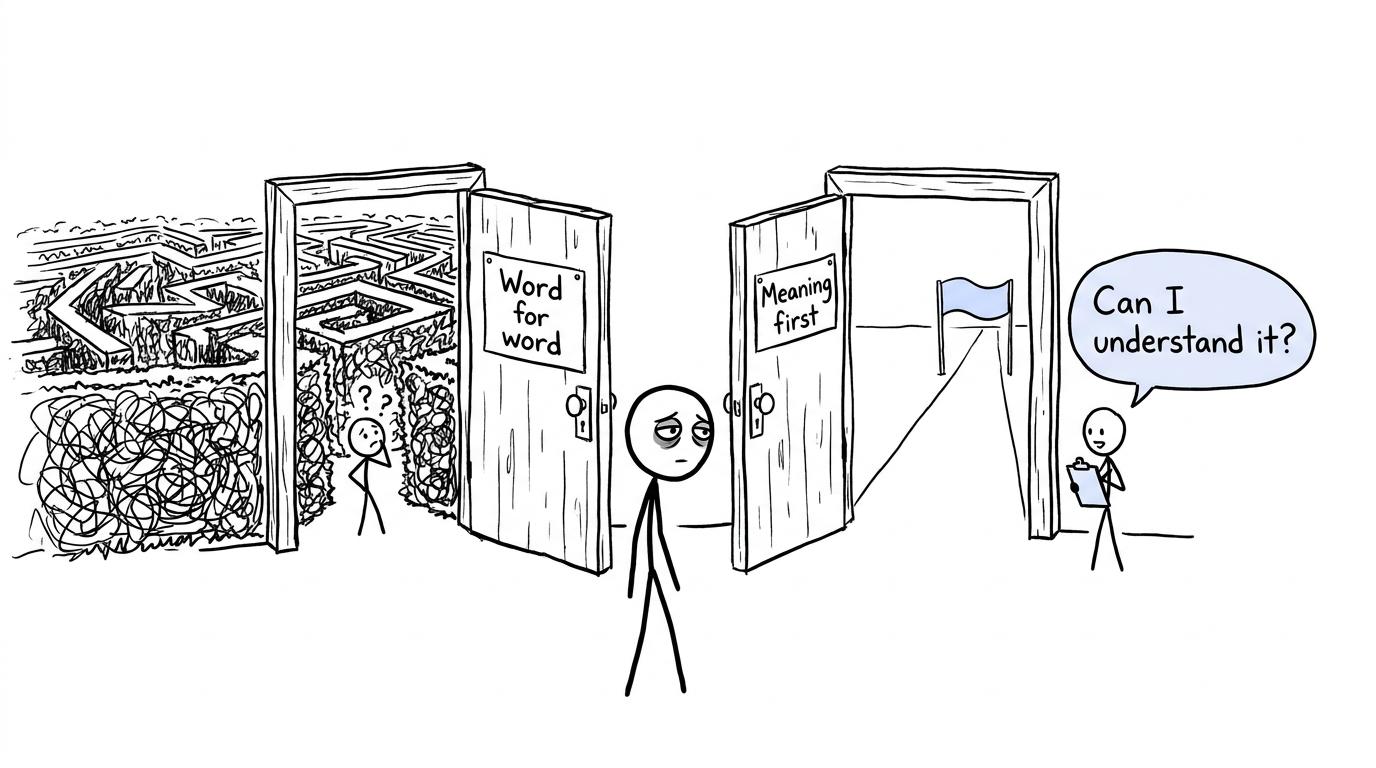 A student choosing between word-for-word translation and meaning-first translation
Arabic to English: preserve the message
When translating into English, your answer should sound like understandable English while remaining faithful to the Arabic passage. A stiff translation is not automatically more accurate. In fact, copying Arabic structures too closely can make the result ambiguous.
Complete communication comes first
Treat each clause as a unit of meaning. Identify:
- the person or group involved;
- the action or state;
- when it happens;
- whether it is positive or negative;
- any reason, opinion, contrast or consequence;
- details such as place, frequency and degree.
Examiners cannot reward an idea that has disappeared. If you understand most of a sentence but omit its final detail, the rest of your English does not replace that missing content.
This is why short words deserve attention. A connector may signal contrast rather than addition. A negative may reverse the message. A time marker may move an action from the present into the past or future.
Natural English is not the same as paraphrasing freely
A good translation often changes the order of words because Arabic and English organise sentences differently. That is sensible. Changing the underlying idea is not.
You may choose an idiomatic English expression when it communicates the same meaning. You should not make the sentence more dramatic, more polite or more specific than the source. Translation gives you freedom over wording, not freedom over content.
If one Arabic word has several possible meanings, use context. Ask which meaning fits the surrounding topic, verb and sentence. The first dictionary meaning you remember is not necessarily the intended one, and dictionaries are not permitted in the examination.
Clear English protects meaning
Pearson's guidance for the reading paper indicates that quality of language and spelling are not separately rewarded in the translation task. Errors can be tolerated when communication remains clear. That does not make presentation irrelevant. Poor punctuation, incomplete sentences or an unfortunate spelling can create ambiguity, and ambiguity can prevent the examiner from identifying the intended message.
Write straightforward English. The safest answer is usually the clearest faithful answer, not the most impressive one.
English to Arabic: communicate and control the language
Translation into Arabic asks you to generate language rather than simply recognise it. You must communicate the source content while controlling vocabulary and structures accurately enough for the meaning to remain clear.
Pearson's translation grids do not require flawless writing for the highest available performance. Occasional errors may be tolerated when they do not hinder clarity. However, repeated errors, omissions and mother-tongue interference can weaken both communication and linguistic accuracy.
Build around secure structures
Under pressure, students sometimes choose ambitious language they cannot control. A simpler, accurate construction is usually more valuable than an elaborate sentence whose agreement or tense makes the meaning uncertain.
Prioritise:
- correct verb tense and person;
- gender and number agreement;
- secure pronoun reference;
- possession and prepositions;
- sentence links that express the intended relationship;
- suitable formal or informal language;
- legible Arabic script.
Vocalisation is not a substitute for grammatical control, and you should follow the conventions taught for your course. The goal is not decoration. It is unambiguous communication.
Register carries meaning
Register is part of the message. Language addressed to a friend may not suit a formal audience, and a polite request should not become a blunt instruction. Look for contextual signals before translating: who is speaking, who is receiving the message and what is the purpose?
This is one of the features that separates strong translation from word replacement. The best answer carries the social meaning of the sentence as well as its vocabulary.
Why word-for-word accuracy is not enough
Translation is a sequence of decisions. A weak response sees isolated words. A strong response sees relationships.
Consider what must survive the journey between languages:
Tense and time frame
A recognisable verb with the wrong time frame can alter the whole event. Track time expressions and check that connected actions remain in a logical sequence.
Negation
Missing a negative reverses meaning. During your final check, actively search for every negative construction rather than hoping you noticed it on the first reading.
Pronouns and participants
Arabic can encode information about gender, number and person within verbs and pronouns. English may require you to state that information differently. Make sure the reader can identify the subject and object without guessing.
Connections between ideas
Words expressing cause, contrast, condition and result are structural. Confusing “because” with “therefore”, or contrast with simple addition, changes the argument of the passage.
Degree and frequency
Expressions such as “usually”, “rarely”, “too much” and “a little” are not optional extras. They control the strength of a claim and should be translated deliberately.
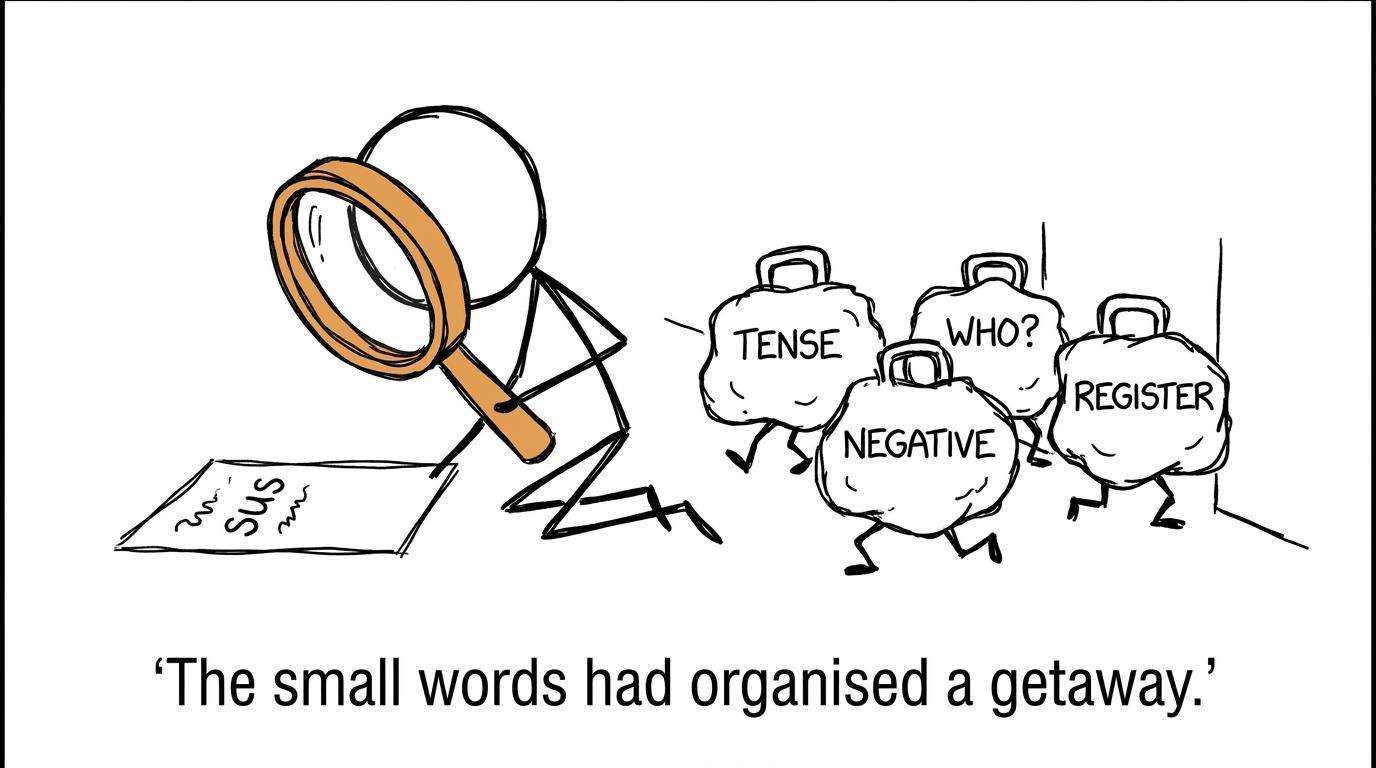 An examiner watches small meaning-changing words escape from a student's revision
A reliable method for GCSE Arabic translation questions
Read for the whole message
Read the complete passage before writing. Identify its topic, time frame, speakers and tone. This context helps you resolve unfamiliar or flexible vocabulary.
Divide it into meaning units
Mark natural clauses or phrases. Do not automatically split after every word. Each unit should contain one manageable idea that you can transfer without losing its relationship to the rest.
Draft for meaning
Translate the ideas you understand securely. When one phrase is uncertain, use the surrounding sentence to narrow the possibilities. Avoid inventing a detail simply because it sounds plausible.
Improve the target language
For Arabic-to-English translation, make the English natural without changing content. For English-to-Arabic translation, check that your vocabulary, word order and structures communicate the required message accurately.
Audit against the source
Compare the source and answer clause by clause. Ask:
- Have I translated every idea?
- Is the tense unchanged?
- Did I preserve every negative?
- Are the people, places and quantities correct?
- Is the register suitable?
- Have I added anything unsupported?
This final audit is more valuable than casually rereading your answer in isolation.
How to revise translation effectively
Translation improves through feedback, not volume alone. Complete one short task under timed conditions, mark it against the official scheme and classify each lost mark.
Your error log might use categories such as omission, tense, vocabulary in context, agreement, register, ambiguity and unnatural target-language structure. Repeated patterns tell you what to revise next.
This is the same evidence-led habit used in effective maths revision. MathsGenie's guide to finding your weakest GCSE topics explains how to turn lost marks into specific next actions. Its advice on using past papers properly also provides a useful mark, diagnose, repair and retest cycle.
Use official Arabic materials for Arabic practice. For your maths preparation, MathsGenie provides free GCSE and A Level maths revision, Edexcel GCSE Maths past papers and a GCSE teaching resources hub. Keeping each subject's resources separate avoids confusing exam-board requirements while allowing you to reuse the same disciplined revision routine.
Common mistakes that weaken translation answers
Translating every word in the original order
This often produces unnatural target-language sentences and can obscure relationships between ideas. Translate meaning units, then check each source detail.
Omitting difficult material
Leaving out a word may remove a person, opinion, time reference or negative. Attempt a contextually sensible translation rather than silently skipping an important idea.
Adding information
Do not explain what you think the writer meant or supply background details. Examiners reward the given message, not an expanded version of it.
Ignoring small grammatical signals
Pronouns, prepositions, connectors and negatives can carry decisive meaning. Give them the same attention as topic vocabulary.
Treating both directions identically
Arabic-to-English prioritises faithful, clear communication in English. English-to-Arabic additionally requires active control of Arabic vocabulary and structures. Adjust your checking routine accordingly.
Marking practice generously
If your version “roughly means the same thing”, identify exactly what differs. The MathsGenie night-before revision plan reinforces a useful principle for any examination: fix recurring mark leaks rather than attempting endless unfocused revision.
Turn careful decisions into marks
Strong translation answers are rarely built from spectacular vocabulary. They are built from small, correct decisions: preserving a negative, maintaining a tense, identifying a pronoun and choosing wording that a reader can understand immediately.
Practise with your board's current Arabic specification, sample materials, past papers and official mark schemes. Then apply the same honest feedback loop across your GCSE subjects. For maths, explore MathsGenie's exam-board and tier topic guide, free revision lessons, practice questions, mini tests, past papers, predicted papers, mark schemes and video solutions.
Start with one task. Mark it carefully. Find the decision that cost you marks, then practise making that decision better next time.