

GCSE Arabic Topics Breakdown: Revision Priorities
GCSE Arabic topics breakdown covering themes, exam weightings and skills, with a practical plan to focus your revision where it can earn more marks.
Revision becomes difficult when everything looks equally urgent. One vocabulary list leads to another, grammar notes spread across the desk, and the speaking exam somehow feels both close and easy to postpone.
This GCSE Arabic topics breakdown gives you a clearer map. For Pearson Edexcel GCSE Arabic, the five compulsory themes are intended to have equal weighting, so each represents roughly 20%20\%20% of the thematic content. Listening, speaking, reading and writing are also equally weighted at 25%25\%25% each. Your starting point should therefore be balanced revision, followed by extra time for the areas where your own marks are weakest.
You can find the relevant papers and supporting materials in the GCSE Arabic revision hub. Before planning, confirm that you are taking Pearson Edexcel GCSE Arabic rather than an International GCSE qualification, because the structures are different.
GCSE Arabic revision checklist
Use this short checklist before deciding what to revise:
- Confirm your qualification, tier and specification with your teacher.
- Cover all five themes rather than trying to predict a single dominant topic.
- Give all four language skills regular attention.
- Complete a paper or timed section to identify genuine weaknesses.
- Separate vocabulary gaps from grammar, comprehension and timing problems.
- Revisit weak areas using new questions rather than simply rereading notes.
- Keep speaking practice active and frequent.
The principle is simple: begin with the official weighting, then let evidence from your work change the plan.
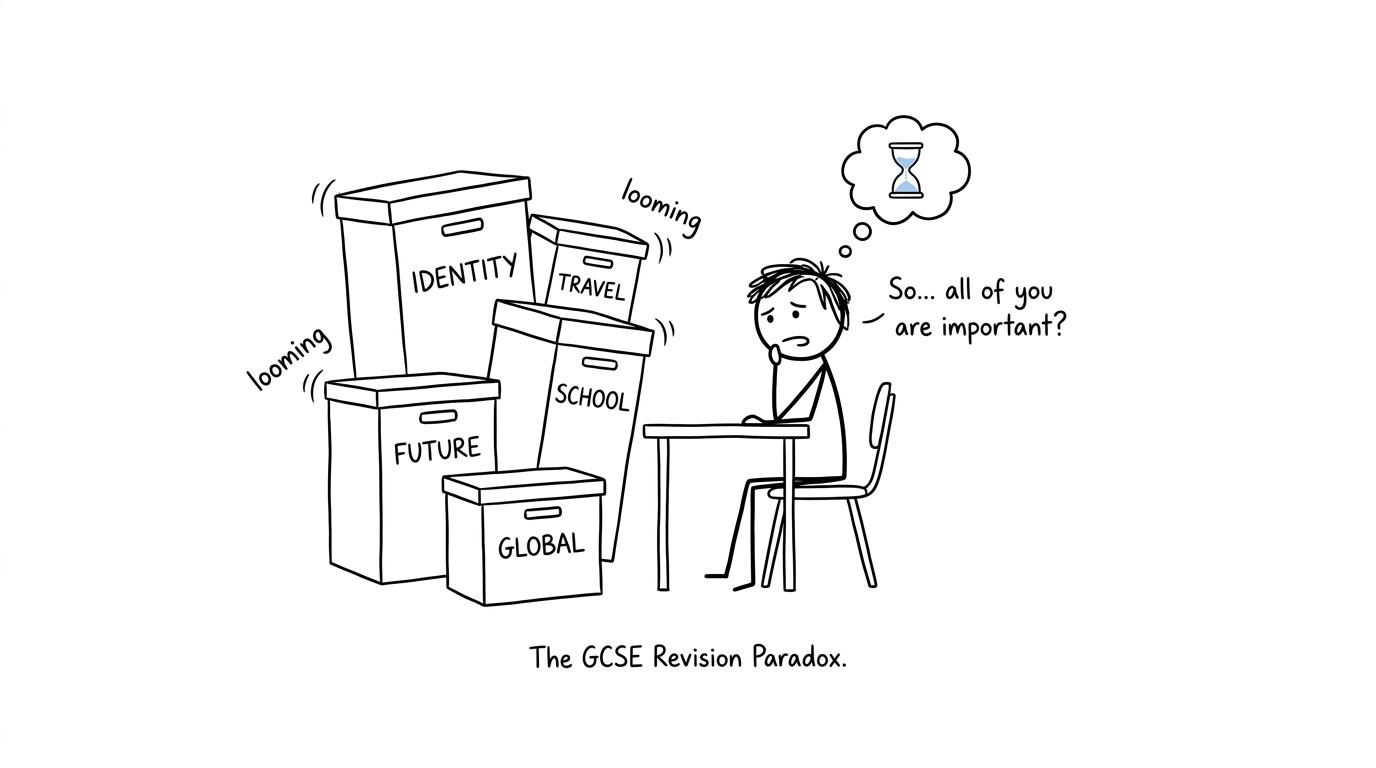 A student negotiates revision time with five eager GCSE Arabic themes
How much is each part of GCSE Arabic worth?
The current Pearson Edexcel GCSE Arabic qualification has four assessments. Each tests a different language skill and contributes 25%25\%25% of the final qualification.
| Assessment | Weighting | Raw marks | Main focus |
|---|---|---|---|
| Listening and understanding | 25%25\%25% | 505050 | Understanding spoken Arabic |
| Speaking | 25%25\%25% | 707070 | Communicating and interacting in Arabic |
| Reading and understanding | 25%25\%25% | 505050 | Understanding texts and translating into English |
| Writing | 25%25\%25% | 606060 | Written communication and translation into Arabic |
The different raw totals do not make speaking more important than reading. Pearson scales the papers so that each contributes the same 25%25\%25% to the qualification.
At Foundation tier, listening lasts 353535 minutes including 555 minutes of reading time, while Higher listening lasts 454545 minutes. Reading lasts 505050 minutes at Foundation and 656565 minutes at Higher. Writing lasts 757575 minutes at Foundation and 858585 minutes at Higher. The speaking assessment lasts 777 to 999 minutes at Foundation or 101010 to 121212 minutes at Higher, with 121212 minutes of preparation at either tier.
All four papers must be entered at the same tier. Foundation offers grades 111 to 555, while Higher offers grades 444 to 999, with the possibility of a grade 333 for a narrowly missed grade 444 under the awarding rules. Individual papers do not receive separate qualification grades; the total scaled mark determines the final result.
The five GCSE Arabic themes
Pearson organises the course into five broad themes and states that there is equal weighting between them. As a planning baseline, treat each theme as approximately:
100%5=20%\frac{100\%}{5}=20\%5100%=20%That does not mean every paper will divide neatly into five identical sections. Themes can appear through different tasks, and one passage may draw on more than one area. It means that ignoring a theme is a poor revision gamble.
Identity and culture
This theme covers identity, relationships, family, friends, role models, interests and socialising. It also includes daily life, food and drink, shopping, customs, celebrations and cultural activities.
Spend time here if you struggle to describe people, express opinions or move between past, present and future experiences. The vocabulary is familiar enough to feel safe, which can hide weaknesses in adjective agreement, verb forms and extended answers.
Local area, holiday and travel
Expect contexts involving your home, town, region, holidays, accommodation, transport, directions and tourist transactions. Questions may require practical understanding as well as descriptions and opinions.
This area deserves extra attention if small details disappear when you listen, such as dates, destinations, prices or changes of plan. Build vocabulary in connected groups, transport, accommodation and activities, rather than learning isolated words.
School
The school theme includes subjects, rules, routines, facilities, school activities, trips and opinions about education. It often feels predictable, but good performance requires more than recognising classroom nouns.
You should be able to justify preferences, compare experiences and discuss what happened or will happen. If your answers remain short and repetitive, the problem may be language range rather than topic knowledge.
Future aspirations, study and work
This theme covers ambitions, further study, careers, employment, volunteering and using languages beyond the classroom. It naturally invites future constructions, reasons and conditional ideas.
Prioritise it if you can name jobs but cannot explain choices. Speaking and writing responses become stronger when plans are supported by reasons, contrasts and relevant detail rather than lists of memorised sentences.
International and global dimension
Here you meet international events, campaigns, communication, environmental issues and ways communities are connected. The vocabulary may be less common in everyday conversation, so it can become a late revision blind spot.
Focus on recognising the central message before chasing every unfamiliar word. In productive tasks, aim to communicate a clear view using language you can control accurately.
Where should you spend your revision time?
Equal content weighting gives you a baseline, not a personalised timetable. If your five themes are genuinely similar in strength, divide theme revision close to 20%20\%20% each. If not, shift time towards the areas losing marks.
A practical weekly allocation might look like this:
| Evidence from practice | Suggested response |
|---|---|
| One theme is clearly weakest | Give it about 30%30\%30% of theme revision time |
| One theme is the next weakest | Give it about 25%25\%25% |
| Three themes are reasonably secure | Give each about 15%15\%15% |
These figures are revision advice, not official assessment weightings. Review them after another timed task. A weak theme should not continue receiving extra time once the evidence changes.
Use the same logic for skills. Begin from 25%25\%25% each, but ask where marks are actually escaping. A student with strong reading and weak spontaneous speaking should not spend four equal evenings silently learning vocabulary.
The most reliable diagnosis comes from completing Edexcel GCSE Arabic past papers and checking the official mark schemes. MathsGenie's guide to finding your weakest GCSE topics explains how to turn lost marks into a focused revision list.
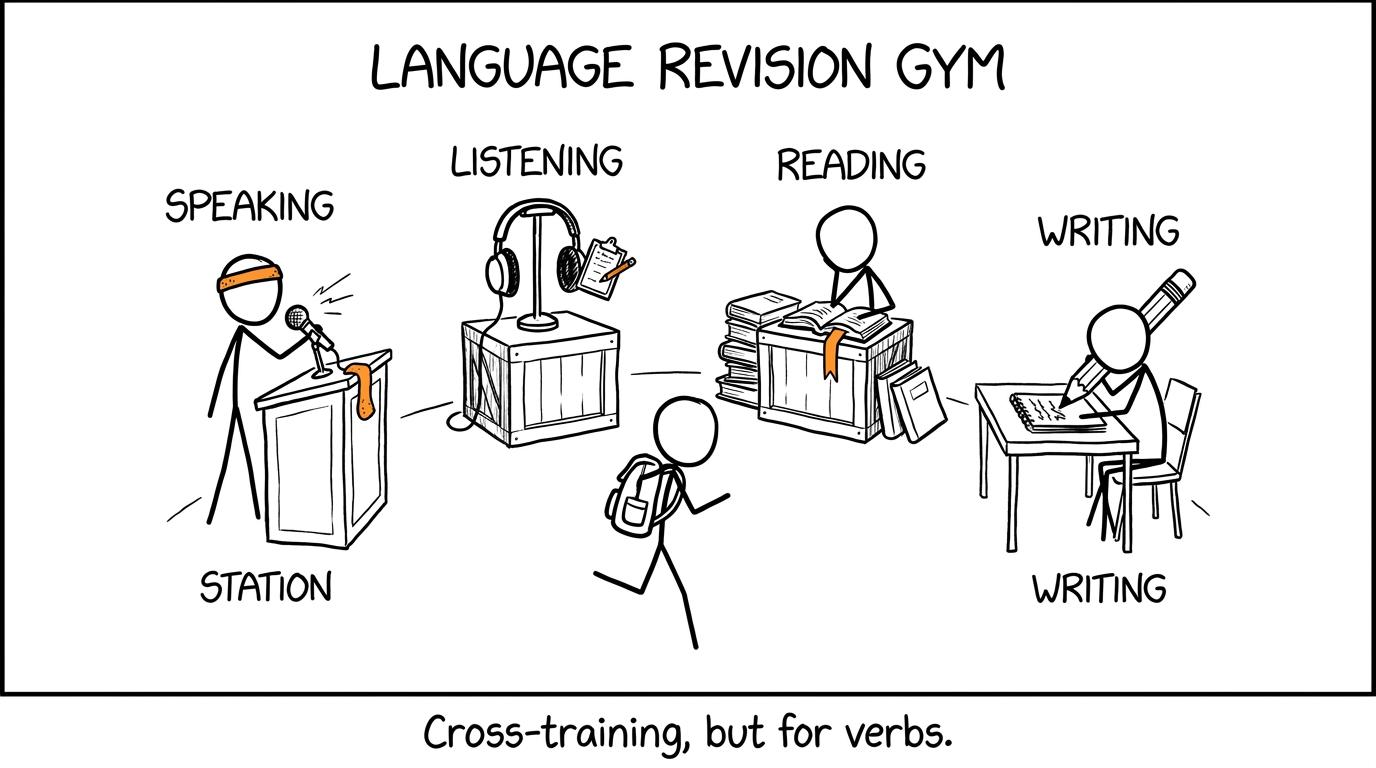 Four language skills take part in a revision gym
Match the revision method to the language skill
Listening
Practise listening without reading a transcript first. Identify the context, speaker, opinion, tense and important details. Then listen again and investigate what caused each mistake.
A missed answer may come from unknown vocabulary, failure to recognise a familiar word at natural speed, or confusion caused by a distractor. Those are different problems and need different fixes.
Speaking
The speaking assessment contains a role play, a picture-based task and a conversation. Revision must therefore include unrehearsed responses, not only polished paragraphs learnt in advance.
Practise answering aloud, extending an idea and recovering when you forget a word. Short daily sessions usually preserve fluency better than one long weekly rehearsal. The 20-minute GCSE revision routine can be adapted easily: retrieve vocabulary, speak for several minutes, then record one correction to revisit.
Reading
Train yourself to locate evidence instead of translating every line. Pay attention to negatives, time markers, opinions and contrasts. The reading paper also includes translation from Arabic into English, so your English version must communicate the meaning clearly rather than follow Arabic word order mechanically.
Writing
Writing rewards communication, linguistic range and accuracy. Practise planning briefly, covering every bullet point and checking agreement, spelling and verb forms. Translation into Arabic also requires precise control of grammar and vocabulary.
Keep a small bank of flexible structures, but avoid forcing a memorised paragraph onto an unrelated question. Adaptation is safer than imitation.
A revision cycle that turns mistakes into marks
A completed paper is most useful after it has been marked. Follow this cycle:
- Complete a timed paper or selected section.
- Mark it carefully using the official scheme.
- Label each lost mark by theme and skill.
- Record the cause: vocabulary, grammar, comprehension, task coverage or timing.
- Practise the smallest area that would correct the problem.
- Retest it with different material.
The guide to using GCSE past papers properly develops this process, while when to start GCSE past papers helps you move gradually from short sections to full timed attempts.
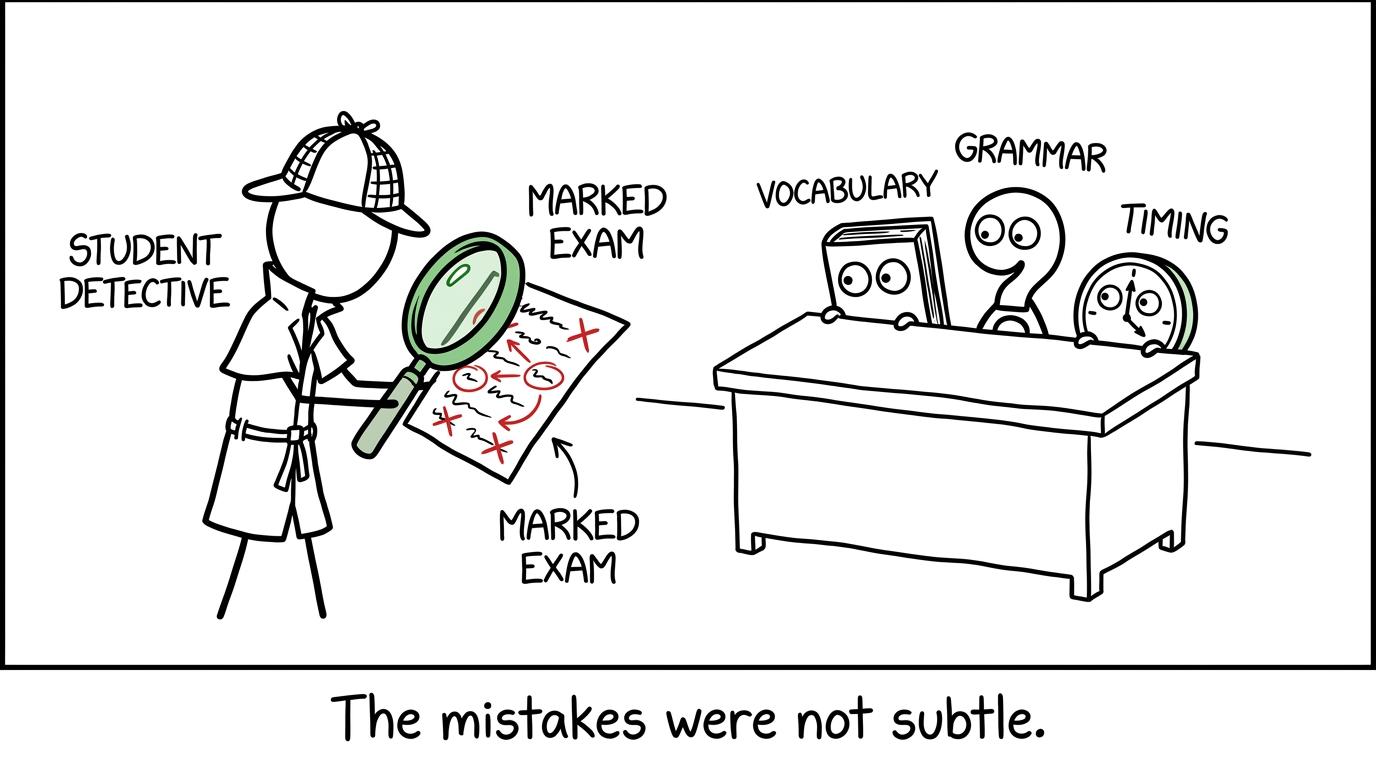 A student detective discovers vocabulary, grammar and timing behind the mistakes
Common GCSE Arabic revision mistakes
Treating fluency at home as complete exam preparation
Conversational confidence is valuable, but the examination also tests formal reading, accurate writing, translation and responses within unfamiliar contexts. Use a past paper to discover which assessed skills still need deliberate practice.
Revising favourite themes repeatedly
Familiar themes produce reassuring sessions, but reassurance is not the same as progress. Since the five themes are equally weighted overall, avoiding environmental issues or future work can leave a preventable gap.
Learning vocabulary without using it
Recognition is only one stage. Say new words, place them in sentences, retrieve them later and use them in responses across several themes.
Ignoring task instructions
A linguistically impressive answer can still lose marks if it misses a required bullet point or answers the wrong question. Underline the task, audience, time frame and required content before beginning.
Counting practice without reviewing it
Three completed papers with the same repeated errors are less valuable than one paper analysed properly. Use the mark scheme, keep an error log and retest. The broader MathsGenie resources hub can help you organise timed revision alongside your other GCSE subjects.
Make the breakdown personal
The official structure tells you what matters: five broadly equal themes and four equally weighted skills. Your marked work tells you what matters next.
Begin at the MathsGenie GCSE Arabic revision page, choose the correct Edexcel paper and complete a manageable section under timed conditions. Mark it, identify the largest marks leak and build your next revision session around that evidence.
MathsGenie is designed to make focused revision easier, with free revision materials, past papers, practice questions and mark schemes, alongside predicted papers, mini tests, revision lessons and video solutions across GCSE maths. Use the one-month GCSE revision plan to structure your wider timetable, then give Arabic the same disciplined rhythm: practise, mark, correct and return.










