GCSE Arabic Study Planner: Work Backwards
GCSE Arabic study planner for working backwards from exam day, balancing four language skills with maths revision and building a realistic timetable.
Revision often begins with a vague promise: do more next week. The trouble is that next week arrives carrying homework, maths practice, speaking preparation and several other subjects. Nothing has been turned into a decision.
A GCSE Arabic study planner fixes that by starting at the other end. Record each assessment date, decide what exam-ready performance should look like, then work backwards to today. This gives every week a purpose. It also protects your maths revision because Arabic no longer expands into every free evening.
For the current Pearson Edexcel GCSE Arabic specification, listening, speaking, reading and writing each contribute 25%25\%25% of the qualification. Speaking is conducted during an assessment window set by the exam board, while the written papers follow the published summer timetable. Confirm your exact dates, tier and arrangements with your school before building your plan.
Your backward-planning checklist
Before filling a calendar, collect the facts:
- Confirm your qualification, exam board and specification. UK GCSE Arabic students commonly take Pearson Edexcel GCSE Arabic, but do not assume this from a revision book cover.
- Ask whether you are entered for foundation or higher tier. Edexcel requires one tier across all four papers.
- Record the date of your speaking assessment and every written paper.
- Add your maths, English, science and other GCSE dates to the same calendar.
- Complete a short diagnostic task in listening, speaking, reading and writing.
- Rank weaknesses by evidence rather than preference.
- Reserve time for timed practice, marking, correction and rest.
- Review the plan weekly instead of rebuilding it daily.
If maths also feels difficult to organise, the GCSE maths revision timetable guide uses the same principle: diagnose gaps, schedule repeatable sessions and leave room for catching up.
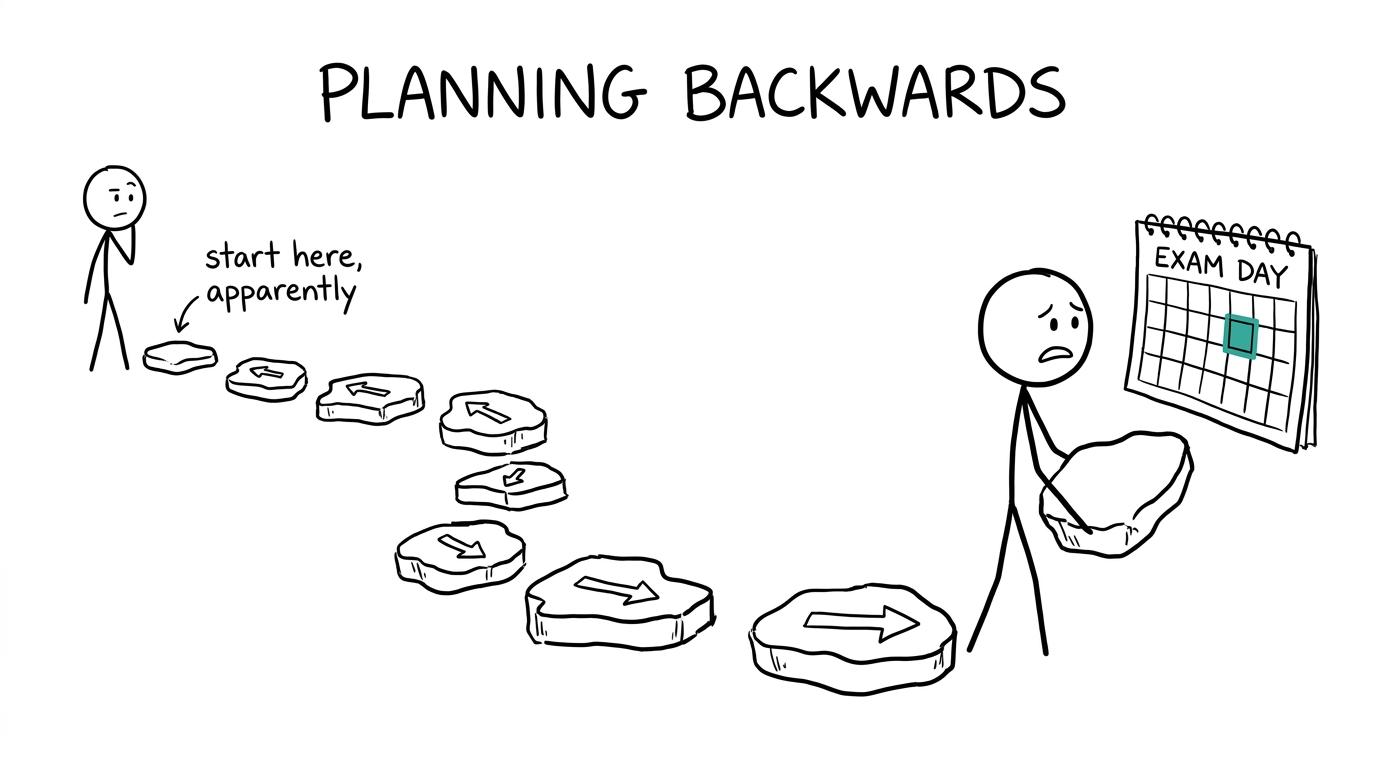 A student building stepping stones backwards from exam day
Start with the real finish line
Your finish line is not simply the date printed beside Arabic on a general exam timetable. GCSE Arabic contains separate assessments, and speaking may arrive before the written papers. Treat each assessment as its own deadline.
Create one calendar containing:
- the speaking assessment window given by your school;
- listening, reading and writing paper dates;
- internal mocks or teacher deadlines;
- all other GCSE examinations;
- fixed commitments such as lessons or appointments;
- the official contingency date, where relevant.
Exam timetables can change between series, and schools organise speaking assessments within prescribed arrangements. Use your school-issued timetable as the final authority. Do not copy dates from an old social media post or another student's calendar.
This wider view matters. A quiet week before Arabic writing may contain a maths paper the following morning. A plan that ignores this is mathematically neat but practically useless.
Calculate the revision time you actually have
Let DDD be the number of usable revision days before an assessment and let SSS be the average number of sessions you can complete each week. Your approximate session budget is
B=D7×S.B = \frac{D}{7} \times S.B=7D×S.This is a budget, not a command. Round down rather than pretending every available hour will be productive. Remove school events, family commitments and the evenings before demanding exams. A smaller honest plan is stronger than an ambitious fictional one.
Next, divide your session budget between the four skills. Equal weighting in the qualification does not mean equal revision time. If diagnostic evidence shows that listening and writing are weaker, they should receive more sessions until the gap narrows.
Use a simple priority score:
P=I×U,P = I \times U,P=I×U,where III represents the importance of the assessment and UUU represents your current level of uncertainty. Because each Edexcel Arabic paper is worth 25%25\%25%, differences in priority will usually come from your current performance and the closeness of each assessment.
The same evidence-led approach works in maths. MathsGenie's guide to finding your weakest GCSE topics explains why lost marks provide a better revision order than instinct alone.
Build the planner in four phases
Foundation phase: map knowledge and routines
Far from the exams, focus on coverage and consistency. Identify vocabulary gaps across the specification themes, revise grammar in context and establish regular contact with spoken and written Arabic.
Each week should include all four skills, even when one receives greater attention. Speaking and listening cannot be rescued solely by writing more notes. Reading vocabulary without producing language can also create familiarity without recall.
Keep sessions short enough to repeat. The structure in MathsGenie's 20-minute GCSE revision routine can be adapted: retrieve from memory, complete an active task, check it and record the next action.
Development phase: turn weaknesses into tasks
A weak area must be specific enough to schedule. Replace broad labels such as writing or vocabulary with actions such as:
- recall vocabulary from one specification theme;
- record and review a response to a speaking prompt;
- identify details and opinions in a listening extract;
- translate a short passage accurately;
- plan a response that covers every bullet point;
- check verb forms, agreement and spelling in completed writing.
Now add spaced revisits. Return to difficult material after a short delay, then again later. The aim is retrieval without prompts, not recognition when the answer is visible.
A useful weekly pattern is two focused Arabic sessions, one mixed-skills session and one review slot. Adjust the volume around your other subjects rather than assigning identical hours every week.
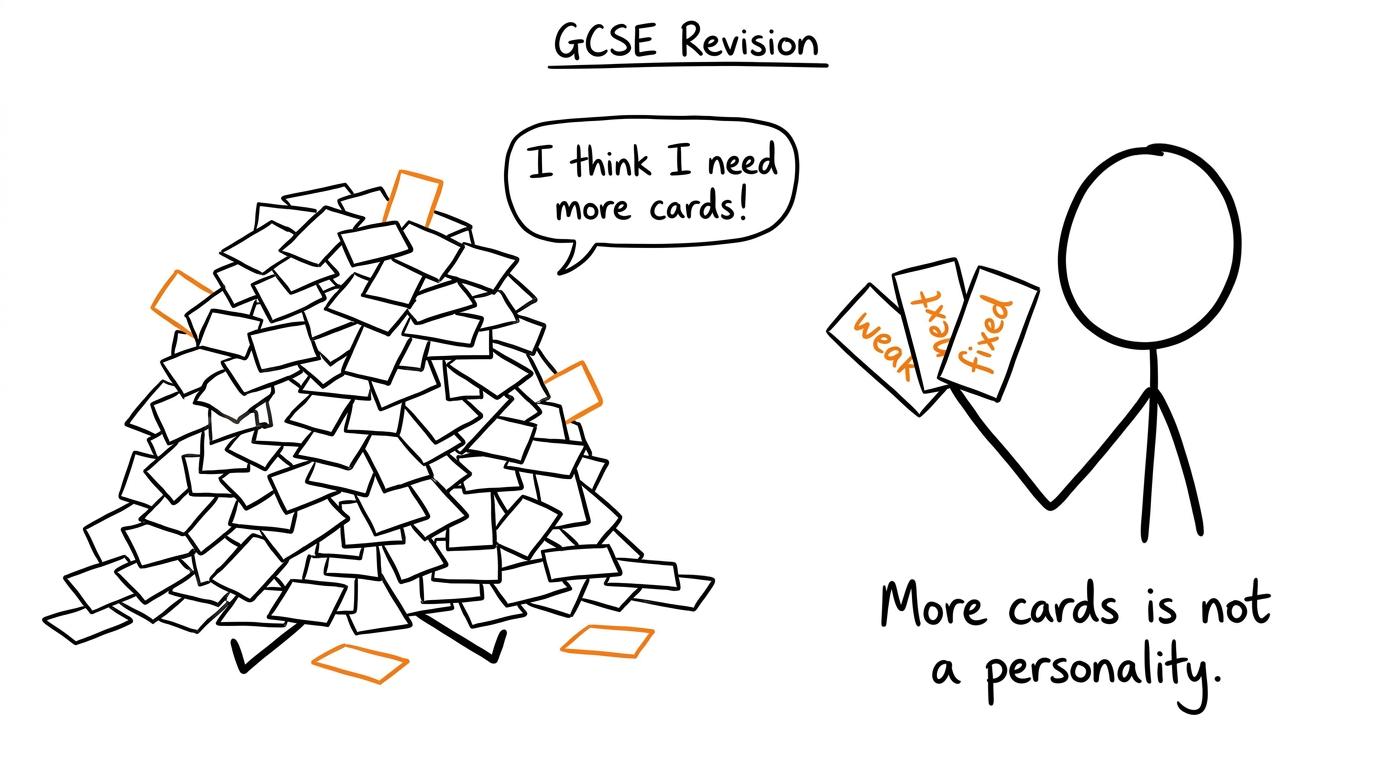 One student buried in flashcards while another uses a focused shortlist
Exam-practice phase: add timing and feedback
Once you can attempt tasks independently, introduce sections from official specimen or past assessment materials supplied by your school or exam board. Match the correct tier and paper. The purpose is not merely to collect a score. It is to discover what breaks under time pressure.
After each task, classify the cause of lost marks:
- vocabulary was unknown;
- the question or bullet point was misread;
- an answer lacked relevant detail;
- grammar or spelling reduced clarity;
- time was distributed poorly;
- the required response language was misunderstood.
Then schedule the correction. Feedback without a future slot is just information.
This is exactly how productive maths paper practice works. The MathsGenie guide to using past papers properly follows a paper, mark, fix and retest cycle. For maths-specific practice, use the GCSE maths revision hub to select your board and appropriate resources.
Final phase: rehearse, reduce and protect
In the final weeks, stop adding large new resource collections. Use timed sections, speaking rehearsals, targeted vocabulary retrieval and correction of recurring mistakes. Your planner should become narrower as the examination approaches.
Keep the evening before each assessment light. Review a small correction list, check the arrangements and prepare what your school requires. Protecting sleep is more valuable than squeezing in an exhausted final session.
Give each Arabic skill a clear job
Listening
Schedule frequent, manageable listening rather than one long weekly block. Practise identifying the topic, key details, opinions, negatives, time references and changes of view. Review the transcript only after making a genuine attempt where one is legitimately available.
Speaking
Speaking needs rehearsal aloud. Plan recurring sessions for role-play responses, picture-based discussion and conversation themes in line with your specification. Ask your teacher to confirm the permitted preparation and assessment rules. Recordings can help you notice hesitation and unclear pronunciation, but teacher feedback remains important.
Reading
Mix short texts with longer exam-style passages. Train yourself to locate evidence, distinguish familiar-looking distractors and translate meaning rather than replacing each word mechanically.
Writing
Plan, produce and check. Your checklist should include task coverage, opinions, reasons, varied time references where appropriate, accurate structures and a final spelling check. Writing more is not automatically better; relevant, controlled language earns more than memorised material forced into the wrong task.
Balance Arabic with GCSE maths
A subject planner should reduce conflict between subjects, not create it. Put Arabic and maths on the same weekly page. Avoid placing two demanding timed tasks on one school night, and give the closest exam greater short-term priority without abandoning later papers.
Maths revision can remain compact between Arabic sessions. Use Edexcel GCSE maths mini tests for focused timed practice, then move to Edexcel GCSE maths past papers when a longer block is available. Students following other boards can choose the correct route from the main GCSE hub.
Near the maths exams, GCSE predicted papers can provide unseen practice. They are practice resources, not promises about exact questions, so use them alongside past papers, revision lessons and your error log.
Common GCSE Arabic planning mistakes
Planning from Monday instead of from the assessment
A generic weekly timetable can look busy without building towards anything. Start with each deadline, then assign milestones backwards.
Giving every skill identical time
The papers may have equal weighting, but your weaknesses are unlikely to be equal. Let diagnostic evidence shape the allocation.
Treating speaking as something to revise silently
Reading a prepared answer is not the same as retrieving and delivering it aloud. Speaking practice must involve speaking.
Counting tasks rather than corrections
Completing a paper does not guarantee improvement. Record why marks were lost, schedule a repair session and retest the skill.
Ignoring the rest of the GCSE timetable
Arabic revision cannot consume the evenings needed for mathematics or science. Plan all subjects together and reduce workloads during crowded exam weeks.
Leaving no buffer
Illness, homework and tired days happen. Leave at least one flexible slot each week so one missed session does not collapse the whole plan.
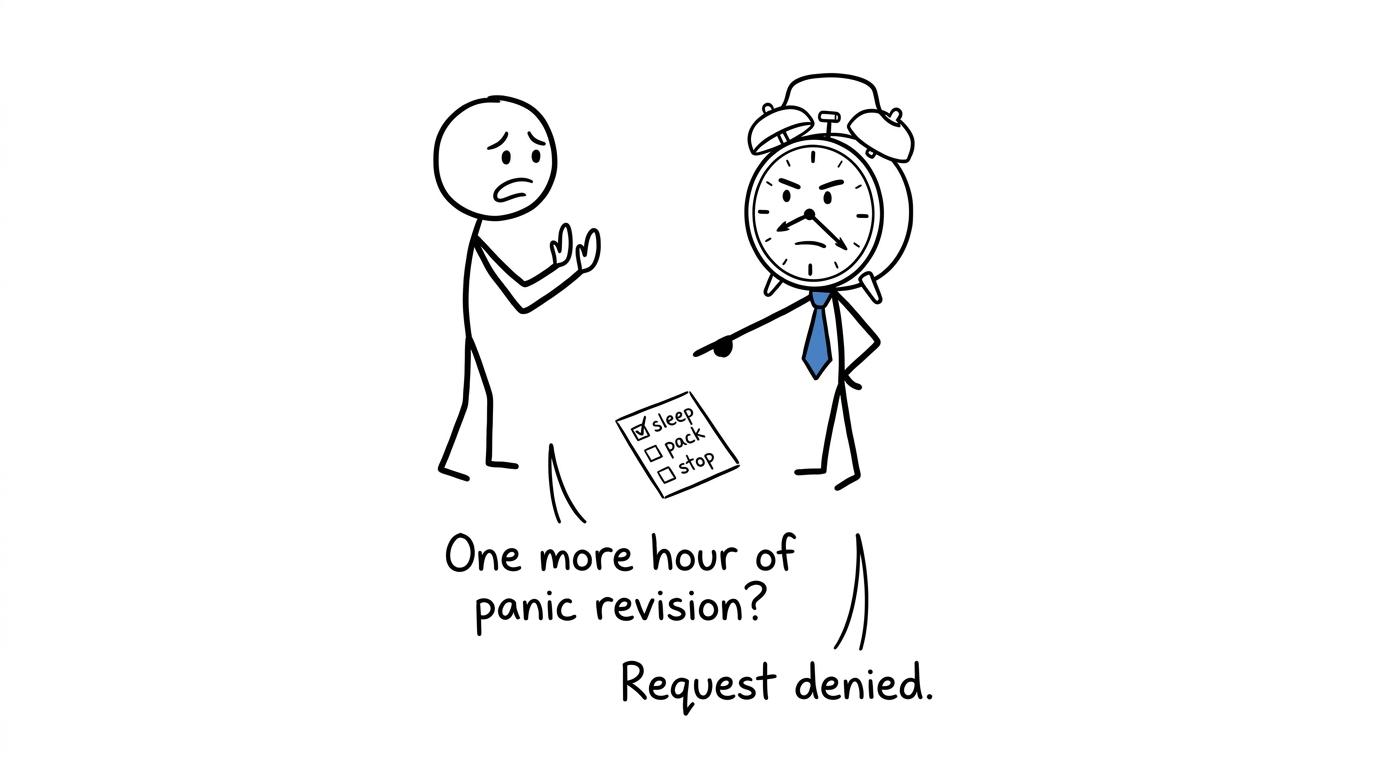 A student negotiating unsuccessfully with an alarm clock before an exam
Work backwards, then move forwards calmly
A useful planner does not predict your motivation. It removes decisions from moments when motivation is low. Begin with verified assessment dates, calculate a realistic session budget, identify weaknesses and move through foundation, development, exam practice and final rehearsal.
Then keep maths organised beside Arabic. Visit the MathsGenie GCSE maths revision hub for free revision lessons and practice questions, use mini tests to diagnose gaps, and build towards past papers and predicted papers. Mark schemes and video solutions show where methods need attention, while a simple revision planner keeps the work attached to an actual date.
Open your calendar today. Add the finish lines first. The next useful session will then become much easier to see.