

GCSE Arabic Study Group: Make It Actually Work
GCSE Arabic study group advice for planning focused sessions, practising all four skills, using past papers and avoiding an inactive group chat.

A new study group often begins with good intentions. Someone creates a chat, everyone agrees that revision matters, and then nothing happens except a stream of messages asking when everyone is free.
A GCSE Arabic study group works differently. It has a small membership, a fixed meeting time, a specific task for every session and an agreed way to check progress. Its purpose is not to make revision feel social. Its purpose is to help each member practise listening, speaking, reading and writing more effectively than they would alone.
The same disciplined approach is useful for students balancing Arabic with GCSE maths. Group time should be used for interaction and feedback; independent time should handle the focused practice that only you can do.
The quick study group checklist
Before inviting anyone, decide whether your group can meet these conditions:
- Keep the group to roughly 333 to 555 reliable students.
- Choose one recurring day, time and place.
- Meet for around 454545 to 606060 minutes.
- Publish the task before the meeting.
- Give every member a role.
- Practise more than you discuss.
- Record mistakes and next actions.
- Review all four Arabic skills over time.
- Keep ordinary chat separate from revision decisions.
- End every meeting by booking the next one.
A group does not need to be large or elaborate. It needs to be predictable. The fewer decisions you have to make each week, the more energy remains for the work itself.
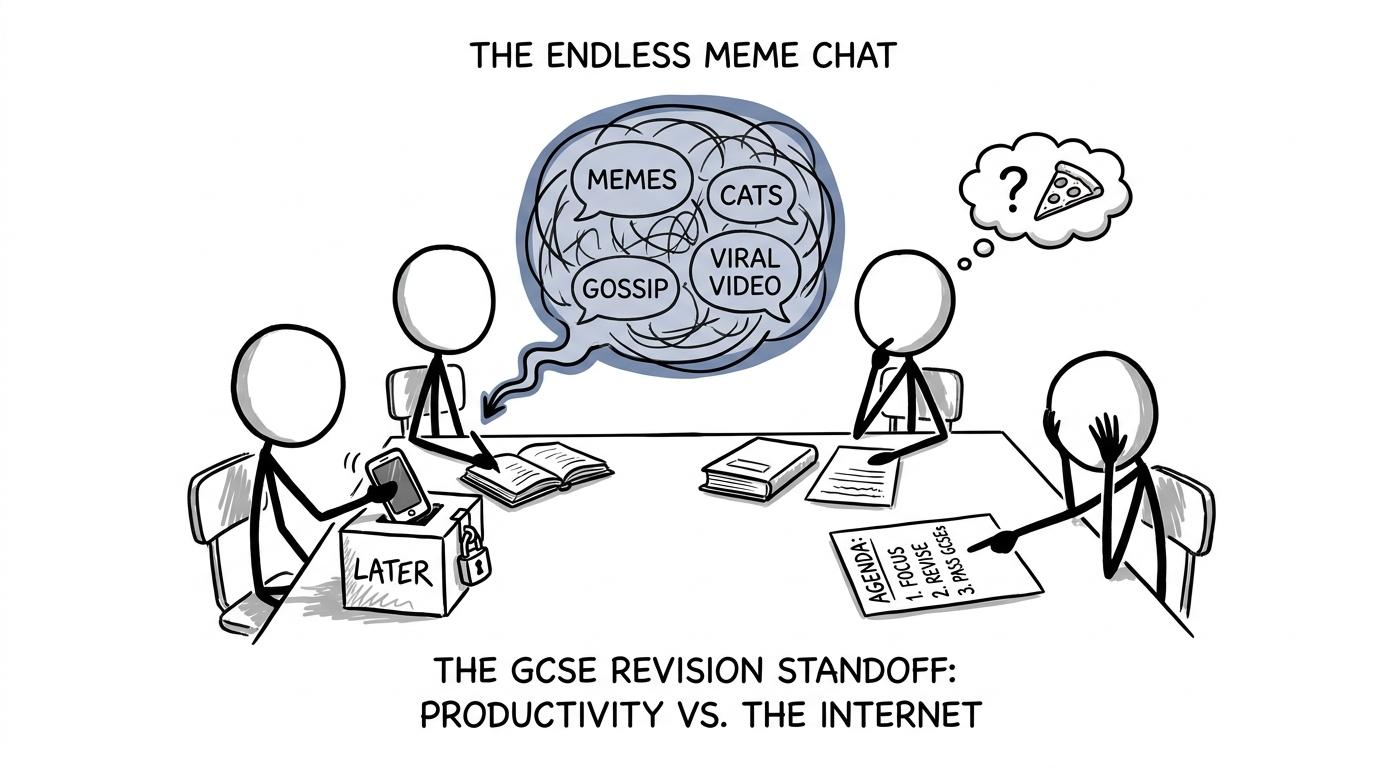 Students protecting a focused revision meeting from a distracting group chat
Build the group around the actual GCSE Arabic assessment
A useful group starts with the specification rather than a vague intention to “do some Arabic”. Check the current specification and instructions supplied by your school and exam board before planning activities.
Under the current Pearson Edexcel GCSE Arabic specification, assessment covers four skills: listening, speaking, reading and writing. Each contributes 25%25\%25% of the qualification. Papers are available at foundation and higher tier, and students must be entered for the same tier across the papers. Dictionaries are not permitted in the assessments.
That structure gives your group a clear test. If every meeting becomes an informal speaking conversation, you are neglecting most of the qualification. If every session is silent vocabulary copying, you are missing the main advantage of having other people present.
Create a simple rotation:
| Week | Main group activity | Independent follow-up |
|---|---|---|
| Listening | Hear a suitable recording and compare evidence for answers | Revisit missed vocabulary without the transcript first |
| Speaking | Practise role plays, picture prompts or conversation questions | Record and review an individual response |
| Reading | Complete a timed text and justify answers from the passage | Correct errors and review unfamiliar language |
| Writing | Plan and assess responses against the task requirements | Rewrite one section independently |
Speaking practice is especially well suited to a group because another person can ask follow-up questions. Reading and writing still belong in the plan, but nobody should spend the meeting silently completing a long paper that could have been attempted at home.
Choose people for reliability, not friendship alone
Friends can make excellent revision partners, but friendship is not the selection criterion. Reliability is.
Look for students who will prepare beforehand, accept correction without turning it into an argument and attend at the agreed time. A mixture of strengths can help: one person may notice grammatical accuracy, another may speak confidently, while someone else may be careful with reading evidence.
Avoid making the group too large. As membership grows, arranging a meeting becomes harder and speaking time per person falls. With 444 members in a 202020-minute speaking block, equal participation allows about 555 minutes each before transitions and feedback are considered. A smaller group makes hiding difficult, which is precisely why it can work.
Agree an attendance rule at the beginning. For example, the meeting goes ahead if one person is absent rather than being rearranged repeatedly. Students should, of course, follow their school’s safeguarding arrangements and use an appropriate supervised or public setting where required.
Replace the group chat with a working system
The chat should support meetings, not replace them. Pin one message containing:
- the regular meeting time and location;
- the current skill and topic;
- what each member must bring or complete;
- who holds each role;
- the link or file needed for the task.
Use a clear deadline for changes. Endless availability polls reward delay because every new reply reopens the decision. A recurring slot makes attendance a habit rather than a weekly negotiation.
You can borrow this principle for your wider GCSE preparation. Maths Genie’s guide to building a realistic GCSE maths revision timetable explains why repeatable sessions are more useful than ambitious plans that collapse after a few days. If exams are close, a one-month GCSE revision plan can help you fit independent maths work around group meetings.
Give every GCSE Arabic study group session a job
A productive meeting should answer one question: what will each member be better able to do by the end?
“Revise education” is too broad. “Practise answering unprepared conversation questions about school and improve the use of reasons and opinions” is actionable. The target should name a skill, a context and the improvement you want.
Use a repeatable meeting structure
A focused 606060-minute session could use this shape:
- First 555 minutes: begin on time and recall vocabulary or structures without notes.
- Next 101010 minutes: check the prepared task and identify common gaps.
- Next 252525 minutes: complete the main paired or group activity.
- Next 151515 minutes: give specific feedback and retry weak responses.
- Final 555 minutes: record next actions and confirm the next meeting.
This is a session framework, not an official exam timing. Adapt it to your needs, but preserve the sequence: retrieve, practise, receive feedback, retry and plan.
For busy school weeks, Maths Genie’s 20-minute maths revision routine offers a shorter model for your independent maths sessions. The important idea is the same: a modest routine completed regularly beats a heroic timetable that exists only on paper.
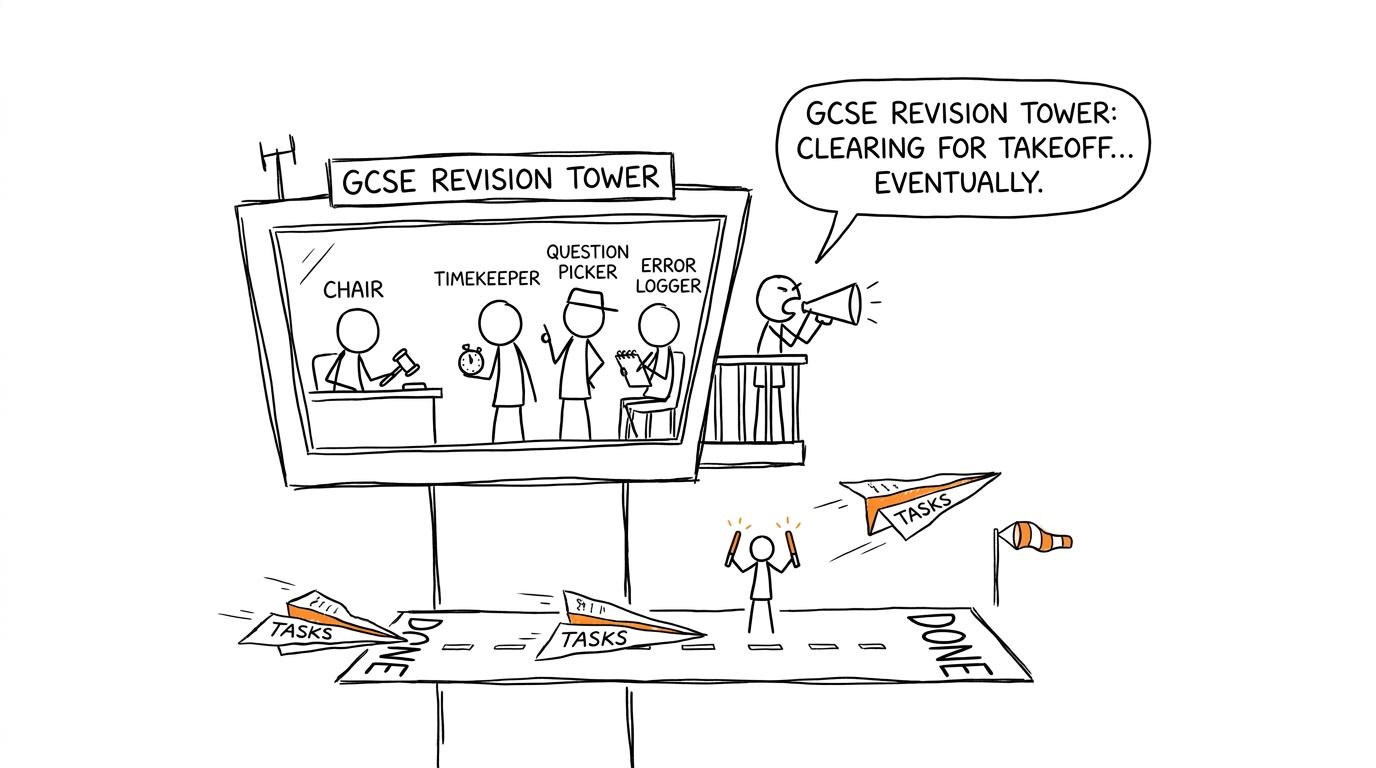 A revision control tower giving every group member a practical role
Rotate practical roles
Assign roles so that responsibility does not drift towards the most confident person:
- Chair: starts the meeting and keeps it on the agreed task.
- Timekeeper: protects speaking and feedback time.
- Question selector: prepares suitable prompts or paper sections.
- Error logger: records recurring vocabulary, grammar and exam-technique gaps.
Rotate these roles each meeting. The chair is not a substitute teacher, and the strongest Arabic speaker should not dominate every correction. Where the group cannot resolve a language question confidently, mark it for a teacher rather than voting on an answer.
Make feedback precise and safe
“Good” does not tell a student what to repeat. “That answer gave an opinion and a reason, but the verb form needs checking” is useful because it identifies both a strength and an action.
Agree that feedback will focus on the response, not the person. Use a simple pattern:
- one feature that communicated meaning effectively;
- one specific error or omission;
- one improvement to attempt immediately.
The immediate retry matters. Correction can feel productive without changing future performance. A second attempt shows whether the feedback has actually been understood.
Keep a shared error log, but let each student maintain an individual version too. Group patterns may reveal a topic worth revisiting, while personal logs prevent confident members from deciding what everyone else needs.
This diagnose-and-repair process is equally important in maths. Use Maths Genie’s guide to finding your weakest GCSE topics, then select targeted lessons and questions from the GCSE maths revision hub.
Use past papers without turning the meeting silent
Past papers reveal the wording, demand and structure of an assessment, but merely completing them is not the whole revision process. Attempt relevant tasks before the meeting, then use group time to compare reasoning, identify evidence, test speaking responses or discuss why marks were lost.
Use only materials appropriate to your current specification and tier. For speaking, practise the relevant task types, but do not assume that rehearsing one memorised answer prepares you for every prompt. Build flexibility by varying follow-up questions and requiring answers that respond to what was actually asked.
The same rule applies to mathematics: the learning happens when you diagnose and repair errors after the attempt. Maths Genie explains the full process in how to use GCSE past papers properly. Students taking Edexcel can use the organised collection of Edexcel GCSE maths past papers and mark schemes, while OCR students can start from the OCR GCSE maths revision hub.
Measure progress without making it competitive
A leaderboard may reward the strongest starting point rather than the greatest improvement. Track behaviours and corrected weaknesses instead.
At the end of each session, record:
- whether the prepared task was completed;
- the main skill practised;
- one recurring mistake;
- the exact action to take before the next meeting;
- whether the same weakness improves when retested.
Once every few meetings, ask whether the group is covering all four skills and whether everyone is speaking, preparing and receiving feedback. If not, change the process rather than blaming motivation.
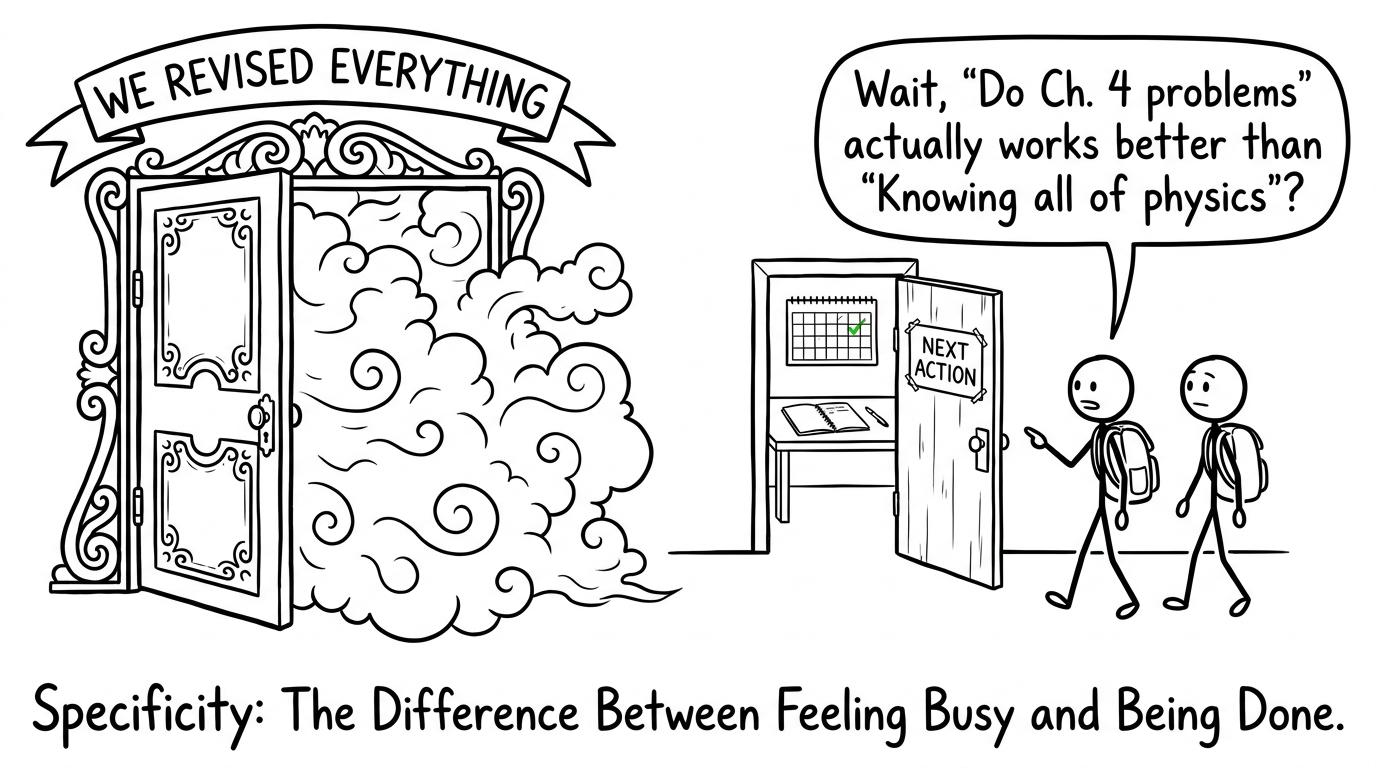 Students choosing a specific next action instead of claiming to have revised everything
Common mistakes that stop study groups working
Waiting until everyone is available
Perfect attendance is rare. Keep a recurring slot and let the meeting proceed when the agreed minimum can attend.
Arriving without a prepared task
The first part of the meeting then disappears into deciding what to do. Publish the resource, skill and expected preparation in advance.
Letting one fluent speaker take over
Fluency can help the group, but it can also reduce everyone else’s retrieval and speaking. Allocate equal turns and rotate leadership.
Correcting answers by confidence
A confident explanation is not automatically accurate. Check the specification, official mark scheme, teacher guidance or an approved reference. Keep unresolved questions on a list.
Spending the meeting making beautiful notes
Notes may support revision, but group time is most valuable for speaking, questioning, comparison and feedback. Create concise records, then return to active practice.
Ignoring other GCSE subjects
An Arabic group should strengthen one part of your timetable, not consume it. Protect independent sessions for maths and your other subjects. Maths Genie brings free maths revision lessons, practice questions, mini tests, mark schemes, video solutions, past papers and predicted papers together, making those sessions easier to plan.
Turn the next message into a real meeting
A successful GCSE Arabic study group is not defined by how active its chat appears. It is defined by what its members can do afterwards that they could not do before.
Choose 333 to 555 reliable people. Fix one recurring slot. Select one precise skill. Give everyone a role. Practise actively, record errors and end with a specific next action. Then repeat the structure until meeting becomes normal rather than negotiable.
For the maths side of your GCSE preparation, open the Maths Genie GCSE revision hub, choose the correct exam board and tier, and build your independent sessions around revision lessons and practice questions. Move on to mini tests, past papers and predicted papers when you are ready to test what has stuck. A good group provides momentum; a good revision system turns that momentum into marks.










