GCSE Arabic Revision Timetable: Worth It?
GCSE Arabic revision timetable worth it? See when a written plan helps, when flexible revision works, and how to keep GCSE maths preparation on track calmly.

A revision timetable can feel productive before you have revised a single word. The colours look organised. The weeks appear manageable. Then Tuesday changes, one session is missed, and the whole plan begins to feel like evidence that you are behind.
So, is a GCSE Arabic revision timetable worth it? Usually, yes, but only when it guides real practice and remains flexible. A timetable does not improve outcomes by itself. Its value comes from helping you space revision, balance listening, speaking, reading and writing, and return to weaknesses. A flexible weekly plan can work just as well as a detailed written timetable if it achieves those things consistently.
That distinction matters when Arabic is only one of several GCSE subjects competing for your time. For students also preparing for maths, the best plan protects regular mathematical practice rather than allowing one demanding subject to take over the week.
The short answer: timetable or flexible revision?
Use this checklist before spending an evening designing a schedule:
- Make a written timetable if you regularly postpone Arabic or forget particular skills.
- Use a flexible weekly plan if your school, family or extracurricular commitments change often.
- Give every session a specific action, such as listening practice or an assessed speaking task.
- Revisit material across several days instead of concentrating it into one long session.
- Include a catch-up space so one missed evening does not break the plan.
- Review your progress weekly and move time towards genuine weaknesses.
- Keep separate, protected sessions for GCSE maths practice.
The format is secondary. The important question is whether the plan changes what you actually do.
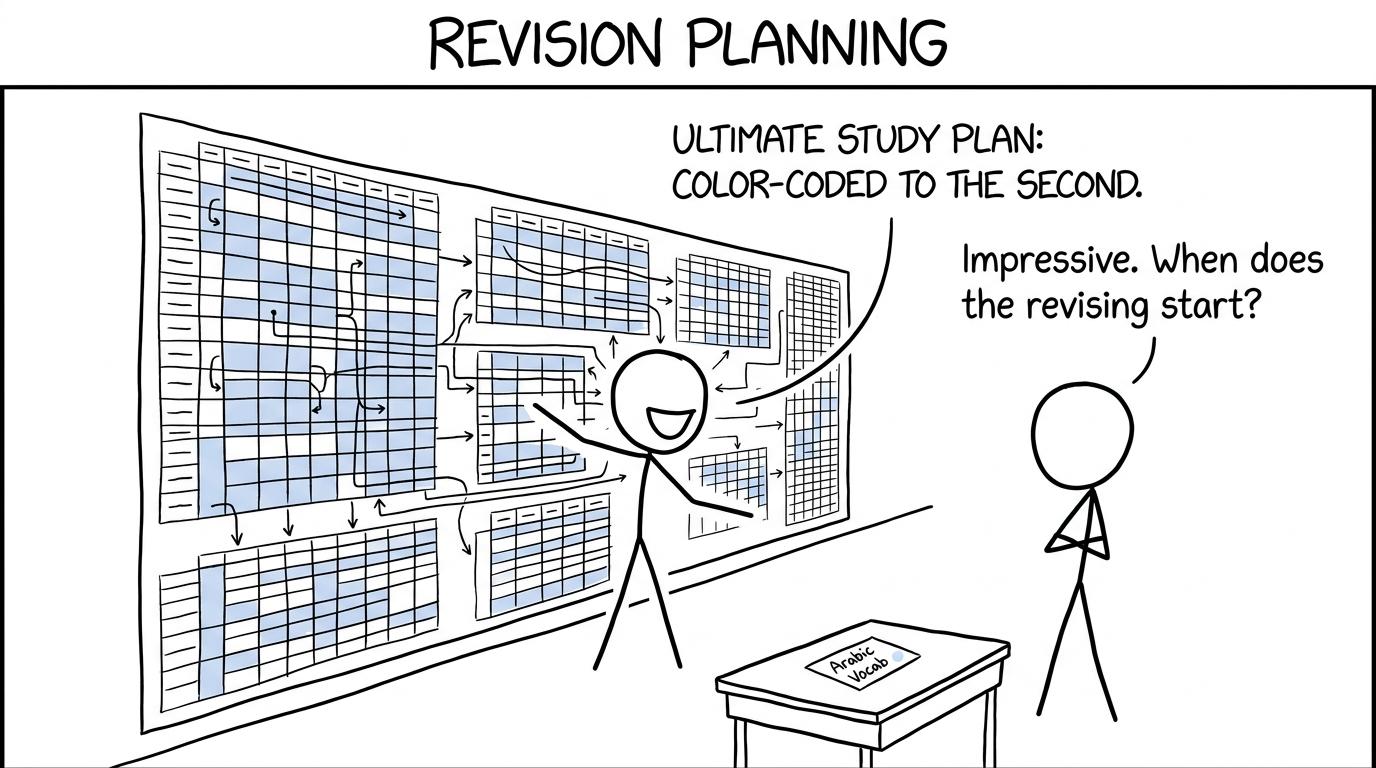 A student discovers that designing a timetable is not the same as revising
What a GCSE Arabic timetable can genuinely change
A useful timetable reduces decisions. Instead of reaching the evening and asking, “What should I revise?”, you already know that today is for listening retrieval and tomorrow is for speaking practice.
This can improve the conditions around learning in three ways.
It gives all four language skills proper attention
For the current Pearson Edexcel GCSE Arabic qualification, listening, speaking, reading and writing are each worth 25%25\%25% of the qualification. Students enter either Foundation or Higher tier across all four papers, rather than mixing tiers.
That equal weighting makes imbalance expensive. A student may enjoy reading Arabic and therefore keep choosing reading tasks, while avoiding spontaneous speaking or listening. A timetable makes that preference visible.
Your plan should therefore contain recurring opportunities to:
- understand spoken Arabic without relying immediately on a transcript;
- answer and develop ideas aloud;
- read for overall meaning, detail and opinion;
- produce accurate written Arabic under appropriate time limits;
- practise translation in the directions required by the specification.
Check the exact qualification entered by your school. GCSE Arabic and International GCSE Arabic are not interchangeable: their papers, skill weightings and assessment structures differ.
It creates spacing rather than cramming
Research on learning consistently supports spacing practice over time and retrieving information from memory. A timetable can make those methods more likely because it places repeated encounters with vocabulary, grammar and exam skills on different days.
But the timetable is only the container. Writing “Arabic revision” in four boxes achieves little if every session becomes passive rereading. More useful tasks require you to recall vocabulary without notes, respond to an unfamiliar prompt, listen before checking a transcript or rewrite an answer after feedback.
It makes progress easier to monitor
Effective independent revision involves planning, monitoring and evaluating. Educational evidence on metacognition supports teaching students to use that cycle within normal curriculum work.
A weekly plan can prompt three practical questions:
- Plan: Which skill or topic needs attention?
- Monitor: Can I complete the task without excessive support?
- Evaluate: What should I repeat, change or ask my teacher about?
This is why a timetable should be revised after practice. If it never changes in response to evidence, it is a calendar rather than a learning tool.
When flexible revision works just as well
A detailed timetable is not compulsory. There is no good basis for claiming that simply owning a written schedule guarantees a stronger grade.
Flexible revision can be equally effective when it contains firm priorities. Instead of assigning every task to an exact hour, you might set weekly commitments:
- two short vocabulary retrieval sessions;
- one listening session;
- one speaking session with recorded or live responses;
- one reading or translation task;
- one extended writing task followed by correction;
- one catch-up slot.
You then complete those tasks when your week allows. This approach is especially sensible if your school deadlines, caring responsibilities, health or travel make fixed evenings unreliable.
The danger is confusing flexibility with vagueness. “Revise Arabic when possible” is not a flexible plan because it has no minimum commitment, task or review point. A flexible system still needs boundaries.
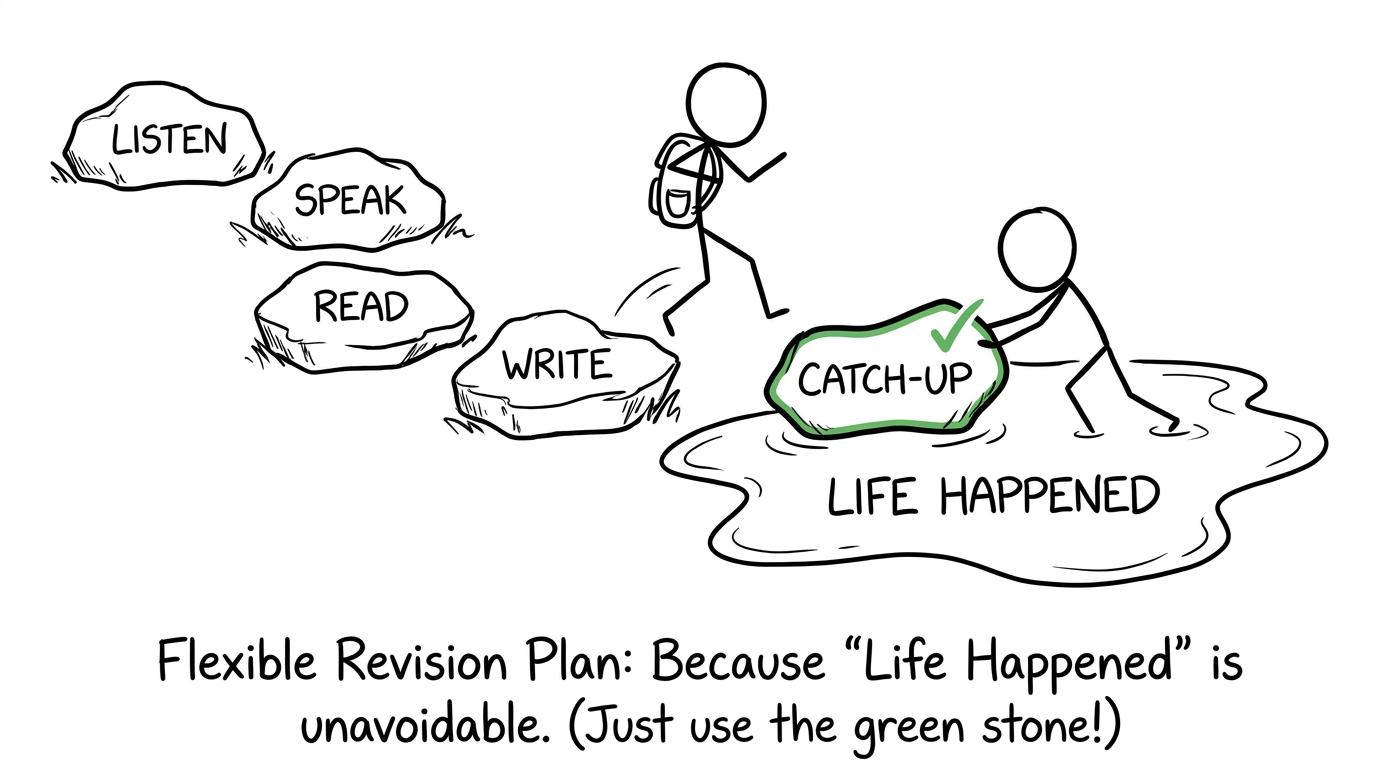 A catch-up slot rescues a flexible revision week when life changes
How to build a timetable you will actually follow
The best timetable is rarely the most detailed one. It is the one that survives an ordinary week.
Start from assessment evidence
Do not allocate time according to which topics feel important. Use teacher feedback, marked assessments and specimen or past-paper tasks to identify where performance breaks down.
For Arabic, separate the problem precisely. “Listening is bad” is difficult to act on. “I miss opinions when speakers use unfamiliar vocabulary” gives you a target. In writing, distinguish between limited content, grammatical accuracy, vocabulary range and failure to answer every part of the task.
The same principle strengthens maths revision. MathsGenie’s guide to finding your weakest GCSE topics explains how marked work can become a practical priority list rather than just a score.
Plan actions, not subject labels
Replace “Arabic” with a task that has a visible finish line. For example:
- retrieve vocabulary from one theme;
- complete one listening task and record missed details;
- answer speaking prompts without a script;
- plan and write one exam-style response;
- correct yesterday’s errors from memory.
Do the same for maths. “Complete a mini test and review every lost mark” is far stronger than “revise algebra”. The GCSE Maths revision hub provides lessons, practice questions and exam-board resources, while GCSE mini tests make short sessions easier to define.
Build around minimums, priorities and catch-up time
Give each week three layers:
- Minimum: the small amount you can complete even during a difficult week.
- Priority: extra work directed at the weakest current skill.
- Catch-up: unallocated time for missed or unexpectedly difficult tasks.
This avoids the all-or-nothing trap. Missing Wednesday no longer means abandoning the entire schedule; the task moves to the catch-up slot or the next appropriate session.
Maths students can adapt the structure in MathsGenie’s GCSE maths revision timetable guide or use the more focused one-month GCSE revision plan when exams are close.
Review the plan once a week
At the end of the week, ask:
- Which sessions were completed?
- What became easier?
- Which mistake appeared again?
- Was the planned workload realistic?
- What should receive more or less time next week?
Keep the review brief. Its purpose is to improve the following week, not to produce another elaborate document.
Keeping GCSE maths on track alongside Arabic
Language revision benefits from frequent contact, while maths requires repeated problem-solving and feedback. Both can disappear if they are left for “when there is time”.
Protect maths by placing a few non-negotiable sessions into the week first. Use the appropriate Edexcel, AQA, OCR or Eduqas resources for your exam board and match practice to Foundation or Higher tier.
A balanced maths cycle could include topic learning, independent questions, marking and later retesting. When you are ready for full exam practice, follow the guide to using GCSE past papers properly. Edexcel students can go directly to the Edexcel GCSE Maths past papers, including mark schemes and available worked solutions.
The broader lesson applies to both subjects: revision should produce evidence. In Arabic, that evidence might be a recording, corrected translation or marked writing task. In maths, it might be a completed mini test, an error log or improved paper score.
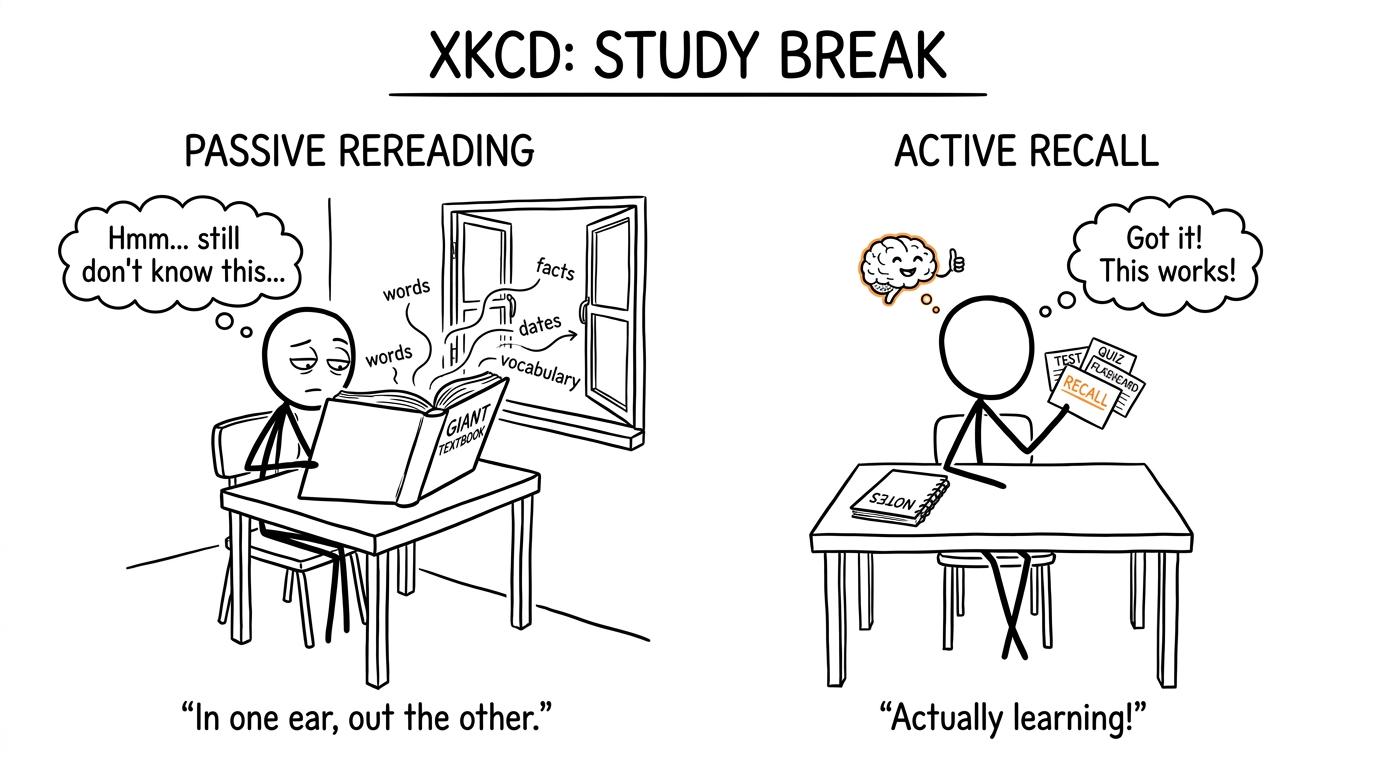 Active recall keeps knowledge at the desk instead of letting it escape
Common mistakes with GCSE Arabic revision timetables
Spending longer designing than revising
A timetable is valuable only when it leads to action. Keep the design plain enough that you can begin the first task immediately.
Scheduling every free minute
Plans without rest or catch-up time assume that every week will go perfectly. That makes a single disruption feel like failure. Leave deliberate space.
Revising favourite skills repeatedly
Comfort creates a misleading sense of progress. Use assessment evidence to distribute time across listening, speaking, reading and writing, then give extra attention to the weakest area.
Listing subjects instead of tasks
“Arabic for one hour” does not tell you what success looks like. Define the output and how you will check it.
Relying on passive review
Rereading vocabulary and model answers can support understanding, but it should not dominate. Close the notes, retrieve, respond, check and correct.
Ignoring the specification
Make sure your resources match the qualification, tier and current assessment structure used by your school. Do not assume that GCSE Arabic and International GCSE Arabic have the same requirements.
Letting the timetable become a judgement
A missed session is information, not a verdict. Move the task, reduce an unrealistic workload or change the time of day. The plan works for you, not the other way around.
The verdict: make a plan, not a monument
A GCSE Arabic revision timetable is worth making when it balances the assessed skills, spaces practice and removes daily uncertainty. It is not automatically better than flexible revision. A clear weekly checklist with minimum commitments, specific tasks and regular review can produce the same useful structure.
Choose the lightest system that keeps you consistent. Test it for a week, review what actually happened and adjust it. Above all, protect time for your other subjects.
For maths, make MathsGenie’s free GCSE resources your revision base. Use revision lessons to rebuild methods, practice questions to develop accuracy, mini tests to retrieve skills, and past papers, predicted papers, mark schemes and video solutions to prepare for the real exam. Your timetable does not need to look perfect. It needs to keep bringing you back to the work that earns marks.