GCSE Arabic Paper 1: What to Actually Expect
GCSE Arabic Paper 1 explained: timings, sections, question types and a calm listening strategy for Foundation and Higher tier exam preparation.
The unsettling thing about a listening exam is that the words disappear. On a reading paper, you can return to a difficult sentence. In GCSE Arabic Paper 1, the recording moves on whether you understood it or not.
But the paper is more predictable than it first feels. Under the current Pearson Edexcel GCSE Arabic specification, Paper 1 is the listening examination. It lasts 35 minutes at Foundation tier or 45 minutes at Higher tier, including five minutes of reading time. It is worth 505050 marks and 25%25\%25% of the qualification.
You hear each passage twice and answer multiple-response or short-answer questions. The real challenge is not writing sophisticated Arabic. It is recognising exactly which detail, opinion, time frame or conclusion the question requires.
GCSE Arabic Paper 1 at a glance
Before refining your listening, make sure you understand the shape of the examination.
| Feature | Foundation tier | Higher tier |
|---|---|---|
| Paper code | 1AA0/1F | 1AA0/1H |
| Total time | 35 minutes | 45 minutes |
| Reading time | Five minutes | Five minutes |
| Marks | 505050 | 505050 |
| Qualification weighting | 25%25\%25% | 25%25\%25% |
| First section | Questions and instructions in English | Questions and instructions in Arabic |
| Second section | Questions and instructions in Arabic | Questions and instructions in English |
| Main question styles | Multiple-response and short-answer | Multiple-response and short-answer |
Both tiers assess understanding of standard spoken Arabic in public and social settings. Recordings can include male and female speakers, and every passage is played twice. You must answer all questions in both sections.
This structure is specific to Pearson Edexcel GCSE Arabic, specification 1AA0. Do not assume that “Paper 1” means the same skill in another language qualification, an International GCSE or an A Level course. Check the code on your own entry information and use current materials supplied by your school.
What is actually different about Paper 1?
Paper numbers can create false familiarity. In GCSE maths, Paper 1 may indicate a non-calculator examination for boards such as Edexcel or AQA. In Edexcel GCSE Arabic, Paper 1 means listening and understanding.
There is no speaking performance, extended writing task or translation passage on this paper. You are being assessed on what you can extract from spoken language: the overall message, key details, opinions, relationships between ideas and whether events happened in the past, are happening now or will happen later.
That makes the paper less about displaying everything you know and more about selecting evidence under time pressure. A student may understand most of a recording yet lose a mark by giving the speaker's first plan rather than the final decision. Another may miss several unfamiliar words but still earn the mark by identifying the relevant opinion.
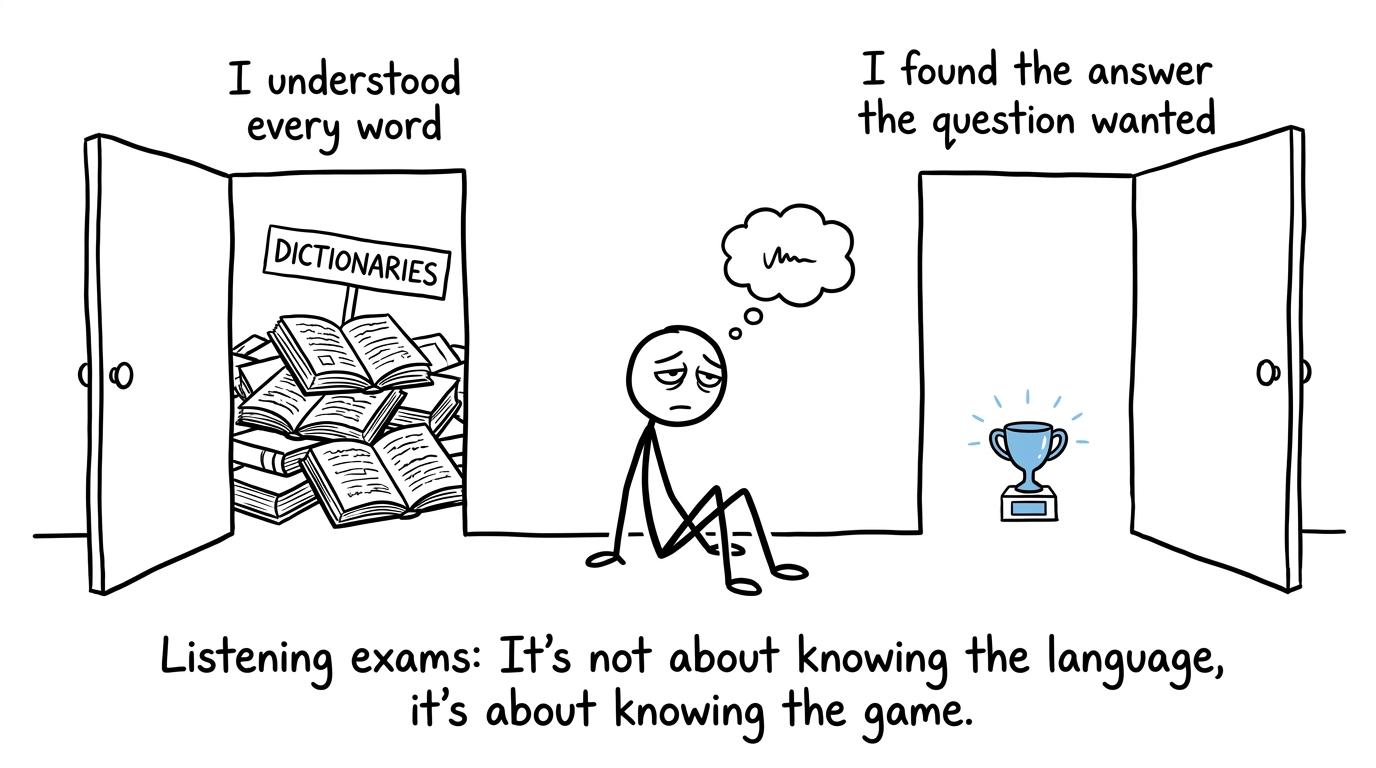 A student choosing between understanding every word and finding the required answer
How the five minutes of reading time work
You receive five minutes to read through the question paper before the first extract begins. You may make notes during this period.
Those minutes are not a waiting room. They are part of the assessment strategy.
Use them to:
- identify where the paper changes between English and Arabic questions;
- read the instructions and determine the required response format;
- underline names, places, times and opinion words in the questions;
- notice how many separate details each question requires;
- predict the topic and likely vocabulary without inventing an answer;
- mark any question where a contrast or change of plan may matter.
If a question asks why somebody changed their mind, you already know that the recording may contain an initial view, a reason and a final view. That prediction helps you organise what you hear. It does not tell you the answer, but it gives the answer somewhere to land.
This habit is transferable across subjects. Before beginning a timed maths paper from the GCSE maths revision hub, strong candidates also inspect the instructions, tier and mark allocation before committing to a method.
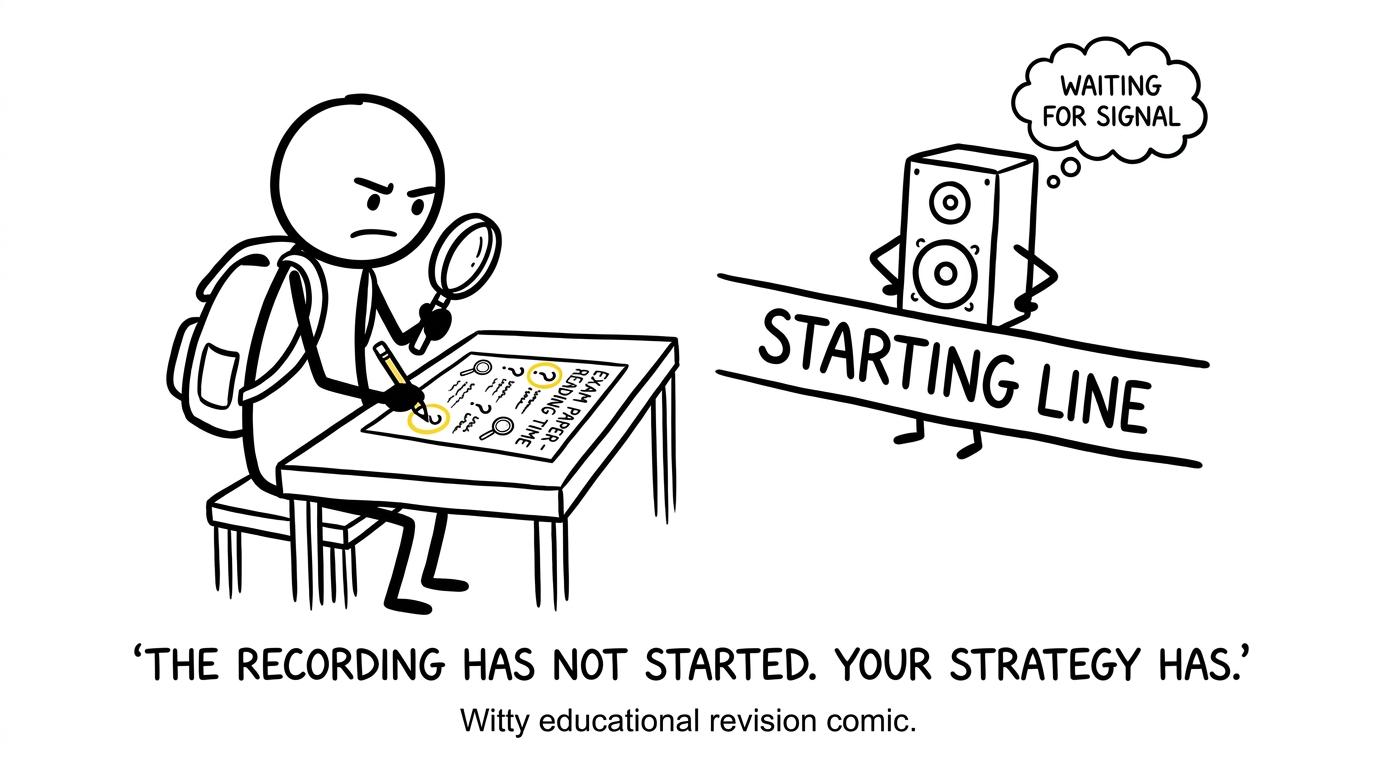 A student using reading time like a detective before the audio begins
The question types Paper 1 favours
Multiple-response questions
These may ask you to select a correct option, match information to speakers or identify several statements. They test discrimination: can you separate what was actually said from an option that merely contains familiar vocabulary?
Distractors often sound plausible because they reuse a word from the recording. Listen for the full meaning rather than matching isolated words. Negatives, comparisons and changes of opinion can reverse an otherwise convincing answer.
Short-answer open-response questions
These require brief, precise information. The number of marks shown is a useful signal: if two distinct details are required, one vague statement is unlikely to be enough.
The specification does not require extended written responses in Arabic on Paper 1. Nevertheless, follow the wording and response format printed on the paper. Your job is to communicate the requested information clearly, not to reproduce an entire sentence from the recording.
Questions about opinions and conclusions
Paper 1 can move beyond simple factual retrieval. You may need to recognise approval, disappointment, preference, uncertainty or a reason behind a decision. Higher-tier material is more likely to demand inference, although all students should be ready to distinguish fact from opinion.
A useful mental question is: “What evidence in the recording makes this answer true?” If your choice is based only on hearing the same noun, it may be a distractor.
Questions involving time
The assessment can test relationships between past, present and future events. Revise tense markers and time expressions as listening cues, not just as grammar rules.
A speaker may describe what they used to do, what they do now and what they intend to do next year. The vocabulary may be familiar throughout, yet the mark depends on attaching the correct action to the correct time.
What topics can appear?
Paper 1 draws vocabulary and structures from across the specification rather than one special “listening” topic. The five broad themes are:
- identity and culture;
- local area, holiday and travel;
- school;
- future aspirations, study and work;
- international and global matters.
Public and social contexts can therefore include family life, celebrations, technology, local facilities, journeys, education, employment or environmental concerns. Topic lists help you organise vocabulary, but the paper rewards flexible understanding rather than memorised paragraphs.
The Foundation and Higher papers cover the same broad themes. The difference lies in the linguistic demand, pace appropriate to the tier, complexity of ideas and amount of inference expected. You must be entered for one tier across all four GCSE Arabic papers, so confirm your tier with your teacher rather than choosing different practice materials from week to week.
A two-hearing strategy that works
Every passage is recorded twice, with pauses that allow you to write and prepare for what follows. Treat the two hearings as different jobs.
On the first hearing
Build the map. Identify the speakers, setting, main subject and broad attitude. Add brief notes beside the relevant question, but do not let one missing word block the rest of the passage.
If you already have a likely answer, mark it lightly. Keep listening in case the speaker corrects, contrasts or qualifies the first statement.
On the second hearing
Verify the evidence. Focus on gaps, uncertain choices, negatives, quantities, reasons and final decisions. Complete the response while the relevant detail is fresh.
This is more reliable than trying to transcribe everything. Working memory is limited, and a page full of hurried notes can hide the one fact the question requests.
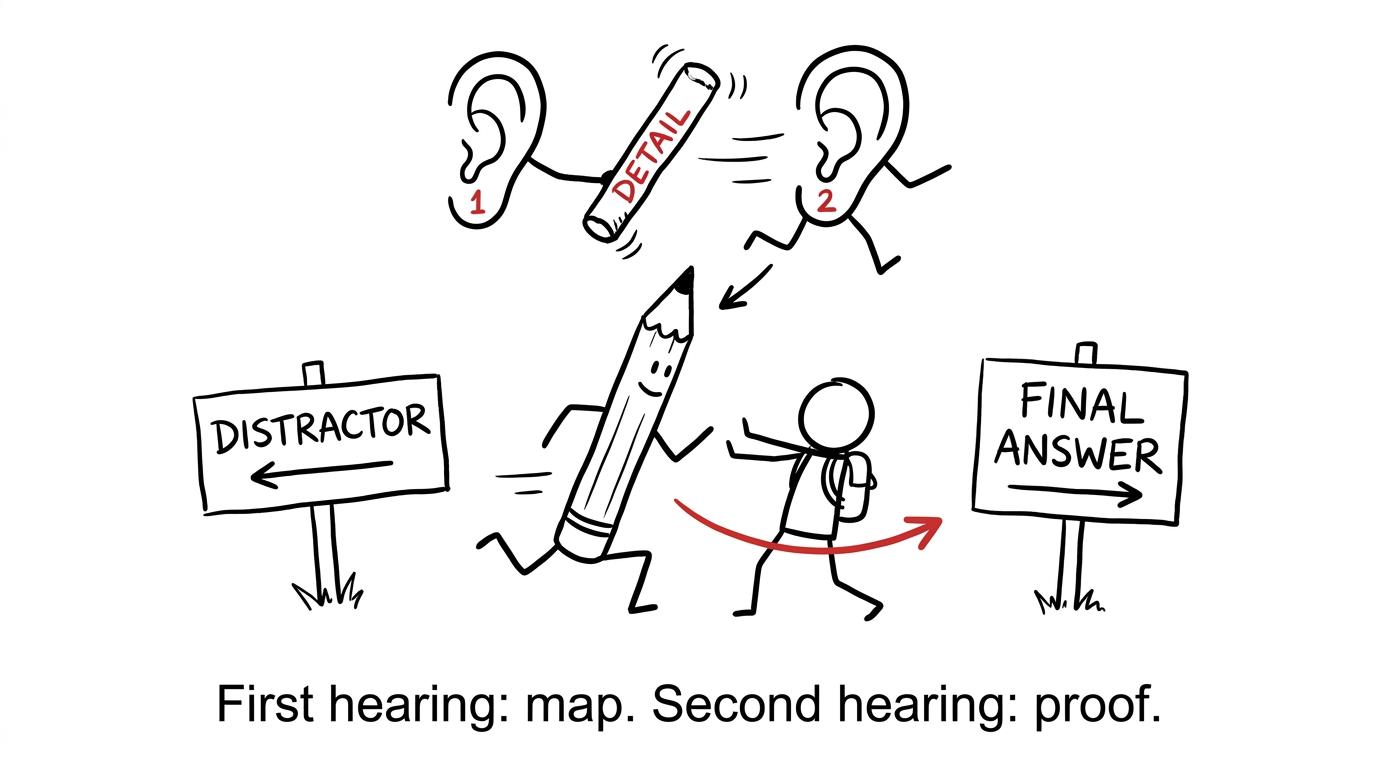 Two ears passing a detail to a pencil while avoiding a distractor
How to revise for the listening paper
Vocabulary revision matters, but silent vocabulary recognition is not enough. You need to recognise words at natural speed, inside sentences and alongside unfamiliar material.
Build each practice session around a short cycle:
- preview the questions under a strict time limit;
- hear the extract without pausing;
- answer using the first-hearing and second-hearing strategy;
- mark the paper carefully;
- classify each error;
- listen again only after committing to an answer;
- record the phrase or listening feature that would have unlocked the mark.
Your error categories might include unknown vocabulary, tense confusion, missed negative, distractor, misunderstood question, spelling ambiguity or loss of concentration. That diagnosis is more valuable than writing down only a score.
The same attempt-mark-fix-repeat loop is central to using GCSE past papers properly. MathsGenie's GCSE mini tests can help you build the wider habit of short, honest retrieval rather than passive rereading.
For Arabic, prioritise official Pearson Edexcel listening papers, audio files and mark schemes provided through your school or the awarding body. Then schedule them in a realistic revision routine. The principles in the MathsGenie GCSE revision timetable guide transfer well: use manageable sessions, mark promptly and revisit mistakes rather than repeatedly choosing comfortable material.
Common mistakes on GCSE Arabic Paper 1
Trying to understand every word
One unfamiliar word can attract all your attention while the answer passes by. Return to the question and listen for the information category you need: person, reason, place, opinion, activity or time.
Choosing an option because one word matches
A repeated keyword is not proof. The surrounding sentence may contain a negative, comparison or rejected suggestion. Match meanings, not sounds.
Treating both hearings identically
If you simply repeat the same listening behaviour, uncertainty often remains. Use the first hearing for orientation and the second for confirmation.
Ignoring the final opinion
Speakers may change their minds. Notes such as “at first”, “however” and “in the end” can help you track the direction of the message.
Giving too much information
An overlong answer creates opportunities for contradiction. Give the exact detail requested and ensure separate marks receive separate, clear points.
Practising without the audio
Reading transcripts improves vocabulary but does not recreate a listening examination. Practise with uninterrupted recordings and the real pause structure before using a transcript to diagnose errors.
Recording scores but not causes
A score tells you where you are. An error log tells you what to do next. This is why MathsGenie places so much value on pairing past papers and mark schemes rather than treating paper completion as the finish line.
Make Paper 1 feel familiar
The recording will always move forward. Your preparation should make that feel normal rather than threatening.
Know the timings. Use the five-minute preview deliberately. Read for the required detail, give each hearing a purpose and learn the examiner's accepted answers through mark schemes. Most importantly, practise recovering after uncertainty. One missed phrase does not decide a 505050-mark paper.
MathsGenie does not replace your official Arabic specification or listening audio, but it can anchor the rest of your GCSE preparation. Use the free GCSE maths revision lessons and practice questions, build speed with mini tests, review real papers with worked solutions and use GCSE predicted papers as an additional pressure test.
Good revision is rarely dramatic. It is a calm loop: attempt, mark, understand, repeat. Begin your next listening paper with that loop in mind, then carry the same discipline into every GCSE exam you sit.