GCSE Arabic Grade Boundaries Year to Year
GCSE Arabic grade boundaries year to year can shift noticeably. Compare Edexcel marks from 2022 to 2025, learn why they move and revise safely today.
A boundary can look like a promise when you are revising: reach this mark and the grade is yours. But historical boundaries are records, not guarantees. Looking at GCSE Arabic grade boundaries year to year, the short answer is that they sometimes move noticeably. In Pearson Edexcel Arabic, the largest one-year change between June 2022 and June 2025 was 121212 marks on higher tier and 242424 marks on foundation tier.
That does not mean grading suddenly became harsher. Grade boundaries move so that the standard of work represented by each grade remains comparable when papers differ in difficulty. The useful response is not to predict the next boundary exactly, but to understand the historical range and build a sensible safety margin into your revision target.
The quick answer and checklist
Here is what students should know first:
- The latest complete summer boundaries available at the time of writing are from June 2025.
- This article analyses Pearson Edexcel GCSE Arabic specification 1AA01AA01AA0.
- The qualification has a maximum total of 280280280 marks.
- Higher-tier boundaries moved by up to 121212 marks in a single year from 2022 to 2025.
- Foundation-tier boundaries were less steady, with a largest one-year movement of 242424 marks.
- Boundaries are set after the assessments have been taken and marking is nearly complete.
- A previous boundary is useful context, not a prediction for your examination.
- Your safest target is several marks above the recent boundary range.
You can inspect the complete figures on the Edexcel GCSE Arabic grade boundaries page.
How much have GCSE Arabic boundaries actually changed?
Pearson Edexcel GCSE Arabic is assessed through listening, speaking, reading and writing. Each skill contributes 25%25\%25% of the qualification, and grades are awarded from the combined subject total rather than as separate formal grades for each paper.
The following tables show the overall June boundaries. They should not be confused with notional component boundaries, which may be published to help interpret performance on individual papers but do not determine the final qualification grade.
Higher-tier boundaries from 2022 to 2025
| Year | Grade 999 | Grade 888 | Grade 777 | Grade 666 | Grade 555 | Grade 444 | Grade 333 |
|---|---|---|---|---|---|---|---|
| 2022 | 228228228 | 200200200 | 173173173 | 144144144 | 115115115 | 878787 | 737373 |
| 2023 | 219219219 | 192192192 | 166166166 | 141141141 | 116116116 | 929292 | 808080 |
| 2024 | 225225225 | 196196196 | 168168168 | 146146146 | 124124124 | 103103103 | 929292 |
| 2025 | 237237237 | 208208208 | 179179179 | 156156156 | 134134134 | 112112112 | 101101101 |
The movement was not identical at every grade. From 2024 to 2025, for instance, the grade 999 and grade 888 boundaries each rose by 121212 marks, while the grade 333 boundary rose by 999 marks.
Across the full 2022 to 2025 period, the lowest and highest grade 999 boundaries were 219219219 and 237237237, a range of 181818 marks. At grade 444, the range was wider: from 878787 to 112112112, or 252525 marks.
Yet the biggest movement from one year directly to the next at any listed higher-tier grade was 121212 marks. As a proportion of the 280280280 available marks, that is:
12280×100≈4.3%\frac{12}{280}\times 100\approx 4.3\%28012×100≈4.3%That is large enough to matter, but not a reason to panic. It is a reason not to build your revision plan around scraping one historical boundary exactly.
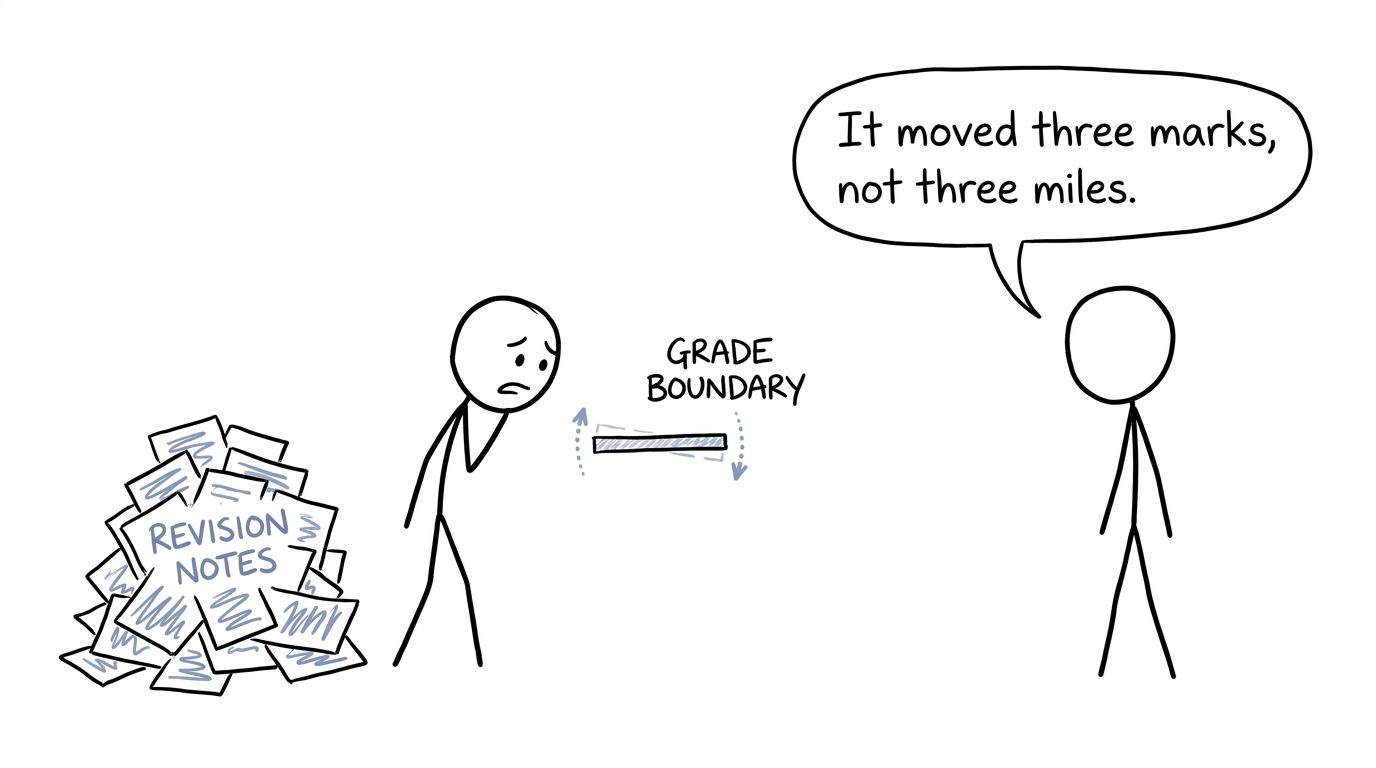 A student watches a grade boundary move slightly while the revision pile stays still
Foundation-tier boundaries from 2022 to 2025
| Year | Grade 555 | Grade 444 | Grade 333 | Grade 222 | Grade 111 |
|---|---|---|---|---|---|
| 2022 | 142142142 | 101101101 | 828282 | 646464 | 464646 |
| 2023 | 137137137 | 112112112 | 898989 | 666666 | 444444 |
| 2024 | 158158158 | 136136136 | 109109109 | 828282 | 555555 |
| 2025 | 164164164 | 144144144 | 110110110 | 777777 | 444444 |
Foundation tier shows why the honest answer is more nuanced than “boundaries only move a few marks”. Between 2023 and 2024, the grade 444 boundary increased from 112112112 to 136136136, a change of 242424 marks. That represents approximately:
24280×100≈8.6%\frac{24}{280}\times 100\approx 8.6\%28024×100≈8.6%Other movements were much smaller. From 2024 to 2025, the grade 333 boundary changed by only 111 mark, while the grade 111 boundary fell by 111111 marks. Boundaries at different grades do not have to move in parallel.
Overall, recent higher-tier movement has been more contained than foundation-tier movement. However, four examination series are not enough to support a reliable forecast. They show what happened, not what must happen next.
Why GCSE Arabic grade boundaries move
Ofqual’s guidance explains that grade boundaries are set once marking is nearly complete. Exam boards use statistical evidence about the cohort and the assessment, while senior examiners examine work around proposed boundaries and compare its quality with work from previous years.
The central aim is stable standards. Every new paper contains different questions, so it cannot be guaranteed to have precisely the same difficulty as an earlier paper. If students generally find an assessment harder, a lower raw-mark boundary may be needed. If they find it easier, the boundary may rise.
This leads to three important conclusions.
A higher boundary does not mean a higher standard
Suppose a boundary rises. That does not automatically mean the exam board has demanded better Arabic or decided that fewer students should receive the grade. It usually reflects evidence that the assessment produced higher raw marks for work of a comparable standard.
Likewise, a low boundary is not an “easy route” to a grade. It may indicate that the paper was more demanding.
There is no fixed quota for each grade
Ofqual states that there is no cap on how many students can receive a particular grade. Cohort information forms part of the evidence used when boundaries are considered, but the final aim is to maintain the meaning of grades over time rather than impose a simple pass or fail quota.
Exact boundaries cannot be known in advance
The necessary evidence does not exist until students have taken the assessments and most marking has been completed. Any predicted boundary published beforehand is therefore an estimate.
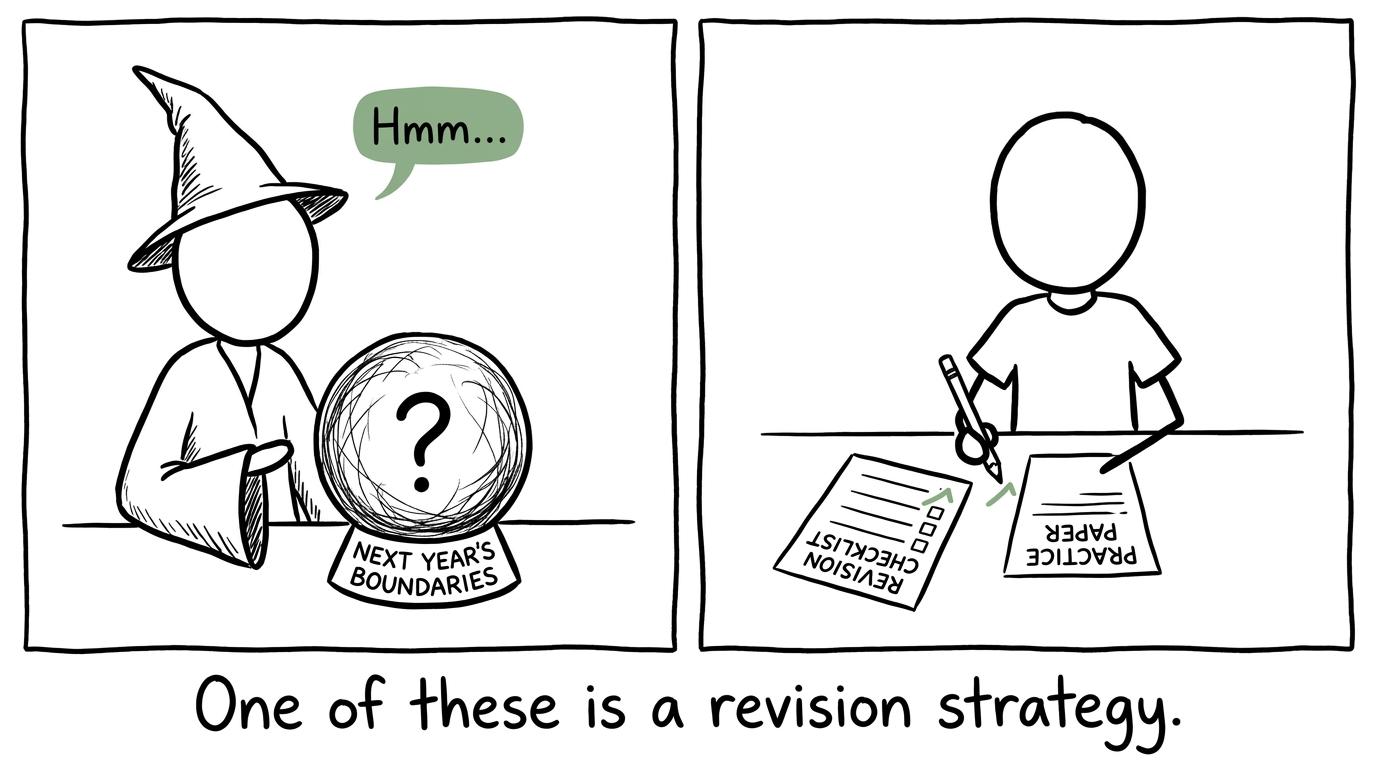 A fortune teller tries to predict boundaries while a student follows a revision checklist
For a broader explanation of the process, read how GCSE grade boundaries work. On results day, the GCSE grade boundary table guide will help you match the correct subject, tier and examination series.
What this means for a student preparing for maths
You may be taking Arabic as one GCSE while spending much of your revision time on maths. The transferable lesson is important: do not treat last year’s boundary as this year’s target.
Boundaries for Arabic cannot be copied across to maths, and boundaries from Edexcel cannot be applied to AQA, OCR or Eduqas. The papers have different maximum marks, specifications and levels of difficulty. Even percentages do not prove that one board is easier than another.
Start by checking your own board and tier through the GCSE Maths revision hub. If you take Edexcel, the historical figures are collected on the Edexcel GCSE Maths grade boundaries page.
The most productive use of an old boundary is diagnostic. Compare a timed-paper score with several recent boundaries, not just one. Then ask:
- Is the mark consistently above the recent range for my target grade?
- Which topics are repeatedly costing me marks?
- Are errors caused by missing knowledge, weak method, timing or misreading?
- Can I repeat the performance on an unfamiliar paper?
A single score just above an old boundary is fragile. Several timed scores above a range are stronger evidence of readiness.
Build a safety margin instead of predicting one mark
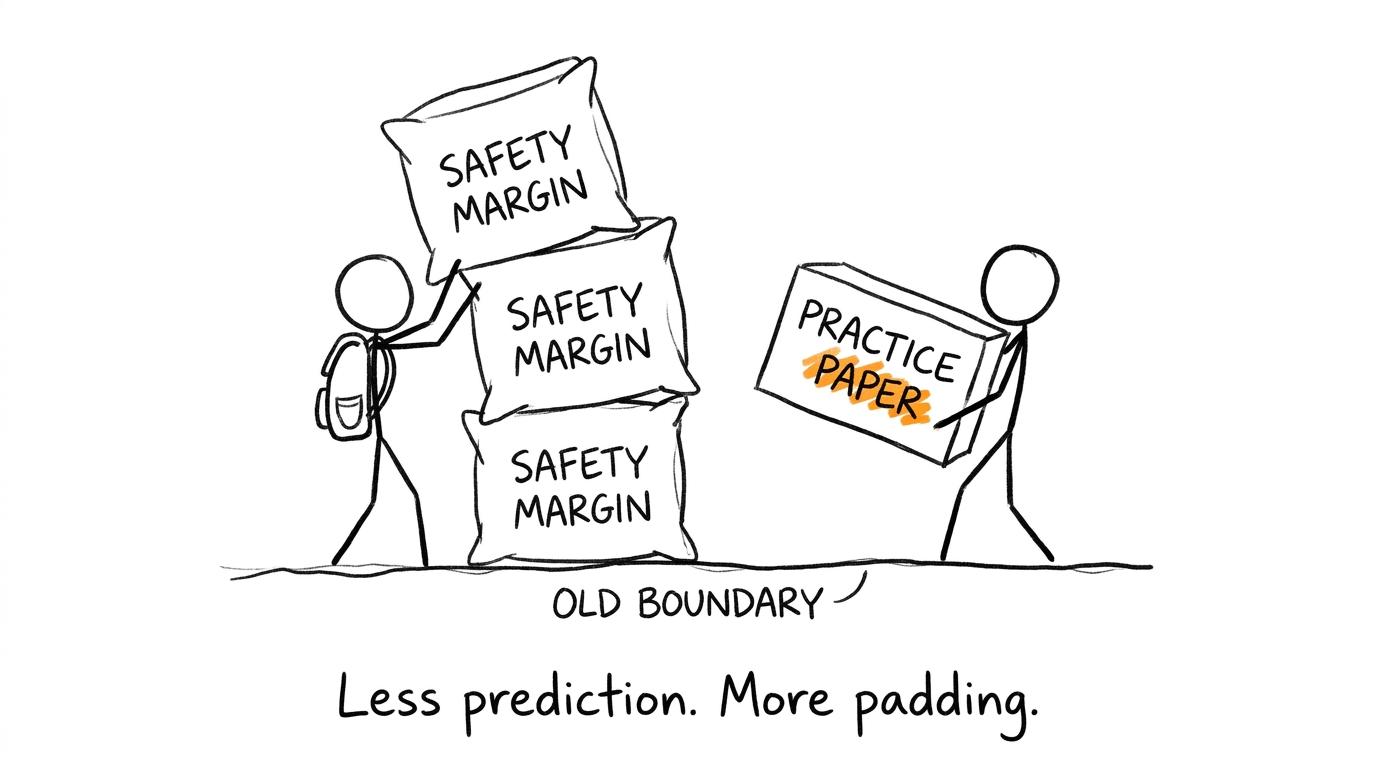
A safety margin is not an official rule. It is a practical revision choice. If your chosen historical boundary is bbb and your personal margin is mmm, your working target becomes:
T=b+mT=b+mT=b+mThe value of mmm should reflect recent variation, your consistency and the time remaining. It should not be a random promise that a particular mark will guarantee a grade.
Use MathsGenie’s guidance on when to start past papers, then record your total marks under timed conditions. Follow each paper with revision lessons and practice questions for the topics that lost marks. Nearer the examinations, Edexcel GCSE Maths predicted papers can provide fresh practice, but they should complement rather than replace official past papers.
 A student builds a revision safety margin above an old boundary
Common mistakes when reading Arabic grade boundaries
Using the wrong qualification
GCSE Arabic, International GCSE Arabic and A Level Arabic are different qualifications. Always confirm the qualification title, specification code and maximum mark before comparing figures.
Mixing higher and foundation tiers
Foundation and higher have separate boundaries and different available grade ranges. A foundation-tier mark should not be interpreted using the higher-tier table.
Treating a component boundary as a final grade
For this linear qualification, the overall subject total determines the final grade. Notional paper boundaries do not create separate certified grades for listening, speaking, reading or writing.
Assuming the 2025 boundary will repeat
The 2025 figures describe the 2025 assessments. They cannot confirm the boundary for a later series because that boundary depends on new evidence.
Comparing raw marks across unrelated subjects
A mark out of 280280280 in Arabic cannot be compared directly with a maths mark from a qualification carrying a different total. Always use the correct board, subject, tier and series.
Turn uncertainty into useful revision
GCSE Arabic boundaries do change from year to year. Between 2022 and 2025, higher-tier boundaries moved by no more than 121212 marks in any single year, while foundation tier produced a larger maximum movement of 242424 marks. So the movement is usually manageable, but it can be substantial enough to punish a target based on one old table.
The calmer strategy is to control what can be controlled: knowledge, accuracy, timing and the number of marks you can earn consistently. For maths, begin with MathsGenie’s free revision lessons, practise with topic questions and mini tests, and then test yourself using past papers, mark schemes, video solutions and predicted papers. If you need a clear structure, follow the GCSE one-month maths revision plan.
Historical boundaries tell you where yesterday’s line was. Good revision gives you enough room that tomorrow’s line matters less.