

GCSE Arabic Grade 9 Meaning: Skills and Old Grades
GCSE Arabic grade 9 meaning explained: discover the ability it represents, how it compares with old A* grades and which language skills matter most.
The difference between a grade 888 and a grade 999 can feel strangely mysterious. Both are excellent. Both suggest strong subject knowledge. Yet one sits alone at the top of the GCSE scale.
The GCSE Arabic grade 9 meaning is straightforward in principle: it is the highest available grade and represents exceptional performance across listening, speaking, reading and writing. It is not simply a renamed A*. Nor does it certify perfect Arabic or guarantee complete fluency. It shows that, in that examination series, your combined mark reached the highest grade boundary on the Higher tier.
For students balancing Arabic with GCSE maths, science and other subjects, understanding that distinction matters. A clear target is easier to revise towards than a mysterious number.
GCSE Arabic grade 9 meaning at a glance
A grade 999 means that you have:
- achieved the highest grade available in the GCSE;
- taken the Higher tier, because Foundation tier does not offer grade 999;
- performed exceptionally well across the complete qualification, rather than receiving a grade for one isolated paper;
- demonstrated secure understanding of complex spoken and written Arabic;
- communicated detailed ideas effectively in speech and writing;
- used a broad range of vocabulary and grammatical structures with strong accuracy;
- performed above the level represented by the bottom of the old grade A range.
The important phrase is across the complete qualification. A brilliant writing paper cannot entirely replace weak listening, just as one strong GCSE maths paper cannot erase difficulties across the rest of the assessment.
Is a grade 9 in GCSE Arabic equivalent to an A*?
Not exactly.
England replaced the old A* to G scale with grades 999 to 111. Official comparison points align the bottom of grade 777 with the bottom of the old grade A, the bottom of grade 444 with the bottom of the old grade C, and the bottom of grade 111 with the bottom of the old grade G.
At the upper end, grades 777, 888 and 999 collectively cover the performance previously represented by grades A and A*. The numerical scale was deliberately designed to create more differentiation among the strongest candidates.
A useful interpretation is:
- grade 777 begins around the old grade A comparison point;
- grade 888 represents performance within the former A and A* region;
- grade 999 identifies the strongest performance at the top of that region.
Calling grade 999 a “high A*” is convenient shorthand, but it is not an official one-to-one conversion. There was no separate old letter grade with precisely the same boundary or meaning. Grade 999 is a new top grade, not merely A* with a different label.
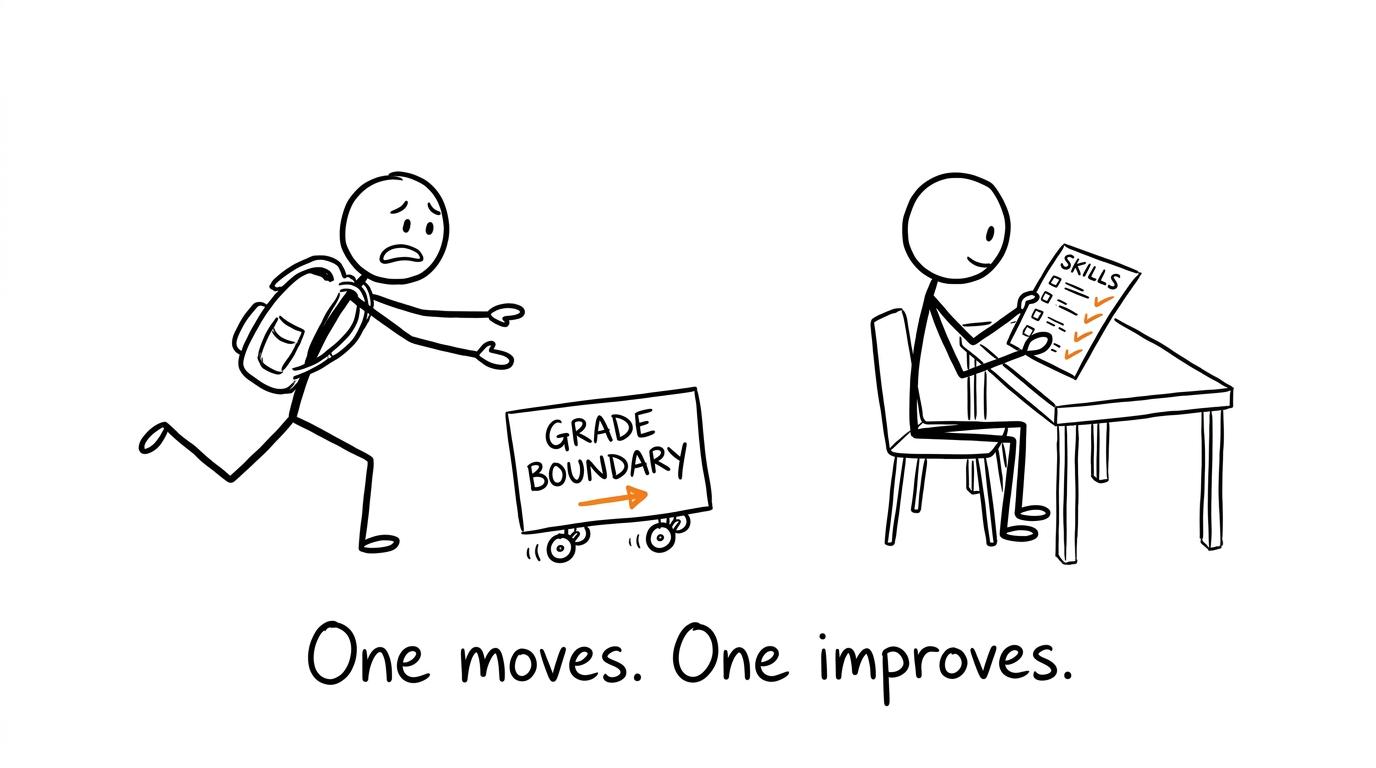 A student choosing between chasing a moving grade boundary and improving real skills
What ability does a grade 9 actually represent?
The current Pearson Edexcel GCSE Arabic qualification assesses four skills: listening, speaking, reading and writing. Each contributes 25%25\%25% of the qualification, so each deserves serious revision time.
Ofqual's modern foreign language descriptors provide detailed indications at grades 222, 555 and 888, rather than a separate full checklist for grade 999. The grade 888 descriptor is therefore a useful starting point for understanding top-level performance. A grade 999 reflects even stronger evidence across most or all of those demanding skills.
Listening beyond recognising vocabulary
At the highest level, listening is not a word-spotting exercise. Students need to follow more complex and extended passages, extract precise information, recognise speakers' opinions and draw conclusions.
That may involve understanding an implied attitude rather than waiting for a familiar phrase. Less familiar vocabulary should not cause the whole passage to collapse. Strong candidates use context, tone and surrounding language to preserve meaning.
Speaking with detail and spontaneity
Top performance in speaking means sustaining communication rather than delivering a memorised paragraph and hoping the questions match it.
Students should be able to develop ideas, justify opinions and respond effectively when a question is phrased unexpectedly. Pronunciation and intonation should be mostly accurate, while vocabulary and grammar should be varied enough to discuss different time frames and viewpoints.
This distinction matters for fluent or heritage speakers. Everyday confidence can be a major strength, but the examination also rewards task fulfilment, linguistic range, accuracy and structured development. Natural conversation alone does not automatically produce grade 999 marks.
Reading for inference as well as facts
A grade 999 candidate should cope confidently with extended and comparatively complex texts. That includes identifying opinions, distinguishing important details and inferring meanings that are not stated directly.
Translation also requires precision. A response can sound natural in English but still lose marks if it omits a qualification, changes a tense or reverses the writer's meaning.
Writing with control
High-level writing combines communication with control. Students need to answer the exact task, explain ideas, justify opinions and manipulate vocabulary and grammar effectively.
Complexity helps only when it remains understandable. A shorter, accurate sentence can be more valuable than an ambitious construction that obscures the intended meaning. Grade 999 performance normally shows range, but it also shows judgement about when and how to use that range.
How the GCSE Arabic assessment creates the final grade
Pearson Edexcel GCSE Arabic uses four compulsory papers covering the four language skills. The speaking assessment is conducted in the centre and externally assessed; the other papers assess listening, reading and writing. Students complete the qualification in one examination series and must be entered for the same tier across all papers.
The tier decision is crucial:
- Foundation tier offers grades 111 to 555;
- Higher tier offers grades 444 to 999, with a possible grade 333 for a mark narrowly below the grade 444 boundary under the qualification rules.
Therefore, a student aiming for grade 999 must be entered for Higher tier. Confirm this with your school rather than assuming your Arabic tier matches your maths tier.
Your final grade comes from the combined subject mark. Individual-paper boundaries published for analysis may be described as notional; they do not create four separate GCSE grades. What counts on results day is the overall qualification result.
Grade boundaries are set after the papers have been taken and can change between examination series. This protects standards when papers vary in difficulty. It also explains why copying last year's grade 999 mark and treating it as a guaranteed target is unreliable.
The wiser target is consistently excellent performance, with enough margin to absorb an unfamiliar listening extract or a difficult writing task.
What a grade 9 does not mean
Sometimes a grade becomes larger in the imagination than it is on the certificate. It helps to be precise.
A grade 999 does not mean:
- every response was perfect;
- the student achieved full marks;
- the student is equally fluent in every Arabic dialect;
- the qualification is a complete measure of real-world fluency;
- the result can be converted automatically into a particular international language level;
- a native or heritage speaker will receive it without examination preparation.
GCSE Arabic assesses performance against a defined specification and mark schemes. That is meaningful, but narrower than measuring everything someone knows about a language, its literature or its cultures.
How maths students can revise for two high grades
Aiming high in Arabic while preparing for GCSE maths can create a familiar problem: every subject feels urgent, so revision becomes reactive. One evening disappears into vocabulary. The next goes entirely to algebra. Neither subject receives a reliable feedback loop.
The solution is not an heroic timetable. It is a repeatable one.
MathsGenie's guide to building a realistic GCSE maths revision timetable can help you protect regular maths sessions while leaving clear space for language practice. On busy school days, the 20-minute maths revision routine keeps key methods active without consuming the whole evening.
For Arabic, use a parallel structure:
- retrieve vocabulary and grammar without notes;
- complete one focused listening, speaking, reading or writing task;
- mark it or obtain feedback;
- record the precise weakness;
- revisit that weakness on another day.
For maths, start from the GCSE maths revision hub, where you can select your exam board and work through revision lessons, practice questions and papers. If you are unsure where marks are leaking, use the process in finding your weakest GCSE topics.
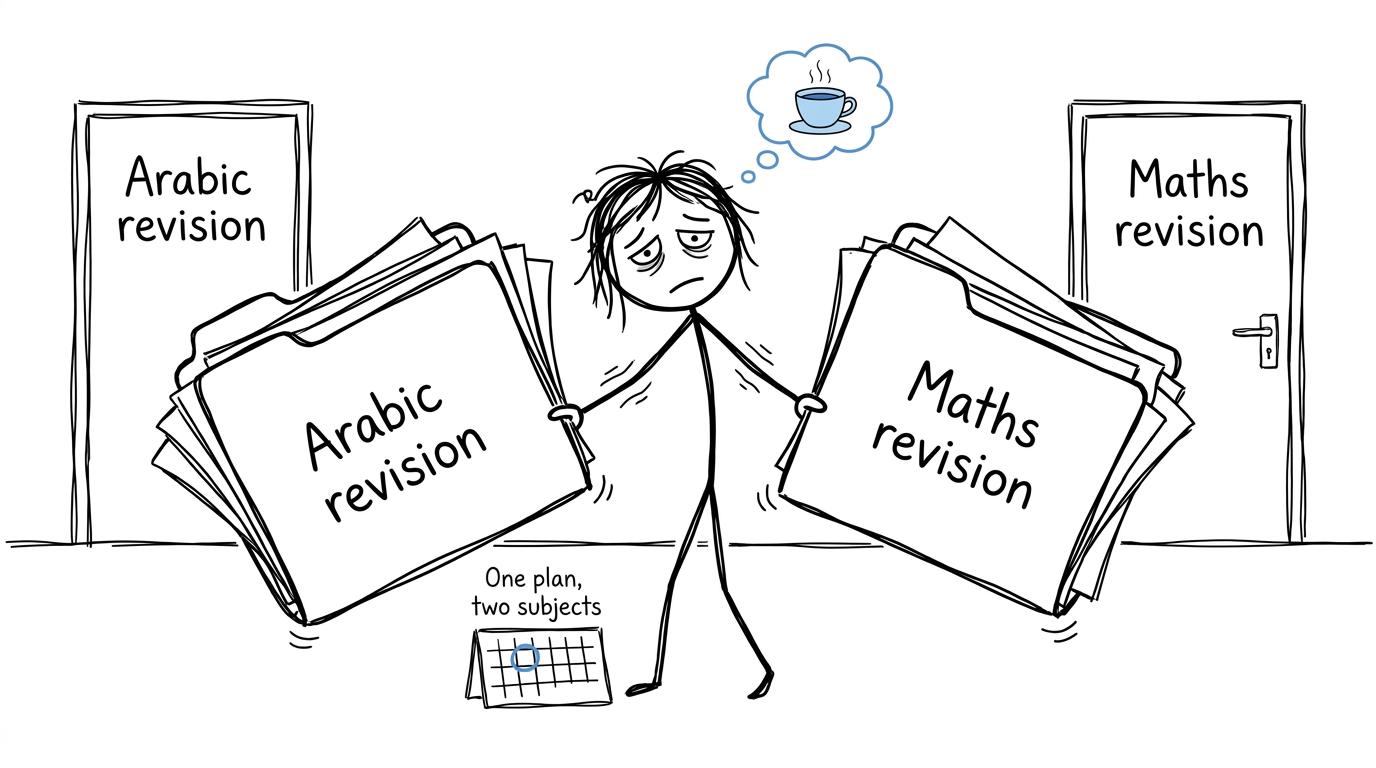 A student calmly balancing Arabic and maths revision folders using one simple plan
A practical grade 9 revision checklist
Use evidence rather than confidence to decide whether you are approaching top-grade performance:
- Can you understand extended speech without relying on isolated familiar words?
- Can you identify attitudes and implied meaning?
- Can you answer unpredictable speaking questions naturally?
- Can you justify opinions rather than merely state them?
- Can you move between past, present and future contexts accurately?
- Can you read for detail and inference?
- Can you translate without adding, omitting or distorting meaning?
- Can you produce coherent extended writing that answers every part of the task?
- Have you practised under realistic time conditions?
- Are you correcting repeated errors rather than simply completing more material?
The same evidence-led thinking improves maths revision. Learn how to use GCSE past papers properly, then decide when to introduce regular past-paper practice. Near the examination, GCSE predicted papers can provide further timed maths practice, but they should support specification coverage rather than replace it.
Common mistakes when interpreting or chasing grade 9
Treating grade 9 as an exact A* replacement
It belongs at the top of the scale, but there is no exact one-to-one letter conversion. Grades 777 to 999 provide finer differentiation across the old A and A* region.
Assuming fluency guarantees the grade
The examination rewards performance on particular tasks. Fluent speakers can still lose marks through incomplete answers, weak translation, limited formal writing or insufficient grammatical accuracy.
Ignoring one of the four skills
Because listening, speaking, reading and writing each carry 25%25\%25%, repeatedly avoiding a weaker skill creates a serious ceiling on the overall result.
Revising to last year's boundary
Boundaries move because paper difficulty changes. Previous boundaries are useful context, not promises about the next examination series.
Confusing activity with improvement
Reading notes, watching videos and highlighting vocabulary can feel productive. Improvement becomes visible only when you retrieve, answer, mark and correct. Maths revision works in the same way: follow a sensible order for learning GCSE maths topics, then test whether each method survives an unfamiliar question.
Aim for the performance, not the label
A grade 999 in GCSE Arabic represents exceptional examination performance across four distinct language skills. It sits above the old grade A comparison point and distinguishes achievement at the highest end of the former A and A* range, but it is not an exact renamed A*. More importantly, it reflects a pattern of ability: understanding complexity, communicating with detail, responding spontaneously and using language with accuracy and control.
That pattern is built one correction at a time.
For the maths part of your GCSE journey, make MathsGenie's free GCSE revision resources your starting point. Use revision lessons to rebuild weak methods, practice questions and mini tests to check them, then past papers, predicted papers, mark schemes and video solutions to make your performance dependable under pressure. The grade comes later. First, build the evidence that you are ready for it.










