

GCSE Arabic Careers: Jobs Where It Helps
GCSE Arabic careers explained: discover jobs and apprenticeships where Arabic is valued, what the grade proves, and skills to build for future work.
The careers adviser asks what you are good at. You mention Arabic, then maths, and wonder whether the first answer sounds relevant to a real job. It does, but probably not in the way a qualification title alone suggests.
The honest answer about GCSE Arabic careers is that the qualification can strengthen applications for language services, intelligence, international business, aviation, travel, public services and community-facing work. It can also distinguish you in apprenticeships involving customers, overseas suppliers or multilingual communities. However, GCSE Arabic is normally evidence of potential rather than a professional licence. The careers where Arabic matters most usually expect greater fluency, specialist training or another skill alongside it.
That combination is where the opportunity becomes interesting.
The short answer: where can GCSE Arabic help?
A good GCSE Arabic grade may be noticed when you apply for:
- language, translation or interpreting courses
- intelligence and security careers
- diplomatic and wider Civil Service work
- international business, finance and logistics
- travel, tourism, aviation and hospitality roles
- healthcare, social care and community services
- journalism, research and international development
- technology, data and Arabic-language localisation
- customer service apprenticeships serving multilingual communities
- business, digital, finance and public service apprenticeships with an international element
It will not usually qualify you to become a professional translator or interpreter immediately. Instead, it tells an employer, college or apprenticeship provider that you have developed communication skills and have begun building knowledge of another language and culture.
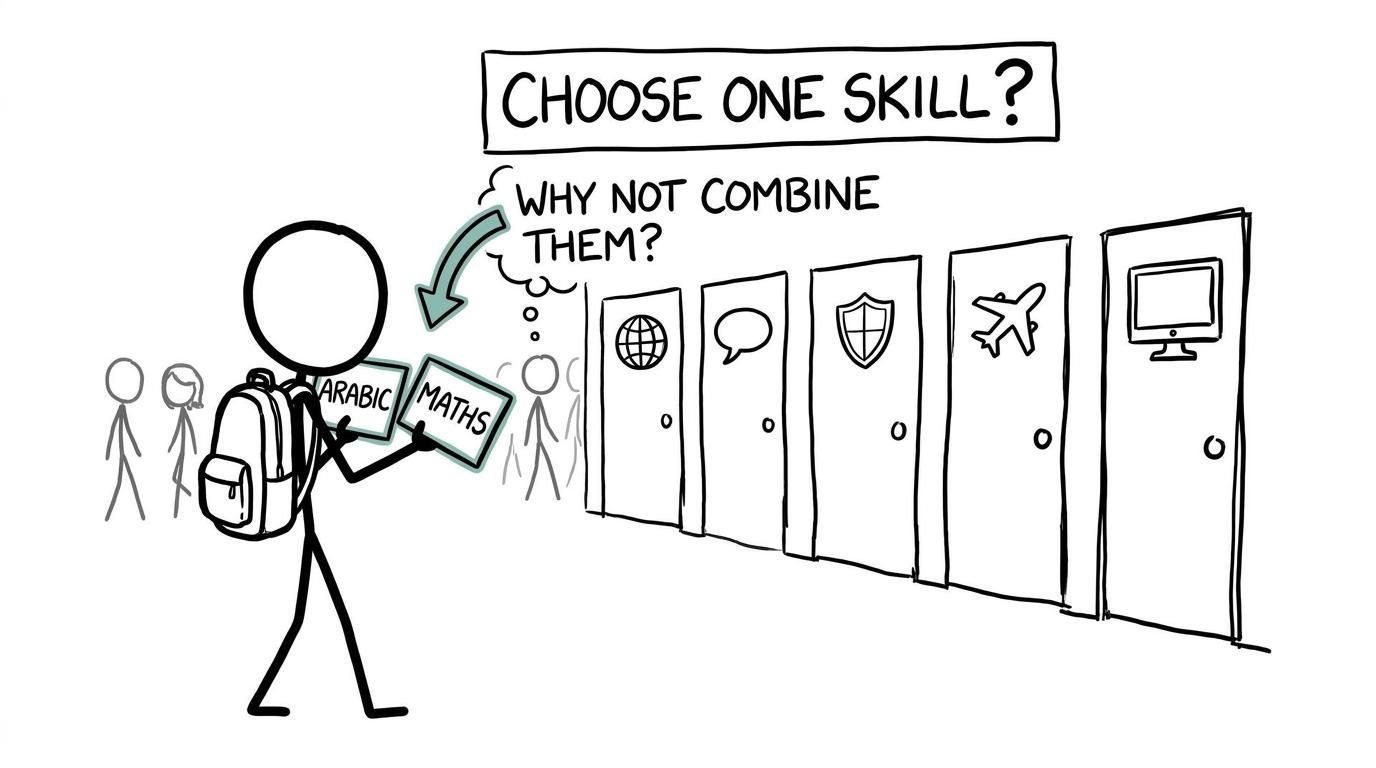 A student combining Arabic and maths at a careers fair
What does a good GCSE Arabic grade actually prove?
The Pearson Edexcel GCSE Arabic qualification assesses listening, speaking, reading and writing. Those four areas matter because workplace language is not just vocabulary recall. You may need to understand a caller, explain an idea clearly, read a document and produce an accurate written response.
A higher grade can therefore provide evidence of:
- sustained language learning
- attention to detail
- written and verbal communication
- memory and careful preparation
- willingness to understand another culture
- the ability to switch between different forms of information
There is no universal grade at which employers suddenly consider Arabic valuable. Grades 777 to 999 can provide particularly strong academic evidence, while grades 444 to 666 still demonstrate a recognised qualification and useful foundations. Your actual speaking, listening and writing ability will matter more as a role becomes increasingly language-focused.
This is important for bilingual students too. Speaking Arabic at home can be a substantial strength, but a GCSE gives you formal evidence to place on an application. Conversely, achieving a high grade does not automatically mean you are ready to interpret a legal hearing or translate a technical contract. Professional settings require accuracy, judgement and subject-specific vocabulary.
Careers where Arabic is the main professional skill
Translation and interpreting
Arabic is among the languages identified as being used by translation services in National Careers Service guidance. Translators work primarily with written material, while interpreters communicate spoken or signed meaning between people.
Possible settings include:
- business and technical translation
- healthcare and community interpreting
- courts and public services
- conferences and international organisations
- media subtitles and digital content
GCSE Arabic is a useful beginning, not the final qualification. Professional translators commonly develop advanced fluency through a degree, postgraduate course or professional qualification. Interpreting routes can include university, college and specialist professional training. Excellent English is also essential because conveying meaning accurately depends on both languages.
Arabic includes different regional varieties as well as Modern Standard Arabic. A future employer may need a particular dialect, so being precise about the Arabic you understand and use is better than simply writing “fluent” without explanation.
Intelligence and security
UK intelligence organisations employ language specialists who analyse, translate and contextualise foreign-language material. Current GCHQ careers information explains that formal qualifications are not always required for language specialist roles, but applicants need strong practical proficiency and cultural understanding. Recruitment can also involve language assessment, eligibility rules and security vetting.
A GCSE will not by itself demonstrate the proficiency required. It can, however, mark the beginning of a pathway combining Arabic with:
- analytical thinking
- politics or international relations
- cyber security
- computing and communications technology
- research and report writing
This is one area where Arabic and maths can complement each other particularly well. Maths develops structured reasoning; language study develops interpretation and sensitivity to context. Intelligence work may require both.
Diplomacy and international public service
Diplomatic work involves much more than speaking another language. Policy, negotiation, economics, careful writing and cultural awareness all matter. Some government employees receive intensive language training for overseas postings, so Arabic is not necessarily an entry requirement for every diplomatic role.
Still, GCSE Arabic can make your interest in the region more credible, particularly if you continue the language and combine it with history, economics, politics, law or maths. It shows that your international interest is supported by sustained effort rather than a sentence added to a personal statement.
Careers where Arabic gives you an advantage
For many students, the most realistic benefit is not a job called “Arabic speaker”. It is becoming an accountant, analyst, engineer or customer adviser who can also communicate in Arabic.
International business, finance and logistics
Businesses operating across borders need people who understand customers, suppliers and markets. Arabic may be useful in roles involving the Middle East and North Africa, including:
- sales and account management
- banking and financial services
- procurement and supply chains
- shipping, freight and logistics
- market research
- compliance and customer support
Maths becomes valuable here because finance, pricing, forecasting and data analysis depend on quantitative confidence. If that combination appeals to you, keep your core skills secure through the GCSE maths topics by exam board and tier.
Aviation, travel and hospitality
Airlines, airports, hotels and travel businesses serve people from many linguistic backgrounds. Arabic can help in customer-facing work, particularly when it makes a traveller feel understood during a complicated or stressful moment.
Employers will still look for reliability, clear English, teamwork and customer service. Language ability is usually an advantage alongside these qualities rather than a replacement for them.
Healthcare and community services
Arabic can support communication in hospitals, councils, charities, housing services and community organisations. Yet knowing a language does not automatically make someone a qualified interpreter. Sensitive conversations may involve medical terminology, confidentiality or legal consequences, so organisations may require trained interpreters.
The useful distinction is simple: Arabic may help you build trust and understand communities, while professional interpreting requires additional competence and responsibility.
Technology, data and localisation
Technology companies need people who can test Arabic interfaces, review content, understand regional users and help adapt products for different markets. Careers can include localisation, content operations, user research, software testing and data analysis.
Arabic combined with computing or strong maths is often more powerful than either skill presented alone. You become someone who can understand the language, examine the system and communicate what needs changing.
Apprenticeships where GCSE Arabic may get noticed
Arabic is rarely the standard entry requirement for an apprenticeship. Employers are more likely to specify English and maths, alongside requirements that vary by programme. Read every vacancy carefully rather than assuming that one employer’s rules apply everywhere.
Your Arabic grade may still strengthen applications for:
- customer service apprenticeships
- business administration
- travel consultancy and aviation operations
- digital marketing and content work
- accountancy and financial services
- supply chain and logistics
- public service operational delivery
- IT, data and cyber security
The best place to mention it is where it solves an employer’s problem. If the organisation serves Arabic-speaking customers, works with overseas partners or produces international content, explain that connection in your application.
Do not merely state the grade. Add honest evidence: the language skills assessed, any continuing study, the variety of Arabic you use and situations in which you can communicate confidently.
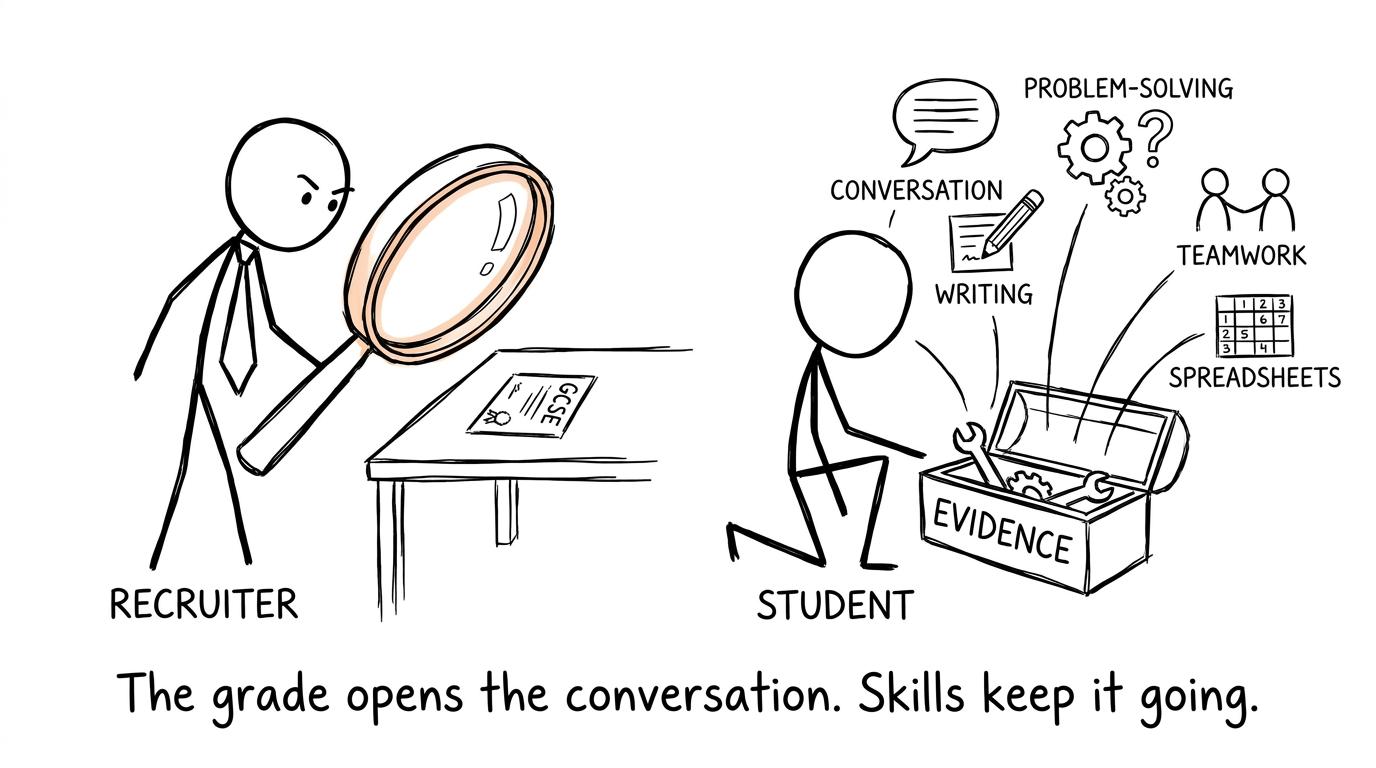 A recruiter looking beyond the certificate to the student's skills
Why Arabic and maths make a strong combination
Students sometimes imagine that choosing a direction means abandoning unrelated strengths. Careers are rarely so tidy. An employer may need a person who can analyse a spreadsheet and speak to a customer, or understand data and explain its meaning across cultures.
Arabic plus maths can support routes into:
- international banking and accountancy
- economics and market analysis
- engineering projects overseas
- aviation operations
- data and technology
- intelligence analysis
- logistics and supply-chain planning
That is why your GCSE maths preparation still matters, even while you explore language-based careers. Begin by finding genuine gaps with MathsGenie’s guide to identifying your weakest GCSE topics, then use Edexcel GCSE maths mini tests for short, focused checks.
How to turn GCSE Arabic into career evidence
A qualification becomes more persuasive when it is followed by action.
Keep developing the language
Consider A Level or another recognised language route if it is available and suitable. Read and listen widely, develop formal written Arabic and learn about regional varieties. Never exaggerate your fluency; accurate descriptions build trust.
Add a second useful skill
Choose according to the career rather than collecting qualifications at random. That might mean maths, computing, economics, business, politics, law or a relevant vocational course.
Research actual vacancies
Look at live job and apprenticeship descriptions. Record which qualifications, technical skills and levels of language proficiency appear repeatedly. Vacancy availability and entry requirements change, so current listings are more reliable than a general careers list.
Protect your core GCSE results
English and maths are commonly important for progression, including many apprenticeships and post-161616 courses. Build a manageable timetable using the GCSE one-month maths revision plan, then move into timed practice at the right stage. The guide to when to start GCSE past papers can help you pace this sensibly.
For Edexcel students, GCSE maths past papers with mark schemes provide realistic practice. Students taking AQA, OCR or Eduqas should use resources matching their own board and tier.
Common mistakes when planning GCSE Arabic careers
Assuming the GCSE guarantees fluency
It proves assessed achievement at GCSE level. Professional language work usually demands much more extensive practical ability.
Searching only for jobs with “Arabic” in the title
The larger opportunity may be a mainstream career where Arabic differentiates you. Search by sector as well as language.
Ignoring English and maths requirements
A language advantage cannot compensate for every missing entry requirement. Check each course, apprenticeship or job specification carefully.
Treating all Arabic as identical
Employers may need Modern Standard Arabic or a particular regional dialect. Describe your abilities precisely.
Claiming interpreting ability without training
Informal communication and professional interpreting are not the same. Medical, legal and public service settings can require specialist qualifications and strict standards.
Letting career research replace exam preparation
Planning feels productive, but your immediate task is still to earn the strongest results you reasonably can. If the exam is close, use a calm GCSE maths night-before checklist rather than attempting to relearn the entire specification.
Your next step with MathsGenie
GCSE Arabic can open a door, but combinations create careers. Arabic with customer service can support travel. Arabic with policy can lead towards public service. Arabic with maths, data or computing can become valuable in finance, technology, logistics and intelligence.
Start by choosing two or three career areas and checking their current entry routes. Then protect the qualifications those routes commonly require. MathsGenie gives you free revision lessons, practice questions, mini tests, past papers, predicted papers, mark schemes and video solutions so that career planning does not come at the expense of exam marks.
Choose your exam board and tier, repair one weak maths topic today, and let your Arabic become part of a broader, credible set of skills.










