

GCSE Arabic 5 to 8: A Practical Grade Plan
GCSE Arabic 5 to 8: discover what separates the grades, improve all four language skills and build a focused, examiner-led revision plan.
A grade can become a label surprisingly quickly. Get a grade 5 in a mock and it is easy to assume that grade 5 is simply where you belong. It is not. It is evidence of how you performed on one set of tasks, on one day, with your current habits.
Moving from GCSE Arabic 5 to 8 requires more than memorising extra vocabulary. You need stronger comprehension, more developed answers, better control of grammar and the ability to use Arabic independently under pressure. Most importantly, you must improve across listening, speaking, reading and writing rather than relying on one comfortable skill.
This guide focuses on Pearson Edexcel GCSE Arabic (1AA0)(1AA0)(1AA0). Check your own specification and tier with your teacher before building your revision plan.
Your grade 5 to grade 8 checklist
The practical changes are clear:
- confirm that you are preparing for Higher tier
- diagnose marks lost in all four papers
- learn vocabulary through active recall and context
- develop opinions with reasons and details
- control past, present and future references
- practise unfamiliar listening and reading material
- speak without depending entirely on memorised scripts
- write under timed conditions and edit systematically
- use mark schemes to identify what higher-level responses do
- retest weaknesses instead of merely rereading notes
A grade 8 is not built by making every answer elaborate. It is built by knowing when detail, precision, inference and independent language are required.
Understand how GCSE Arabic is assessed
In Edexcel GCSE Arabic, listening, speaking, reading and writing are each worth 25%25\%25% of the qualification. All four papers are compulsory, and your final grade is based on your total subject mark rather than separate grades for each paper.
That balance matters. A student who enjoys speaking but avoids listening practice is leaving a quarter of the qualification exposed.
Foundation and Higher papers are available, but students must take the same tier across all four components. Foundation tier does not award grades above grade 5, so a grade 8 target requires Higher-tier entry. Discuss this with your teacher rather than changing your practice materials independently.
Grade boundaries also change between exam series. In June 2025, the official Higher-tier Edexcel Arabic boundary was 134134134 out of 280280280 for grade 5 and 208208208 for grade 8. Those figures describe that particular series, not a permanent target. You can review the historical figures on the Edexcel GCSE Arabic grade boundaries page.
The useful lesson is not to chase one percentage. It is to create enough headroom that a slightly harder paper or different boundary does not undo your preparation.
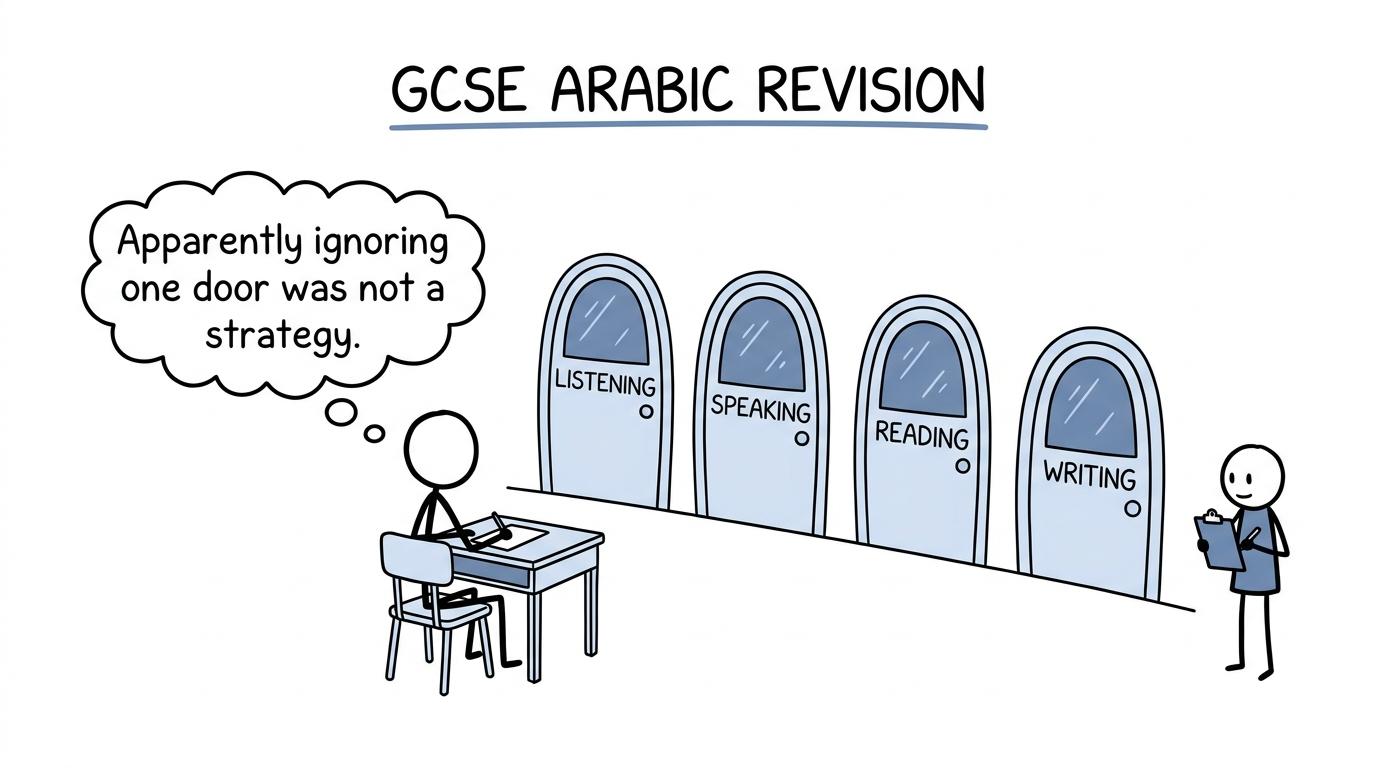 A GCSE student choosing between four equally important language skills
What separates a grade 5 from a grade 8 in GCSE Arabic?
A grade 5 response often communicates the main message using familiar vocabulary and straightforward structures. It may contain relevant opinions, but development can be uneven. Accuracy may fall when the student changes tense, extends a sentence or moves beyond a rehearsed topic.
A grade 8 performance is more consistent. The student understands detail and opinion, handles less familiar material, develops ideas and selects language to suit the task. Errors can still occur, but they rarely obscure the intended meaning.
Grade 5 knowledge must become flexible knowledge
At grade 5, students may recognise vocabulary on a list yet struggle when it appears in a recording, a longer sentence or an unfamiliar context. Grade 8 performance requires retrieval and transfer: the same knowledge must work across different topics and papers.
Instead of learning isolated words, revise useful language in clusters:
- topic vocabulary
- associated verbs
- common descriptive language
- connectives and time markers
- opinion phrases and justifications
- words that signal contrast, doubt or change
Test both directions. Recognition helps reading, but speaking and writing require you to produce language without seeing it first.
Short opinions must become developed ideas
Higher-mark responses do not simply contain more words. They communicate more.
When preparing an answer, train yourself to move through four layers:
- make the point
- explain or justify it
- add a relevant detail
- extend it through another time frame, comparison or consequence
This is especially valuable in speaking and writing. Pearson's higher-tier criteria reward developed key points, convincing opinions, varied expression and language adapted to the purpose. A long answer that repeats one basic idea does not achieve the same thing.
Rehearsed Arabic must become independent Arabic
Memorised material can provide useful foundations, but it becomes fragile when a question is phrased differently. In Higher-tier speaking, interaction and spontaneity matter. You need to respond, sustain communication and recover when you cannot immediately recall a word.
Practise with shuffled questions, unexpected follow-ups and different wording. Ask a teacher or partner to interrupt the predictable order. Learn repair strategies so that one forgotten expression does not end the answer.
The aim is not to sound scripted perfectly. It is to communicate naturally enough that you can adapt.
Improve each GCSE Arabic paper deliberately
Listening: move beyond keyword spotting
Grade 5 listening can depend heavily on catching a familiar noun or verb. This becomes risky when a recording includes negatives, contrasting opinions, distractors or references to different time frames.
During practice, identify why an answer is correct and why the tempting alternative is wrong. Listen for the whole clause rather than the loudest familiar word. After marking, use the transcript where available and classify the cause of each mistake:
- unknown vocabulary
- recognised too slowly
- missed a negative or contrast
- confused the speaker or time frame
- understood the words but misread the question
Replay short sections after analysis. Repeated listening without identifying the problem can make a recording feel familiar without improving the underlying skill.
Speaking: build extended but controllable answers
For speaking, prepare flexible idea banks rather than one fixed script per theme. Each bank should include opinions, reasons, events, future intentions and questions you could ask where the task requires them.
Record yourself answering under realistic conditions. Then listen for hesitation, unclear pronunciation, repetitive vocabulary and grammatical slips. Repeat the task with different questions rather than polishing one recording indefinitely.
Higher-level language is useful only when you can control it. A reliable extended sentence is worth more than an overambitious structure that makes the message unclear.
Reading: infer before reaching for a translation
Higher-tier reading includes a range of texts and requires more than retrieving obvious facts. You may need to identify opinions, connect details or deduce meaning from context.
When a word is unfamiliar, examine its role in the sentence, surrounding vocabulary and the overall tone. Ask whether the missing word describes a person, action, time, place or judgement. This keeps one gap from blocking the whole passage.
For translation into English, preserve meaning rather than copying Arabic structures mechanically. Check who performed each action, when it happened and whether a small connecting word changes the relationship between ideas.
Writing: prioritise communication, range and accuracy
Edexcel's Higher-tier writing criteria consider communication and content alongside linguistic knowledge and accuracy. Stronger responses expand key ideas, use appropriate register, link sentences effectively and refer successfully to past, present and future events.
Plan briefly before writing. Identify every bullet point, the required purpose and the time frames you need. Reserve time to check:
- whether every part of the task has been answered
- verb forms and agreement
- spelling and word endings
- pronoun references
- repeated vocabulary
- register and style
- places where an error changes the meaning
Do not edit only for impressive vocabulary. Clarity remains the foundation on which range is rewarded.
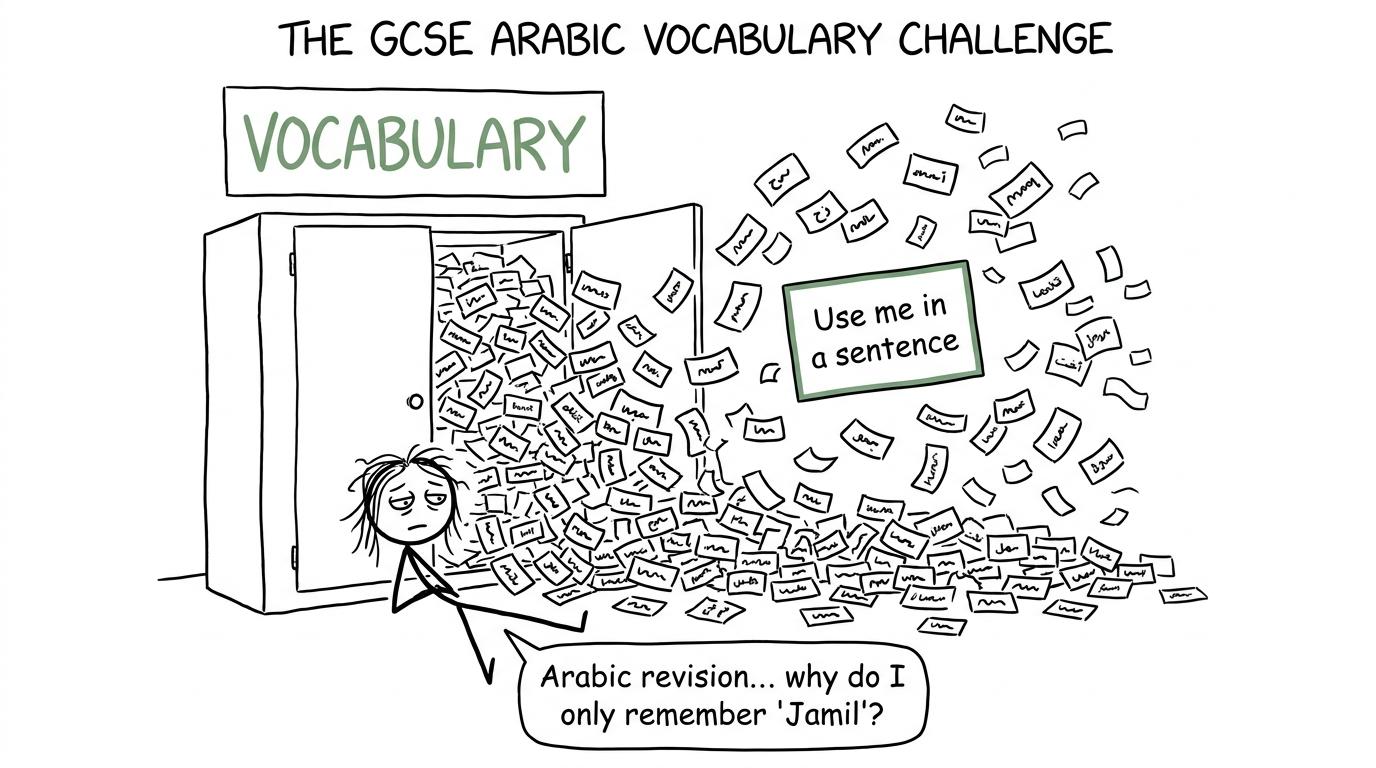 A student discovers that vocabulary works better inside sentences
Use a revision loop that actually changes performance
The same disciplined loop used in strong maths revision transfers well to Arabic:
attempt, mark, diagnose, repair, retest.
Begin with one timed section from an appropriate Arabic paper. Mark it using the official mark scheme and record each lost mark by paper, skill and cause. Then repair the smallest identifiable weakness before attempting fresh material.
MathsGenie's guide to finding your weakest GCSE topics explains how to turn errors into useful revision priorities. The principle is identical here: “writing” is too broad, while “future references become inaccurate in extended answers” is actionable.
Use a weekly rhythm such as:
- two vocabulary and grammar retrieval sessions
- one listening and transcript-analysis session
- one speaking recording or teacher practice session
- one timed reading or writing task
- one review session devoted to previous errors
Spacing matters more than heroic bursts. The GCSE revision timetable guide can help you organise Arabic alongside maths and your other subjects without creating an impossible schedule.
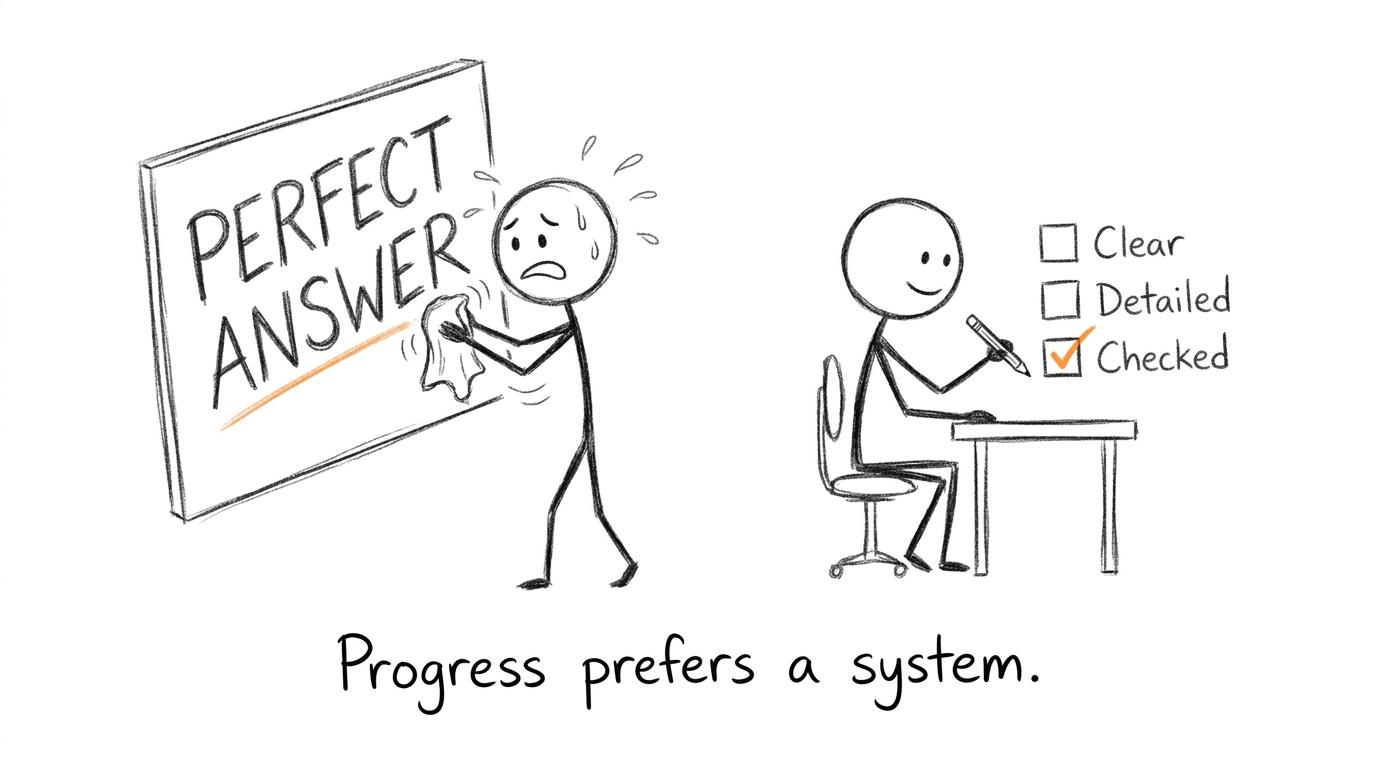 Two different approaches to progress: polishing perfection and building a repeatable system
Treat mark schemes as revision material
Completing papers is only the visible half of revision. The improvement happens afterwards.
Read the assessment grids before your next speaking or writing task. Highlight the difference between your current band and the band above. You may discover that the next improvement is not “use harder words” but “develop key points”, “link extended sentences” or “reduce errors that hinder clarity”.
Apply the approach in MathsGenie's guide to using GCSE past papers properly: sit appropriate material under controlled conditions, mark strictly, log errors, repair the weakness and retest it. For Arabic papers and recordings, use materials supplied by your school or Pearson and confirm that they match your specification and tier.
Do not exhaust every paper too early. Topic drills and shorter timed sections can build individual skills first. Maths students can use GCSE mini tests for the same short-feedback approach, while the GCSE maths revision hub keeps lessons, practice questions and board-specific papers together.
Common mistakes that keep students near grade 5
Revising only the strongest skill
Comfort is not the same as progress. Because the four Arabic skills are evenly weighted, repeatedly practising your favourite paper can leave a large weakness untouched.
Memorising answers without practising adaptation
A script may work for one anticipated question and collapse under a follow-up. Learn reusable structures and idea clusters, then practise changing the wording, tense and detail.
Using complexity before securing clarity
Ambitious grammar is valuable when controlled. If it regularly obscures who did what or when something happened, simplify the sentence and rebuild accuracy.
Ignoring the task's bullet points
Sophisticated language cannot compensate fully for missing content. Underline the separate requirements and check them before finishing.
Counting papers rather than corrections
Five unreviewed papers reveal less than one paper that has been marked, analysed and retested. If you need help building this habit across subjects, read when to start GCSE past papers.
Treating a previous boundary as a promise
Grade boundaries vary. Use the latest official information for context, but build performance around the specification and assessment criteria rather than one historical mark.
Make the next grade band your immediate target
The distance between grade 5 and grade 8 can look intimidating when treated as one leap. In practice, it is a sequence: make answers relevant, then developed; make grammar understandable, then consistently accurate; make vocabulary recognisable, then usable; make rehearsed speech adaptable.
Choose one paper this week. Diagnose three recurring weaknesses and build your next sessions around them. That is how a grade target becomes a working system.
For the maths side of your GCSE revision, make MathsGenie your free base. Use the GCSE predicted papers, revision lessons, practice questions, mini tests, past papers, mark schemes and video solutions to run the same cycle of attempt, feedback and repair. Better grades rarely come from doing everything. They come from noticing what loses marks, fixing it carefully and proving that the fix holds under pressure.










