

GCSE Arabic 4 to 6: A Practical Grade Plan
GCSE Arabic 4 to 6: learn the listening, speaking, reading and writing changes that build accuracy, range and confidence for a higher grade.
A grade 444 can feel like a strange place to be. You understand plenty of Arabic, yet marks still disappear through missed details, short answers, uncertain grammar or revision that never quite reaches exam conditions.
The route from GCSE Arabic 4 to 6 is not simply learning twice as many words. It is about becoming more consistent across listening, speaking, reading and writing, then using broader language accurately enough to handle less familiar material. One practical detail matters immediately: Pearson Edexcel Foundation tier offers grades 111 to 555, while Higher tier offers grades 444 to 999. A grade 666 therefore requires Higher-tier entry.
This guide follows the Pearson Edexcel GCSE Arabic specification, code 1AA01\text{AA}01AA0. Confirm your qualification and tier with your teacher before building your plan.
The grade 444 to grade 666 checklist
Focus on these changes:
- move from recognising the general topic to retrieving precise details and opinions
- give developed spoken answers rather than isolated statements
- write coherent responses covering every bullet point
- use past, present and future time frames securely
- replace repeated basic vocabulary with a controlled range of expressions
- practise standard spoken Arabic as well as written Arabic
- use mark schemes and examiner feedback to diagnose recurring losses
- complete timed Higher-tier tasks and retest mistakes later
The important word is controlled. A complicated structure that collapses does less for your mark than varied language you can use clearly and accurately.
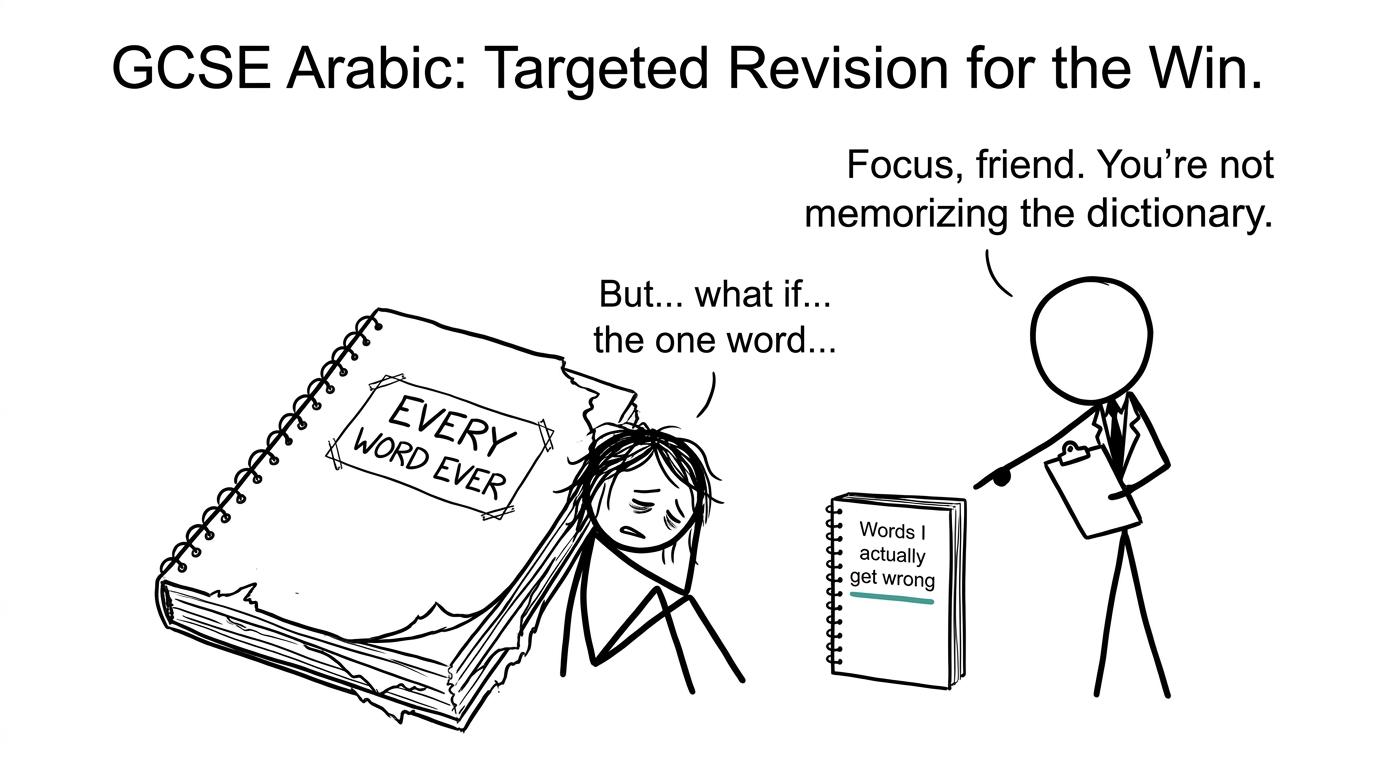 A student discovers that targeted vocabulary revision is more useful than learning every word
What separates a grade 444 from a grade 666 in GCSE Arabic?
Pearson assesses four skills: listening, speaking, reading and writing. Each contributes 25%25\%25% of the qualification, although the raw marks differ and are scaled. The qualification contains 280280280 scaled marks overall, and the final grade comes from the combined subject total rather than a separate grade for each paper.
At around grade 444, a student can usually communicate familiar ideas, identify key information and use common language with reasonable success. Errors remain noticeable. Longer passages, detailed opinions, unfamiliar vocabulary and spontaneous interaction may expose gaps.
A grade 666 performance is broader and steadier. The student can follow more extended material, distinguish details from distractors, explain opinions, adapt familiar language and produce longer coherent responses. Accuracy is not perfect, especially with complex structures, but meaning remains clear.
The difference is therefore not fluency versus no fluency. It is reliability:
- Grade 444 tendency: the main message is understood.
- Grade 666 tendency: the main message, supporting details, time frame and opinion are understood.
- Grade 444 tendency: familiar sentences are produced.
- Grade 666 tendency: sentences are linked, developed and adapted to the task.
- Grade 444 tendency: language works best in rehearsed contexts.
- Grade 666 tendency: language survives some unfamiliar wording and follow-up questions.
Do not turn a previous boundary into a permanent target. Grade boundaries change between exam series. In June 202520252025, for example, Pearson's Higher-tier grade 444 boundary was 112112112 out of 280280280, while grade 666 was 156156156 out of 280280280. Those figures describe that series only. You can compare completed series on the MathsGenie GCSE Arabic grade boundaries page, but your safest goal is better performance in every skill rather than chasing one historic total.
Improve all four papers, not only your favourite
It is tempting to revise the skill that feels comfortable. A confident speaker may keep talking while avoiding reading. A careful writer may fill notebooks but rarely listen. Equal weighting makes that strategy expensive.
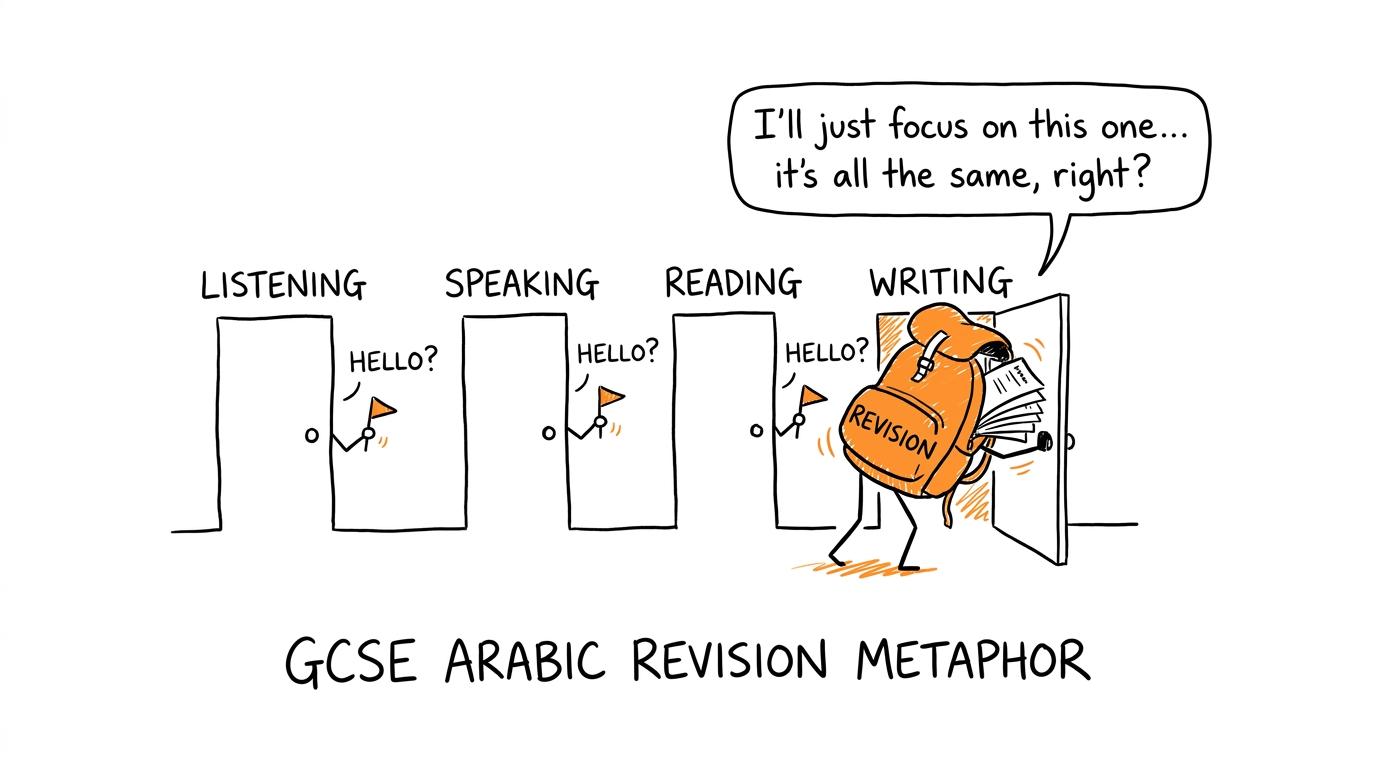 Four language skills wonder why all the revision is going through one door
Listening: train for detail, not just recognition
Edexcel assesses understanding of standard spoken Arabic in public and social settings. Higher-tier listening can demand key points, details, opinions and relationships between events.
Use short sections of official recordings. On the first play, identify the topic and overall attitude. On the next play, listen for names, negatives, quantities, reasons and shifts between past, present and future. Then check the transcript or mark scheme where available.
Keep a listening error log with categories such as:
- vocabulary unknown
- word known but not recognised at natural speed
- negative missed
- wrong time frame
- distractor selected
- answer lacked the required detail
This is more useful than writing “listening is weak”. A category tells you what to practise next.
Speaking: develop without memorising a script
The speaking assessment contains a role play, picture-based questions and a conversation. Higher-tier speaking lasts 101010 to 121212 minutes, with 121212 minutes of preparation. Marking rewards communication, linguistic knowledge, accuracy, spontaneity and interaction across the relevant tasks.
Build answers in layers: direct response, detail, opinion and reason. Practise follow-up questions so that a change of wording does not stop you. If you forget a word, paraphrase or repair the sentence rather than abandoning the answer.
Memorised paragraphs can sound impressive until the question changes. Learn reusable structures and topic vocabulary instead, then combine them in fresh responses. Record yourself and listen for hesitation, unclear pronunciation, repeated words and unfinished ideas.
Reading: prove each answer from the text
Grade 666 reading depends on more than spotting a familiar word. You need to understand extended texts, identify details and opinions with reasons, and cope with some less familiar contexts. The paper also includes translation into English.
Before answering, locate the exact evidence. Watch for pronoun references, connectives, negatives and time markers. If the question asks for two details, supply two distinct details. In translation, preserve meaning rather than forcing an unnatural word-for-word version.
A strong routine is to underline the evidence, answer concisely, then ask whether your response matches the language of the question. This prevents a common loss: understanding the passage but answering something nearby rather than something asked.
Writing: cover the task before trying to impress
Higher-tier writing contains two open-response tasks and a translation into Arabic. Examiners assess communication and content alongside linguistic knowledge and accuracy.
Plan each response around the bullet points. Decide where you will include different time frames, an opinion, justification, description and narration. Link ideas so the piece reads as one response rather than several disconnected sentences.
Then check high-impact accuracy:
- verb agreement and tense
- gender and number agreement
- pronouns and possessives
- spelling and letter forms
- connective use
- appropriate register
- whether every bullet point has been answered
Complexity should be deliberate. Use structures that broaden your response without making its meaning uncertain.
Build vocabulary that you can actually use
A long vocabulary list creates the feeling of work. Retrieval creates usable language.
Organise vocabulary by function as well as topic: giving opinions, explaining reasons, comparing, narrating, describing change and discussing future plans. Learn common word families and contrasting expressions. Include the specification themes, but give extra attention to words you repeatedly fail to recognise or produce.
Test in both directions. Recognising an Arabic word supports reading and listening; producing it from an English prompt supports speaking and writing. Say it aloud, write it in a sentence, then revisit it after a delay.
The same principle powers effective maths revision. MathsGenie's guide to turning GCSE notes into active recall shows how to convert passive notes into prompts, while the GCSE one-month revision plan demonstrates how retrieval, feedback and spaced practice can fit into a realistic week.
Use a weekly plan that closes specific gaps
A useful Arabic week contains retrieval, skill practice and exam feedback:
- Monday: vocabulary retrieval and short listening
- Tuesday: one planned writing response
- Wednesday: speaking questions recorded without a script
- Thursday: reading and translation practice
- Friday: correct errors and retest vocabulary
- Weekend: one timed paper section, followed by careful marking
Keep sessions focused. “Revise Arabic” is too vague; “distinguish opinions from facts in Higher listening” gives you something measurable.
Use the process recommended in MathsGenie's guide to finding your weakest GCSE topics: diagnose, classify errors, repair one weakness and retest it. The subject changes, but the feedback loop does not. For organising Arabic alongside your other subjects, adapt the structure in the GCSE revision timetable guide.
Turn past papers into improvement
A completed paper is evidence, not the end of revision. The useful work begins after marking.
Use official Edexcel Arabic papers, recordings, mark schemes and examiner reports for your specification. Attempt sections without notes and under the correct timing. After marking, label every lost mark as a knowledge gap, misunderstanding, language error, incomplete response or time-pressure mistake.
Then repair the cause. Relearn the vocabulary, practise the grammar or rewrite the incomplete answer. Reattempt the task later without copying the correction. The MathsGenie method for using past papers properly explains this attempt-mark-fix-retest cycle in more detail.
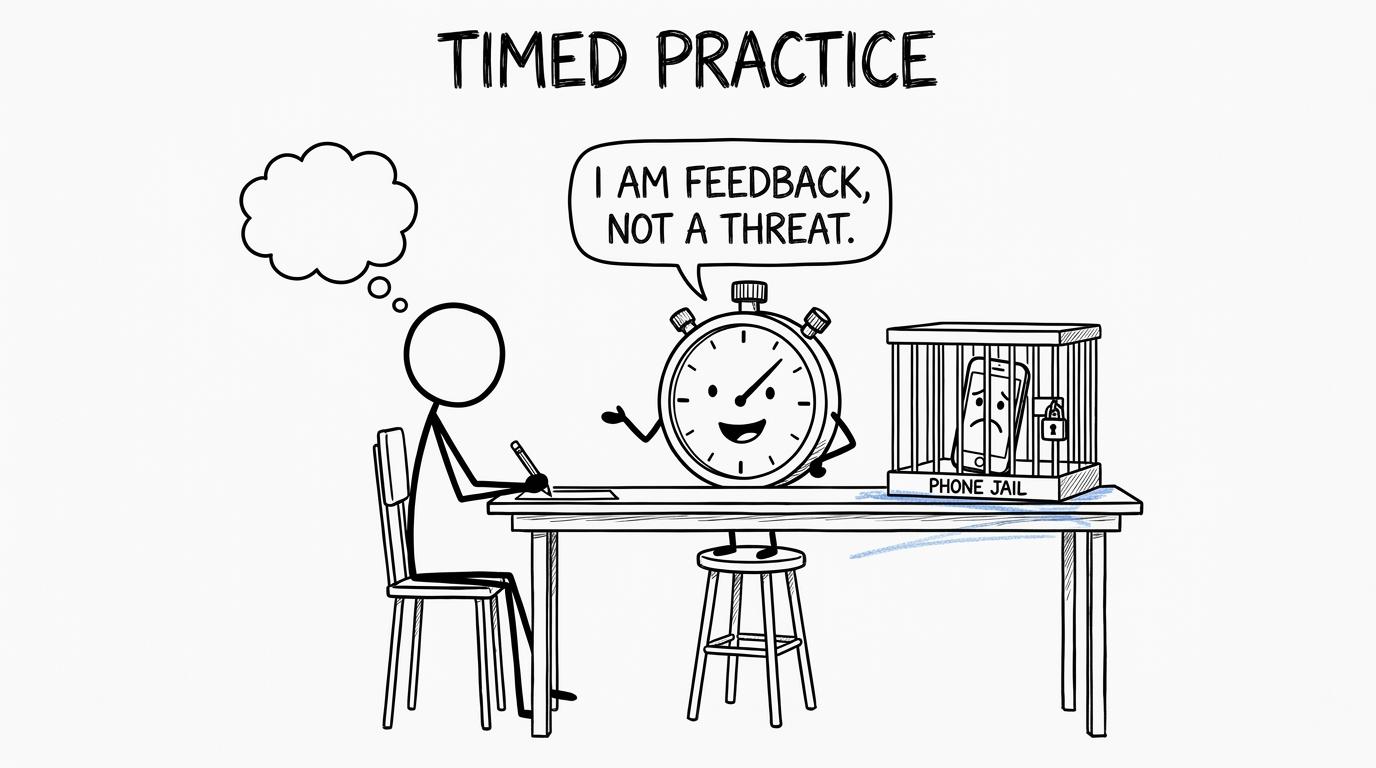 A friendly stopwatch explains that timing is feedback rather than a threat
Common mistakes that keep students near grade 444
Revising vocabulary without retrieving it
Rereading produces familiarity, but the exam asks you to retrieve meaning and language independently. Cover the answers and test yourself aloud and in writing.
Ignoring one of the four skills
Because each skill contributes 25%25\%25%, a neglected paper can limit the overall result. Give weaker skills more time while maintaining stronger ones.
Giving short but technically correct answers
A direct answer may communicate, yet fail to show range or development. Add relevant detail, opinions and reasons where the task permits.
Using dialect when standard Arabic is required
Home or community Arabic can be a major strength, but the specification assesses standard spoken Arabic and formal written language where required. Practise moving deliberately into the register expected by the task.
Attempting Higher-tier papers too late
A grade 666 requires Higher tier. Build familiarity with Higher vocabulary, pace and task demand early, then discuss your evidence and entry decision with your teacher.
Counting marks without studying their cause
A total tells you where you finished. An error log tells you what to do tomorrow. Record precise causes and retest them, just as MathsGenie's GCSE mini tests help maths students check whether a repaired skill now holds under pressure.
Make the next grade a collection of smaller changes
Moving from grade 444 to grade 666 in GCSE Arabic is not one dramatic leap. It is the accumulation of quieter improvements: one more detail heard correctly, one opinion justified, one unfamiliar passage handled calmly and one recurring grammar error removed.
Begin with a Higher-tier diagnostic across all four skills. Identify the three patterns costing you the most marks. Build your next fortnight around those patterns, then retest them using fresh material.
MathsGenie remains your free home for strengthening the maths side of your GCSE programme. Use the GCSE Maths revision hub for revision lessons, practice questions, past papers, predicted papers, mark schemes, video solutions and mini tests. Apply the same disciplined cycle to Arabic: learn, retrieve, practise, mark, correct and return. Grades tend to move when revision stops being a pile of hours and becomes a reliable system.










