Gamify Revision: GCSE English Language and Literature
Gamify revision GCSE English Language and Literature wisely: learn when points, streaks and rewards support recall, writing practice and feedback.
Revision can look productive without producing much learning. A streak grows. A badge flashes. A leaderboard moves. Yet the blank page still feels blank when you must analyse an unseen extract or plan an essay.
So, does it help to gamify revision GCSE English Language and Literature preparation? Yes, but only when the game rewards the work that exams assess. Points can help you begin, progress bars can make consistency visible and small rewards can sustain a routine. None of them can replace retrieving quotations, analysing writers’ choices, planning responses, writing under time pressure and learning from feedback.
That distinction matters if you are balancing English with GCSE maths. Your revision system should reduce the effort needed to start useful practice, not give you another elaborate project to manage.
The short answer: gamification is a tool, not a method
Recent reviews of educational gamification generally report positive effects on motivation and engagement, with possible benefits for academic performance. However, results vary according to the learner, subject and design of the activity. Points, badges and leaderboards are not automatically educational.
The stronger principle is simple: gamification may get you to the task, but the task creates the learning.
Use this quick checklist:
- Award points for completed exam-relevant actions, not time spent near a textbook.
- Include active recall, extended writing and feedback.
- Make progress personal rather than dependent on beating classmates.
- Keep administration shorter than the revision itself.
- Review whether your answers are improving, not merely whether your score is rising.
- Stop using any feature that creates anxiety, rushing or dishonest box-ticking.
This resembles the effective loop used in MathsGenie’s GCSE revision guide: learn, practise, check, correct and return later. The subject changes, but the logic of improvement does not.
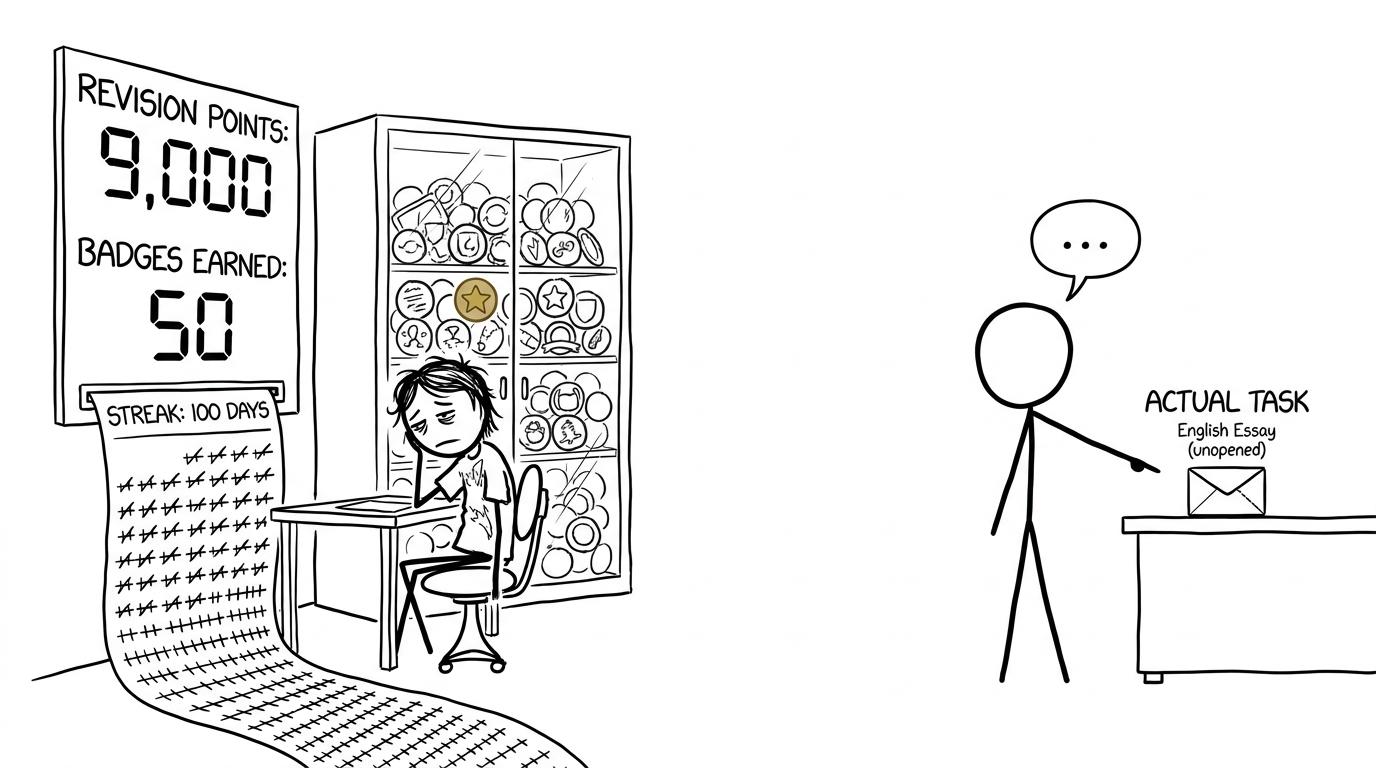 A student notices that building a giant revision scoreboard has replaced doing the actual task
Why points, streaks and rewards can help
The hardest part of revision is often not understanding what matters. It is beginning when the work feels uncomfortable.
A short challenge can lower that barrier. A visible streak can remind you that yesterday’s effort should not be wasted. A progress bar can turn a large course into manageable steps. Immediate feedback can also make practice feel less vague.
These features are particularly useful when they support three behaviours.
Starting promptly
A defined mission such as “retrieve five quotations, then check them” is easier to begin than “revise literature”. The game mechanic has converted an unclear intention into a concrete action.
This is why a repeatable routine often beats a heroic timetable. Maths students can see the same idea in the twenty-minute maths revision routine: make the starting process predictable so less energy is spent deciding what to do.
Returning after a delay
Memory strengthens through repeated retrieval over time, not through one perfect-looking set of notes. A streak or scheduled level can prompt you to revisit vocabulary, quotations, themes and writing structures on different days.
Research guidance on retrieval practice also stresses that recalling information should involve an active attempt, appropriate challenge and feedback. For English, retrieval might involve recalling textual evidence, explaining a theme without notes or reconstructing the stages of an argument. It should not stop at recognising an answer in a multiple-choice quiz.
The same principle supports mathematical retention. MathsGenie’s guide to stopping GCSE maths content from being forgotten combines active recall with spaced, exam-style practice.
Making progress visible
Revision often feels unrewarding because improvement is gradual. A simple tracker can reveal that you have completed several timed paragraphs, corrected recurring punctuation errors or revisited every major theme.
The tracker should record evidence, however. “English revised” tells you very little. “Unseen extract analysed and checked against the mark scheme” describes genuine work.
Where gamification becomes a pleasant distraction
The danger arrives when the visible system becomes more satisfying than the invisible learning.
You may collect points by answering easy questions, protect a streak with two minutes of shallow activity or spend an evening designing a beautiful revision dashboard. The system reports success because it measures activity. The exam measures performance.
GCSE English Language requires students to read and interpret unseen material, analyse language and structure, compare viewpoints where required, evaluate texts and communicate accurately and effectively. GCSE English Literature requires close knowledge, supported interpretation and analysis of language, form and structure, alongside other assessment requirements determined by the specification.
Exact papers, texts and question structures vary across AQA, Edexcel, OCR and Eduqas. Check your own specification rather than assuming an app’s generic “English level” matches your course.
A quotation-matching game may support recall. It cannot by itself show that you can select the best evidence for a particular argument. A terminology quiz may test whether you recognise a metaphor. It does not prove that you can explain how a writer’s choice shapes meaning.
Gamification fails when success inside the game becomes detached from success in the assessment.
How to gamify English revision without weakening it
A good system rewards four stages: retrieve, apply, check and revisit. Keep it small enough to run on paper or in a basic notes app.
Build missions around assessment skills
Give each session one outcome connected to your exam board. Suitable missions include:
- recall quotations and verify their accuracy;
- annotate an unseen passage without notes;
- plan a response to a real exam question;
- write one timed analytical paragraph;
- compare two ideas or texts where your specification requires it;
- edit a piece of writing for sentence control, spelling and punctuation;
- mark a response and record one precise improvement.
These missions involve the knowledge and higher-order thinking that English exams demand. They are better than vague rewards for reading notes.
Award more credit for deeper work
Not every task deserves equal status. Retrieving a quotation is useful, but applying it in a well-reasoned paragraph is more demanding. Completing a timed response and acting on feedback is more valuable again.
You do not need a complicated scoring formula. Use three categories such as quick recall, applied analysis and exam practice. The purpose is to nudge yourself towards demanding work, not to build a flawless economy.
Maths revision follows a similar progression. Topic recall matters, but performance must eventually survive unfamiliar questions and time pressure. MathsGenie’s guide to using GCSE past papers properly explains the useful cycle of completing, marking, repairing and retesting.
Make feedback part of the game
A task is not complete when the timer ends. It is complete when you know what to keep and what to change.
Research on retrieval practice warns that unchecked errors can leave misconceptions in place. For English, feedback may come from a teacher, an official mark scheme, an examiner report or a carefully chosen model response. Record a specific action such as “link evidence back to the argument” rather than “add detail”.
Your reward should recognise correction. Otherwise, the game encourages you to produce more work without making the work better.
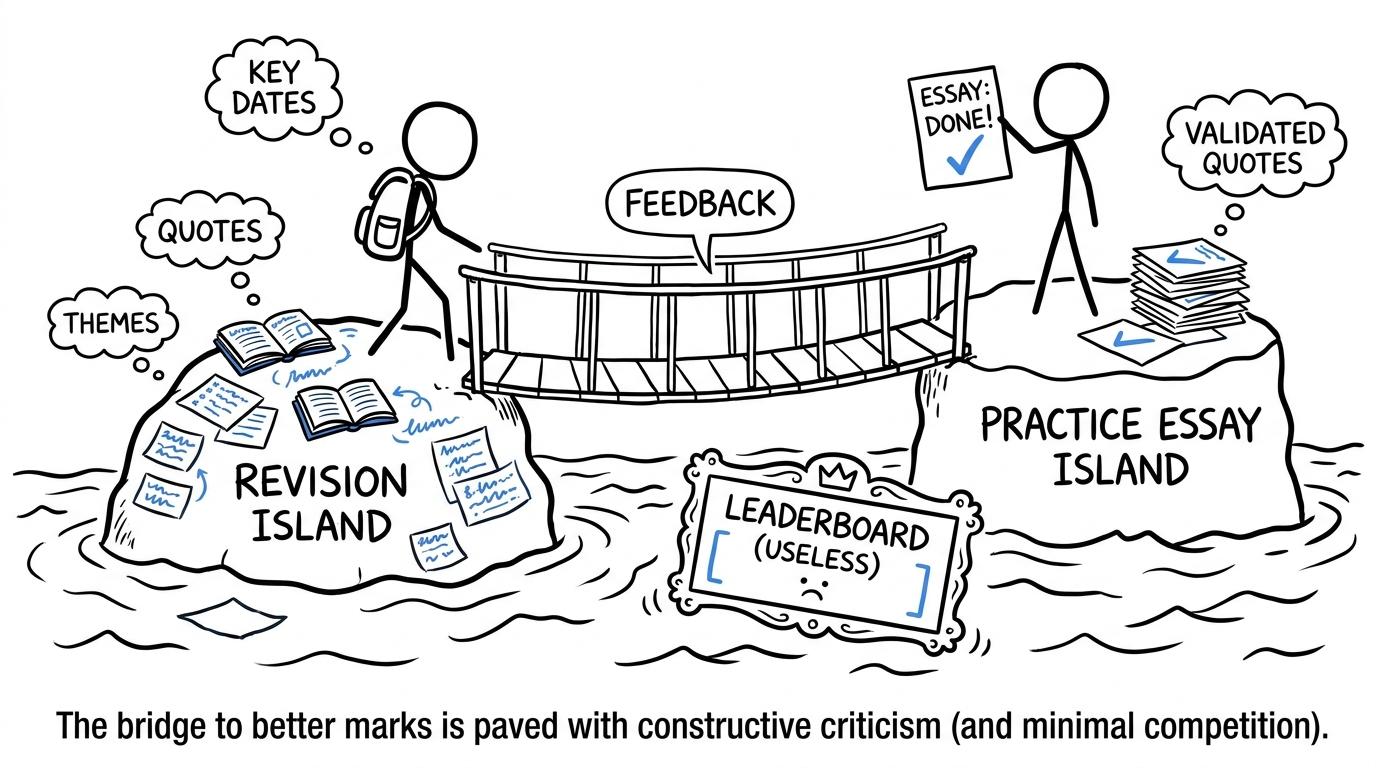 A feedback bridge connects revision points to a checked piece of exam practice
Prefer personal progress to public leaderboards
Leaderboards can energise some students, but they can also reward speed, prior attainment or sheer available time. Someone revising carefully may appear to be losing to someone completing easier tasks.
A personal best is usually more informative. Track whether you can recall more accurately, plan more quickly, sustain a clearer argument or eliminate a repeated technical error. That keeps the competition connected to your own development.
Add an anti-cheating rule
The person most easily fooled by a revision game is its designer.
Set one rule: no credit without evidence. Evidence might be a completed plan, a marked paragraph, corrected quotations or an error-log entry. If the evidence does not exist, the task does not count.
That principle works especially well across subjects. In maths, use a marked question set rather than minutes watched. You can diagnose gaps through MathsGenie’s weakest-topics routine, then use the result to choose the next mission.
A balanced system for English and maths revision
If maths exams are also approaching, avoid running two elaborate games. Use one shared framework with subject-specific evidence.
For English, evidence might be retrieval cards, essay plans, timed paragraphs and corrected responses. For maths, it might be completed practice questions, an updated error log or a marked paper.
Keep these features:
- Daily minimum: one small task that preserves momentum.
- Weekly challenge: one substantial piece of exam-style practice.
- Feedback bonus: credit for correcting and retesting an error.
- Recovery token: permission to miss a day without abandoning the system.
- Review point: a weekly decision about what needs attention next.
For maths, the GCSE one-month revision plan provides a structured rhythm, while Edexcel GCSE Maths mini tests offer short, measurable challenges. When greater exam realism is needed, move to Edexcel GCSE Maths past papers or the relevant board area.
The important transfer is not the subject content. It is the habit of replacing a vague feeling with evidence: attempt, mark, diagnose, repair and return.
Common mistakes when gamifying revision
Rewarding attendance instead of learning
Opening an app, watching a video or sitting at a desk may be the beginning of revision, but it is not proof of learning. Attach rewards to an observable output.
Making every activity quick
Fast quizzes are convenient, but English Language and Literature include extended thinking and writing. Your system must eventually reward sustained responses under realistic conditions.
Protecting the streak at all costs
A streak should encourage consistency, not produce guilt. Illness, school deadlines and tiredness happen. A recovery rule makes the routine more durable.
Choosing easy tasks to collect points
If you repeatedly revise familiar quotations or comfortable maths topics, your score rises while your weaknesses remain. Give extra credit for tackling diagnosed gaps.
Ignoring the mark scheme
Completion is not the same as quality. Use your board’s current materials and teacher guidance to understand what successful responses require.
Spending longer designing than revising
If maintaining the tracker takes a significant part of the session, simplify it. A list of tasks and a weekly total is enough.
Make the game serve the grade
Gamification genuinely can help with GCSE English Language and Literature revision. Its best role is modest but valuable: making useful work easier to start, repeat and track. It becomes a distraction when badges replace feedback, streaks reward shallow activity or points hide the absence of exam practice.
Keep the game light. Make the evidence demanding. Reward retrieval, application, correction and return.
Then bring the same disciplined system to maths. Start at the MathsGenie GCSE maths revision hub, choose your exam board and tier, and combine free revision lessons with practice questions, mini tests, past papers, predicted papers, mark schemes and video solutions. The scoreboard is optional. The practice is not.