

Gamify Revision GCSE Art and Design: Does It Help?
Gamify revision GCSE Art and Design effectively with rewards that support making, reflection and progress, rather than becoming another distraction.
A revision streak can feel strangely important. Miss one day and the unbroken chain disappears; earn another badge and progress seems certain. Yet your sketchbook may still be waiting, your annotations unfinished and your maths practice untouched.
So, does it help to gamify revision GCSE Art and Design, or are points, streaks and rewards simply pleasant distractions? The short answer is: gamification can help you begin, persist and see progress, but only when the game rewards work that genuinely improves your portfolio, preparatory studies or exam readiness. A score cannot replace thoughtful investigation, experimentation, reflection or making.
That distinction matters for students balancing Art and Design with GCSE maths. Gamification should reduce the effort needed to start productive revision. It should not become a second hobby that consumes the time you meant to spend revising.
The quick checklist
A useful revision game should:
- reward completed evidence, not time spent inside an app;
- connect each task to a clear Art and Design assessment objective;
- encourage making, recording, refining and reflecting;
- give you quick, honest feedback;
- include small tasks for low-energy days;
- preserve choice rather than forcing meaningless competition;
- leave enough time for maths and your other GCSE subjects;
- become less important as productive habits become stronger.
If you are spending longer designing the game than completing the work, simplify it.
What gamifying Art and Design revision really means
Gamification is the use of game-like features in a non-game activity. It might include points, levels, streaks, progress bars, challenges, badges or rewards. You are not turning your GCSE course into a video game. You are borrowing a few useful design ideas to make progress more visible.
That can be valuable because Art and Design often contains large, open-ended tasks. “Improve my portfolio” is difficult to begin because it has no obvious first move. “Complete one artist comparison and photograph two experiments” is smaller, clearer and easier to finish.
The strongest system therefore begins with specific actions. You might award progress for:
- investigating an artist, designer or craftsperson;
- recording observations through drawing, photography or annotation;
- testing a material or technique;
- explaining what succeeded and what needs refinement;
- developing an idea rather than merely producing another version;
- acting on teacher feedback;
- organising evidence so that the development of your intentions is clear.
The point is not the badge. The point is that the badge makes the next useful action obvious.
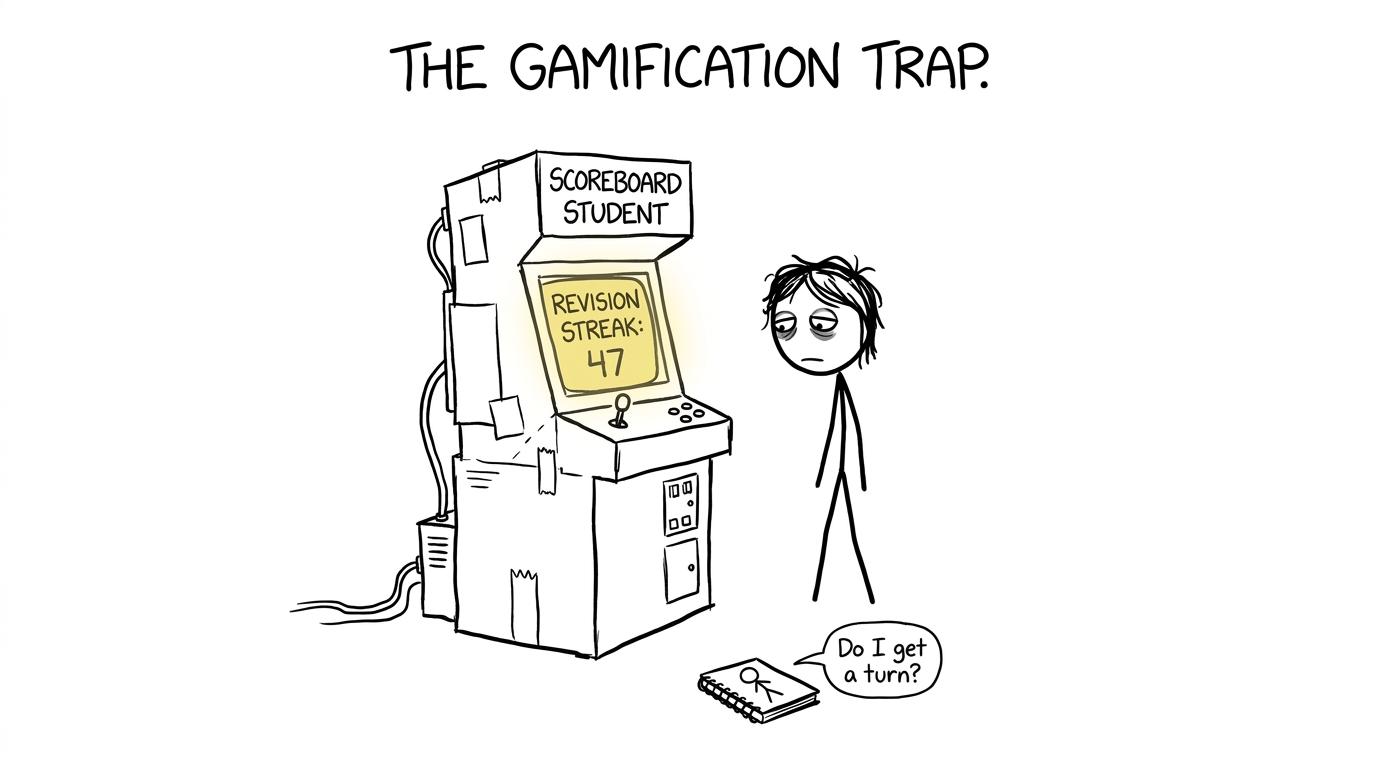 A revision streak scoreboard overshadows an unopened sketchbook
What the evidence says about points, streaks and rewards
Recent systematic reviews of gamification in education generally report promising effects on motivation, participation and engagement. However, the results are context-dependent. Researchers continue to identify differences between subjects, learners, game designs and the length of interventions. Evidence for durable academic improvement is less straightforward than evidence that students enjoy or participate in an activity.
In other words, a game mechanic may make you more willing to open the sketchbook. That is useful. It does not automatically make the work perceptive, personal or technically accomplished.
Points can clarify progress
Points work best when they represent meaningful evidence. A point for opening an app measures an app visit. A point for completing a material experiment and recording what it revealed measures something closer to genuine progress.
Use points as a private tracking tool, not as proof of artistic quality. Ten rushed annotations are not necessarily better than one careful reflection that changes the direction of a project.
Streaks can protect consistency
A modest streak can help you repeat small behaviours: photographing work, adding an annotation, reviewing feedback or completing a short observational drawing. The danger arrives when preserving the streak matters more than the quality of the action.
Build in a “minimum useful action” for difficult days. It should be small, but real. You might spend ten focused minutes identifying one refinement, rather than adding an empty tick simply to keep the chain alive.
Rewards can help you start
A planned break, music, a snack or time on a favourite activity can act as a reasonable reward after a focused session. Problems arise when the reward becomes disproportionate, or when you begin to avoid worthwhile work unless a prize is attached.
Think of external rewards as scaffolding. They may help establish a routine, but the long-term aim is to notice the more valuable rewards: stronger work, clearer intentions and less last-minute panic.
Leaderboards are often a poor fit
Competition can energise some students, but public rankings can also distract or discourage. Art and Design is not a race to produce the greatest number of pages. Personal intentions, experimentation and critical understanding matter.
A private progress bar against your own plan is usually more useful than comparing output with classmates. Compete with yesterday’s uncertainty, not somebody else’s sketchbook.
Build the game around the assessment objectives
Across GCSE Art and Design specifications, assessment focuses on four broad objectives: developing ideas through investigation, refining through experimentation, recording relevant ideas and observations, and presenting a personal and meaningful response. The objectives are equally weighted, although students should always check the precise wording and requirements for their exam board and course.
This gives your revision game a natural structure. Create four progress areas linked to AO1, AO2, AO3 and AO4. Before awarding progress, ask which objective the work supports and what evidence now exists that did not exist before.
A balanced week might contain:
- an investigation task connected to sources and context;
- an experiment with media, materials, techniques or processes;
- a recording task using images, observations or purposeful annotation;
- a development or presentation decision that moves towards a personal response.
Do not treat these as four isolated boxes. Strong projects often connect them. An investigation influences an experiment; the experiment creates something to record; reflection then shapes the final response.
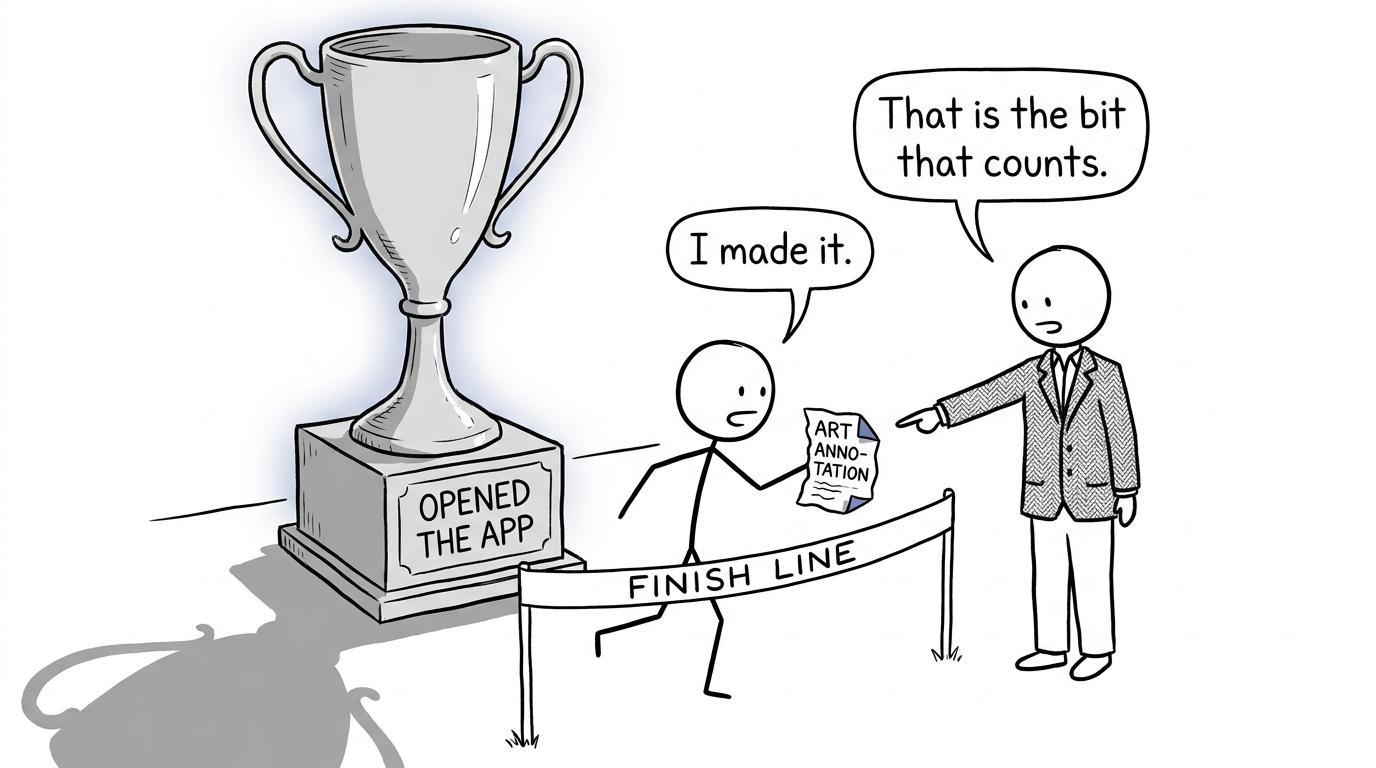 A tiny piece of useful work crosses the finish line beside an oversized app trophy
A practical system that does not take over your revision
Keep the rules on one page. Choose a small number of weekly “missions” based on teacher feedback, unfinished evidence and the areas where your project is least convincing.
Set output-based missions
Each mission should contain a verb and a visible result. “Revise photography” is vague. “Select three contact-sheet images and explain how composition affects the intention” is observable.
Your missions should be challenging enough to matter but small enough to complete in one session. If a task keeps rolling into the next day, divide it into stages.
Use levels to show depth, not volume
A sensible level system might move from started, to developed, to refined, to reviewed with feedback. This discourages the belief that more pages automatically mean stronger evidence.
Require a quality check before moving up a level:
- Does the work connect to my intention?
- Have I explained a decision rather than merely described an image?
- Did the experiment reveal something useful?
- What will change because of this evidence?
These questions turn gamification into metacognition: planning, monitoring and evaluating your own learning. Evidence reviews suggest that these self-regulation processes are most useful when applied to real subject content rather than taught as generic “learning skills”.
Add feedback to every challenge
Educational games often feel effective because feedback is immediate. Your revision system needs the same loop. Feedback might come from your teacher, your own comparison with the assessment criteria, or a written review after an experiment.
A completed task without reflection can create false confidence. Record what worked, what did not and the next decision. Then award the progress.
Use a weekly reset
At the end of the week, review the evidence rather than admiring the score. Remove tasks that no longer matter. Carry forward only the unfinished work that remains relevant.
For maths, the same principle applies: marks and mini-test scores are useful only when they reveal the next skill to practise. The MathsGenie GCSE maths revision hub brings together lessons, questions and board-specific resources, while the guide to finding your weakest GCSE topics explains how to turn results into focused action.
Balance Art and Design with GCSE maths
Art projects can expand to fill every available evening. Maths can do the same. Gamification is most useful when it creates boundaries between them.
Give each subject its own evidence of progress. For Art and Design, that evidence may be an experiment, annotation or refinement. For maths, it should usually be attempted questions, corrected errors or improved performance on a later test.
Use GCSE mini tests as short maths missions when Art and Design has taken most of your energy. On longer revision days, follow a realistic GCSE maths revision timetable and include one timed paper section.
The game should also recognise recovery. A missed day is information, not failure. Restart with a smaller action rather than abandoning the system because a perfect streak has ended.
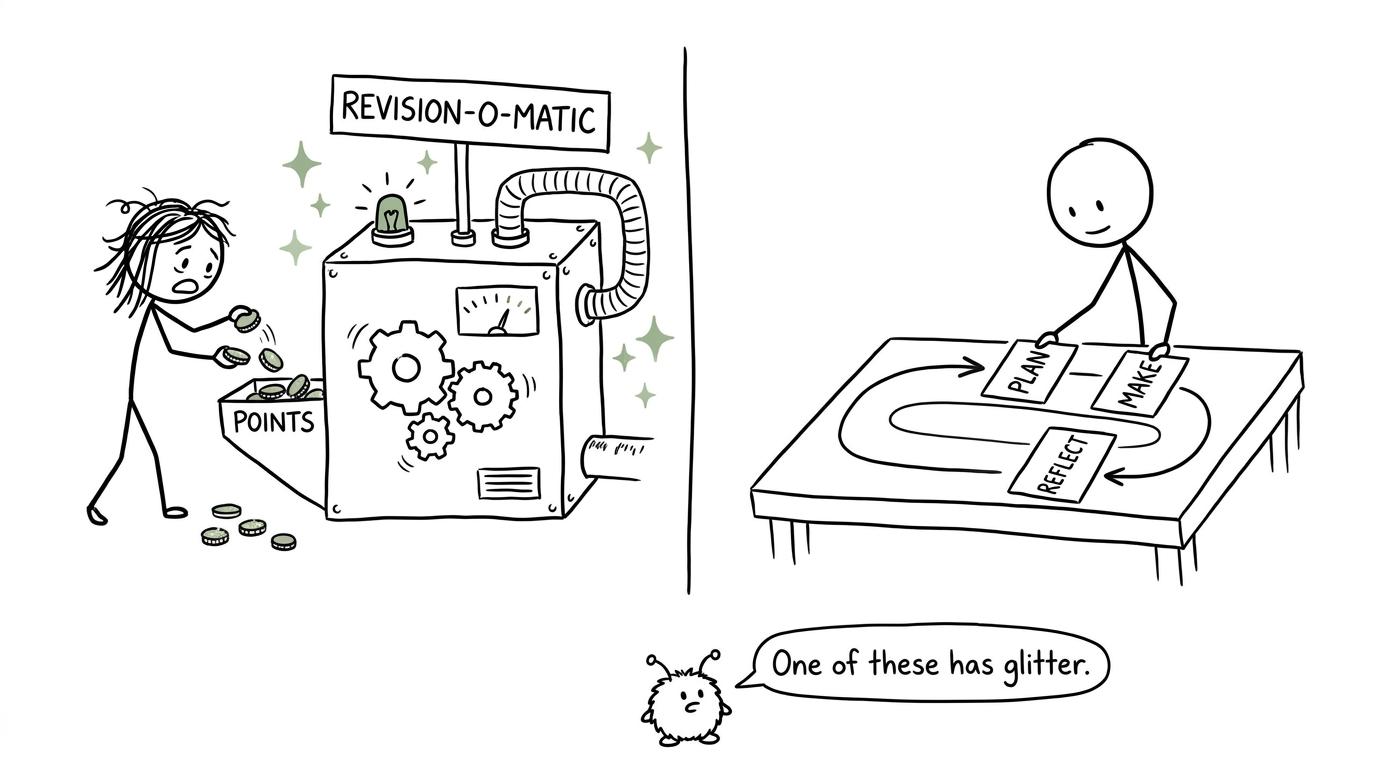 One student feeds points into a flashy machine while another follows a simple plan, make and reflect path
Signs gamification has become a distraction
A revision game is failing if:
- you repeatedly change colours, icons or scoring rules;
- easy tasks earn more than difficult, important work;
- you protect a streak with actions that create no useful evidence;
- the score makes you avoid teacher feedback;
- you rush work to unlock rewards;
- you compare task totals rather than the quality of decisions;
- you feel unable to revise without an app;
- tracking consumes time that should go into making or practising.
Run a simple test: hide the score and look only at what you produced. Would your teacher be able to see development, experimentation, recording or refinement? If not, the system is measuring motion rather than progress.
Common mistakes when gamifying revision
Rewarding time instead of learning
Time matters, but sitting beside a sketchbook for an hour is not the same as completing purposeful work. Track outputs first and focused time second.
Making every task worth the same
Tiny administrative jobs should not outscore difficult thinking. Give greater importance to tasks that address feedback, repair weak evidence or move a project forward.
Turning creative work into a checklist
Checklists can help you remember requirements, but personal work needs room for uncertainty and discovery. Leave some choice within each mission: select the material, source or visual direction that best supports your intention.
Ignoring your specification and teacher guidance
A generic app does not know your title, project, course requirements or current evidence. Use your exam board specification, assessment criteria and teacher feedback to decide what the game rewards.
Gamifying only the enjoyable subjects
A beautiful Art and Design tracker will not prepare you for a maths paper. Make maths actions equally concrete. Use MathsGenie past papers under timed conditions, mark them honestly and use the result to choose your next revision lesson.
Make the game smaller and the learning stronger
Gamification is not a shortcut to a higher grade. It is a tool for reducing friction. Points can make progress visible, streaks can protect consistency and rewards can help you begin. None of them can judge whether an idea is thoughtful, an experiment is purposeful or a response is genuinely personal.
Build a small system around meaningful evidence, feedback and reflection. Then let the system fade into the background while the work becomes more important.
For the maths side of your GCSE preparation, start with MathsGenie’s free revision lessons and practice questions, test yourself with mini tests, and move towards past-paper practice at the right stage. Use mark schemes and video solutions to correct mistakes, then add predicted papers when you need fresh exam-style practice. The best score is not the one displayed by your revision game. It is the understanding you can still use when the real task begins.










