

A Four-Week GCSE Maths Revision Plan That Works
A four-week GCSE Maths revision plan with topic triage, weekly priorities, past-paper practice, rest days and simple ways to catch up calmly before exams.
Four weeks can feel uncomfortably short when the GCSE Maths specification seems to contain everything you have ever learnt. A four-week GCSE Maths revision plan should identify where marks are being lost, prioritise useful practice and leave space for past papers, corrections and rest.
The aim is to become more accurate at answering exam questions. Start with evidence from recent work, choose manageable priorities and adjust your timetable as those priorities change.
Your four-week plan at a glance
Give each week a clear purpose:
| Week | Main purpose | Core work |
|---|---|---|
| Week one | Diagnose and rebuild | Topic triage, priority skills and mini tests |
| Week two | Strengthen and mix | Targeted practice, mixed questions and corrections |
| Week three | Apply under pressure | Timed past papers, marking and focused repairs |
| Week four | Consolidate calmly | Repeated mistakes, recall and rest |
Try a focused session of around forty-five minutes, adjusting the length around schoolwork and concentration. Reserve longer blocks for papers and include at least one rest day each week.
The GCSE Maths revision timetable guide and GCSE one-month Maths revision plan offer further planning guidance.
Week one: identify your priorities
Familiar topics feel reassuring, but repeating comfortable work can leave your biggest weaknesses untouched.
Use a recent assessment, mini test or selected exam questions to sort topics into three groups:
- Red: you cannot begin or repeatedly choose the wrong method.
- Amber: you understand the method but make errors or need prompts.
- Green: you answer exam questions accurately without help.
Choose three or four red topics and several amber topics for the first fortnight. Give priority to skills that support other work, such as fractions, rearranging equations and interpreting graphs.
For each priority topic, review a revision lesson, attempt practice questions independently, then mark them. Describe each mistake precisely and retry the question later without notes.
Use the GCSE Maths revision hub to find suitable resources. Check that practice matches your exam board, specification and foundation or higher tier.
Finish the week with a short priority list and an error log. Record the topic, what went wrong and what you will check next time.
Week two: make sessions specific
Writing “maths revision” in a timetable leaves the hardest decision until you are already tired. Give each session a task you can finish and assess.
| Day | Session focus |
|---|---|
| Monday | Review one red topic and answer focused questions |
| Tuesday | Practise two amber topics |
| Wednesday | Rest |
| Thursday | Attempt mixed questions across different topic areas |
| Friday | Correct mistakes and retry questions without notes |
| Saturday | Complete a mini test or timed paper section |
| Sunday | Rest and review next week's priorities |
A task such as “practise simultaneous equations and retry incorrect questions on Friday” tells you where to start and when to revisit the learning.
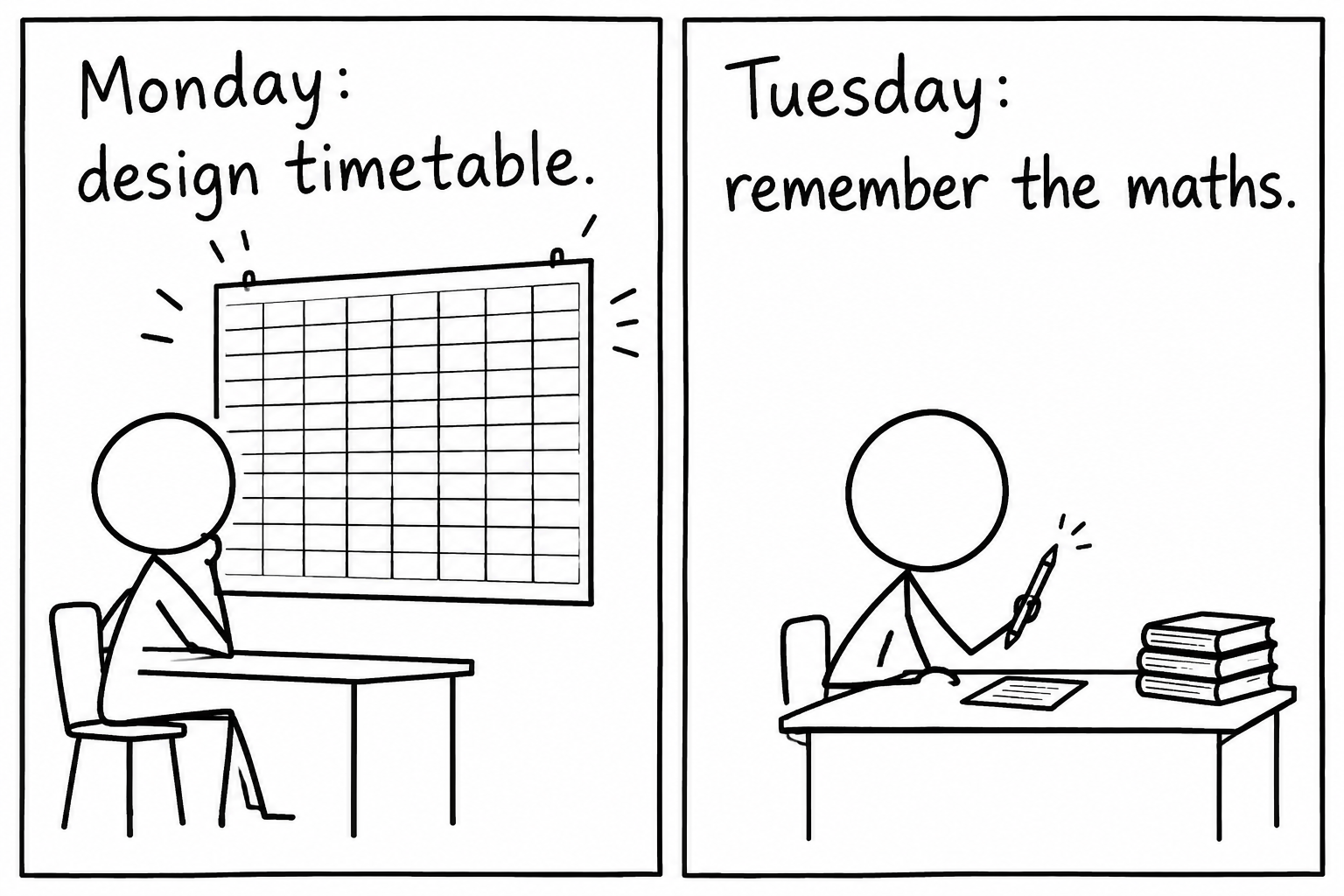 XKCD-style comic of a student spending Monday designing a huge timetable before remembering the maths
Build your sessions in the MathsGenie Revision Planner. Keep planning brief enough that you still have time to practise.
Week three: turn past papers into feedback
Past papers test whether you can recognise methods when nobody has supplied a topic heading. They also reveal problems with timing, reading instructions and presenting working.
Complete at least one paper or substantial timed section. Use the correct equipment and avoid pausing to look up solutions. Afterwards, mark your work carefully.
Sort lost marks into useful categories:
- Knowledge gap: you did not know the method.
- Method error: you chose an unsuitable approach.
- Accuracy error: arithmetic, algebra or rounding went wrong.
- Reading error: you missed an instruction, unit or required form.
- Time problem: you left work unfinished or spent too long on one question.
Each category suggests a different response. A knowledge gap needs focused revision; repeated calculator errors need more careful input and checking.
Read when to start GCSE past papers for further guidance. Use MathsGenie's mark schemes and video solutions to understand the reasoning, then attempt missed questions independently.
Week four: consolidate calmly
Complete another timed paper early enough to review it properly. Use the remaining sessions to repair the two or three weaknesses costing the most accessible marks.
Revisit your error log and check whether you can now answer previously missed questions without help. Include occasional green-topic questions to maintain secure skills, while keeping most attention on unresolved weaknesses.
Keep the final day lighter. Organise equipment, confirm the exam time and protect your sleep. Avoid filling every spare hour with unfamiliar material.
If you are working around the pass boundary, explore GCSE Maths revision when you are stuck at a pass grade for advice on securing accessible marks.
What to do when you fall behind
Missing Tuesday does not mean Wednesday needs two full sessions. Keep the next high-priority task, move one less urgent activity and shorten optional review before cutting rest.
Drop repeated practice on secure topics before removing essential weak-topic work. At each weekly review, update your priorities using recent answers. A topic moving from red to amber is a reason to adjust the timetable.
Common revision mistakes to avoid
Planning instead of practising: limit timetable design and begin your first question set.
Completing papers without reviewing them: reserve time for marking, corrections and another attempt.
Copying solutions too quickly: close the solution and reproduce the method independently later.
Revising only comfortable topics: use your error log to keep weaknesses visible.
The guide to GCSE revision mistakes that waste time offers further ways to make practice active.
Put your plan into action
Start with one assessment, one priority topic and one focused session. Build your schedule in the MathsGenie Revision Planner, then use revision lessons, practice questions and past papers to turn each week's feedback into your next useful task.















