

Do You Need to Be Fluent Before Starting GCSE Biblical Hebrew?
Fluent before starting GCSE Biblical Hebrew? No. Learn which alphabet, grammar and vocabulary foundations beginners need, with a practical starting plan.

Beginning an ancient language can feel like arriving halfway through a conversation. Other students may recognise the script, know familiar passages or use Hebrew elsewhere in their lives. You may look at the first page and wonder whether everyone received instructions that you somehow missed.
So, do you need to be fluent before starting GCSE Biblical Hebrew? No. Pearson Edexcel explicitly states that its GCSE has no prior-learning requirement. A beginner can start the course from scratch.
More importantly, conversational fluency is not what this qualification asks for. GCSE Biblical Hebrew is centred on reading, vocabulary, grammar, translation and literature. You do not need to speak Hebrew fluently before the first lesson. You need enough time, teaching and regular practice to develop the assessed skills during the course.
The short answer and readiness checklist
You are ready to begin if you can:
- commit to learning a new writing system;
- practise vocabulary frequently rather than relying on occasional cramming;
- accept that grammar will feel unfamiliar at first;
- review mistakes without treating them as evidence that you cannot do the subject;
- ask your school or course provider how beginners are supported.
Recognising the alphabet before the course starts would make the opening weeks gentler, but it is helpful preparation rather than a formal entry requirement.
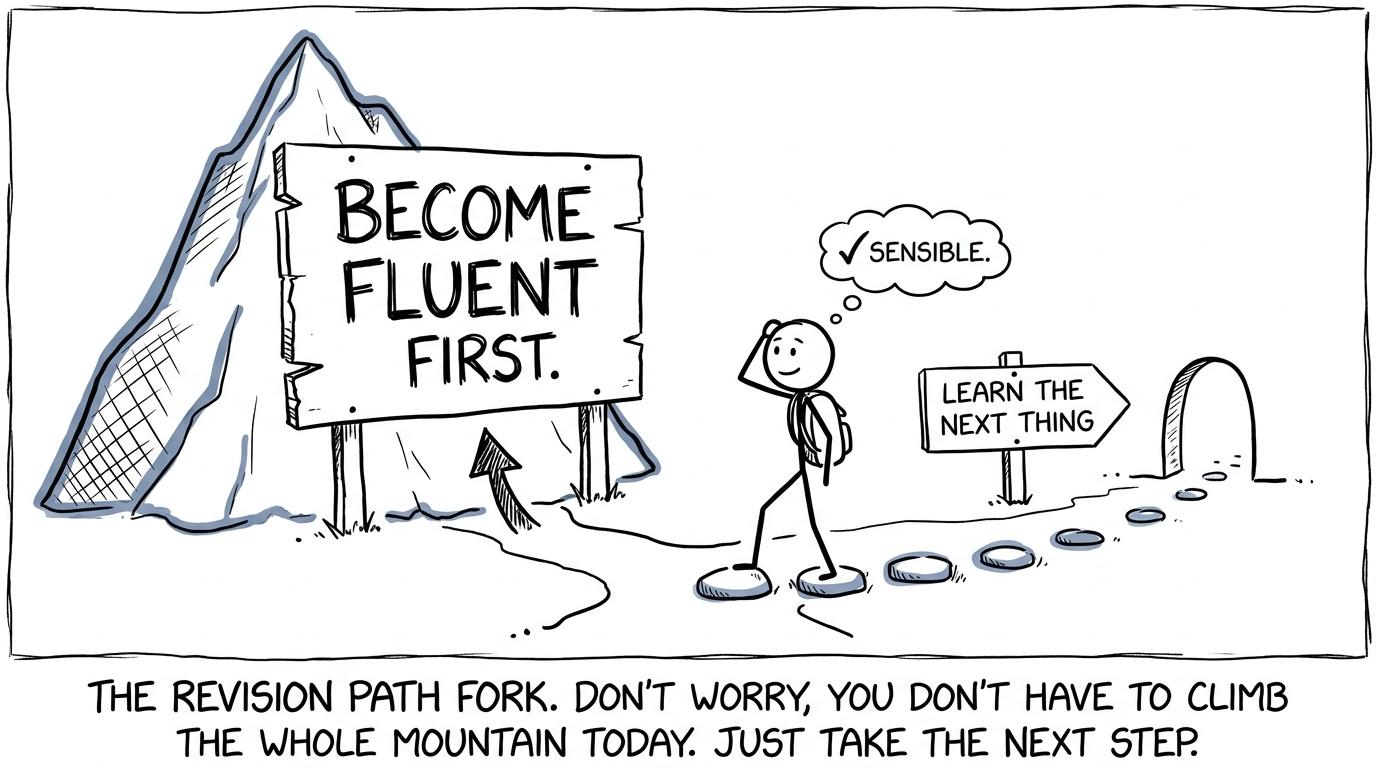 A student choosing steady learning steps instead of climbing the mountain of fluency
What does fluency mean in GCSE Biblical Hebrew?
The word fluent can create the wrong picture. In a modern language, it often suggests holding conversations, understanding speech and responding naturally. Biblical Hebrew is assessed as an ancient language, so the destination is different.
The current Pearson Edexcel GCSE specification develops students’ ability to read and understand unseen passages, translate into English, recognise grammatical structures and study prescribed literature. Students also encounter an assessment choice involving either grammatical understanding or translation of simple English sentences into pointed Biblical Hebrew.
There is no speaking or listening assessment. You are not preparing to order food, discuss weekend plans or understand a live conversation. Your developing fluency is primarily reading fluency: recognising forms accurately enough to work out what a passage means.
That distinction matters. A student can begin with no conversational Hebrew and still follow the course successfully. Equally, someone who speaks Modern Hebrew may possess useful familiarity with the script and vocabulary but still need to learn the specific grammar, forms and conventions of Biblical Hebrew.
How much prior knowledge do you actually need?
Formally, none. In practice, a small foundation reduces the number of new things competing for your attention in the first few lessons.
Knowledge that is helpful before starting
If possible, become familiar with:
- the consonantal alphabet and final letter forms;
- the fact that Hebrew is read from right to left;
- the purpose of vowel pointing;
- the idea that words may change form to communicate grammatical information;
- basic English grammar terms such as noun, verb, adjective, pronoun, subject and object.
You do not need perfect handwriting, instant recognition of every vowel sign or a memorised dictionary. The aim is simply to make the page feel less unfamiliar.
Think of it like starting algebra. You do not need to know every equation before beginning GCSE maths, but comfort with arithmetic gives you more attention for the new method. MathsGenie’s guide to the best order for learning GCSE maths topics follows the same principle: secure a manageable foundation, then add complexity in a sensible order.
Knowledge you are not expected to bring
A beginner is not expected to arrive able to:
- translate unseen biblical passages;
- identify every verb form immediately;
- analyse literary features in Hebrew;
- recall the full specification vocabulary;
- explain complex syntax;
- speak Biblical or Modern Hebrew fluently.
Those are not entry tickets. They are areas of knowledge and skill developed through the course.
What the GCSE course will expect you to learn
The qualification is currently offered by Pearson Edexcel under specification code 1BH0. It is a grades 999-111 qualification with language and literature components.
The language component requires more than recognising isolated words. Students learn to interpret vocabulary in context, understand morphology and syntax, translate accurately into English and respond to questions about unseen material. The specification includes a defined core vocabulary list; words outside that list may receive assistance under the conditions explained by Pearson.
The literature component involves prescribed passages from the Hebrew Bible. Set texts can change between examination cycles, so always use the specification and set-text information for the year in which you will sit the examination. For examinations from 202620262026 to 202820282028, Pearson identifies passages concerning Joseph’s rise to power in Genesis and the miracles of Elisha in Kings.
The important lesson is not that you should know these passages before enrolling. It is that the course has a defined destination. Before buying books or memorising chapters independently, confirm your examination year and ask your teacher which specification materials your class will use.
A sensible way to prepare from scratch
Preparation should make the beginning easier, not attempt to replace the course. A short routine is usually more sustainable than trying to become “fluent” during one holiday.
Begin with script recognition
Learn a few letters at a time, including their printed forms and sounds. Practise reading from right to left and notice final forms where relevant. Keep sessions short enough that concentration remains high.
Do not demand speed immediately. Accurate recognition comes first; speed grows through repeated exposure.
Add vowel pointing gradually
Once several consonants feel familiar, learn the main vowel signs in the order recommended by your teacher or introductory course. Your goal is to connect the visible marks with pronunciation and word recognition, not to master every exceptional detail before term begins.
Refresh English grammar
Students sometimes blame Hebrew when the actual obstacle is an unfamiliar grammatical label. Make sure you can identify common word classes and understand ideas such as tense, person, number and gender.
This is similar to revising a prerequisite maths skill before a harder topic. The MathsGenie GCSE maths revision hub lets maths students return to an earlier lesson whenever a missing foundation blocks progress. Use the same principle in Hebrew: step back, repair the precise gap and continue.
Build a small vocabulary habit
Learn vocabulary in both directions where appropriate, but prioritise recognition within short contexts rather than memorising a long, disconnected list. Frequent retrieval is more useful than repeatedly reading the same page.
A simple session might contain alphabet recall, a small vocabulary set and one grammar idea. Maths students can see the same compact structure in the 20-minute GCSE revision routine.
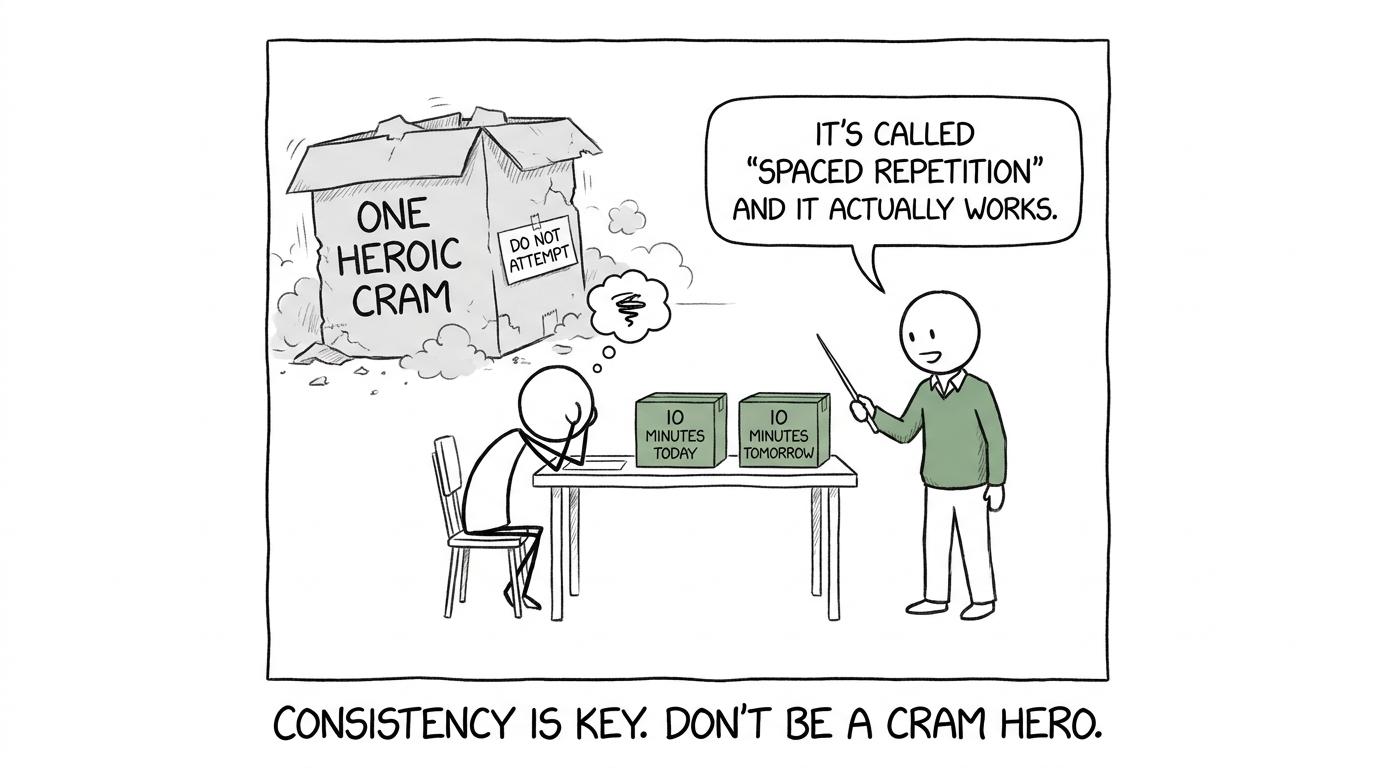 A student choosing two small daily revision boxes while one heroic cram collapses
How to balance Biblical Hebrew with GCSE maths
The real challenge may not be whether you can start Hebrew. It may be fitting another demanding subject around maths, English, science and everything else.
Avoid giving every subject equal time automatically. Instead, plan around upcoming assessments, current weaknesses and the type of practice each subject needs. Hebrew may need frequent vocabulary retrieval; maths may need written problem-solving and examination questions.
Use the MathsGenie GCSE revision timetable to organise your maths sessions, then place shorter Hebrew recall sessions around them. A realistic weekly pattern is better than an impressive plan that survives for three days.
MathsGenie’s resources are maths-specific, not Biblical Hebrew lessons. However, its revision process transfers well:
- learn one clearly defined idea;
- practise it without copying;
- check your work against reliable answers or a mark scheme;
- record the exact mistake;
- return to the skill after a short gap.
For maths, mini tests provide quick evidence of what needs attention. In Hebrew, a teacher-created vocabulary quiz, short parsing task or translation check can perform the same diagnostic role.
When should you ask for extra support?
Starting from scratch is permitted, but the pace and teaching arrangements still matter. Before enrolling, ask:
- Is the class designed to accept complete beginners?
- How much teaching time is available each week?
- What alphabet and grammar work is covered at the beginning?
- Which examination series and set texts will the class follow?
- What independent work is expected?
- Who will mark translations and explain grammatical errors?
This is particularly important if the course is being taught intensively or outside your normal timetable. “No prior-learning requirement” describes the qualification, but your school can explain how its particular course supports beginners.
Common mistakes when preparing for GCSE Biblical Hebrew
Confusing Biblical Hebrew with Modern Hebrew
The two are related, but they are not interchangeable qualifications. Do not assume that a Modern Hebrew app or conversational course covers the grammar, vocabulary and literary analysis required by the Biblical Hebrew specification.
Trying to learn everything before the course
This turns preparation into a private version of the entire GCSE. Learn enough to reduce initial friction, then let the course provide sequence, feedback and depth.
Memorising without retrieving
Reading a vocabulary list creates familiarity, but familiarity is not reliable recall. Close the book, test yourself, check the answer and repeat missed words later.
Ignoring small errors
A missed letter, vowel sign or grammatical ending may alter how a form is understood. Record recurring mistakes precisely. Maths students can apply this habit using MathsGenie’s guide to finding your weakest GCSE topics.
Using examination material too early
Past papers are valuable once you understand enough content to learn from them. Beginning with a full paper on day one may measure inexperience rather than guide improvement. In maths, the same progression is explained in when to start GCSE past papers.
You need a starting point, not fluency
You do not need to be fluent before starting GCSE Biblical Hebrew, and the official qualification does not require previous study. What you need is a course that genuinely accommodates beginners, a willingness to learn the script and grammar, and a routine built around small amounts of accurate practice.
Start with the alphabet. Learn how the writing system works. Refresh essential grammar terminology. Then allow fluency to be the result of the journey rather than the price of admission.
For your maths alongside Hebrew, make MathsGenie’s free GCSE revision resources your base. Use revision lessons and practice questions to build each topic, mini tests to expose gaps, and past papers, predicted papers, mark schemes and video solutions to prepare for the examination. One subject at a time, one clear next step at a time.










