

First-Generation A-Level Results Day Guide
First-generation university A-level results explained calmly: prepare for results day, understand UCAS decisions and take confident next steps.

Results day can feel as though everyone else received an instruction manual years ago. Family conversations are full of unfamiliar terms: firm choice, insurance, confirmation and Clearing. If you are the first in your family to university, you may be learning the process while living through it.
This first-generation university A-level results guide gives you the manual. For 2026, A-level results day is Thursday 13 August in England, Wales and Northern Ireland. Your immediate job is simple: obtain your grades, check your UCAS application, understand the decision and ask for help before making any irreversible choice.
Your results day checklist
Before the detailed walkthrough, save this short list:
- Check how and when your school or college will release results.
- Find your UCAS sign-in details and Personal ID.
- Keep your phone charged and monitor your email.
- Save the contact details for your firm and insurance universities.
- Write down two or three alternative courses you would genuinely consider.
- Arrange access to a teacher, careers adviser or trusted adult.
- Do not decline a confirmed place until you understand the consequences.
Preparation does not guarantee a particular result. It does something nearly as useful: it reduces the number of decisions you must make while emotional.
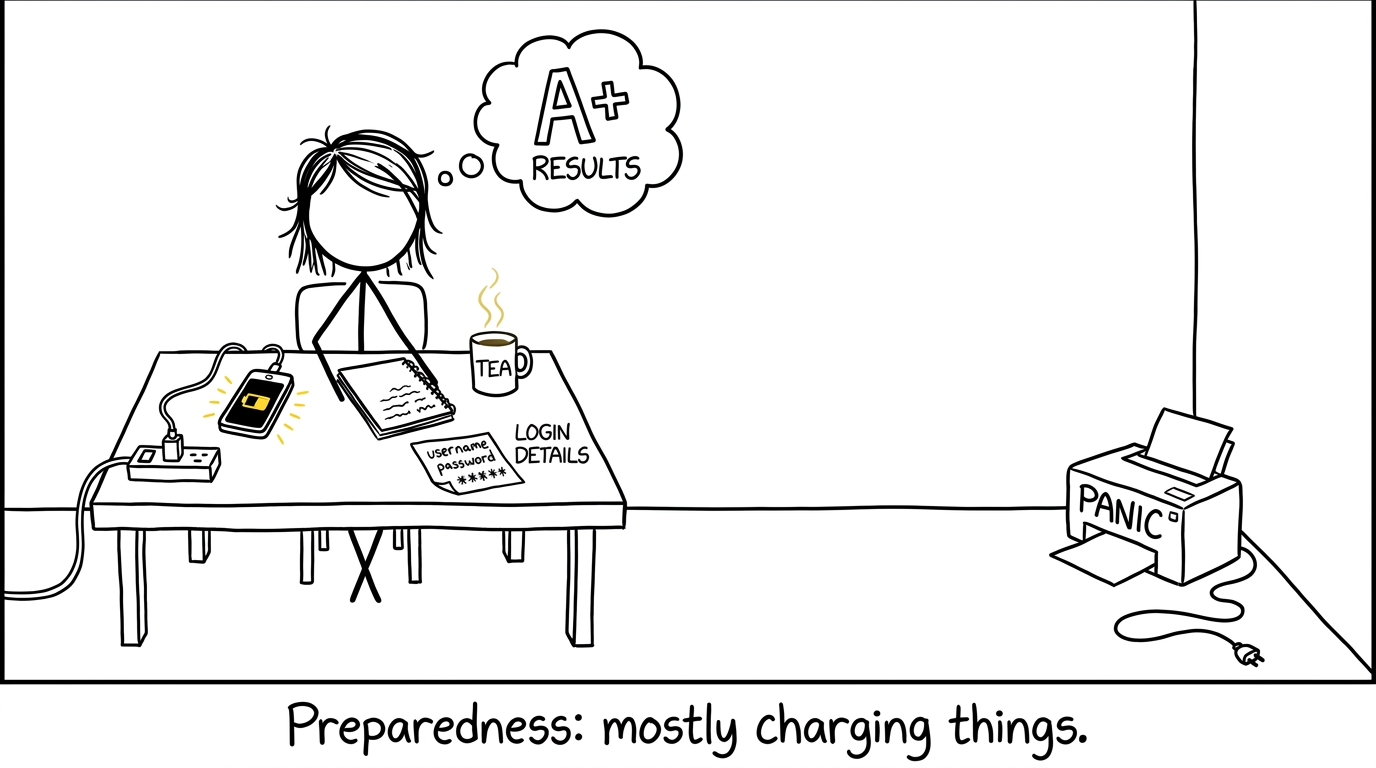 A prepared student treats login details and a charged phone like results-day superhero equipment
Step one: prepare before results day
Check your school's collection time and whether results will be provided in person, by email or through a secure portal. UCAS shows the status of your application, but your school or college provides your actual grades.
Confirm that you can access your UCAS account and the email address attached to it. UCAS advises applicants to update their contact details and remain available because it cannot normally discuss an application with somebody else unless nominated access has been arranged.
Create one results-day page containing:
- your UCAS Personal ID;
- your firm and insurance course details;
- university admissions telephone numbers;
- your school or college contact;
- your GCSE and A-level qualification details;
- questions you want to ask about courses, accommodation or support.
If nobody at home has experienced university admissions, ask a teacher or careers adviser whether they will be available. Seeking informed help is not surrendering independence. It is using the system properly.
Step two: collect your grades and check UCAS
On results morning, obtain your grades and sign in to your UCAS application. Most A-level results are passed from awarding organisations to UCAS and then to universities, but applicants should check whether any qualifications must be sent separately.
Your application may show that your firm place is confirmed, your insurance place is confirmed, a decision is pending, an alternative course has been offered, or you are eligible for Clearing.
Read the exact wording. A pending decision does not automatically mean rejection. A university might still be considering your application or waiting for information. Check your messages and contact admissions if the reason is unclear.
Universities sometimes accept applicants who narrowly miss their conditions, but this is never guaranteed. Let the official decision guide your next action rather than trying to predict it from your grades alone.
Step three: follow the route shown in your application
If your firm place is confirmed
Your first-choice university has accepted you. Read its messages and check your applicant portal for enrolment, accommodation and other next steps. If your course or institution has changed, make sure the details held by your student finance provider are accurate.
You do not need to prove that you understand everything immediately. University teams routinely answer questions about registration, accommodation, disability support, bursaries and travel.
If your insurance place is confirmed
Your firm choice has not been confirmed, but your insurance university has accepted you. Revisit the course information rather than treating it as an inferior outcome. Check the modules, location, accommodation and support available, then follow the university's instructions.
If your decision is pending
Check whether UCAS or the university has requested information. If there is no explanation, telephone admissions with your Personal ID and grades ready. Stay polite and take notes, including the name of the person you spoke to and what they advised.
If you have no confirmed place
This is where Clearing may help. It is not a punishment or a list of courses nobody wanted. It is the UCAS process through which universities fill remaining places and applicants find available courses.
For 2026 entry, UCAS states that Clearing runs from 2 July to 19 October. Availability changes, particularly around results day, so research current vacancies rather than relying on an old list.
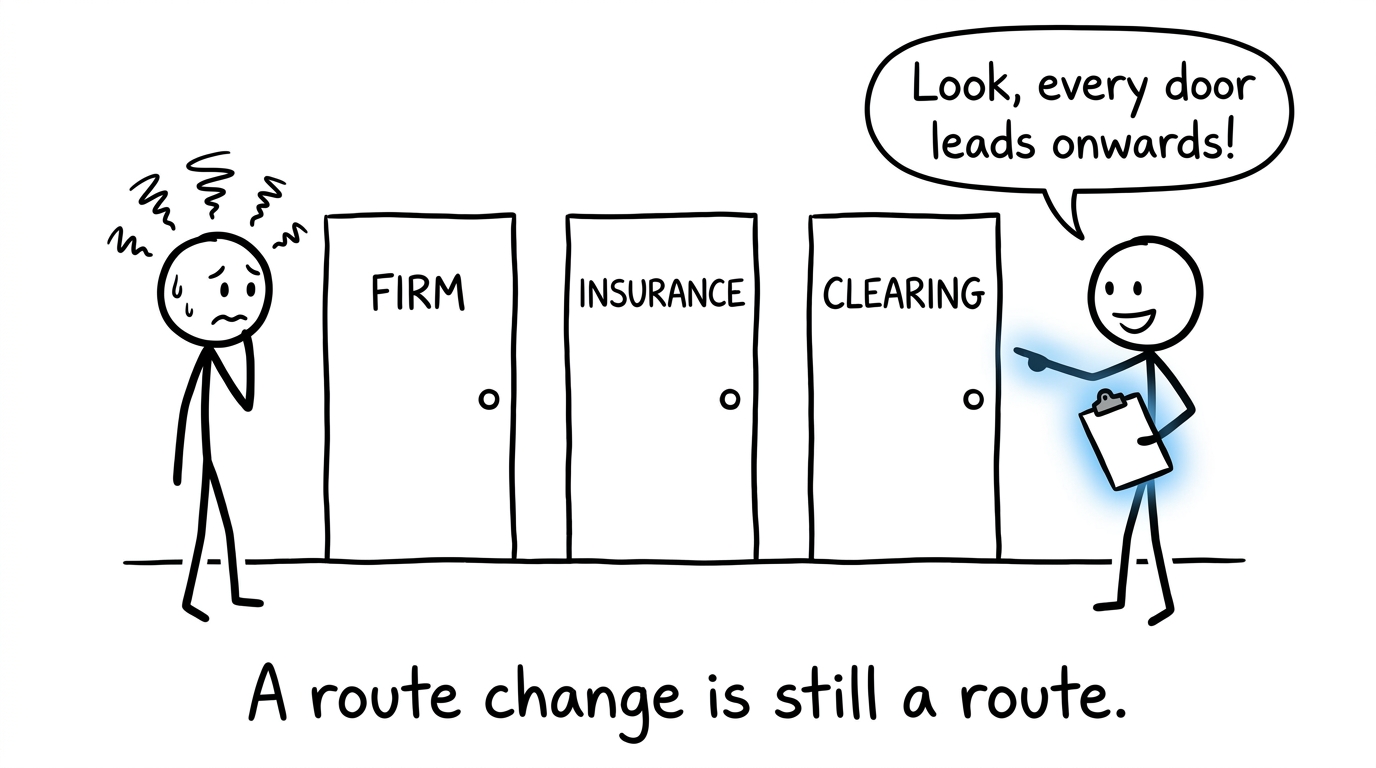 A student discovers that firm, insurance and Clearing are all routes forwards
Step four: use Clearing without rushing
Search for courses you would genuinely be willing to take. Compare course content, location, accommodation, costs and entry requirements. A familiar university name is less important than whether the course suits your plans.
Contact the university before adding a Clearing choice. Be ready to explain:
- your grades and qualifications;
- why the subject interests you;
- why that particular course appeals to you;
- any relevant experience;
- questions you have about accommodation and student support.
If a university gives you permission or an offer through Clearing, follow its instructions and add the choice in UCAS. Do not add a course speculatively without first speaking to the institution.
If you already hold a confirmed place but are considering declining it, speak to an adviser and the prospective new university first. Using the UCAS decline option cancels the place you hold. That is a serious decision, not a button to press while browsing.
For further guidance as the admissions cycle develops, use the MathsGenie revision blog to find our latest Clearing and UCAS explainers.
Step five: question an unexpected result correctly
If a grade looks unexpectedly low, speak to your school or college immediately. It can obtain information about post-results services and may request access to a script or a review of marking.
A review is not simply a second attempt to gain extra marks. The exam board checks for marking errors, and the mark or grade can rise, remain unchanged or fall. Your school may need your consent, a fee may apply, and deadlines vary by board and service.
Where a university place depends on the outcome, ask about a priority review and contact the university promptly. Explain that a review is being considered or requested, but do not assume the institution can hold the place indefinitely.
Step six: use support without apologising
Being first in your family to university can create an odd pressure: you may feel responsible for understanding a system nobody around you has used. But universities, schools and UCAS all have staff whose role is to explain it.
Ask direct questions. What happens next? Is this offer confirmed? When is the deadline? Who should receive this document? Can you email that information to me?
Keep a written record. Processes become less intimidating when converted into names, dates and actions.
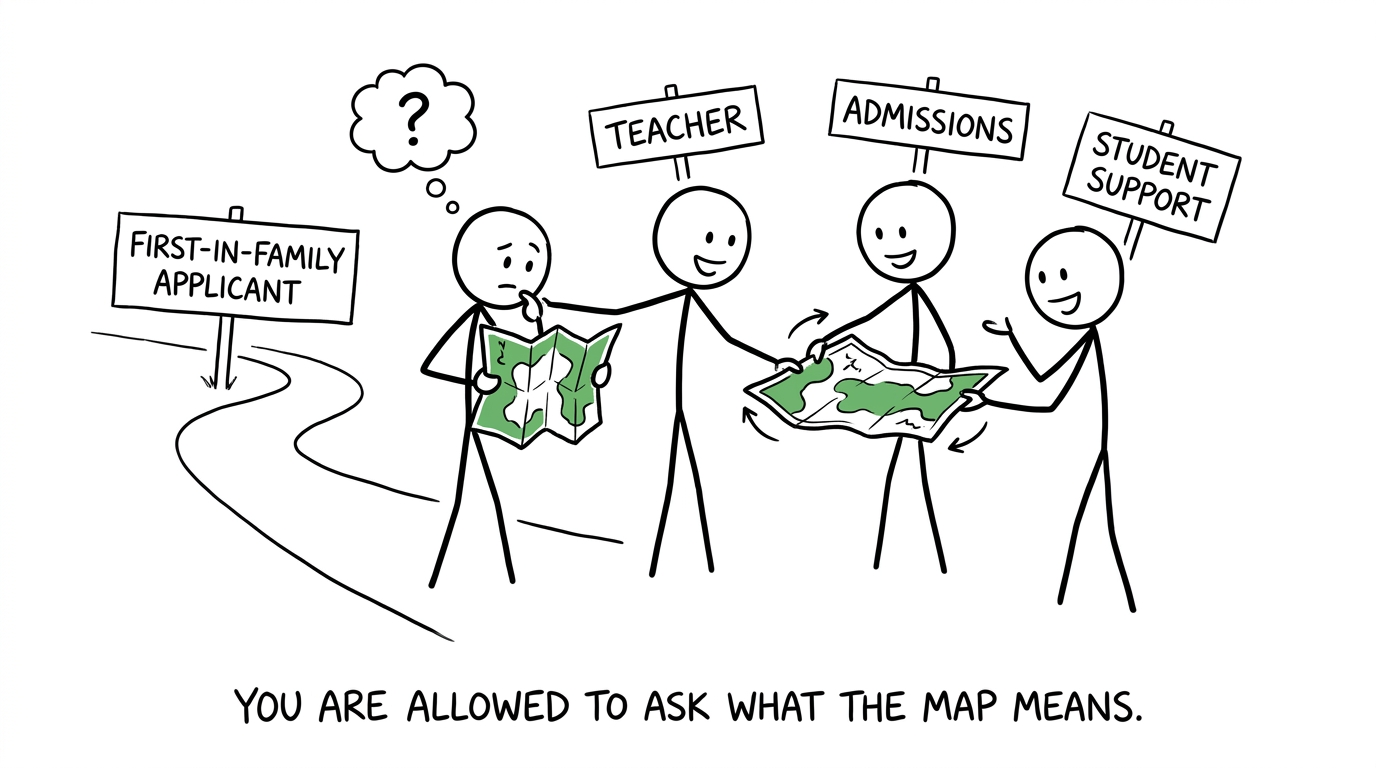 A first-in-family applicant gets help turning the university map the right way up
What GCSE students can do now
If you are currently preparing for GCSEs, results day and university may feel distant. Yet the useful habit begins now: learn to work with evidence rather than panic.
Use the GCSE Maths revision hub to match resources to Edexcel, AQA, OCR or Eduqas. Diagnose gaps with GCSE Maths mini tests, then learn how to turn every paper into feedback with the guide to using GCSE past papers properly.
Edexcel students can combine GCSE Maths revision lessons and questions with the predicted papers and short-test resources. If A-level maths becomes part of your route, the Edexcel A-level Maths revision hub brings together lessons, questions, papers and mark schemes.
Common results day mistakes
Checking rumours instead of your application: Group chats cannot confirm your place. Use your official results, UCAS account and university messages.
Assuming missed grades mean automatic rejection: Read the decision. A university may still be considering you.
Calling without your information ready: Keep your Personal ID, grades, course details and questions beside you.
Accepting an unsuitable course through panic: Clearing can move quickly, but you should still examine the course and practical details.
Declining a confirmed place too early: Once declined through UCAS, that place is cancelled. Take advice first.
Treating a review as risk-free: A reviewed mark can go up, stay the same or go down.
Your next step is the one that matters
A-level results day is not a judgement on whether you belong at university. It is a decision point with several possible routes. Collect the facts, ask for explanations and take one deliberate action at a time.
Long before that morning arrives, MathsGenie can help you build the habits that make important days calmer. Start with free revision lessons and practice questions, test yourself with mini tests, then use past papers, predicted papers, mark schemes and video solutions to turn uncertainty into a clear revision plan.










