Feeling Behind in GCSE Geography? How to Catch Up
Feeling behind GCSE geography is common. Learn how to identify gaps, build a calm catch-up plan and strengthen geographical and numerical skills for exams.
Feeling behind GCSE geography can feel strangely personal. A classmate remembers every case study. Someone else seems effortless with fieldwork. Meanwhile, your notes contain half-finished diagrams and place names you barely recognise.
The useful answer is simple: yes, feeling behind is normal, and it does not mean you cannot catch up. GCSE Geography is a broad course combining knowledge, interpretation, fieldwork, numerical skills and extended writing. You may be secure in some areas while feeling lost in others. The solution is not to revise everything at once. It is to identify the precise gaps, prioritise them and work through a calm cycle of recall, practice, marking and correction.
Your quick catch-up checklist
Start here before building a detailed timetable:
- Confirm your exam board and specification: AQA, Edexcel, OCR or Eduqas.
- List the physical geography, human geography, fieldwork and skills topics you have covered.
- Mark each topic green, amber or red according to what you can do without notes.
- Choose three red areas rather than trying to repair the entire course.
- Practise recalling knowledge before rereading it.
- Answer exam questions and use the mark scheme to identify missing detail.
- Revisit corrected material several days later.
- Keep maths revision moving alongside geography rather than abandoning one subject for the other.
That final point matters. Students preparing for several GCSE exams rarely have the luxury of focusing on one subject for a week. A catch-up plan must fit your real timetable.
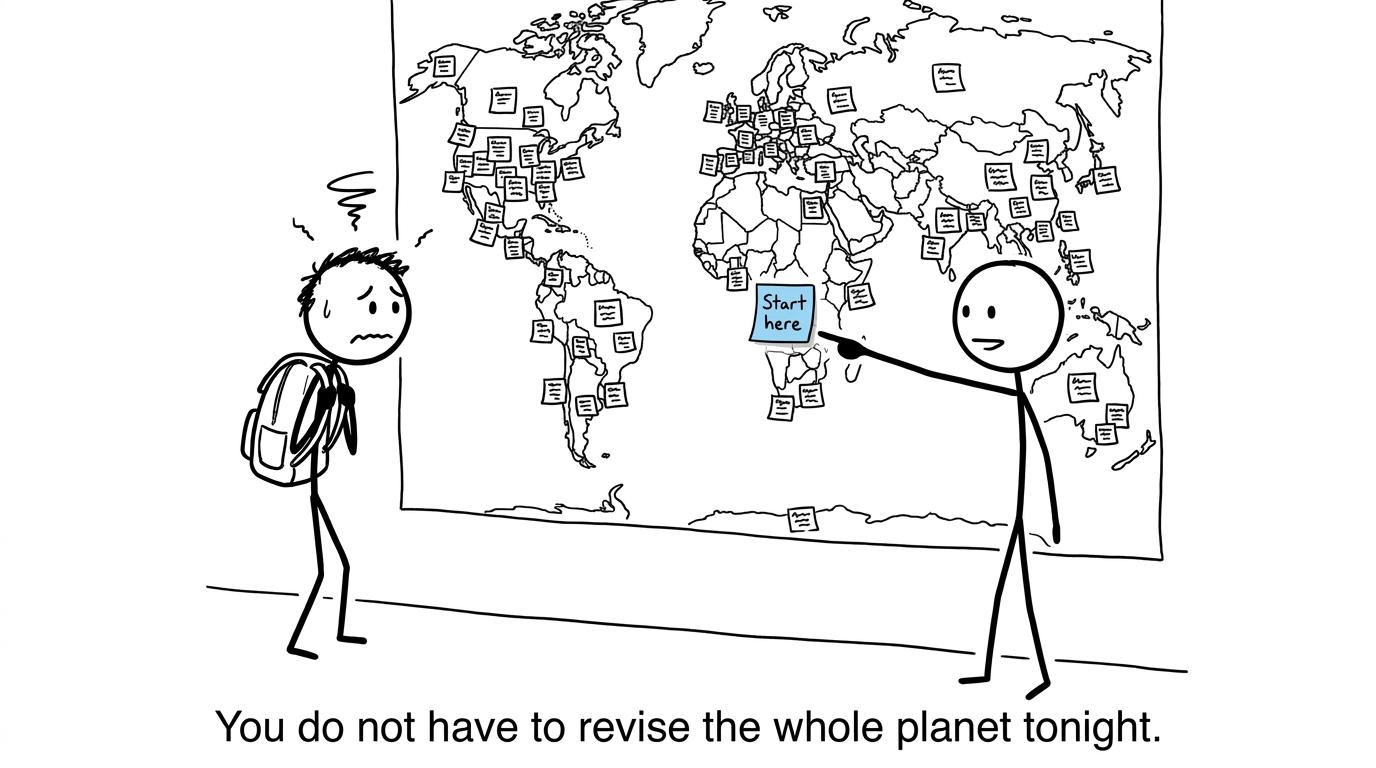 A student is reminded that they do not need to revise the whole planet tonight
Why feeling behind in GCSE Geography is so common
GCSE Geography can create an unusual illusion. Lessons move between rivers, cities, ecosystems, economic development, hazards, resources, maps and fieldwork. Because the topics look different, the course can appear larger than it really is.
There is also more than one kind of success. A student might know a case study thoroughly but struggle to interpret an unfamiliar graph. Another might understand coastal processes but lose marks because their extended answers are not developed. Comparing yourself with either student gives you an incomplete picture.
The official assessment objectives across GCSE Geography require more than recall. Students must demonstrate knowledge, explain geographical relationships, apply understanding, interpret evidence, evaluate issues and use geographical skills. Fieldwork is assessed through the examinations, while maps, graphs, numerical information and unfamiliar resources can appear across papers. Your sense of being behind may therefore come from one weak component rather than the whole subject.
That distinction changes everything. “I am behind at geography” is too large to act on. “I cannot explain my urban case study without notes” is a problem you can solve.
Find out what “behind” actually means
Do not begin by copying a new set of beautiful notes. Begin with an audit.
Divide your specification into four broad areas:
| Area | What to check |
|---|---|
| Physical geography | Processes, landforms, hazards, ecosystems and named examples |
| Human geography | Urban change, development, resources and named examples |
| Fieldwork | Enquiry question, methods, results, conclusions, limitations and improvements |
| Geographical skills | Maps, scale, graphs, statistics, data interpretation and judgement |
For each area, ask three questions:
- Can I recall the essential knowledge without looking?
- Can I apply it to an unfamiliar source or question?
- Can I communicate an answer that matches the command word?
A green rating should mean that you can answer independently, not merely that the page looks familiar. Amber means partial recall or inconsistent application. Red means you cannot yet explain or use the material confidently.
This produces a map of the problem. Maps are useful precisely because they reduce a large landscape to something navigable.
Build a catch-up plan without panicking
Panic encourages breadth: open every book, highlight every page and make an enormous timetable. Progress usually requires the opposite. Narrow the task.
Choose three priorities
Select one knowledge gap, one skills gap and one exam-technique gap. For example, those categories might be:
- knowledge: a physical process or named example;
- skills: interpreting a choropleth map or statistical graph;
- technique: developing an evaluation rather than listing ideas.
This gives your week balance. It also stops familiar case-study revision from crowding out the less comfortable skills that may be costing marks.
Use a repeatable revision cycle
For each priority:
- Recall: write or say what you remember without notes.
- Check: compare your recall with your specification, class materials or revision guide.
- Repair: learn only the missing or inaccurate parts.
- Practise: answer an appropriate exam-style question.
- Mark: use the mark scheme and teacher feedback carefully.
- Return: test the same content again after a gap.
Retrieval practice and spacing are more useful for durable learning than repeatedly reading the same material. They can feel harder because they reveal what you do not know. That difficulty is information, not failure.
Maths students can see the same principle in the GCSE one-month revision plan: diagnose, practise, mark, repair and revisit. The subject changes, but the learning cycle remains useful.
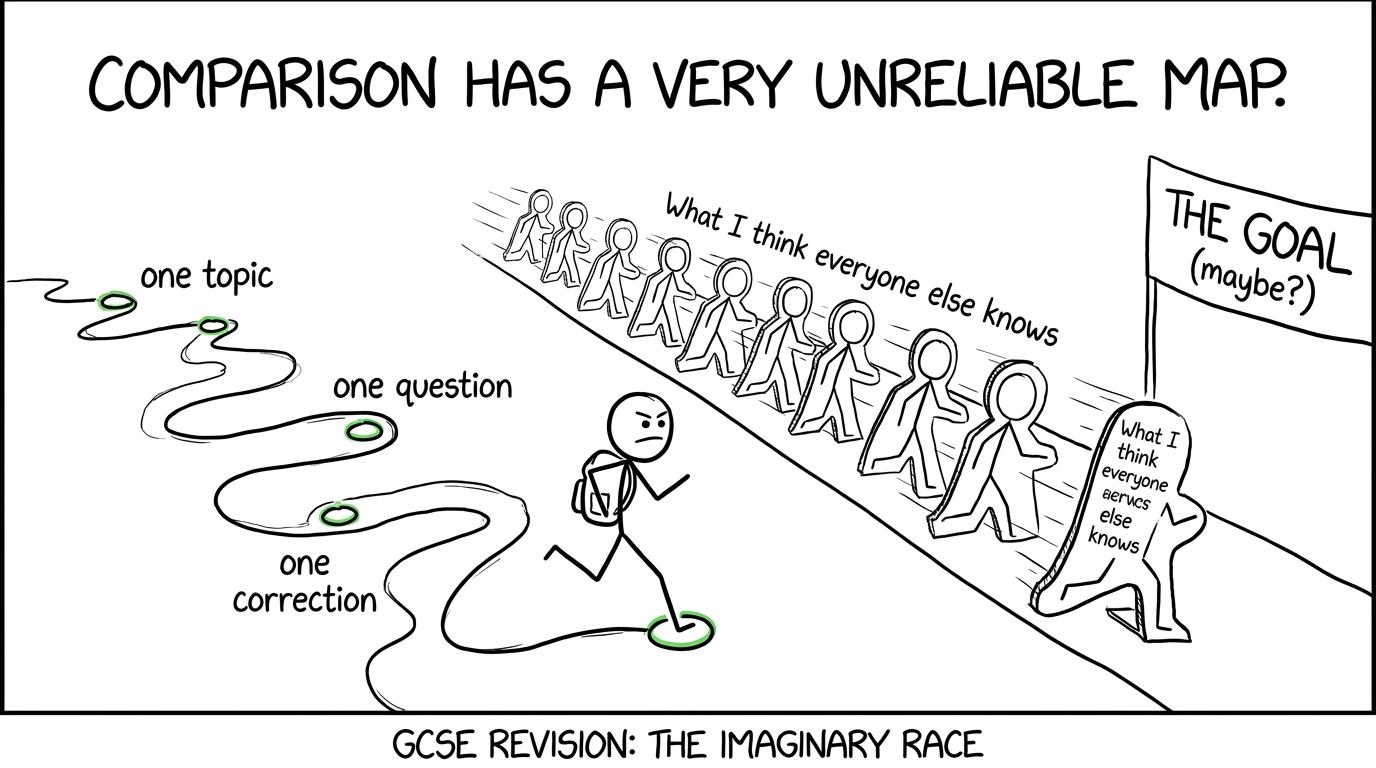 Comparison runs against cardboard competitors while progress follows real checkpoints
Revise knowledge, application and skills differently
A single revision method cannot do every job.
Knowledge needs active recall
Case studies and processes need organised recall. Reduce each one to a manageable framework: location, causes, effects, responses and the geographical idea it demonstrates. Then retrieve that structure without looking.
Avoid collecting disconnected facts. A specific detail is valuable when it supports an explanation or judgement. Ask what each fact helps you prove.
Application needs unfamiliar material
Exam questions may provide maps, photographs, graphs, tables or written sources. Practise looking at an unfamiliar resource and asking:
- What pattern is visible?
- What evidence supports that description?
- Which geographical process could explain it?
- Is there an anomaly or limitation?
- What conclusion is justified by the evidence?
This is where students sometimes mistake recognition for readiness. Knowing a definition does not automatically mean you can apply it in a new context.
Extended answers need deliberate structure
Read the command word before planning. “Describe”, “explain”, “assess” and “evaluate” ask for different thinking. For longer answers, select a small number of relevant ideas, develop the links between cause and consequence, use evidence where appropriate and finish with a judgement that answers the exact question.
Do not memorise one paragraph and force it into every question. Learn flexible knowledge, then shape it around the task.
Do not ignore the maths inside geography
Geographical skills include numerical and statistical work. Depending on the specification, this can involve scale, distance, proportion, percentages, averages, spread, graphs, trends, interpolation and the evaluation of data. AQA explicitly assesses cartographic, graphical, numerical and statistical skills throughout its written papers, and other exam boards include comparable skills.
If this is one source of feeling behind, repair the underlying maths rather than memorising isolated geography answers. MathsGenie’s AQA Geography statistical skills guide covers averages, spread, percentage change, scatter graphs and data evaluation in a geographical context.
For broader support, use the GCSE Statistics revision hub or practise specific foundations through the AQA averages questions. Edexcel students can also explore the Edexcel GCSE Statistics resources.
The goal is not to turn geography revision into an extra maths course. It is to make sure that a manageable calculation or graph does not block you from demonstrating your geographical understanding.
Make geography fit beside maths revision
If your main pressure is preparing for maths exams, geography cannot consume every available evening. Use short, defined sessions instead.
A sensible weekly pattern could include:
- one session for physical or human geography recall;
- one session for fieldwork or geographical skills;
- one short mixed exam-question session;
- regular maths topic practice on other days;
- one timed maths section or paper when appropriate.
Keep each task specific. “Revise geography” creates friction. “Retrieve the causes and responses for one named example, then answer one question” tells you exactly when the session is complete.
For maths, Edexcel GCSE Maths past papers provide papers, mark schemes and worked solutions where available. Nearer the exams, GCSE predicted papers can provide additional maths rehearsal. Predicted papers should complement official past-paper practice rather than replace it.
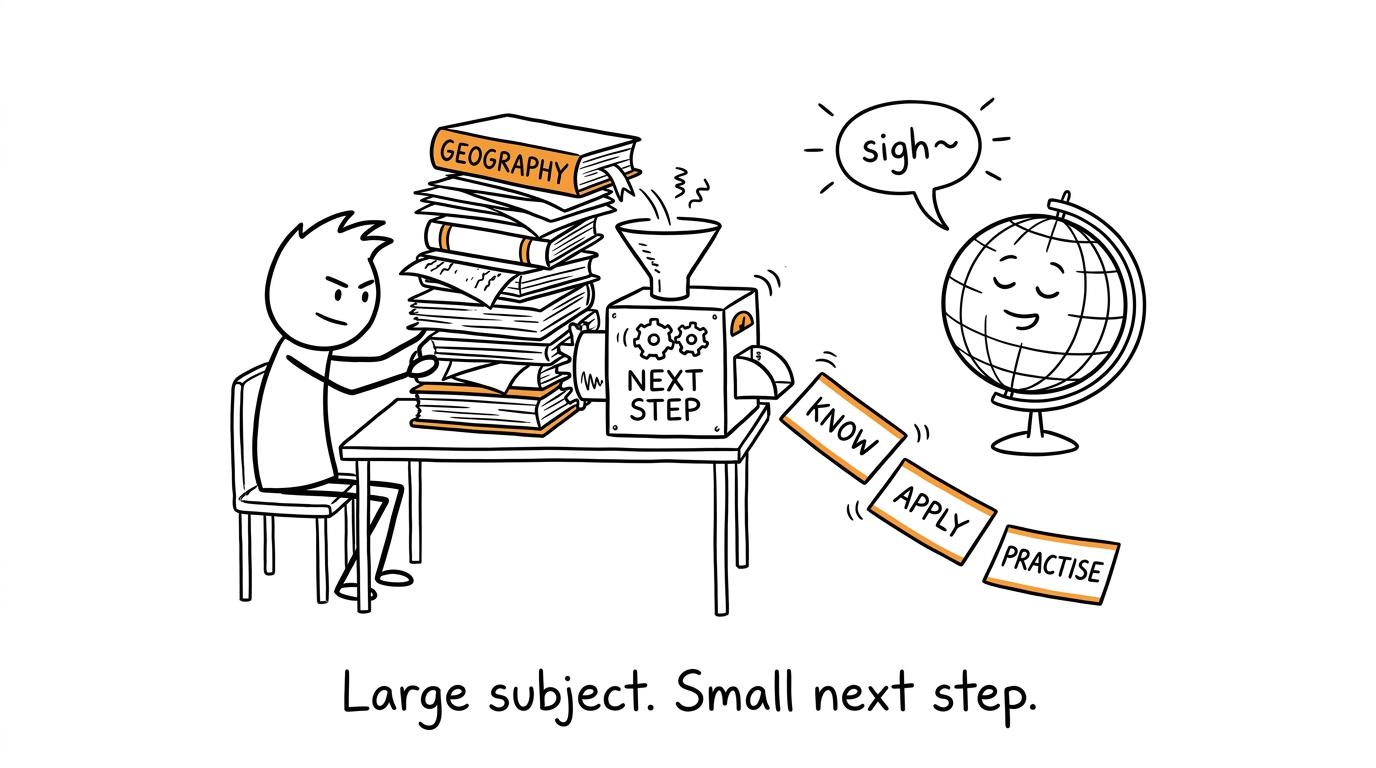 A large geography book is turned into three manageable revision cards
Common mistakes when trying to catch up
Revising the entire course in specification order
Specification order is designed to organise content, not necessarily to prioritise your revision. Start with the gaps that are losing you marks.
Spending too long making notes
Condensing material can help, but copying is not the same as remembering. Close the book and retrieve the content regularly.
Memorising case studies without understanding them
A list of facts is fragile. Connect evidence to processes, consequences and possible judgements so you can adapt it to different questions.
Avoiding fieldwork
Your own fieldwork may feel distant, but you should be able to explain the enquiry process, data-collection methods, presentation, conclusions, limitations and realistic improvements. Do not revise only the location.
Treating every low mark as a knowledge problem
You may have misread the command word, failed to use the resource, given an undeveloped explanation or omitted a conclusion. Classify the error before deciding what to revise.
Comparing hours instead of evidence
Someone saying they revised for an entire weekend tells you little about what they can retrieve or apply. Measure your progress through corrected questions, stronger recall and fewer repeated errors.
You are not required to catch up all at once
Feeling behind is uncomfortable because it turns the whole course into a single judgement. A useful revision plan turns that judgement back into separate tasks.
Confirm your specification. Audit your knowledge and skills. Choose three priorities. Recall, practise, mark, correct and return. Then repeat. If worry about exams is disrupting sleep, school or daily life, speak to a parent, carer, teacher or another trusted adult rather than trying to manage it alone.
MathsGenie can support the numerical side of geography while keeping your GCSE maths preparation organised. Use the free revision lessons and practice questions to repair weak skills, mini tests to check progress, past papers and mark schemes to understand where marks are awarded, video solutions when a method is unclear, and predicted papers for focused maths practice near the exams.
You do not need to feel fully caught up before beginning. Beginning is how you catch up.