Extra Practice Material GCSE Spanish: How to Ask
Extra practice material GCSE Spanish can target weak skills. Learn how to ask your teacher confidently, use feedback and balance your maths revision.
There is an awkward moment familiar to many GCSE students. You know you need more practice, but asking for it can feel as though you are admitting you have not used the work already provided. The good news is simple: asking for extra practice material GCSE Spanish is worthwhile when you explain what you have attempted, identify the skill you need to improve and show that you intend to use the material properly.
Your teacher is more likely to respond helpfully to a precise request than to a vague appeal for “more worksheets”. Ask for targeted practice in listening, speaking, reading, writing, translation, dictation, vocabulary or grammar. Then agree on when you will complete it and how you will check your answers.
For students preparing for maths exams at the same time, the aim is not to create an impossible pile of work. It is to make each revision session more useful.
A quick checklist before asking your teacher
Before you approach your Spanish teacher, check that you can answer these questions:
- Which exam board and tier are you taking?
- Which Spanish skill is costing you marks?
- What practice have you completed already?
- Is there one recent task that demonstrates the problem?
- What kind of resource would help: questions, audio, a speaking prompt or feedback?
- When will you complete the extra work?
- How will you avoid neglecting GCSE maths and your other subjects?
This preparation changes the meaning of your request. You are not saying, “Give me more work because I do not know what to do.” You are saying, “I have found a specific gap and would like help closing it.”
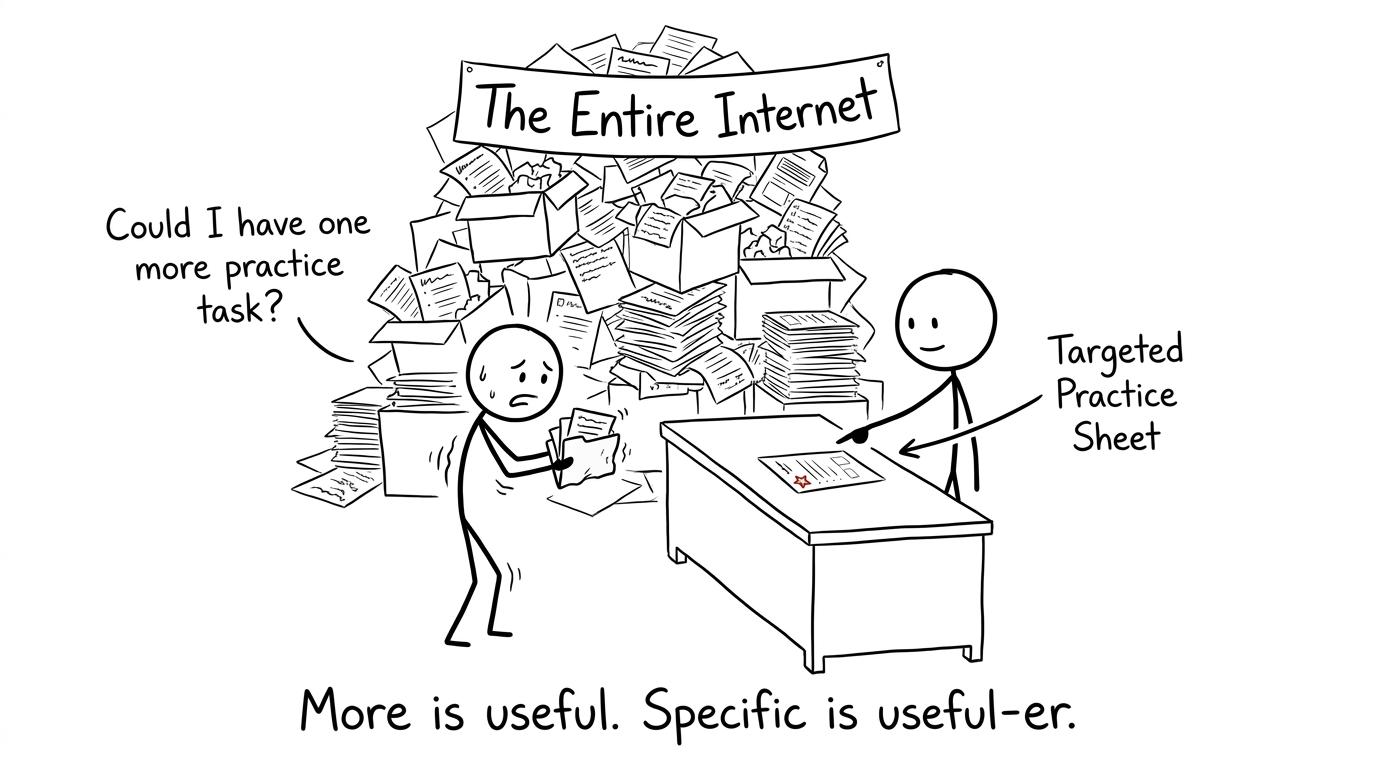 Student asking a teacher for one targeted practice task rather than collecting random worksheets
Is extra GCSE Spanish practice material actually worth asking for?
Usually, yes, but only when the material has a purpose.
Current GCSE Spanish courses assess several connected abilities. Depending on your exam board, these include understanding spoken and written Spanish, speaking, writing, translation, grammar, vocabulary and pronunciation-related tasks. The reformed French, German and Spanish GCSE specifications in England were first taught from September 2024 and first assessed in summer 2026. Their precise paper structures vary, so practice should match your own specification rather than an old worksheet found at random.
AQA, for example, assesses listening, speaking, reading and writing through four components. Its current assessment includes tasks such as dictation, reading aloud, role-play and translation. Pearson Edexcel also assesses speaking, listening, reading and writing, but its paper order and task details are not identical. Eduqas students should likewise follow the materials and instructions for their own qualification.
This is one reason your teacher is useful. They know your board, your tier and the point your class has reached. They may also have access to secure assessment material that cannot simply be shared online or taken home. If a teacher says a particular paper is being saved for a mock, that is not a refusal to help. Ask for a similar skill-based task instead.
Extra material is most valuable when it does one of three things:
- isolates a weakness, such as recognising verb forms in listening;
- reproduces the format of an assessment task;
- gives you fresh material after you have corrected an earlier attempt.
Ten unfocused worksheets can create less progress than one carefully chosen task followed by feedback.
How to ask without sounding as though you are not trying
The tone of the request matters less than the evidence behind it. Teachers do not generally expect perfect revision. They do need enough information to recommend something appropriate.
Begin with what you have already done
Briefly state the work you attempted. You might mention a homework task, vocabulary test, speaking response or practice question. There is no need to give a long defence of your effort.
Useful openings include:
- “I completed the listening questions from this week, but I struggled to identify the tense when the speakers talked quickly.”
- “I have corrected my last writing task and would like another short task to see whether I can apply the feedback independently.”
- “I have learnt the vocabulary list, but I need more practice recognising the words in spoken Spanish.”
These are requests based on action. They show that you are not trying to replace your existing work with a new worksheet.
Ask for one specific kind of practice
Avoid asking, “Do you have anything else I can do?” That puts the whole diagnostic job onto the teacher.
Instead, request one manageable resource:
- a short dictation task at your tier;
- a fresh role-play or speaking card;
- a translation matching your exam-board format;
- a grammar task on a named structure;
- a listening exercise with a transcript;
- a writing prompt that allows you to apply recent feedback;
- a short reading task focused on inference or opinions.
If you are unsure what went wrong, bring the marked task and ask which skill should come first. That is still a focused conversation because you are providing evidence.
Explain how you will use the material
A simple plan makes the request credible. Say when you will complete the task and whether you would like an answer sheet, mark scheme or brief feedback.
For example: “Could I complete it by Friday and bring you the two questions I still cannot correct?” This respects your teacher’s time. It also makes clear that you will attempt the work independently before asking for detailed help.
Choose the right moment
Try not to begin a complicated conversation while the teacher is starting a lesson or dealing with several students. Ask briefly after class, during an agreed support session or through the school’s approved messaging system.
You can say: “Could I ask you later about some targeted listening practice?” That gives the teacher an opportunity to choose a suitable time.
Diagnose the weakness before collecting resources
“Spanish” is too broad to be a revision target. So are “listening” and “grammar” unless you inspect the error more closely.
After a marked task, classify the difficulty:
- Knowledge: you did not know the word, phrase or grammatical structure.
- Recognition: you knew it on a vocabulary list but did not recognise it in audio or a text.
- Application: you understood the rule but used it incorrectly in speech or writing.
- Task technique: you misunderstood the instruction, omitted a required detail or gave an answer in the wrong form.
- Timing: you could complete the task, but not quickly enough under assessment conditions.
This resembles productive maths revision. A low mark on an algebra question does not automatically mean “bad at algebra”; the real issue may be factorising, substitution or an arithmetic slip. MathsGenie’s guide to building a GCSE maths revision timetable uses the same principle: diagnose the precise gap, practise it and then retest it.
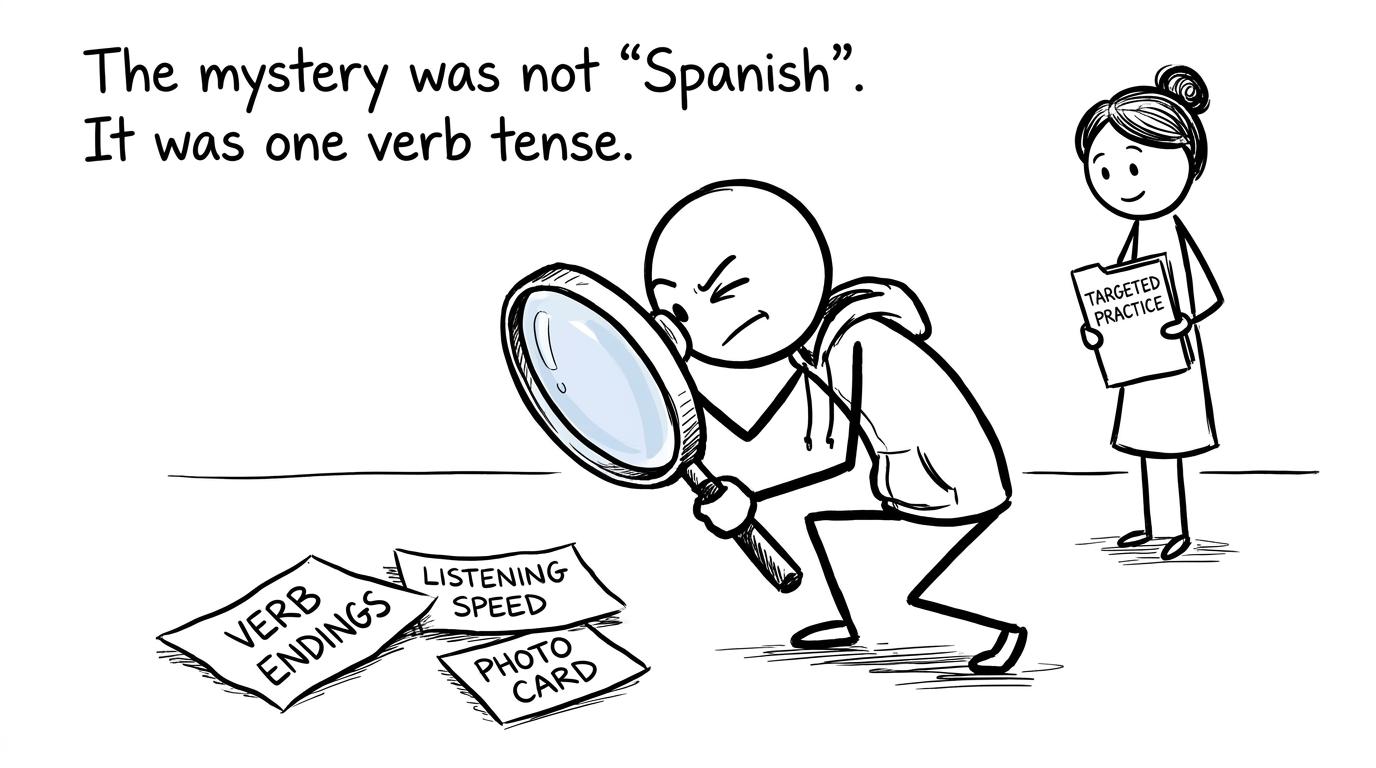 Student acting as a detective to identify one precise Spanish weakness
What to do when your teacher gives you extra material
Receiving a worksheet is not the finish line. It is the beginning of a short learning cycle.
Attempt it without immediate help
Use realistic conditions where appropriate. For a listening task, do not replay each section endlessly unless the exercise is specifically for careful transcription. For writing, complete an initial response without copying a model answer.
Mark and classify the errors
If you have answers or a mark scheme, do more than count correct responses. Record why each mistake occurred. Was it missing vocabulary, a verb ending, a misunderstood negative or failure to answer every part of the task?
Correct the work actively
Rewrite incorrect sections or repeat the speaking response. Merely reading the correct answer can create familiarity without recall. If no answer sheet is available, mark the questions you want to discuss rather than asking your teacher to inspect every line without direction.
Retest the same skill
Ask whether a second, shorter task is available, or adapt the original prompt without memorising an entire model response. Retesting reveals whether the correction has become usable knowledge.
This attempt-mark-fix-retest cycle is equally valuable in maths. MathsGenie’s GCSE mini tests help you test a manageable set of maths skills, while GCSE past papers provide broader exam practice with mark schemes.
Balance Spanish practice with GCSE maths revision
Extra Spanish practice should replace ineffective revision time, not sleep or every session allocated to another subject. A resource is only helpful if you have space to use it properly.
Start by placing fixed commitments and exam dates into the MathsGenie revision planner. Then assign short, clear tasks. “Spanish revision” is vague; “complete one listening task and correct it” is actionable. The same applies to maths: “complete one higher-tier mini test and review two errors” is more useful than “revise maths”.
You can also separate the roles of different resources:
- use targeted questions to repair a weakness;
- use short tests to check recall;
- use full papers to develop timing and stamina;
- use mark schemes and video solutions to understand lost marks;
- use predicted papers near the exam period to encounter fresh exam-style questions.
For maths, choose papers that match your board and tier. MathsGenie provides dedicated collections of Edexcel GCSE Maths past papers and AQA GCSE Maths past papers, alongside GCSE predicted papers. Its one-month GCSE maths revision plan can help you organise this work without allowing one subject to consume the week.
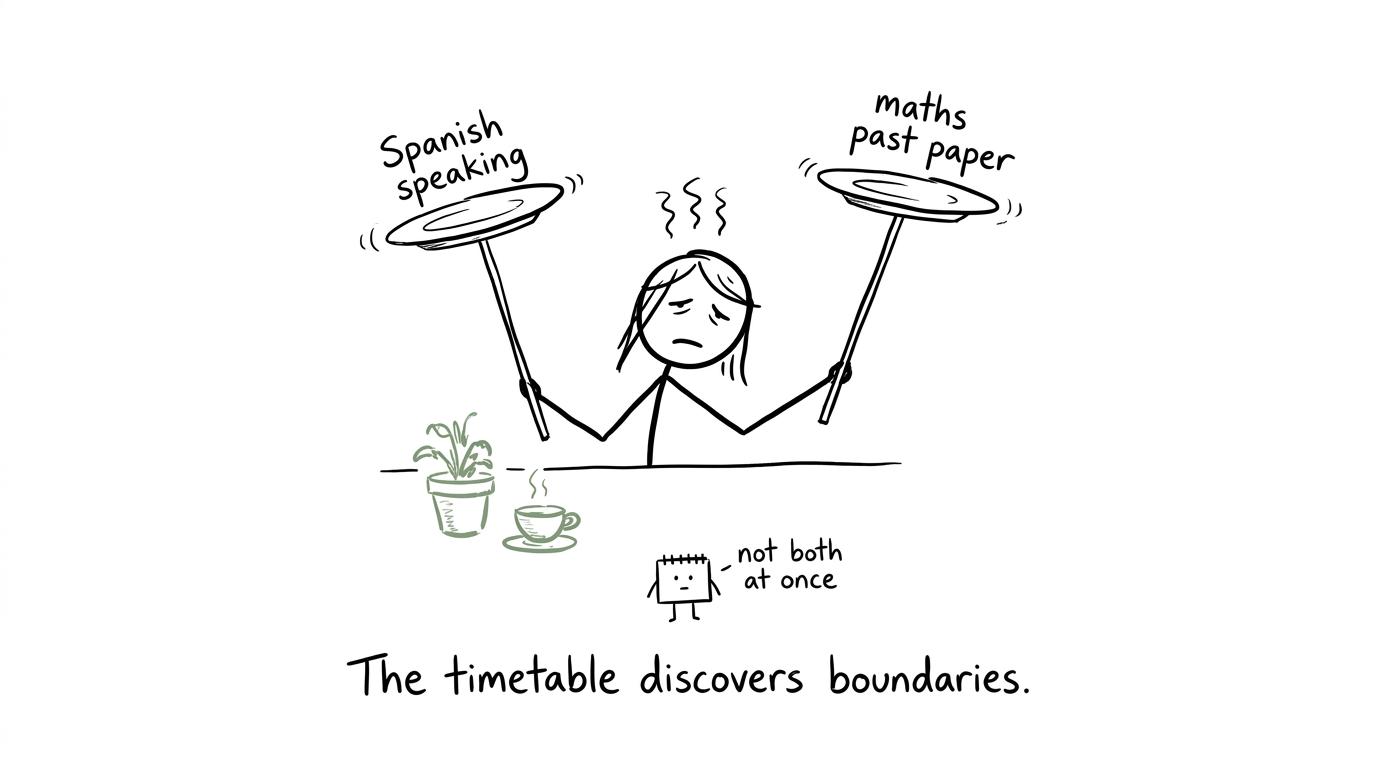 Student balancing Spanish speaking practice and a maths past paper with help from a sensible calendar
Common mistakes when requesting extra practice
Asking for “everything”
A large pack can feel productive while remaining untouched. Ask for one priority skill and complete it before requesting more.
Ignoring existing feedback
If your teacher has already marked a task, correct it first. Extra material cannot help if the same feedback is repeatedly left unused.
Requesting a confidential mock paper
Teachers may need to keep assessment materials secure so they remain valid for mocks. Accept an alternative task covering the same skill.
Using material from the wrong specification
Old tasks may still develop language skills, but their format might not reflect your current exam. Confirm the board, tier and specification before treating a resource as exam practice.
Asking for extra work but no feedback method
Decide whether you need answers, a mark scheme, peer practice, self-recording or a brief teacher check. Without feedback, repeated errors can become habits.
Taking on too much across subjects
More work is not automatically better revision. Protect time for GCSE maths, English, science and your other options. A small completed task has more value than a large abandoned pack.
Make the request, then make the material count
Asking your teacher for extra GCSE Spanish practice does not suggest that you are failing to try. A thoughtful request suggests the opposite. Bring evidence of an attempt, name the difficulty, request one suitable task and explain how you will use the feedback.
The deeper lesson reaches beyond Spanish. Strong revision is not the endless collection of resources. It is the calm conversion of mistakes into specific next actions.
Use your teacher’s guidance to select Spanish practice that matches your specification. For maths, make MathsGenie your free revision base: begin with revision lessons and practice questions, test yourself with mini tests, then build towards past papers and predicted papers supported by mark schemes and video solutions. Choose one weakness today, practise it properly and return to it until it is no longer the part of the exam you hope will not appear.